


Overview
New York, NY – Oct 05, 2026 – The Global Ibuprofen API Market size is expected to be worth around US$ 1070.5 Million by 2034 from US$ 689.3 Million in 2024, growing at a CAGR of 4.5% during the forecast period 2025 to 2034. In 2024, North America led the market, achieving over 37.2% share with a revenue of US$ 256.4 Million.
The global Ibuprofen API Market is witnessing steady growth, supported by the continued demand for ibuprofen-based medicines used for pain relief, fever reduction, and inflammation management. Ibuprofen API, the active pharmaceutical ingredient used in the production of various oral and topical formulations, remains an important component of the global pharmaceutical supply chain.
Market growth is being driven by the rising prevalence of pain and inflammatory conditions, increasing consumption of over-the-counter (OTC) analgesics, and growing pharmaceutical manufacturing activities across emerging economies. Expansion of generic drug production and increasing healthcare expenditure are also supporting demand for ibuprofen API.
Asia-Pacific represents a significant production and consumption region due to its large pharmaceutical manufacturing base, cost-efficient production capabilities, and expanding healthcare infrastructure. Meanwhile, North America and Europe continue to generate demand through established pharmaceutical markets and strong requirements for high-quality active pharmaceutical ingredients.
Key manufacturers are focusing on production capacity expansion, quality enhancement, regulatory compliance, and supply-chain efficiency to strengthen their market position. Increasing emphasis on pharmaceutical quality standards and reliable API sourcing is expected to create further opportunities for market participants.
Overall, the Ibuprofen API Market is expected to maintain a positive growth trajectory as pharmaceutical companies continue to address rising demand for effective, affordable, and widely accessible pain-management products.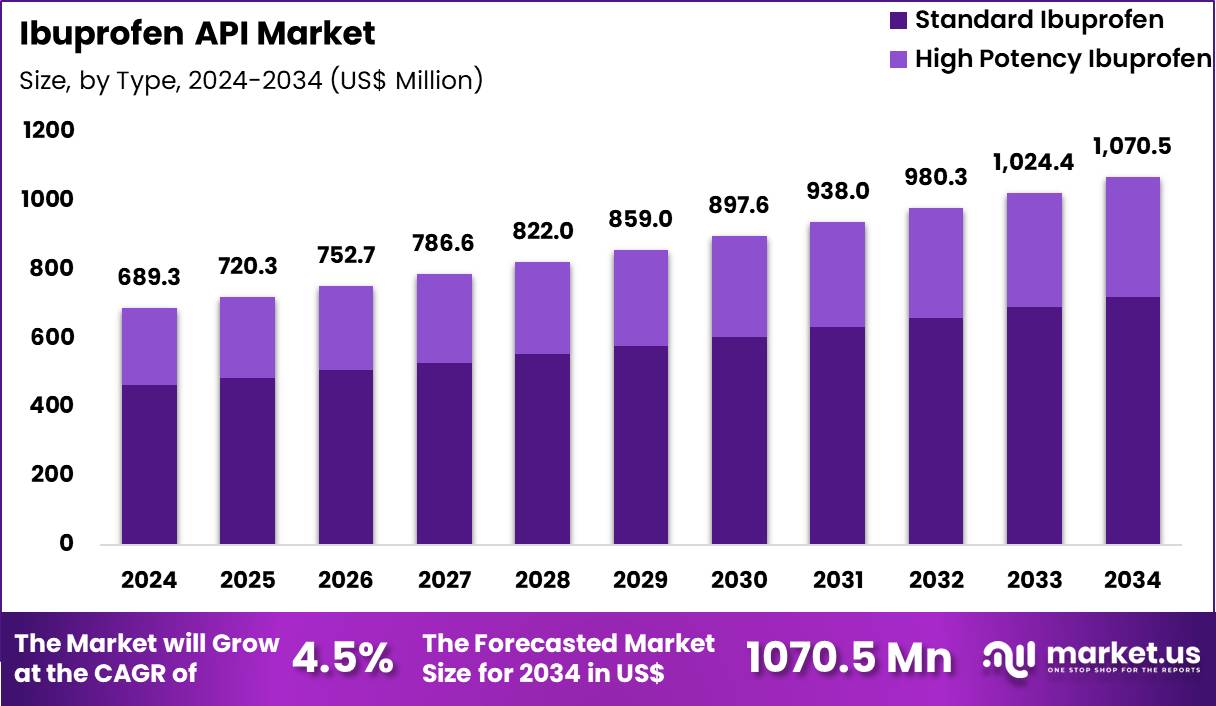
Key Takeaways
- In 2024, the Ibuprofen API Market generated revenue of US$ 689.3 million and is projected to grow at a CAGR of 4.5%, reaching US$ 1,070.5 million by 2034.
- By type, the market is segmented into Standard Ibuprofen and High Potency Ibuprofen, with Standard Ibuprofen dominating in 2024, accounting for a 67.4% market share.
- By application, the market comprises Headache & Migraine Relief, Arthritis & Musculoskeletal Pain, and Other Applications. Headache & Migraine Relief held the leading position in 2024, with a 44.1% market share.
- By end user, the market is categorized into Pharmaceutical & Biopharmaceutical Companies, CROs and CMOs, and Others. Pharmaceutical & Biopharmaceutical Companies dominated the segment in 2024, accounting for 77.5% of the market.
- North America remained the leading regional market in 2024, supported by high NSAID consumption rates, and accounted for a 37.2% market share.
Key Market Segments
- Type Analysis: Standard Ibuprofen dominates with a 67.4% market share, supported by extensive use in tablets, capsules, syrups, suspensions, and combination medicines. Its established safety, effectiveness, broad therapeutic applications, and strong demand from generic manufacturers continue to support large-scale API procurement globally.
- Application Analysis: Headache & Migraine Relief leads the application segment with a 44.1% market share, driven by the widespread prevalence of headache disorders and demand for rapid, affordable pain relief. Retail pharmacies, hospitals, and online channels continue supporting consumption of Ibuprofen-based products globally.
- End-User Analysis: Pharmaceutical & Biopharmaceutical Companies account for 77.5% of the market, driven by extensive Ibuprofen API requirements for tablets, suspensions, gels, and combination medicines. Consistent quality, regulatory compliance, impurity control, and reliable supply chains remain essential for high-volume pharmaceutical production.
Regional Analysis
North America leads the global Ibuprofen API Market, accounting for 37.2% of the market share in 2024. Regional growth is supported by high NSAID consumption, widespread use of OTC pain medications, and strong pharmaceutical manufacturing capabilities.
The growing prevalence of arthritis, musculoskeletal disorders, headaches, and chronic pain further sustains Ibuprofen demand. Established pharmacy networks, e-commerce channels, advanced R&D facilities, and stringent API quality standards also support market development.
Asia Pacific is projected to register the highest CAGR during the forecast period, driven by expanding pharmaceutical manufacturing capacity, increasing NSAID consumption, and the rising burden of pain-related conditions. China and India remain major producers of Ibuprofen API and intermediates, supplying pharmaceutical markets globally.
Improving healthcare access, expanding hospital and pharmacy networks, government support for domestic pharmaceutical production, and increasing online medicine sales are expected to accelerate regional growth. A strong raw-material base and developing chemical manufacturing infrastructure further strengthen Asia Pacific’s long-term market potential.
Emerging Trends
- Stronger focus on API quality and GMP compliance: API buyers are placing greater importance on consistent purity, documentation, process controls, and manufacturing-site compliance. WHO states that API manufacturing should operate under appropriate GMP systems to ensure the expected quality and purity of the ingredient.
- Growing importance of reliable API supply: Pharmaceutical companies are increasingly focused on dependable sourcing of active ingredients. Supplier qualification, manufacturing capacity, quality records, and continuity of supply are becoming important purchasing factors as manufacturers seek to reduce production interruptions.
- Greater demand from generic medicine production: Ibuprofen is used in both prescription and nonprescription medicines and is available in several dosage forms. Its established use for pain, fever, and inflammatory conditions supports continued requirements for API among generic-drug manufacturers.
- Higher attention to regulatory documentation: API suppliers are facing stronger requirements for technical documentation, manufacturing information, testing data, and traceability. WHO’s API framework includes assessment of the API master file and verification that manufacturing sites comply with GMP requirements.
- Expansion of quality-based supplier selection: Procurement is increasingly moving beyond price-based selection. Pharmaceutical manufacturers are evaluating suppliers based on quality systems, regulatory history, manufacturing controls, testing capabilities, and consistency. This is expected to support established API producers with strong compliance records.
Use Cases
- Manufacturing of pain-relief tablets: Ibuprofen API is primarily used to manufacture tablets for temporary relief of common mild-to-moderate pain. Official drug labeling identifies headaches, toothaches, backaches, menstrual cramps, muscular aches, and minor arthritis pain among its uses.
- Production of fever-reducing medicines: Ibuprofen API is used in medicines intended to temporarily reduce fever. This creates demand across OTC pharmaceutical products, where ibuprofen is formulated as a pain reliever and fever reducer.
- Formulation of arthritis medicines: The API is incorporated into prescription and nonprescription products used for arthritis-related pain and inflammation. MedlinePlus identifies ibuprofen use for osteoarthritis and rheumatoid arthritis, supporting its application in chronic inflammatory pain treatment.
- Manufacturing of liquid and pediatric formulations: Ibuprofen API is also used in oral suspensions and other liquid formulations. MedlinePlus identifies suspension, concentrated liquid drops, and chewable forms among available formulations, creating demand beyond conventional tablet manufacturing.
- Combination pharmaceutical products: Ibuprofen API can be incorporated into combination medicines with other active ingredients. MedlinePlus notes that ibuprofen is available both alone and in combination products, including products used for cold and other symptoms.
Frequently Asked Questions About Ibuprofen API
- What is the main use of Ibuprofen API?
The main use of Ibuprofen API is manufacturing medicines for temporary relief of mild-to-moderate pain and reduction of fever. Ibuprofen products are also used for inflammatory conditions, including arthritis and related musculoskeletal pain. - Which pharmaceutical products use Ibuprofen API?
Ibuprofen API is used in several pharmaceutical forms, including tablets, capsules, chewable tablets, liquid suspensions, and concentrated drops. It may also be included in combination medicines designed to address pain, fever, or selected cold-related symptoms. - Why is GMP important for Ibuprofen API?
GMP is important because API quality directly affects the quality of finished medicines. WHO recommends controlled manufacturing, quality management, testing, storage, packaging, and distribution processes to ensure APIs meet their stated quality and purity requirements. - What factors are important when selecting an Ibuprofen API supplier?
Important supplier-selection factors include API quality, manufacturing consistency, GMP compliance, testing capability, documentation, supply reliability, regulatory support, and production capacity. Buyers generally require dependable suppliers capable of meeting technical specifications and maintaining consistent product quality. - Is Ibuprofen API used in generic medicines?
Yes. Ibuprofen API is widely used as the active ingredient in generic medicines. WHO explains that internationally recognized nonproprietary names support pharmaceutical labeling, regulation, pharmacopoeias, scientific literature, and development of generic pharmaceutical products. - How does regulation affect the Ibuprofen API market?
Regulation affects supplier qualification, manufacturing practices, documentation, testing, and facility compliance. WHO API prequalification requires assessment of API information and verification of manufacturing-site compliance with WHO GMP, demonstrating the importance of regulatory quality systems. - What is the role of generic drug manufacturers in this market?
Generic drug manufacturers represent an important demand base because ibuprofen is an established active ingredient used across many pharmaceutical products. Generic production requires qualified API sources capable of supplying material that meets applicable quality and regulatory specifications. - Why is supply-chain reliability important in the Ibuprofen API market?
Supply-chain reliability is important because interruptions in API availability can affect finished pharmaceutical production. Manufacturers therefore evaluate supplier capacity, quality systems, manufacturing continuity, documentation, and delivery performance when developing long-term API sourcing strategies.
Conclusion
The global Ibuprofen API Market is expected to maintain steady growth, supported by sustained demand for pain relief, fever reduction, and inflammation management products. Increasing generic drug production, rising healthcare expenditure, and expanding pharmaceutical manufacturing are strengthening API requirements worldwide.
North America remains a major market, while Asia Pacific is expected to witness faster growth due to expanding production capacity, cost advantages, and improving healthcare infrastructure. Market participants are increasingly focusing on GMP compliance, product quality, regulatory documentation, supply reliability, and manufacturing efficiency.
Overall, continued demand for affordable medicines, wider pharmaceutical access, and expanding API procurement is expected to create favorable opportunities across the global Ibuprofen API Market.
Discuss your needs with our analyst
Please share your requirements with more details so our analyst can check if they can solve your problem(s)




