


Overview
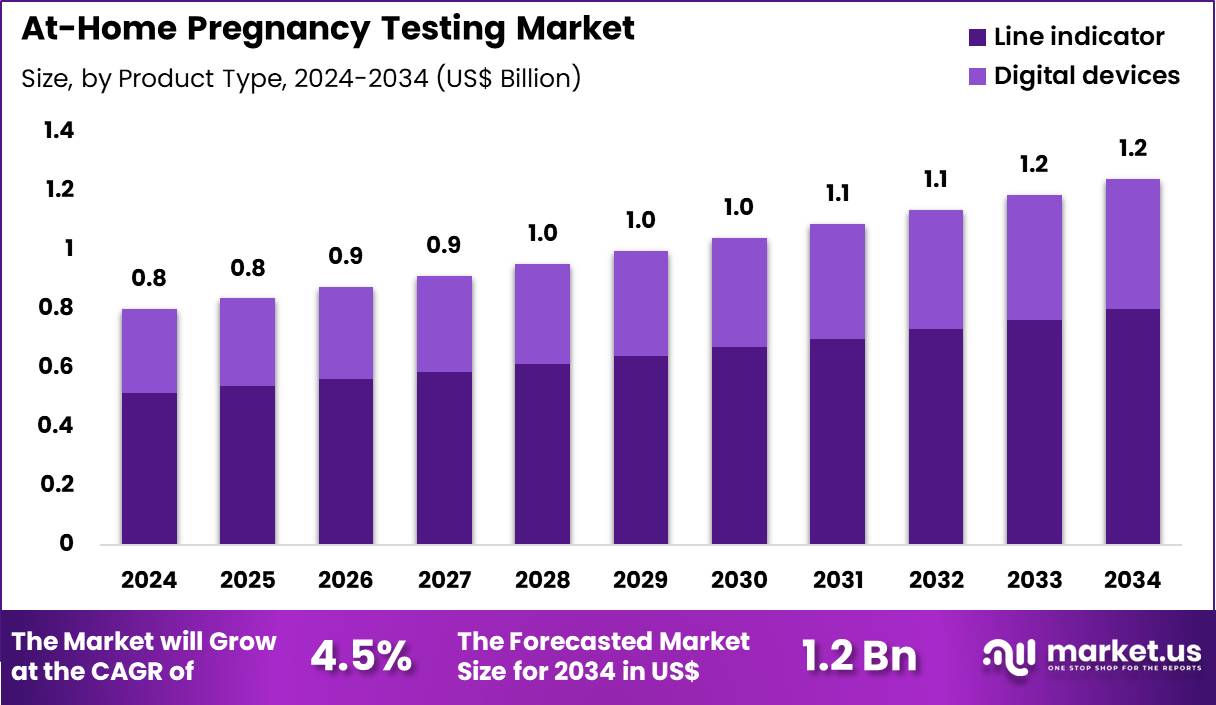
New York, NY – Oct 01, 2026 – Global At-Home Pregnancy Testing Market size is expected to be worth around US$ 1.2 Billion by 2034 from US$ 0.8 Billion in 2024, growing at a CAGR of 4.5% during the forecast period 2025 to 2034. In 2024, North America led the market, achieving over 40.3% share with a revenue of US$ 0.3 Billion.
At-home pregnancy testing is a widely used method for detecting pregnancy in its early stages. These tests identify human chorionic gonadotropin (hCG), a hormone produced by the placenta shortly after a fertilized egg attaches to the uterine lining. Most home pregnancy tests use a urine sample and provide results within a few minutes. They are available through pharmacies, supermarkets, and online retail platforms.
The accuracy of at-home pregnancy tests depends on several factors, including the timing of testing, product sensitivity, and correct usage. Testing after a missed menstrual period generally improves the reliability of results.
Although some tests claim to detect pregnancy earlier, testing too soon may produce a false-negative result due to low hCG levels. Following the manufacturer’s instructions is essential for accurate interpretation.
The growing preference for convenient, private, and accessible healthcare solutions has supported the use of at-home pregnancy testing. These products provide an initial indication of pregnancy, while healthcare professionals can offer confirmation, guidance, and appropriate follow-up care.
Key Takeaways
- In 2024, the at-home pregnancy testing market generated revenue of US$ 0.8 billion and is projected to grow at a CAGR of 4.5%, reaching US$ 1.2 billion by 2034.
- By product type, the market is segmented into line indicators and digital devices. Line indicators dominated the market in 2024, accounting for 64.3% of the total market share.
- Based on detection type, the market is categorized into hCG urine tests, LH urine tests, FSH urine tests, and hCG blood tests. Among these, hCG urine tests held a significant market share of 71.6%.
- By distribution channel, the market is divided into retail sales and institutional sales. Retail sales accounted for the largest revenue share, at 78.4%, in 2024.
- Regionally, North America dominated the at-home pregnancy testing market in 2024, capturing a market share of 40.3%.
Key Market Segments
- Product Type Analysis: The line indicator segment dominated the at-home pregnancy testing market in 2024, accounting for 64.3% of the market share. Its affordability, simplicity, and widespread availability support adoption. Product improvements, retail expansion, and increasing awareness of early pregnancy detection further strengthen demand.
- Detection Type Analysis: The hCG urine test segment held 71.6% of the at-home pregnancy testing market in 2024. Its popularity is driven by convenience, rapid results, and ease of use. Improved test sensitivity, growing reproductive health awareness, and widespread retail availability continue to support segment growth.
- Distribution Channel Analysis: The retail sales segment accounted for 78.4% of the at-home pregnancy testing market in 2024. Pharmacies, supermarkets, and e-commerce platforms support accessibility and convenient purchasing. Discreet shopping options, home delivery services, competitive pricing, and expanding retail networks further contribute to segment growth.
Regional Analysis
North America dominated the at-home pregnancy testing market in 2024, accounting for 40.3% of the global market share. Regional growth is supported by rising awareness of reproductive health, demand for convenient testing solutions, and widespread availability through pharmacies and e-commerce platforms.
Product innovations, including digital tests and improved detection sensitivity, further support adoption. According to the CDC, 3,596,017 births were registered in the United States in 2023.
Asia Pacific is projected to register the highest CAGR during the forecast period. Market expansion is driven by rising disposable incomes, increasing reproductive health awareness, and growing e-commerce penetration. The availability of affordable testing kits from local manufacturers is improving accessibility across urban, semi-urban, and rural areas.
Expanding pharmaceutical retail networks and digital health platforms are also supporting consumer adoption. Additionally, educational initiatives and greater access to family planning information are expected to strengthen demand for at-home pregnancy testing solutions across the region.
Emerging Trends
- Growing demand for early pregnancy detection: Consumers are seeking tests that can identify pregnancy earlier. Some products are designed for use before a missed period. However, the NHS states that most tests are more reliable from the first day of a missed period, creating a need for improved sensitivity and clear product instructions.
- Increasing use of digital pregnancy tests: Digital tests display results using words or symbols, reducing the need to interpret faint lines. This format addresses a common user concern: uncertainty about test results. Clear displays and simple instructions are important areas of product development.
- Wider availability of affordable test formats: Strip, cassette and midstream tests offer different price points and testing methods. The FDA’s 2024 review of an over-the-counter pregnancy test included all three formats, demonstrating the range of products available to manufacturers and consumers.
- Expansion of convenient retail and online access: Pregnancy tests are available through pharmacies and other retail outlets, while online purchasing can provide an additional access channel. Discreet purchasing and the ability to test at home support consumer demand for private reproductive healthcare.
- Greater focus on accuracy and easy result interpretation: Manufacturers are placing importance on clear instructions, reliable results and correct test use. The FDA explains that accuracy depends partly on following instructions and interpreting results correctly. This supports continued attention to user-friendly product design.
Use Cases
- Confirming a missed period: Individuals experiencing a delayed period can use a home pregnancy test to check for pregnancy. Testing provides an initial result without requiring an immediate visit to a healthcare facility.
- Early pregnancy detection: People trying to conceive may use early-detection tests to identify pregnancy around the expected menstrual period. Some products allow earlier testing, although testing too soon can produce a false-negative result.
- Private and convenient testing: Home testing allows individuals to check for pregnancy in a familiar setting. It supports privacy, convenience and timely access to an initial result, particularly when visiting a clinic is difficult.
- Supporting family planning decisions: Test results can help individuals and couples understand whether pregnancy has occurred and plan their next steps. A positive result can prompt early contact with healthcare professionals for pregnancy care and information.
- Repeat testing after an initial negative result: Individuals who receive a negative result but still suspect pregnancy can repeat the test after a few days. This is useful when testing may have occurred before sufficient pregnancy hormone developed.
Frequently Asked Questions About At-Home Pregnancy Testing
- When should you take a home pregnancy test?
Most home pregnancy tests are most reliable from the first day of a missed period. If the expected period date is unknown, the NHS recommends testing at least 21 days after unprotected sex. - How accurate are at-home pregnancy tests?
Many home pregnancy tests claim accuracy of up to 99%, but actual performance depends on timing, correct use and result interpretation. Testing too early may produce a false negative, even when pregnancy has occurred. - Can a pregnancy test give a false-negative result?
Yes, a false-negative result can occur when testing is performed too early or instructions are not followed correctly. If pregnancy is still suspected, repeat the test after a few days or consult a healthcare professional. - What should you do after a positive pregnancy test?
A positive home pregnancy test is usually reliable. Contacting a healthcare professional is recommended to discuss pregnancy care, available options and next steps. Medical advice is particularly important when symptoms or health concerns are present. - What factors are driving demand for home pregnancy tests?
Demand is supported by the need for convenient, private and quick pregnancy detection. Easy access through pharmacies and other retailers, together with the ability to test at home, supports consumer use. - What opportunities exist for manufacturers?
Opportunities include developing easy-to-read digital tests, improving early detection performance and offering affordable product formats. Better instructions and wider access through retail channels may also help manufacturers address different consumer needs.
Conclusion
The at-home pregnancy testing market is expected to experience steady growth through 2034, supported by increasing demand for convenient, private, and accessible pregnancy detection solutions. Line indicators and hCG urine tests are expected to remain important product categories due to their affordability, simplicity, and widespread availability.
Retail sales will continue to represent a major distribution channel, supported by pharmacies, supermarkets, and e-commerce platforms. North America currently holds a leading market position, while Asia Pacific is expected to record the fastest growth during the forecast period.
Increasing adoption of digital tests, improved detection sensitivity, affordable product formats, and expanding healthcare awareness are expected to create further opportunities for market participants.
Discuss your needs with our analyst
Please share your requirements with more details so our analyst can check if they can solve your problem(s)




