


Overview
New York, NY – Aug 12, 2026 – The Global Immunoassay Market size is expected to reach around US$ 55.9 Billion by 2034, up from US$ 37.7 Billion in 2024, growing at a CAGR of 5.2% during the forecast period from 2025 to 2034. North America held a dominant market position, capturing more than a 43.4% share and holding a US$ 14.6 billion market value for the year.
The global immunoassay market is experiencing steady growth, supported by the rising demand for accurate and rapid diagnostic testing across hospitals, laboratories, and research institutions. Immunoassays use antigen–antibody interactions to detect hormones, proteins, infectious agents, and other biomarkers with high sensitivity and specificity. Technologies such as ELISA, chemiluminescent immunoassays (CLIA), and radioimmunoassays are widely used in disease diagnosis, pharmaceutical research, food safety, and environmental monitoring.
The increasing prevalence of cancer is a major factor driving market expansion. According to the World Health Organization (WHO), around 20 million new cancer cases and 9.7 million cancer-related deaths were reported globally in 2022. The International Agency for Research on Cancer (IARC) also states that lung cancer accounted for 12.4% of new cancer cases worldwide, reinforcing the need for reliable biomarker-based diagnostic testing.
The growing burden of chronic diseases is further boosting the adoption of immunoassays. WHO reported that 43 million people died from noncommunicable diseases (NCDs) in 2021, representing 75% of all non-pandemic deaths. In the United States, the Centers for Disease Control and Prevention (CDC) estimates that 38.4 million people are living with diabetes, increasing the demand for routine HbA1c and related immunoassay-based tests.
Government health initiatives, stronger regulatory frameworks, and rising healthcare investments continue to support market growth. Expanding laboratory infrastructure, growing use of point-of-care diagnostics, and increasing focus on early disease detection are expected to strengthen the adoption of immunoassay technologies worldwide over the coming years.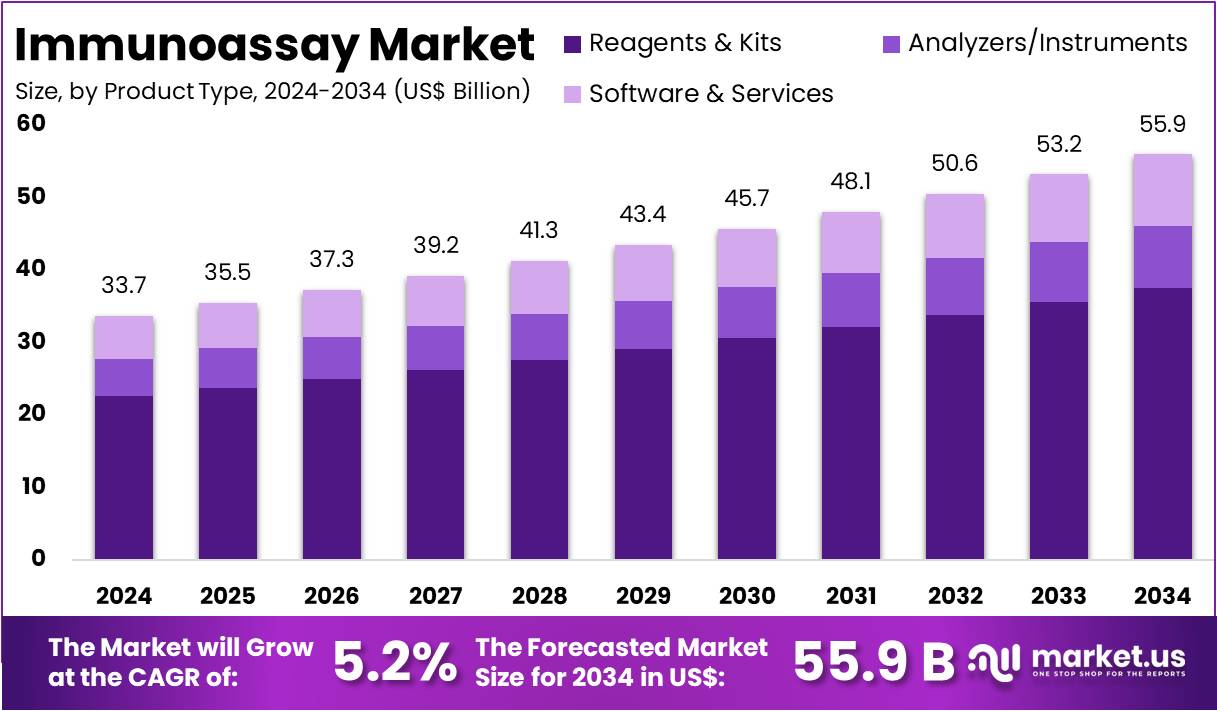
Key Takeaways
- The global immunoassay market is expected to increase from US$ 37.7 billion in 2024 to US$ 55.9 billion by 2034.
- The market is anticipated to register a CAGR of 5.2% during the forecast period from 2025 to 2034.
- Reagents and kits dominated the product type segment in 2024, accounting for more than 67.0% of the total market share due to their extensive use in diagnostic and research applications.
- Enzyme immunoassays (EIA) led the technology segment in 2024, capturing over 60.5% market share, supported by their high efficiency and broad clinical adoption.
- Infectious disease testing held the largest application share in 2024, representing more than 36.3% of the market, driven by increasing demand for disease diagnosis and surveillance.
- Blood specimens emerged as the leading specimen type in 2024, contributing over 44.2% of the market owing to their widespread use in routine immunoassay testing.
- Pharmaceutical and biotechnology companies accounted for the largest end-user share in 2024, holding more than 31.7% of the market, supported by expanding research and drug development activities.
- North America remained the dominant regional market in 2024, capturing over 43.4% of the global market and reaching a valuation of US$ 14.6 billion.
Statistical Information
- Rising Global Cancer Burden Increases Demand for Immunoassays: According to the World Health Organization (WHO), there were 20 million new cancer cases and 9.7 million cancer deaths globally in 2022. The growing number of cancer patients is increasing the demand for immunoassay-based tumor marker testing, companion diagnostics, and disease monitoring.
- Lung Cancer Remains the Largest Cancer Type: The International Agency for Research on Cancer (IARC) reported that lung cancer accounted for 12.4% of all new cancer cases and 18.7% of global cancer deaths in 2022. These figures continue to support high utilization of immunoassays for oncology diagnostics and biomarker testing.
- Noncommunicable Diseases Continue to Drive Diagnostic Testing: WHO reports that 43 million people died from noncommunicable diseases (NCDs) in 2021, representing 75% of all non-pandemic deaths worldwide. Cardiovascular diseases caused 19 million deaths, while cancers accounted for 10 million deaths, increasing the need for routine laboratory diagnostics and immunoassay testing.
- Diabetes Testing Supports Immunoassay Adoption: The U.S. CDC estimates that about 38 million U.S. adults have diabetes, and 1 in 5 are unaware of their condition. Routine HbA1c testing, commonly performed using immunoassay methods, remains an essential part of diabetes diagnosis and disease monitoring.
- Cancer Cases Expected to Increase Significantly by 2050: According to the International Agency for Research on Cancer (IARC), global cancer cases are projected to reach 35 million annually by 2050, representing a 77% increase compared with the estimated 20 million new cases in 2022. This rising disease burden is expected to increase demand for immunoassay-based cancer diagnostics and biomarker testing.
- Hepatitis B Affects Hundreds of Millions Worldwide: WHO estimates that 254 million people were living with chronic hepatitis B infection in 2022, while 1.2 million new infections occurred during the same year. Immunoassays are widely used for hepatitis B surface antigen (HBsAg) screening and diagnosis.
- Hepatitis C Continues to Require Large-Scale Screening: According to WHO, an estimated 50 million people were living with chronic hepatitis C infection in 2022, with around 1 million new infections occurring annually. Immunoassays remain the primary screening method before confirmatory molecular testing
- Tuberculosis Continues to Drive Diagnostic Demand: According to WHO, 10.8 million people developed tuberculosis in 2023, while 1.25 million deaths were attributed to the disease. Immunodiagnostic assays support TB screening and latent tuberculosis detection in several healthcare settings.
- Sepsis Causes Millions of Deaths Worldwide: WHO estimates that 49 million people develop sepsis each year, resulting in approximately 11 million deaths, representing nearly 20% of all global deaths. Immunoassays are commonly used for biomarkers such as procalcitonin and C-reactive protein during sepsis management.
Regional Analysis
North America retained the largest regional share in 2024, accounting for more than 43.4%.
North America dominated the global immunoassay market in 2024, accounting for more than 43.4% of the market and reaching a value of US$ 14.6 billion. The region benefits from a well-established healthcare system, advanced laboratory infrastructure, and widespread adoption of automated diagnostic technologies.
According to the U.S. Centers for Disease Control and Prevention (CDC), approximately 38.4 million Americans are living with diabetes, while the American Cancer Society estimated nearly 2.0 million new cancer cases in the United States in 2024, supporting sustained demand for immunoassay-based diagnostic testing.
Government agencies, including the U.S. Food and Drug Administration (FDA), continue to approve innovative in vitro diagnostic products, accelerating technology adoption across hospitals and laboratories. In addition, strong investments in biotechnology research, precision medicine, and clinical diagnostics, supported by organizations such as the National Institutes of Health (NIH), are driving product innovation. Favorable reimbursement policies, expanding point-of-care testing, and the presence of leading diagnostic manufacturers further strengthen North America’s leadership, ensuring continued growth in the regional immunoassay market.
Emerging Trends
- Rapid Growth of Point-of-Care (POC) Immunoassays: Point-of-care immunoassays are expanding rapidly as healthcare providers seek faster diagnosis outside traditional laboratories. The U.S. FDA notes that the number of at-home and POC diagnostic tests increased significantly following the COVID-19 pandemic, with digital connectivity becoming an important feature for real-time clinical decision-making and public health reporting.
- Increasing Integration of Digital Diagnostics: Healthcare organizations are integrating immunoassay platforms with digital health systems to improve reporting and patient monitoring. According to the FDA, its 2023 TOPx Diagnostic Data Exchange Sprint involved 17 innovation teams, more than 30 user advocates, and experts from FDA, NIH, CDC, and ONC, highlighting the industry’s shift toward connected diagnostics.
- Stronger Regulatory Oversight Improves Test Quality: Regulatory agencies are strengthening oversight to improve diagnostic accuracy. In 2024, the FDA introduced new regulatory requirements for laboratory-developed tests (LDTs), while noting that around 70% of healthcare decisions rely on laboratory test results, emphasizing the importance of reliable immunoassays.
- Development of Near-Patient Testing for Infectious Diseases: WHO continues to encourage development of rapid and near-point-of-care diagnostic technologies. In 2024, WHO updated its tuberculosis diagnostic target product profiles, introducing new performance requirements for point-of-care and near-point-of-care tests to improve early diagnosis and treatment.
- Automation and High-Throughput Laboratory Platforms: Hospitals and diagnostic laboratories are increasingly adopting automated immunoassay analyzers to improve efficiency and reduce turnaround time. Recent clinical research highlights that modern point-of-care and automated laboratory systems are transforming laboratory medicine by supporting faster workflows and improving testing accessibility.
Use Cases
- Cancer Biomarker Testing: Immunoassays are widely used to measure tumor biomarkers for cancer diagnosis and treatment monitoring. WHO reported 20 million new cancer cases and 9.7 million cancer deaths in 2022, increasing demand for accurate laboratory-based immunoassay testing worldwide.
- Diabetes Diagnosis and Monitoring: Immunoassays play an important role in HbA1c testing for diabetes diagnosis and long-term monitoring. According to the U.S. CDC, 38.4 million Americans are living with diabetes, supporting continuous demand for immunoassay-based laboratory testing.
- Infectious Disease Screening: Immunoassays are routinely used for detecting HIV, hepatitis, influenza, COVID-19, and many other infectious diseases. WHO estimated 39.9 million people were living with HIV globally at the end of 2023, reinforcing the importance of antibody and antigen testing.
- Cardiac Biomarker Testing: Hospitals use immunoassays to measure biomarkers such as cardiac troponin and BNP for rapid diagnosis of heart attacks and heart failure. WHO estimates that 17.9 million people die from cardiovascular diseases every year, making cardiac testing one of the largest clinical applications.
- Pharmaceutical Research and Drug Development: Pharmaceutical and biotechnology companies use immunoassays extensively during drug discovery, vaccine development, and clinical trials to evaluate immune responses and biomarker performance. The U.S. NIH continues to support diagnostic innovation through programs such as RADx, accelerating development of advanced diagnostic technologies.
Frequently Asked Questions on Immunoassay
- Which technology is widely used in immunoassay testing?
Enzyme immunoassays (EIA), including ELISA-based technologies, are among the most commonly used methods because of their accuracy, affordability, and broad application range. Chemiluminescent immunoassays are also gaining adoption due to higher sensitivity and automation capabilities. - What are the major applications of immunoassays?
Immunoassays are mainly used for infectious disease detection, cancer biomarker analysis, diabetes monitoring, cardiac testing, hormone evaluation, and pharmaceutical research. Their ability to identify specific biological markers makes them essential tools in modern diagnostic healthcare. - Why is infectious disease testing an important application area?
Infectious disease testing remains a major application because immunoassays enable rapid detection of viruses, bacteria, and antibodies. Growing concerns related to HIV, hepatitis, influenza, and emerging infectious diseases continue to increase demand for reliable diagnostic solutions. - How does cancer diagnosis support immunoassay market growth?
Cancer diagnosis drives immunoassay demand through the increasing use of tumor markers and companion diagnostics. Immunoassays help detect specific proteins and biomarkers that support cancer screening, treatment selection, and monitoring of patient responses. - What role do immunoassays play in diabetes management?
Immunoassays support diabetes care by enabling tests such as HbA1c measurement, which helps evaluate long-term blood glucose control. Growing diabetes prevalence worldwide increases the need for regular monitoring and reliable diagnostic testing solutions. - Which region dominates the immunoassay market?
North America leads the immunoassay market due to advanced healthcare infrastructure, strong diagnostic adoption, high healthcare spending, and significant research investments. The region benefits from regulatory support, technological innovation, and the presence of major diagnostic companies. - How are technological advancements influencing the immunoassay market?
Technological advancements are improving immunoassay performance through automation, digital connectivity, multiplex testing, and point-of-care platforms. These innovations reduce testing time, improve accuracy, and allow healthcare providers to deliver faster diagnostic decisions. - What is the future outlook of the immunoassay market?
The immunoassay market is expected to expand with increasing healthcare demand, rising chronic disease burden, growing personalized medicine applications, and continuous innovation in automated and rapid diagnostic platforms across hospitals, laboratories, and point-of-care settings.
Conclusion
The global immunoassay market is positioned for steady growth due to increasing demand for accurate, rapid, and sensitive diagnostic solutions. Rising cases of cancer, diabetes, cardiovascular diseases, and infectious disorders are driving the need for advanced immunoassay-based testing across healthcare systems. Technological advancements, including automation, digital diagnostics, and point-of-care platforms, are improving testing efficiency and accessibility.
North America continues to maintain a strong position due to advanced healthcare infrastructure and innovation capabilities. With growing emphasis on early disease detection, precision medicine, and preventive healthcare, immunoassays will remain a critical component of modern diagnostics and clinical decision-making.
Discuss your needs with our analyst
Please share your requirements with more details so our analyst can check if they can solve your problem(s)




