


Overview
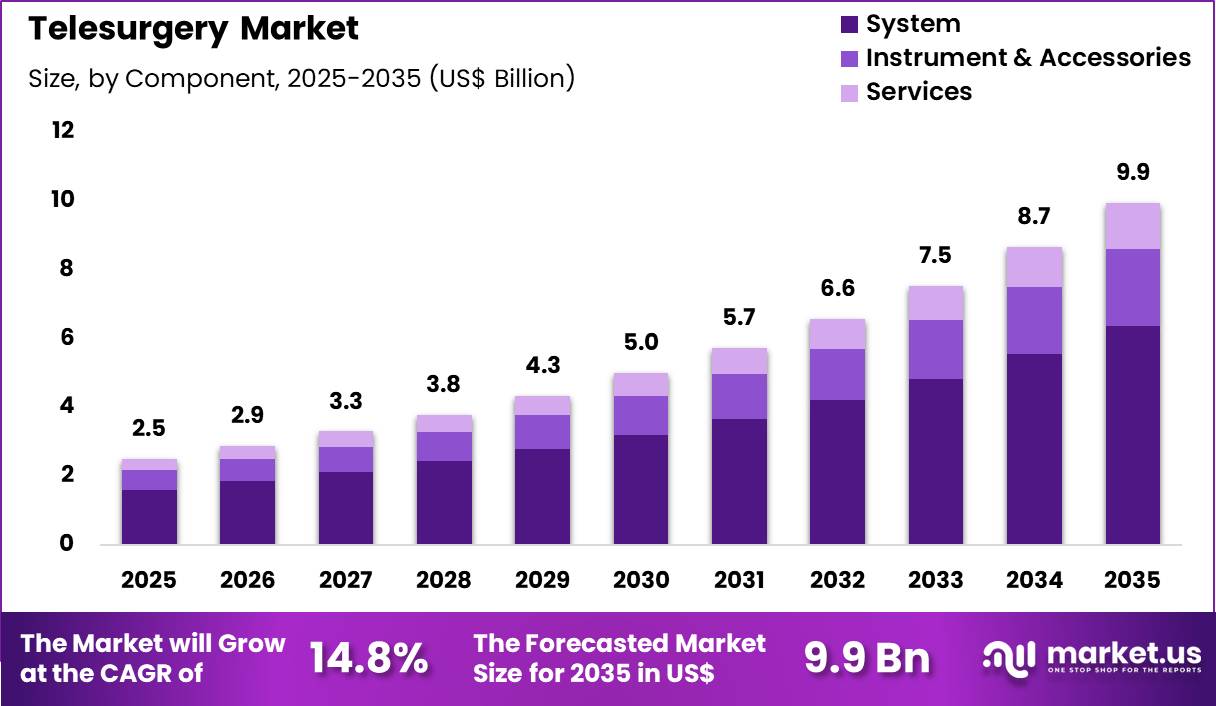
New York, NY – Nov 04 2026 – The Global Telesurgery Market size is expected to be worth around US$ 9.9 Billion by 2035 from US$ 2.5 Billion in 2025, growing at a CAGR of 14.8% during the forecast period 2026-2035. In 2025, North America led the market, achieving over 48.6% share with a revenue of US$ 1.2 Billion.
Telesurgery is an advanced surgical approach that allows doctors to perform operations on patients remotely using robotic systems and high-speed communication networks. It combines robotic-assisted surgery, real-time video transmission, artificial intelligence, and advanced imaging technologies to support precise surgical procedures from a distant location.
The technology enables surgeons to control robotic instruments through specialized consoles while monitoring the patient’s condition through high-definition cameras. It helps connect experienced surgeons with hospitals and patients in remote or underserved areas. This can improve access to specialized surgical care and reduce geographical barriers to treatment.
Growing investments in healthcare robotics, advancements in 5G connectivity, and rising demand for minimally invasive procedures are supporting the adoption of telesurgery. Hospitals are increasingly exploring remote surgical technologies to improve surgical precision, support specialist collaboration, and enhance healthcare delivery.
Furthermore, continuous improvements in robotic platforms, network reliability, and surgical visualization are creating new opportunities for market growth. However, high equipment costs, cybersecurity concerns, regulatory challenges, and network latency remain key barriers to widespread adoption.
Overall, telesurgery is emerging as a promising healthcare technology. It has the potential to transform surgical practices by expanding access to specialist expertise and supporting more connected, technology-driven healthcare systems.
Key Takeaways
- In 2025, the market was valued at US$ 2.5 Billion and is projected to grow at a CAGR of 14.8%, reaching US$ 9.9 Billion by 2035.
- Based on components, the market is segmented into systems, instruments & accessories, and services. The system segment dominated the market, accounting for a 64.1% share.
- By application, the market is categorized into general surgery, urological surgery, gynecological surgery, neurosurgery, and cardiovascular surgery. General surgery emerged as the leading segment, capturing a 37.5% market share.
- In terms of end users, the market is divided into hospitals, outpatient facilities, and research and academic institutions. Hospitals dominated the segment with the largest revenue share of 48.4%.
- Regionally, North America maintained its leading position in the market, accounting for a 48.6% share.
Key Market Segments
- Component Analysis: The system segment dominated the telesurgery market, accounting for 64.1% share. Its leadership is driven by the growing adoption of robotic platforms, surgeon consoles, and advanced imaging systems. Improved connectivity, low-latency communication, and precise robotic control further support system demand across hospitals and specialized surgical centers.
- Application Analysis: General surgery led the telesurgery market, capturing a 37.5% share. Its dominance is supported by the wide range of procedures, including hernia repair, cholecystectomy, and colorectal surgery. Growing adoption of minimally invasive techniques, improved surgical visualization, and robotic precision further strengthens demand across healthcare facilities.
- End-User Analysis: Hospitals dominated the telesurgery market, accounting for 48.4% share. Their leadership is driven by advanced surgical infrastructure, access to specialist surgeons, and increasing investments in robotic technologies. Growing digital healthcare adoption, improved network connectivity, and rising demand for complex surgical procedures further support telesurgery integration across hospitals.
Regional Analysis
North America Telesurgery Market Analysis
North America dominated the telesurgery market, accounting for a 48.6% share in 2024. This leadership is driven by advanced healthcare infrastructure, growing adoption of robotic surgery, and strong digital connectivity. Hospitals increasingly invest in remote surgical platforms to improve specialist access and procedural efficiency.
Rising demand for complex surgeries and minimally invasive procedures further supports regional growth. Academic and defense institutions also contribute through research and technological innovation. According to the American Hospital Association, the United States had over 6,100 hospitals in 2023, highlighting strong infrastructure for adopting advanced surgical technologies.
Asia Pacific Telesurgery Market Analysis
Asia Pacific is expected to register the highest CAGR during the forecast period. Growth is supported by healthcare modernization, expanding 5G networks, and rising investments in robotic surgery. Governments are promoting digital healthcare to improve surgical access in rural and underserved areas.
Hospitals are adopting remote surgical platforms and advanced training technologies. Growing demand for minimally invasive procedures further strengthens regional opportunities. China’s continued expansion of 5G infrastructure also supports reliable connectivity for remote surgical applications.
Emerging Trends
- Growing Adoption of 5G Connectivity: The adoption of 5G networks is improving remote surgical capabilities. These networks support faster data transmission and lower communication delays. Surgeons can control robotic instruments and receive real-time surgical images from distant locations. This development supports more reliable remote procedures.
- Integration of Artificial Intelligence in Robotic Surgery: AI is becoming an important technology in telesurgery. AI-based systems can support surgical planning, image analysis, and instrument movement monitoring. They may also help predict communication delays and improve robotic control. These capabilities can support greater surgical accuracy and operational efficiency.
- Increasing Use of Augmented Reality and 3D Visualization: Augmented reality (AR) and advanced 3D imaging are improving how surgeons view surgical areas. These technologies can display anatomical information and surgical guidance during procedures. Remote specialists can use this information to understand complex structures and support better surgical decisions.
- Greater Focus on Cybersecurity and Patient Data Protection: Healthcare providers are placing greater emphasis on secure communication systems. Telesurgery platforms transmit sensitive patient information and surgical commands over digital networks. Therefore, hospitals are focusing on data encryption, secure connections, network monitoring, and backup systems to reduce operational and cybersecurity risks.
- Development of Hybrid Surgical Models: Healthcare facilities are exploring hybrid surgical models that combine remote specialists with local surgical teams. In this approach, experienced surgeons can operate remotely or provide direct surgical guidance. Local professionals remain available to manage patient care and respond to unexpected situations.
Use Cases
- Surgical Care in Rural and Remote Areas: Telesurgery can connect patients in rural hospitals with experienced surgeons in major medical centers. This approach may reduce the need for long-distance travel and improve access to specialized surgical expertise. It is particularly relevant in regions with limited specialist availability.
- Orthopedic and Spine Surgery: Remote robotic systems can support orthopedic procedures that require accurate instrument positioning. Spine surgery is an important area of development, particularly for robotic-assisted screw placement. Remote navigation and imaging technologies can help specialists guide complex procedures.
- Emergency and Trauma Surgery: Telesurgery can support hospitals dealing with complex trauma cases and limited specialist availability. Remote surgeons may guide local medical teams during difficult procedures. This application could be valuable in regional emergency centers where immediate access to experienced surgeons is limited.
- Military and Disaster Healthcare: Telesurgery has potential applications in military healthcare and disaster response. Remote surgical specialists may assist medical teams working in difficult or isolated environments. This approach could help deliver advanced surgical expertise when transporting specialists to the treatment location is challenging.
- Surgical Education and Remote Training: Hospitals and medical institutions can use connected surgical platforms for remote training and expert guidance. Experienced surgeons can demonstrate techniques, supervise procedures, and share practical knowledge with other medical professionals. This approach can support skill development and improve access to specialized training.
Frequently Asked Questions About Telesurgery
- How does telesurgery work?
Telesurgery works through a robotic surgical system connected to a surgeon’s control console. The surgeon views live images and operates robotic instruments remotely. A high-speed network transfers commands and visual information between both locations. - What are the major benefits of telesurgery?
Telesurgery can improve access to specialized surgical expertise, reduce geographical barriers, and support medical care in underserved regions. It also enables remote collaboration between specialists and local surgical teams, supporting knowledge sharing and professional development. - Which technologies are used in telesurgery?
Telesurgery uses robotic surgical systems, high-speed internet, 5G connectivity, advanced imaging, artificial intelligence, and secure communication platforms. These technologies help surgeons control instruments, view surgical areas, and exchange information during remote procedures. - Which surgical procedures can be performed through telesurgery?
Telesurgery has applications in several surgical specialties, including urology, gynecology, and orthopedics. Remote robotic procedures involving spine surgery and other complex interventions are also being explored through clinical demonstrations and feasibility studies. - What is driving the growth of the telesurgery market?
The telesurgery market is driven by increasing demand for specialized surgical care, advancements in robotic technology, improved 5G infrastructure, and growing investments in digital healthcare. The need to connect remote hospitals with experienced surgeons further supports adoption. - How does 5G technology support the telesurgery market?
5G technology supports telesurgery through faster data transmission, improved connectivity, and reduced communication delays. These capabilities help surgeons control robotic instruments and receive real-time surgical images, making remote procedures more technically feasible. - What is the role of artificial intelligence in the telesurgery market?
Artificial intelligence supports telesurgery through surgical planning, image processing, movement monitoring, and communication delay prediction. These capabilities can improve decision support and robotic system performance while keeping the surgeon responsible for clinical decisions. - What is the future outlook for the telesurgery market?
The future of the telesurgery market will depend on advances in robotic systems, reliable communication networks, and stronger patient safety standards. Wider clinical validation and regulatory clarity will also influence its adoption across healthcare facilities.
Conclusion
The telesurgery market is witnessing strong growth, driven by advancements in robotic surgery, 5G connectivity, artificial intelligence, and digital healthcare infrastructure. Rising demand for minimally invasive procedures and improved access to specialized surgical expertise further supports market expansion.
North America currently leads due to its advanced healthcare infrastructure and early technology adoption, while Asia Pacific offers significant growth opportunities. Hospitals remain key end users as investments in robotic surgical systems increase. However, high implementation costs, cybersecurity risks, and regulatory challenges may limit adoption.
Overall, continuous technological innovation and improved network reliability are expected to strengthen the future growth of the telesurgery market.
Discuss your needs with our analyst
Please share your requirements with more details so our analyst can check if they can solve your problem(s)



