
Overview
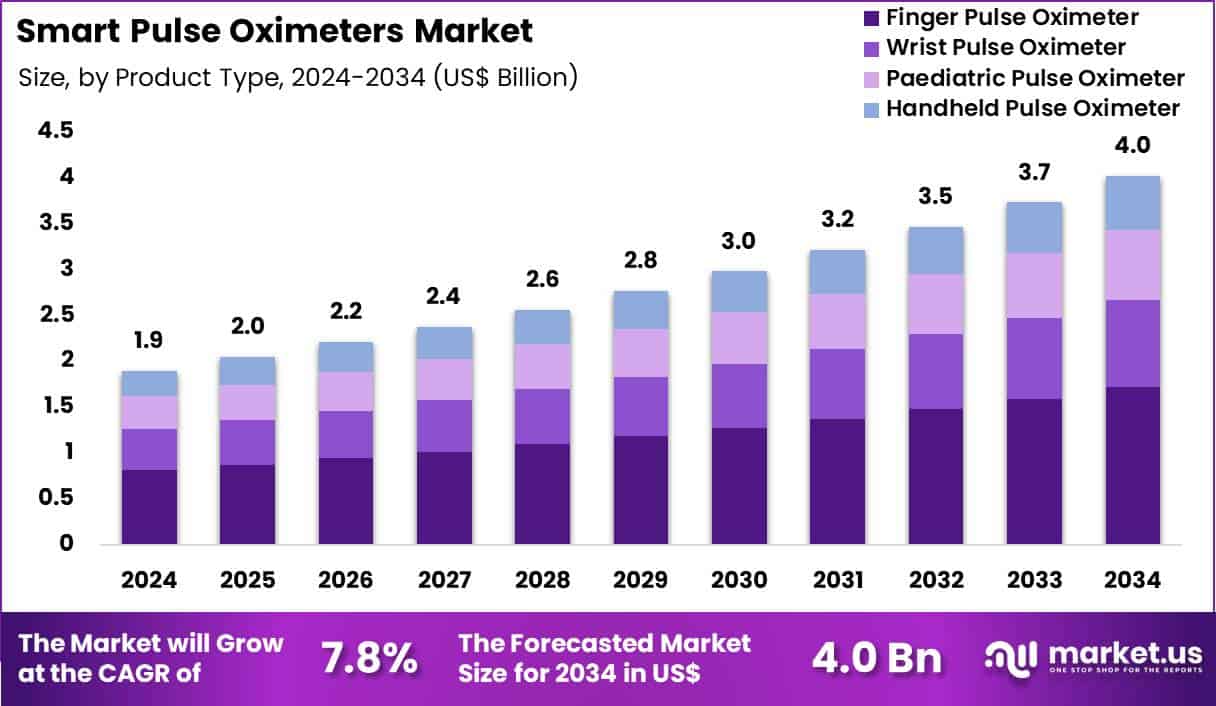
New York, NY – Oct 29, 2026 – Global Smart Pulse Oximeters Market size is expected to be worth around US$ 4.0 Billion by 2034 from US$ 1.9 Billion in 2024, growing at a CAGR of 7.8% during the forecast period 2025 to 2034. In 2024, North America led the market, achieving over 40.6% share with a revenue of US$ 0.8 Billion.
Smart pulse oximeters are digital health monitoring devices designed to measure blood oxygen saturation (SpO₂) and pulse rate conveniently and non-invasively. By combining traditional pulse oximetry technology with smart connectivity features, these devices support real-time health monitoring and improved access to personal health data.
The devices commonly use optical sensors to estimate oxygen saturation and measure pulse rate, while Bluetooth or Wi-Fi connectivity enables data transfer to smartphones, tablets, or compatible healthcare platforms. Depending on the model, additional features may include mobile applications, historical data tracking, customizable alerts, cloud-based data storage, and remote monitoring capabilities.
The adoption of smart pulse oximeters is being supported by growing interest in home healthcare, remote patient monitoring, wearable health technologies, and preventive health management. These devices are increasingly relevant for healthcare professionals, patients requiring regular monitoring, elderly individuals, and consumers seeking convenient access to selected health measurements.
Technological advancements in sensor accuracy, wireless connectivity, battery efficiency, and user-friendly interfaces are expected to strengthen product development and expand potential applications. However, readings may be affected by factors such as poor circulation, movement, skin pigmentation, and device quality.
As healthcare systems continue to explore connected care solutions, smart pulse oximeters are emerging as useful tools for supporting routine monitoring and informed healthcare discussions. They complement, rather than replace, professional medical assessment and should not be used alone to diagnose medical conditions.
Key Takeaways
- In 2024, the market was valued at US$ 1.9 billion and is projected to reach US$ 4.0 billion by 2034, growing at a CAGR of 7.8%.
- By product type, the market is segmented into finger pulse oximeters, wrist pulse oximeters, paediatric pulse oximeters, and handheld pulse oximeters. Finger pulse oximeters dominated the segment, accounting for 42.7% of the market share.
- By end user, the market is categorized into hospitals, home care settings, ambulatory surgical centres, and others. Hospitals accounted for the largest share, at 49.5%.
- Regionally, North America dominated the market, accounting for 40.6% of the total market share.
Key Market Segments
- Product Type Analysis: Finger pulse oximeters dominated the smart pulse oximeters market, accounting for 42.7% of the product type segment. Their compact design, affordability, and ease of use support widespread adoption. Bluetooth connectivity, mobile application integration, and data-sharing capabilities further enhance their utility across hospitals, home healthcare, and remote patient monitoring applications.
- End-User Analysis: Hospitals dominated the smart pulse oximeters market, accounting for 49.5% of the end-user segment. High patient volumes and continuous monitoring requirements drive adoption across emergency, critical care, and postoperative units. Increasing investments in digital healthcare infrastructure, connected monitoring systems, and electronic health records further support demand for smart pulse oximeters in hospitals.
Regional Analysis
North America Market Analysis
North America accounted for 40.6% of the Smart Pulse Oximeters market in 2024, supported by widespread adoption of connected healthcare technologies across hospitals and home care settings.
Growing investments in remote patient monitoring, telehealth platforms, and digital health infrastructure have strengthened demand. The region’s aging population and high prevalence of chronic respiratory and cardiovascular conditions further support market expansion. Integration with mobile applications and electronic health records enables improved patient monitoring and data sharing.
Asia Pacific Market Analysis
The Asia Pacific Smart Pulse Oximeters market is expected to register the highest CAGR during the forecast period. Growth is driven by expanding digital healthcare infrastructure, rising smartphone penetration, and increasing demand for home-based patient monitoring. Government initiatives supporting digital health and early disease detection are encouraging technology adoption.
Furthermore, local manufacturers are introducing affordable connected devices, improving accessibility across emerging economies. The expansion of telemedicine and post-discharge monitoring programs is also expected to create significant growth opportunities across the region.
Emerging Trends
- Integration with mobile health applications: Smart pulse oximeters increasingly connect with smartphones and digital health applications to display oxygen saturation (SpO) and pulse rate readings. This supports convenient tracking, historical data review and information sharing with healthcare professionals. The FDA highlights that pulse oximeter readings must be interpreted carefully because accuracy can vary under different conditions.
- Expansion of remote patient monitoring: Connected pulse oximeters are being used in remote patient monitoring programmes, allowing healthcare teams to review selected patient measurements outside hospitals. This approach can support follow-up care and reduce unnecessary in-person visits when combined with suitable clinical assessment and communication systems. The NIH’s research on remote monitoring supports the importance of evaluating these digital care approaches.
- Growing focus on home-based healthcare: Home healthcare is creating opportunities for smart pulse oximeters designed for simple operation by patients and caregivers. These devices can help monitor oxygen levels during recovery or while managing certain respiratory and cardiovascular conditions. However, readings should support—not replace—medical advice, diagnosis or emergency assessment.
- Improved measurement accuracy and inclusive design: Manufacturers are placing greater emphasis on measurement reliability across different skin tones, patient groups and usage conditions. The FDA has identified skin pigmentation, poor circulation, skin temperature and other factors as potential sources of measurement error. These concerns are encouraging stronger clinical evaluation and more careful device selection.
- Greater attention to connected-data security: As smart pulse oximeters transmit readings through mobile applications and connected platforms, privacy and cybersecurity are becoming more important product considerations. Secure data transfer, controlled access and clear consent practices can strengthen confidence among patients, hospitals and healthcare providers. These features may also influence purchasing decisions by healthcare organisations.
Use Cases
- Home monitoring for respiratory conditions: Smart pulse oximeters can help people with conditions such as chronic obstructive pulmonary disease (COPD) monitor oxygen saturation at home. Recorded readings can be shared with healthcare professionals to support follow-up care and assessment of changes in symptoms.
- Remote consultations and telehealth: During virtual consultations, connected oximeters can provide additional information about a patient’s oxygen levels and pulse rate. Clinicians can review shared measurements alongside symptoms, medical history and other clinical findings when deciding whether further assessment is needed.
- Hospital and post-discharge monitoring: Healthcare teams can use suitable connected oximeters to record oxygen saturation and pulse rate during patient observation and recovery. After discharge, home measurements may support care plans for selected patients when monitoring frequency, reporting procedures and escalation rules are established.
- High-altitude and outdoor activities: Climbers and people travelling to high-altitude locations may use pulse oximeters to check oxygen saturation as altitude increases. Smart models can help users record readings over time, although measurements must be interpreted alongside symptoms and altitude-related health risks.
- Clinical research and health data collection: Research teams can use connected pulse oximeters to collect repeated oxygen saturation and pulse rate measurements during selected studies. Time-stamped records may help researchers examine changes over time, provided the devices are suitable for the study and data quality is carefully checked.
Frequently Asked Questions About Smart Pulse Oximeters
- How does a smart pulse oximeter work?
A smart pulse oximeter shines light through a fingertip and measures changes in light absorption to estimate blood oxygen saturation and pulse rate. Connected models may transfer readings to an application through Bluetooth or another supported connection. - What are the main benefits of smart pulse oximeters?
Smart pulse oximeters can simplify measurement recording, support trend tracking and make it easier to share readings with healthcare professionals. These features may improve monitoring convenience, but readings can be inaccurate and should not replace clinical assessment or medical advice. - Can smart pulse oximeters send readings to doctors?
Yes. Models with compatible connectivity can transfer measurements to smartphone applications or remote monitoring platforms. Depending on the system, healthcare professionals may access these readings remotely, helping them review patient trends and plan follow-up care. - What factors are driving the smart pulse oximeters market?
Market demand is supported by interest in home healthcare, remote patient monitoring, telehealth services and convenient tracking of vital signs. Digital connectivity also enables easier sharing of measurements. However, affordability, accuracy concerns and clinical suitability influence adoption across different customer groups. - What role does technology play in market development?
Technology supports the development of Bluetooth connectivity, mobile applications, digital records and automated data transfer. Advanced devices may incorporate additional sensors or measurements. These capabilities can improve monitoring workflows, although each added feature requires suitable technical performance and validation for its intended purpose. - What opportunities exist for smart pulse oximeter manufacturers?
Manufacturers can explore opportunities in connected home monitoring, telehealth integration, improved sensor performance and user-friendly applications. Products designed for diverse patient groups and healthcare workflows may address unmet needs. Commercial success will depend on reliable evidence, appropriate regulatory compliance, competitive pricing and effective distribution. - What is the future outlook for the smart pulse oximeters market?
The market’s development will depend on the expansion of remote healthcare, demand for home monitoring and improvements in device reliability. Greater integration with digital health systems may create additional opportunities. However, long-term adoption will depend on clinical value, affordability, user trust and regulatory acceptance.
Conclusion
The global smart pulse oximeters market is poised for steady growth, increasing from US$ 1.9 billion in 2024 to US$ 4.0 billion by 2034, at a CAGR of 7.8%. Rising demand for home healthcare, remote patient monitoring, and connected medical devices is expected to support market expansion. Finger pulse oximeters and hospitals remain key market segments, while North America leads regional demand.
Asia Pacific is anticipated to offer significant growth opportunities due to improving healthcare infrastructure and rising digital health adoption. Technological advancements, measurement reliability, affordability, and data security will remain critical factors shaping future market development and competition.
Discuss your needs with our analyst
Please share your requirements with more details so our analyst can check if they can solve your problem(s)