


Overview
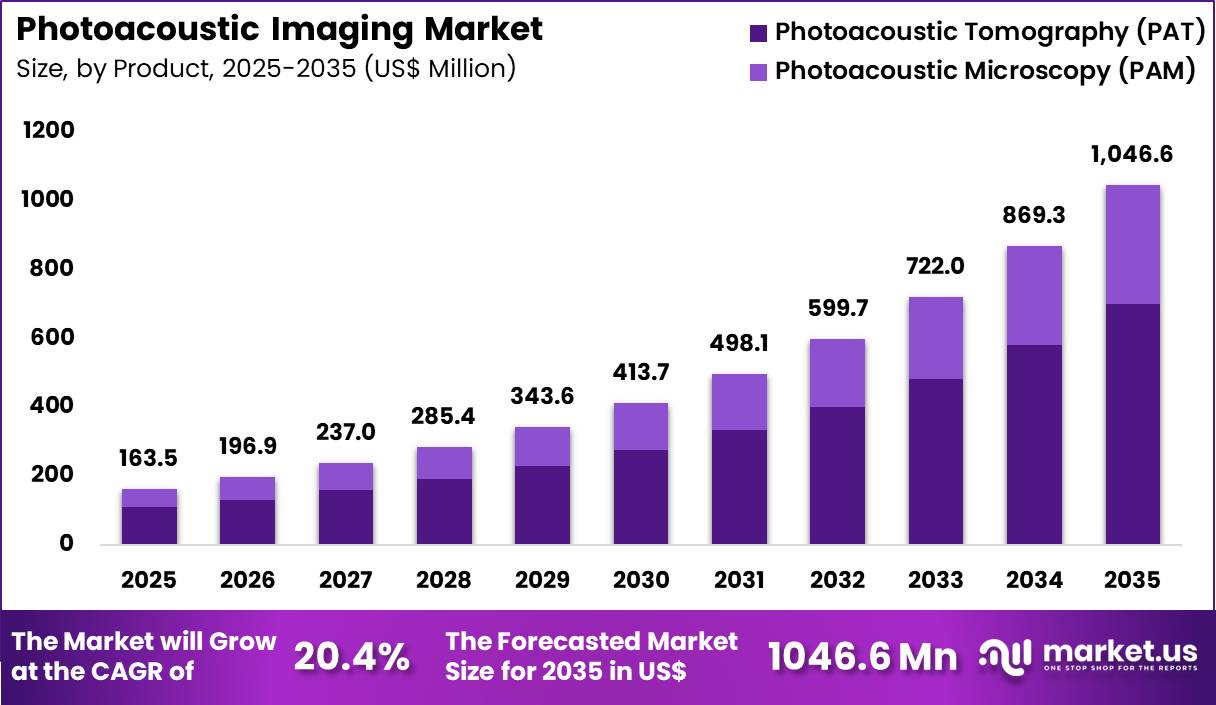
New York, NY – Nov 20 2026 – The Global Photoacoustic Imaging Market size is expected to be worth around US$ 1046.6 Million by 2035 from US$ 163.5 Million in 2025, growing at a CAGR of 20.4% during the forecast period 2026-2035. In 2025, North America led the market, achieving over 36.3% share with a revenue of US$ 59.4 Million.
Photoacoustic imaging is an advanced, non-invasive medical imaging technology that combines optical imaging and ultrasound to produce detailed images of biological tissues. The technology works by delivering short pulses of laser light into biological tissues. The absorbed light generates small temperature changes, resulting in ultrasonic waves that are detected and converted into high-resolution images.
One of the major advantages of photoacoustic imaging is its ability to provide information about tissue structure, blood vessel networks, oxygen saturation, and other functional characteristics. Unlike conventional optical imaging, it offers deeper tissue penetration while maintaining relatively high spatial resolution.
The technology is gaining attention across several medical applications, including oncology, cardiovascular imaging, dermatology, neurology, and breast cancer detection. It is also being explored for applications in preclinical research, disease monitoring, and image-guided interventions.
Growing demand for early disease detection, advancements in laser and ultrasound technologies, and increasing investments in medical imaging research are supporting the development of the photoacoustic imaging field. Furthermore, the integration of artificial intelligence and advanced image processing is expected to improve image interpretation and diagnostic capabilities.
With its potential to deliver structural and functional information in a single imaging approach, photoacoustic imaging is emerging as a promising technology in the future of precision medicine and advanced healthcare diagnostics.
Key Takeaways
- In 2025, the global photoacoustic imaging market was valued at US$ 463.5 million and is projected to grow at a CAGR of 20.4%, reaching US$ 1,046.6 million by 2035.
- Based on product type, the market is segmented into photoacoustic tomography (PAT) and photoacoustic microscopy (PAM). Photoacoustic tomography (PAT) dominated the segment, accounting for a 66.8% market share.
- By imaging type, the market is categorized into pre-clinical and clinical imaging. The pre-clinical segment held the dominant position, capturing a 77.9% market share.
- Based on application, the market is segmented into oncology, cardiology, angiology, histology, and interventional radiology. Among these, oncology emerged as the leading application segment, accounting for the largest revenue share of 41.3%.
- Regionally, North America dominated the global photoacoustic imaging market, accounting for a significant market share of 36.3%.
Key Market Segments
- Product Analysis: Photoacoustic tomography (PAT) dominated the product segment, accounting for 66.8% of the market share. Its leadership is attributed to superior tissue penetration, wider imaging coverage, and suitability for organ-level visualization. Continuous advancements in detector technology, multispectral imaging, and image reconstruction are further supporting its adoption across preclinical research and clinical applications.
- Imaging Type Analysis: Pre-clinical imaging dominated the imaging type segment, capturing 77.9% of the market share. Its leading position is supported by increasing research activities involving tumor oxygenation, vascularity, and treatment response assessment. Growing investments in translational research, small-animal studies, and technology validation are further strengthening demand for preclinical photoacoustic imaging systems.
- Application Analysis: Oncology dominated the application segment, accounting for 41.3% of the market share. The segment’s growth is driven by the technology’s ability to visualize tumor vascularity, oxygen saturation, and tissue characteristics. Rising cancer incidence and increasing demand for advanced cancer detection, tumor characterization, and treatment monitoring are further supporting adoption in oncology research.
Regional Analysis
North America dominated the Photoacoustic Imaging Market in 2025, accounting for 36.3% of the global market share. The region’s leadership is attributed to strong research infrastructure, increasing investments in biomedical imaging, and growing adoption of advanced diagnostic technologies.
The presence of leading universities, cancer research centers, and pharmaceutical companies across the United States and Canada is supporting the development of photoacoustic imaging applications in oncology, vascular imaging, and preclinical research. Rising cancer incidence and continuous advancements in laser systems, ultrasound transducers, and imaging software are further strengthening regional market growth.
Asia Pacific is expected to register the highest CAGR during the forecast period. Growth is supported by increasing government investments in healthcare infrastructure, biomedical research, and precision medicine across China, Japan, South Korea, and Singapore.
Rising demand for early disease detection, expanding biotechnology research, and growing collaborations between academic institutions and medical technology companies are creating new growth opportunities. Additionally, increasing adoption of advanced diagnostic technologies and expanding preclinical research activities are expected to accelerate regional market expansion.
Emerging Trends
- Integration of Artificial Intelligence (AI) in Photoacoustic Imaging: Artificial intelligence is increasingly being explored to improve photoacoustic image reconstruction, reduce image noise, and support faster interpretation. Deep learning methods can help identify tissue abnormalities and measure biological parameters, improving the potential use of this technology in clinical diagnosis.
- Growing Adoption of Combined Photoacoustic and Ultrasound Systems: The integration of photoacoustic imaging with conventional ultrasound is emerging as an important development. These combined systems provide anatomical information through ultrasound and functional information through photoacoustic imaging, supporting more detailed tissue assessment without requiring separate imaging procedures.
- Increasing Research in Breast Cancer Imaging: Research into photoacoustic imaging for breast cancer detection and assessment is increasing. The technology can help visualize tumour-related blood vessels and oxygen levels, providing additional information about the tumour environment. Its potential use alongside mammography and ultrasound is receiving growing clinical attention.
- Development of Advanced Molecular Imaging Techniques: Researchers are exploring photoacoustic imaging with contrast agents to identify specific biological molecules and tissue changes. These developments could improve the visualization of cancer-related biomarkers and other disease indicators, supporting more detailed disease assessment and treatment monitoring.
- Increasing Focus on Standardization and Clinical Applications: Greater attention is being given to standardizing image quality, measurement methods, and system performance. The US Food and Drug Administration (FDA) has identified photoacoustic imaging as an emerging area requiring improved performance testing methods, supporting future clinical evaluation and regulatory development.
Use Cases
- Breast Cancer Detection and Assessment: Photoacoustic imaging can help examine blood vessel patterns and oxygen levels around breast tumours. This information may support tumour characterization, cancer assessment, and treatment monitoring. Researchers are also investigating its potential role as a complementary technique to existing breast imaging methods.
- Vascular Disease and Blood Circulation Monitoring: The technology can visualize blood vessels and assess oxygen-related changes in tissues. It is being investigated for evaluating vascular abnormalities, blood circulation, and changes associated with cardiovascular conditions. These capabilities may support improved assessment of vascular health and related diseases.
- Wound Healing and Burn Assessment: Photoacoustic imaging can help monitor blood flow, oxygen saturation, and tissue regeneration in wounds. It is being investigated for assessing burns, complex wounds, and tissue recovery. Such information may help healthcare professionals evaluate healing progress and identify areas requiring additional attention.
- Brain Imaging and Neurological Research: Researchers are investigating photoacoustic imaging for studying brain blood vessels, oxygen levels, and changes in brain activity. These applications may support research into neurological conditions and brain-related disorders. However, imaging through the skull remains an important technical challenge.
- Inflammatory and Autoimmune Disease Assessment: Photoacoustic imaging can help identify changes in blood vessels and tissue oxygenation associated with inflammation. Researchers are studying its use in conditions such as rheumatoid arthritis and systemic sclerosis to monitor disease activity and evaluate changes in affected tissues.
Frequently Asked Questions About Photoacoustic Imaging
- How does photoacoustic imaging work?
Photoacoustic imaging works by directing short laser pulses into body tissues. Light absorption generates small ultrasonic waves through heat-induced expansion. These waves are detected by ultrasound sensors and processed to create images of internal biological structures. - What are the major advantages of photoacoustic imaging?
Major advantages include non-ionizing imaging, detailed blood vessel visualization, tissue oxygenation assessment, and the ability to combine optical contrast with ultrasound penetration. These features make it useful for investigating several diseases and monitoring biological changes. - Is photoacoustic imaging safe for patients?
Photoacoustic imaging uses non-ionizing laser light rather than X-rays. Its safety depends on factors such as laser exposure, device design, and operating conditions. Medical systems must undergo appropriate safety testing before clinical use. - Can photoacoustic imaging detect cancer?
Photoacoustic imaging is being investigated for cancer detection and assessment, particularly breast cancer. It can visualize tumour-related blood vessels and oxygenation patterns, potentially providing additional information about tumour characteristics and responses to treatment. - What is the difference between photoacoustic imaging and ultrasound?
Ultrasound uses sound waves to produce images of internal structures, whereas photoacoustic imaging uses absorbed light to generate ultrasound signals. Photoacoustic imaging can therefore provide additional information about tissue composition, blood vessels, and oxygenation. - What are the major factors driving the photoacoustic imaging market?
Market growth is supported by increasing research into non-invasive diagnostic technologies, rising cancer detection requirements, technological improvements in medical imaging, and growing interest in functional tissue assessment. Integration with ultrasound is also creating additional development opportunities. - What is the future outlook for the photoacoustic imaging market?
The market outlook is supported by ongoing clinical research, improved imaging technologies, and increasing interest in non-invasive diagnostic methods. Wider adoption will depend on clinical validation, standardized testing, regulatory progress, and demonstrated benefits over existing methods. - Which regions offer opportunities for the photoacoustic imaging market?
North America and Europe offer opportunities through established medical research infrastructure and advanced healthcare facilities. Asia-Pacific also presents potential opportunities due to expanding healthcare infrastructure, increasing diagnostic requirements, and growing investment in medical technology research.
Conclusion
The global photoacoustic imaging market is expected to experience strong growth, supported by increasing demand for advanced diagnostic technologies, rising cancer research activities, and continuous improvements in laser and ultrasound systems. The dominance of photoacoustic tomography, preclinical imaging, and oncology highlights the growing importance of this technology in biomedical research and disease assessment.
North America currently leads the market, while Asia-Pacific is expected to offer significant growth opportunities. Furthermore, AI integration, combined imaging systems, and expanding clinical research are expected to strengthen market development. Overall, photoacoustic imaging holds promising potential in precision medicine and advanced healthcare diagnostics.
Discuss your needs with our analyst
Please share your requirements with more details so our analyst can check if they can solve your problem(s)



