
Overview
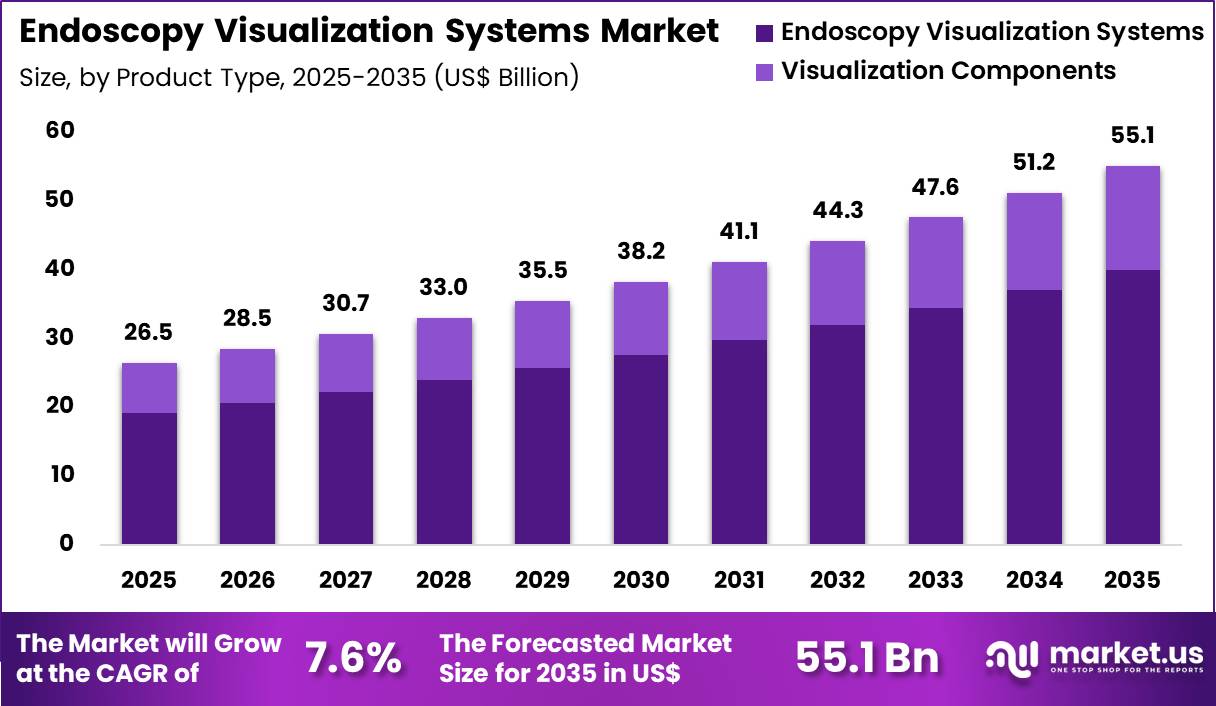
New York, NY – Nov 05 2026 –The Global Endoscopy Visualization Systems Market size is expected to be worth around US$ 55.1 Billion by 2035 from US$ 26.5 Billion in 2025, growing at a CAGR of 7.6% during the forecast period 2026-2035. In 2025, North America led the market, achieving over 39.6% share with a revenue of US$ 10.5 Billion.
The Endoscopy Visualiz`ation Systems Market is growing as healthcare providers increasingly adopt advanced technologies for minimally invasive procedures. Endoscopy visualization systems are medical devices that help doctors view the inside of the human body through high-quality images and videos. These systems generally include cameras, monitors, light sources, video processors, and display units that support accurate examination and treatment.
Rising demand for minimally invasive surgeries is a major factor driving market growth. These procedures help reduce surgical cuts, patient discomfort, recovery time, and hospital stays. Hospitals and diagnostic centers are increasingly investing in high-definition (HD), 4K, and 3D visualization technologies to improve image clarity and support better clinical decisions.
The market is also benefiting from the growing use of endoscopy in gastroenterology, urology, gynecology, pulmonology, and general surgery. In addition, technological improvements such as 3D imaging, narrow-band imaging, and advanced image processing are creating new opportunities for manufacturers. These innovations support detailed visualization of internal organs and tissues during medical procedures.
Furthermore, increasing healthcare investments, rising patient preference for minimally invasive treatments, and the expansion of hospital infrastructure are expected to support market growth.
Key Takeaways
- In 2025, the Endoscopy Visualization Systems Market was valued at US$ 5 billion and is projected to reach US$ 55.1 billion by 2035, growing at a CAGR of 7.6% during the forecast period.
- By product type, the market is categorized into visualization systems and visualization components. The visualization systems segment dominated the market, accounting for a 72.4% share.
- Based on resolution, the market is segmented into 4K (UHD/DCI) and FHD/HD. The 4K segment held the leading position with a significant market share of 71.1%.
- By end user, the market is divided into hospitals and ASCs & specialty clinics. Hospitals dominated the segment, capturing the largest revenue share of 48.7%.
- Regionally, North America led the Endoscopy Visualization Systems Market, accounting for a significant market share of 39.6%.
Key Market Segments
- Product Type Analysis: The visualization systems segment dominated the Endoscopy Visualization Systems Market, accounting for 72.4% of the product type segment. Its leadership is driven by the integration of cameras, processors, light sources, and monitors into complete platforms. Hospitals prefer these systems for better image quality, equipment compatibility, workflow efficiency, and improved surgical precision.
- Resolution Analysis: The 4K resolution segment held the leading position in the Endoscopy Visualization Systems Market, capturing a 71.1% share. Its growth is supported by superior image clarity, detailed tissue visualization, and better color accuracy. Increasing use of minimally invasive surgeries and demand for precise clinical imaging further encourage healthcare providers to adopt 4K systems.
- End-User Analysis: The hospitals segment dominated the Endoscopy Visualization Systems Market, accounting for 48.7% of the end-user segment. This leadership is driven by high surgical volumes, advanced healthcare infrastructure, and increasing demand for minimally invasive procedures. Hospitals continue investing in modern visualization technologies to improve surgical accuracy, patient care, and operational efficiency.
Regional Analysis
North America is leading the Endoscopy Visualization Systems Market
North America accounted for 39.6% of the Endoscopy Visualization Systems Market in 2024. Regional growth is supported by increasing adoption of advanced imaging technologies across hospitals and specialty clinics. Rising demand for minimally invasive gastrointestinal and pulmonary procedures further supports market expansion.
Healthcare providers are upgrading traditional equipment with 4K imaging, narrow-band imaging, and digitally integrated visualization systems. Growing colorectal cancer screening activities also increase the need for advanced endoscopic imaging. According to the CDC, colorectal cancer remains one of the most commonly diagnosed cancers in the US, highlighting the importance of early detection and accurate diagnosis.
Asia Pacific is expected to record the highest CAGR during the forecast period
Asia Pacific is projected to experience strong growth due to expanding healthcare infrastructure and rising investments in diagnostic facilities. Increasing awareness of early cancer detection and growing adoption of minimally invasive procedures are supporting demand. Higher healthcare spending, improved clinical training, and expanding manufacturer service networks are further strengthening regional market growth.
Emerging Trends
- Growing Adoption of AI-Powered Endoscopy Systems: Artificial intelligence is becoming an important part of modern endoscopy visualization. AI-based systems help doctors identify abnormal tissues, detect potential lesions, and improve examination quality. These technologies also support real-time decision-making during procedures. The American Society for Gastrointestinal Endoscopy highlights AI-assisted detection, diagnosis, and quality assessment as important areas of development.
- Increasing Demand for Advanced Imaging Technologies: Healthcare providers are increasingly adopting enhanced imaging technologies to improve the visibility of internal organs and tissues. Techniques such as narrow-band imaging and other image-enhancement methods help doctors examine tissue patterns and identify suspicious areas. These technologies support better lesion detection and characterization during gastrointestinal procedures.
- Rising Preference for Disposable Endoscopy Components: Patient safety is encouraging the development of disposable endoscope components and improved device designs. These products help reduce contamination risks and simplify certain reprocessing requirements. The recommends transitioning toward innovative duodenoscope designs with disposable components or features that make cleaning and disinfection easier.
- Integration of Digital Technologies in Endoscopy Workflows: Endoscopy visualization systems are increasingly incorporating digital technologies to support image processing, examination recording, and procedural quality assessment. AI-based software and connected imaging platforms can help standardize clinical workflows. This development is increasing interest in integrated visualization solutions across modern healthcare facilities.
- Greater Focus on Infection Prevention and Device Safety: Hospitals are placing greater emphasis on infection prevention when selecting endoscopy equipment. Manufacturers are focusing on improved device designs, effective cleaning procedures, and safer reprocessing methods. The and CDC continue to highlight the importance of proper endoscope cleaning and high-level disinfection between patient procedures.
Use Cases
- Gastrointestinal Disease Diagnosis: Endoscopy visualization systems are widely used to examine the digestive tract, including the esophagus, stomach, and intestines. Doctors use these systems to identify ulcers, inflammation, bleeding, and abnormal tissue growth. Clear visualization helps healthcare professionals examine affected areas and decide on appropriate treatment.
- Colorectal Cancer Screening: These systems support colonoscopy procedures used to examine the large intestine and detect abnormal growths, including polyps. High-quality imaging helps doctors identify suspicious tissue and determine whether further examination or removal is required. This application supports early detection and prevention of colorectal cancer.
- Minimally Invasive Surgical Procedures: Endoscopy visualization systems help surgeons observe internal body structures during minimally invasive procedures. They provide live images that support accurate instrument movement and tissue examination. These systems are used in several surgical specialties, helping reduce the need for large surgical openings and supporting faster recovery.
- Diagnosis and Treatment of Bile Duct Disorders: Endoscopy visualization systems are used during endoscopic retrograde cholangiopancreatography (ERCP) to examine the bile and pancreatic ducts. Doctors use these systems to identify blockages, remove stones, and investigate other abnormalities. Duodenoscopes play an important role in supporting these diagnostic and therapeutic procedures.
- Respiratory and Lung Disease Examination: Endoscopy visualization systems are used in bronchoscopy to examine the airways and lungs. Doctors use bronchoscopes to identify airway abnormalities, investigate infections, collect tissue samples, and examine suspicious growths. These applications support the diagnosis and management of several respiratory conditions.
Frequently Asked Questions About Endoscopy Visualization Systems
- What are the main components of an Endoscopy Visualization System?
The main components include an endoscopic camera, light source, image processor, display monitor, and compatible endoscope. These components work together to capture, process, and display images of internal organs during medical examinations and surgical procedures. - What are the different types of Endoscopy Visualization Systems?
Common types include standard-definition, high-definition, and advanced imaging systems. Some platforms also support image-enhancement technologies, three-dimensional visualization, and AI-assisted imaging. The choice depends on clinical requirements, procedure type, and healthcare facility capabilities. - What are the benefits of Endoscopy Visualization Systems?
These systems provide clear images of internal body structures and support accurate examinations. They help doctors identify abnormalities, guide minimally invasive procedures, and monitor treatment. Advanced imaging features can also improve tissue visibility during selected diagnostic examinations. - Which medical specialties use Endoscopy Visualization Systems?
Gastroenterology, pulmonology, urology, gynecology, and general surgery commonly use endoscopy visualization systems. These technologies support examinations and minimally invasive procedures involving the digestive tract, respiratory system, urinary tract, and other internal body structures. - What are the major factors driving the Endoscopy Visualization Systems Market?
Increasing demand for minimally invasive procedures, rising cases of gastrointestinal disorders, and growing adoption of advanced medical imaging are major market drivers. Technological improvements in camera systems and AI-assisted visualization are also supporting market development. - What opportunities are emerging in the Endoscopy Visualization Systems Market?
AI-powered imaging, advanced visualization technologies, and disposable endoscope components are creating new opportunities. Growing healthcare infrastructure and increasing investments in minimally invasive procedures are also expected to encourage the adoption of modern visualization equipment. - Which end users contribute to demand for Endoscopy Visualization Systems?
Hospitals, ambulatory surgical centers, and specialty clinics are important end users. These facilities use visualization systems for diagnostic examinations, cancer screening, and minimally invasive treatments. Growing procedural volumes are encouraging healthcare providers to upgrade their imaging equipment.
Conclusion
The Endoscopy Visualization Systems Market is expected to witness strong growth, driven by increasing demand for minimally invasive procedures and advancements in medical imaging technologies. Rising adoption of 4K resolution, AI-powered imaging, and enhanced visualization solutions is improving diagnostic accuracy and surgical efficiency.
Hospitals remain the leading end users due to higher procedural volumes and investments in advanced healthcare infrastructure. North America continues to dominate the market, while Asia Pacific is expected to experience the fastest growth. Growing healthcare spending, increasing cancer screening activities, and technological innovations will create new opportunities, supporting market expansion through 2035.
Discuss your needs with our analyst
Please share your requirements with more details so our analyst can check if they can solve your problem(s)