
Overview
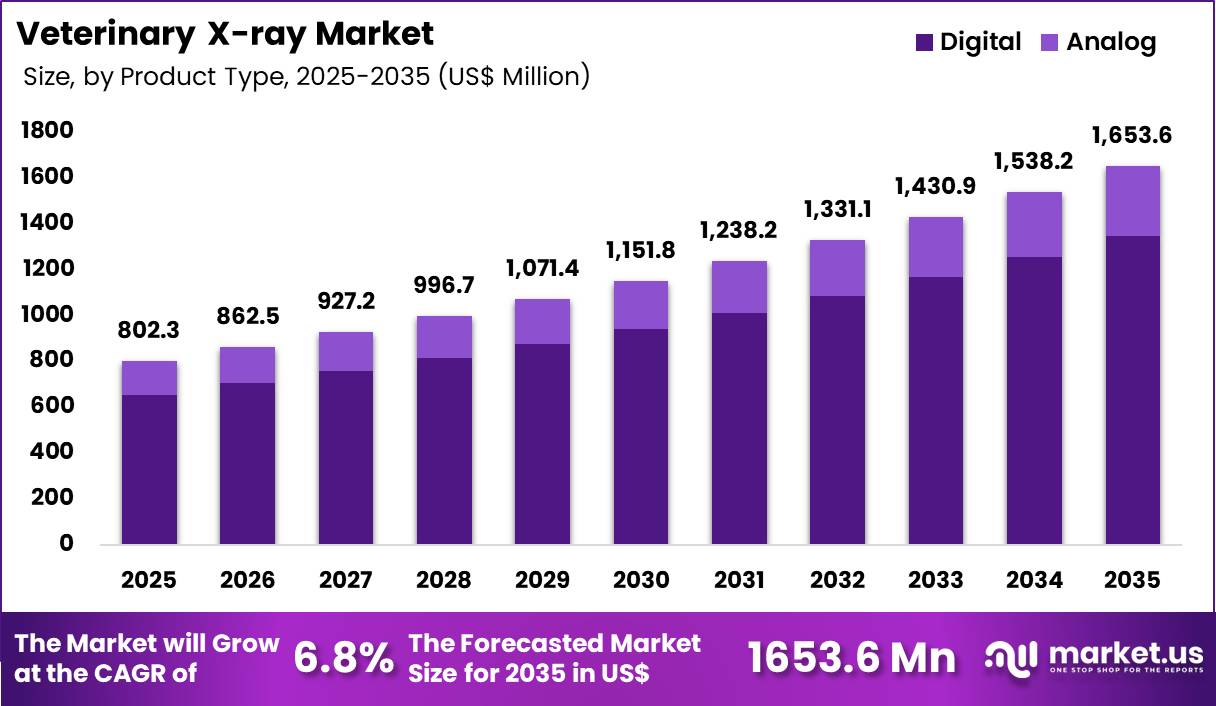
New York, NY – Nov 12 2026 – The Global Veterinary X-ray Market size is expected to be worth around US$ 1653.6 Million by 2035 from US$ 802.3 million in 2025, growing at a CAGR of 6.8% during the forecast period 2026-2035. In 2025, North America led the market, achieving over 47.6% share with a revenue of US$ 382.14 Million.
The Veterinary X-ray Market is growing steadily due to the rising demand for advanced diagnostic imaging in animal healthcare. Veterinary X-ray systems play an important role in identifying fractures, bone disorders, chest infections, dental problems, and internal organ abnormalities in animals. These systems help veterinarians diagnose health conditions accurately and plan suitable treatments for pets, livestock, and other animals.
Increasing pet ownership, rising spending on animal healthcare, and growing awareness of preventive veterinary care are supporting market growth. Veterinary clinics and animal hospitals are increasingly adopting digital X-ray systems because they provide faster imaging, better image quality, and easier storage of diagnostic records. Portable X-ray equipment is also gaining attention due to its convenience in farm settings, mobile veterinary services, and emergency care.
Technological advancements, including digital radiography, wireless detectors, and AI-assisted image analysis, are improving diagnostic efficiency. These innovations help veterinarians examine animals with greater accuracy while reducing examination time.
In addition, expanding veterinary infrastructure and increasing investments in animal health services are creating new growth opportunities. Overall, the veterinary X-ray market is expected to benefit from continued improvements in imaging technology and the growing need for reliable animal diagnostic solutions.
Key Takeaways
- In 2025, the Veterinary X-ray Market generated US$ 802.3 Million in revenue and is projected to reach US$ 1,653.6 Million by 2035, registering a CAGR of 6.8% during the forecast period.
- By product type, the market is segmented into digital and analog, with the digital segment dominating with an 81.6% market share.
- Based on technology, the market includes computed radiography, digital radiography, fluoroscopy, portable X-ray units, and others. Computed radiography (CR) led the segment with a 48.3% share.
- By portability, the market is categorized into fixed and mobile systems, with the fixed segment accounting for the largest market share.
- Based on application, the market is segmented into musculoskeletal exams, thoracic imaging, abdominal imaging, dental care, large animal medicine, and others. Musculoskeletal exams dominated with a 69.3% revenue share.
- By end user, the market is divided into veterinary hospitals & clinics and academic & research institutions, with veterinary hospitals & clinics accounting for a 41.5% share.
- Regionally, North America dominated the Veterinary X-ray Market with a 47.6% market share.
Key Market Segments
- Product Type Analysis: The digital segment dominated the veterinary X-ray market with an 81.6% share, driven by rising demand for high-quality animal diagnostic imaging. Digital systems provide faster image processing, better image clarity, and efficient data storage. Increasing adoption across veterinary clinics supports accurate diagnosis, improved workflows, and early disease detection.
- Technology Analysis: Computed radiography (CR) dominated the technology segment with a 48.3% share, supported by its cost-effectiveness and compatibility with existing imaging equipment. Veterinary clinics increasingly adopt CR systems to improve diagnostic efficiency, reduce processing time, and enable digital image storage. Growing demand for affordable imaging solutions further supports segment growth.
- Portability Analysis: The fixed segment dominated the portability category with a 69.3% share, driven by its reliable imaging performance in veterinary hospitals. Fixed X-ray systems support detailed examinations and accurate image positioning. Increasing investments in advanced diagnostic infrastructure and rising demand for orthopedic imaging are strengthening the adoption of fixed equipment.
- Application Analysis: Musculoskeletal examinations dominated the application segment with a 69.3% share, driven by increasing cases of fractures, joint disorders, and bone injuries in animals. Veterinary professionals rely on X-ray imaging for accurate diagnosis and treatment planning. Growing pet ownership and rising awareness of animal orthopedic health further support segment growth.
- End-User Analysis: Veterinary hospitals and clinics dominated the end-user segment with a 41.5% share, supported by increasing demand for routine examinations and advanced animal diagnostics. These facilities use X-ray systems to identify injuries, monitor diseases, and support surgical planning. Expanding veterinary services and investments in diagnostic equipment further strengthen adoption.
Regional Analysis
North America is leading the Veterinary X-ray Market
North America dominated the Veterinary X-ray market, accounting for 47.6% of the market share in 2025. Growth has been supported by increasing investments in advanced diagnostic imaging across companion animal clinics and equine care facilities. Rising pet ownership, preventive healthcare spending, and expanding pet insurance coverage have encouraged veterinary hospitals in the US and Canada to adopt digital radiography systems.
According to the American Pet Products Association, 66% of US households owned pets in 2023–2024. Additionally, mobile imaging solutions have improved diagnostic access for remote farms and ranches. Growing emphasis on early disease detection, animal welfare, and accurate orthopedic and dental diagnosis is further supporting market expansion.
Asia Pacific is expected to register the highest CAGR
Asia Pacific is projected to record the highest CAGR during the forecast period, driven by increasing pet ownership and investments in veterinary healthcare infrastructure across China, India, and Australia. Australia’s pet population exceeded 28 million in 2022, strengthening demand for diagnostic imaging.
Adoption of compact digital radiography systems, improved veterinary training, and greater availability of portable imaging equipment are expected to accelerate regional market growth.
Emerging Trends
- Increasing adoption of digital X-ray systems: Digital radiography is increasingly being adopted in veterinary clinics because it allows images to be captured, viewed, and stored electronically. It also supports faster image sharing, reduces dependence on physical films, and improves the overall diagnostic workflow.
- Integration of artificial intelligence (AI) in veterinary imaging: AI-based tools are emerging as an important development in veterinary radiology. These systems can support the identification of abnormalities, image measurements, and the review of radiographs. However, veterinary professionals remain responsible for confirming findings and making diagnostic decisions.
- Growing demand for veterinary teleradiology services: Veterinary teleradiology is gaining attention as digital images can be shared with specialist radiologists located in other regions. This allows clinics without in-house imaging specialists to obtain professional image assessments and diagnostic reports.
- Development of advanced imaging software and workflow systems: Veterinary imaging software is becoming more important for managing X-ray images, patient records, image measurements, and diagnostic reports. Integration with picture archiving and communication systems (PACS) is supporting better image storage, retrieval, and clinical workflow management.
- Greater focus on imaging accuracy and radiation safety: Veterinary facilities are placing greater importance on image quality, appropriate equipment use, and radiation protection. Improved imaging procedures and staff training are expected to support safer examinations while helping veterinarians obtain useful diagnostic images with appropriate radiation exposure.
Use Cases
- Diagnosis of bone fractures and joint disorders: Veterinary X-rays are widely used to identify bone fractures, joint dislocations, arthritis, and other skeletal abnormalities in animals. They help veterinarians examine bone alignment, assess injury severity, and plan suitable treatment or surgical procedures.
- Detection of chest and respiratory conditions: Thoracic radiography is used to examine the lungs, heart, and surrounding structures in animals. It supports the investigation of breathing difficulties, lung abnormalities, chest injuries, and certain heart-related conditions, helping veterinarians determine appropriate diagnostic and treatment pathways.
- Identification of gastrointestinal problems and foreign objects: Abdominal X-rays are used to investigate swallowed foreign objects, intestinal obstructions, abnormal gas patterns, and certain abdominal conditions. These examinations are particularly useful when animals show vomiting, abdominal discomfort, or changes in appetite and digestion.
- Dental examination and oral health assessment: Veterinary dental radiography helps identify problems below the gum line, including damaged tooth roots, retained teeth, and abnormalities affecting surrounding bone. It supports treatment planning and allows veterinarians to assess dental conditions that cannot be fully examined visually.
- Monitoring surgical recovery and treatment progress: X-ray imaging is used after orthopaedic surgery to assess bone alignment, implant positioning, and fracture healing. Repeated examinations can help veterinarians monitor recovery and determine whether additional treatment or changes to the care plan are required.
Frequently Asked Questions About Veterinary X-ray
- What are the common types of veterinary X-ray machines?
Common veterinary X-ray systems include conventional film-based, computed radiography (CR), digital radiography (DR), and portable X-ray machines. These systems are used according to animal size, clinical requirements, available infrastructure, and veterinary facility capabilities. - Why are digital X-rays preferred in veterinary hospitals?
Digital X-rays are preferred because images can be viewed quickly, stored electronically, and shared with specialists. They also support easier image retrieval and improve diagnostic workflows compared with traditional film-based radiography systems. - Are veterinary X-rays safe for animals?
Veterinary X-rays are generally considered safe when performed for appropriate medical reasons using controlled exposure and proper procedures. Veterinarians follow radiation protection practices, use suitable positioning, and avoid unnecessary repeat examinations to limit exposure. - Is sedation required before veterinary X-ray examinations?
Sedation is not necessary for every examination. However, it may be recommended when animals experience pain, anxiety, or movement difficulties, as proper positioning is important for obtaining clear images and reducing repeat exposures.
Merck Veterinary Manual - What are the major factors driving the veterinary X-ray market?
Market demand is supported by the increasing need for animal diagnostic services, wider adoption of digital imaging, improvements in veterinary healthcare infrastructure, and growing use of diagnostic imaging for injury assessment and disease detection. - Which technology holds importance in the veterinary X-ray market?
Digital radiography is an important technology segment because it enables rapid image acquisition, electronic storage, and easier sharing of diagnostic images. Its compatibility with imaging software and remote reporting systems further supports its adoption in veterinary facilities. - What opportunities exist in the veterinary X-ray market?
Opportunities are emerging through digital equipment upgrades, portable imaging solutions, AI-assisted diagnostic software, and remote radiology services. These developments can improve access to diagnostic imaging, particularly in smaller clinics and underserved veterinary healthcare locations.
Conclusion
The Veterinary X-ray Market is expected to witness steady growth, driven by increasing demand for advanced animal diagnostic imaging and rising investments in veterinary healthcare infrastructure. The growing adoption of digital radiography, portable X-ray systems, and AI-assisted imaging solutions is improving diagnostic accuracy and operational efficiency.
North America currently leads the market, while Asia Pacific is expected to experience the fastest growth due to expanding veterinary services and increasing pet ownership. Veterinary hospitals and clinics remain key end users, supported by the rising need for musculoskeletal examinations and routine animal diagnostics. Technological advancements are expected to create further market opportunities.
Discuss your needs with our analyst
Please share your requirements with more details so our analyst can check if they can solve your problem(s)