


Overview
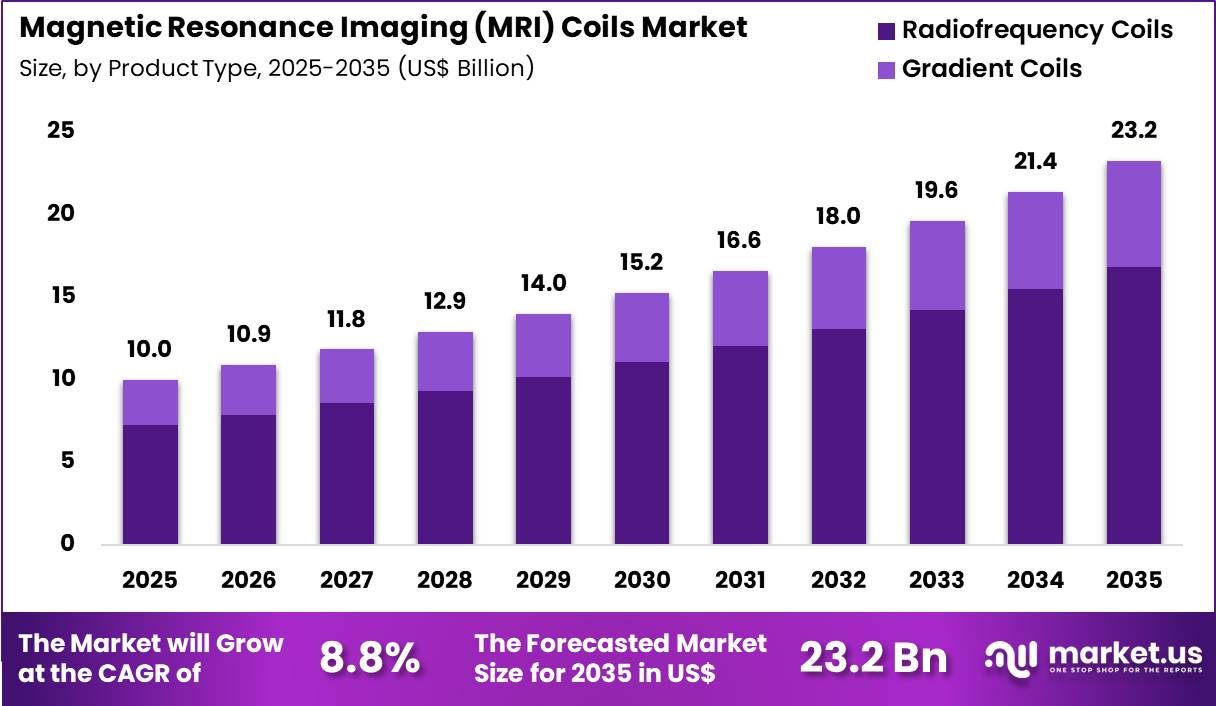
New York, NY – Nov 20 2026 – The Global Magnetic Resonance Imaging Coils Market size is expected to be worth around US$ 23.2 Billion by 2035 from US$ 10.0 Billion in 2025, growing at a CAGR of 8.8% during the forecast period 2026-2035. In 2025, North America led the market, achieving over 42.6% share with a revenue of US$ 4.2 Billion.
Magnetic Resonance Imaging (MRI) coils are essential components of MRI systems that are used to transmit radiofrequency (RF) signals and receive signals generated by hydrogen nuclei within the human body. These coils play a critical role in capturing high-quality images of internal organs, tissues, and other anatomical structures. They help improve image resolution, signal-to-noise ratio, and diagnostic accuracy, supporting the detection and monitoring of various medical conditions.
MRI coils are available in different types, including surface coils, volume coils, phased-array coils, head coils, spine coils, and body coils. These products are designed for specific anatomical regions and clinical applications, such as neurology, cardiology, oncology, orthopedics, and abdominal imaging.
The demand for MRI coils is increasing due to the rising prevalence of chronic diseases, growing demand for advanced diagnostic imaging, and increasing adoption of high-field MRI systems. Technological advancements, including flexible coil designs, lightweight materials, improved channel configurations, and artificial intelligence integration, are further supporting market development.
Additionally, the expansion of healthcare infrastructure, increasing investments in diagnostic imaging equipment, and growing emphasis on early disease detection are expected to create new growth opportunities for the global MRI coils market.
Key Takeaways
- In 2025, the global market was valued at US$ 10.0 Billion and is projected to grow at a CAGR of 8.8%, reaching US$ 23.2 Billion by 2035.
- Based on product type, the market is segmented into radiofrequency coils and gradient coils. Among these, radiofrequency coils dominated the market, accounting for a share of 72.5%.
- Based on application, the market is categorized into brain and neurology, spine and musculoskeletal, cardiac and vascular, abdominal and pelvic, breast imaging, pediatric imaging, and others. Among these, brain and neurology emerged as the leading segment, capturing 32.7% of the market share.
- By end user, the market is segmented into hospitals, diagnostic imaging centers, ambulatory surgical centers, and research and academic institutes. Among these, hospitals accounted for the largest revenue share of 56.8%.
- Regionally, North America dominated the global market, accounting for a significant share of 42.6%.
Key Market Segments
- Product Type Analysis: Radiofrequency coils dominated the magnetic resonance imaging coils market, accounting for 72.5% of the product type segment. Their leadership is attributed to their essential role in receiving radiofrequency signals and enhancing image quality during MRI examinations. Increasing demand for high-resolution imaging, improved signal-to-noise ratios, and advanced multi-channel coil designs is expected to support segment growth.
- Application Analysis: Brain and neurology emerged as the leading application segment, accounting for 32.7% of the market. The segment’s dominance is driven by the widespread use of MRI in diagnosing and monitoring neurological disorders, including stroke, epilepsy, and neurodegenerative diseases. Rising neurological disease prevalence and increasing demand for specialized brain imaging are expected to drive further growth.
- End-User Analysis: Hospitals dominated the end-user segment, accounting for 56.8% of the market. This leadership is supported by extensive diagnostic imaging infrastructure, high patient volumes, and the availability of specialized medical professionals. Increasing investments in advanced MRI equipment, modernization of radiology departments, and growing demand for specialized diagnostic procedures are expected to strengthen hospital adoption of MRI coils.
Regional Analysis
North America is Leading the Magnetic Resonance Imaging Coils Market
North America dominated the magnetic resonance imaging (MRI) coils market in 2025, accounting for 42.6% of the global market share. The region’s leadership is attributed to advanced healthcare infrastructure, widespread availability of MRI systems, and increasing demand for high-quality diagnostic imaging.
Rising prevalence of neurological, cardiovascular, and musculoskeletal disorders is further driving MRI examinations. Additionally, continuous investments in advanced imaging technologies, including multi-channel phased-array coils and flexible coil designs, are supporting regional market growth. The presence of leading medical device manufacturers and strong research and development activities is also contributing to technological advancements and product adoption.
Asia Pacific is Expected to Register the Highest CAGR During the Forecast Period
Asia Pacific is expected to witness the fastest growth during the forecast period, driven by expanding healthcare infrastructure, increasing healthcare expenditure, and rising demand for advanced diagnostic imaging. Countries such as China, India, Japan, and South Korea are investing in modern MRI systems, supporting regional adoption of advanced MRI coils.
Emerging Trends
- Growing Adoption of Flexible MRI Coils: Flexible MRI coils are gaining attention because they can be adjusted to fit different body shapes and anatomical areas. Their ability to improve patient comfort and maintain good signal quality is supporting their adoption across diagnostic imaging facilities.
- Development of Wireless MRI Coils: Wireless coil technology is emerging as an important area of development. These coils aim to reduce cable-related limitations, simplify patient positioning, and improve the overall scanning experience. Research is continuing to explore wireless designs for clinical MRI applications.
- Increasing Use of High-Channel Coil Arrays: MRI manufacturers are developing coils with a higher number of receiving elements. These designs can capture signals from multiple locations and support parallel imaging, helping improve image quality and reduce scanning time.
- Integration of Advanced Coil Technologies: The integration of MRI coils with other imaging technologies and scanner components is gaining importance. Integrated coil designs can support improved signal reception, better imaging performance, and more efficient examination workflows.
- Development of Adjustable and Patient-Friendly Coils: Adjustable and ultraflexible coils are being developed to accommodate differences in patient anatomy. These designs can improve coil positioning and patient comfort while supporting better signal reception, particularly in examinations involving complex body regions.
Use Cases
- Brain and Neurological Imaging: MRI head and neurovascular coils are used to examine the brain, spinal cord, and surrounding structures. They support the diagnosis and monitoring of neurological conditions, including brain tumours, stroke-related changes, and other abnormalities.
- Musculoskeletal Imaging: Dedicated MRI coils are used to examine joints, muscles, ligaments, and bones. Applications include imaging of the knee, shoulder, wrist, ankle, and other extremities, supporting the assessment of sports injuries, joint disorders, and soft-tissue damage.
- Breast Cancer Diagnosis: Dedicated breast MRI coils are used to capture detailed images of breast tissue, chest wall structures, and nearby axillary tissues. These coils support breast cancer assessment, detection of abnormalities, and evaluation of disease extent.
- Cardiovascular Imaging: MRI coils are used in cardiac and vascular examinations to capture images of the heart, blood vessels, and surrounding structures. These applications support the assessment of cardiovascular abnormalities and help physicians evaluate heart structure and function.
- Abdominal and Pelvic Imaging: Flexible and dedicated MRI coils are used to examine organs such as the liver, kidneys, prostate, and pelvic structures. These applications support the diagnosis and monitoring of organ abnormalities, cancers, and other internal health conditions.
Frequently Asked Questions About Magnetic Resonance Imaging Coils
- What are the main types of MRI coils?
The main types include surface coils, volume coils, phased-array coils, flexible coils, and transmit-receive coils. Each type is designed for specific imaging requirements, anatomical regions, and signal reception or transmission functions. - How do MRI coils improve image quality?
MRI coils improve image quality by capturing radiofrequency signals from targeted body regions. Their design and positioning influence signal strength, sensitivity, and image resolution, helping radiologists obtain clearer images for accurate medical assessment. - What is the difference between flexible MRI coils and rigid MRI coils?
Rigid MRI coils have fixed shapes and are generally designed for specific body parts. Flexible coils can adapt to different body contours, offering greater positioning flexibility, patient comfort, and improved proximity to the targeted anatomical region. - Which medical conditions can be examined using MRI coils?
MRI coils support examinations related to brain disorders, spinal conditions, joint injuries, breast abnormalities, cardiovascular diseases, and abdominal disorders. The specific medical conditions examined depend on the coil design, scanner capabilities, and imaging protocol. - What are the major factors driving the MRI coils market?
The market is supported by increasing demand for diagnostic imaging, advancements in MRI scanner technology, growing use of specialised imaging procedures, and the development of advanced coil designs that improve patient comfort and imaging performance. - Which factors are influencing technological advancements in the MRI coils market?
Technological advancements are influenced by the need for higher image resolution, faster examinations, improved signal-to-noise ratios, and better patient positioning. Research into flexible, wireless, and integrated coil arrays is also supporting product innovation. - Which healthcare facilities are the major end users of MRI coils?
Hospitals, diagnostic imaging centres, specialty clinics, and medical research institutions are major end users. These facilities use dedicated MRI coils for neurological, cardiovascular, musculoskeletal, breast, and abdominal imaging procedures. - What is the future outlook for the Magnetic Resonance Imaging Coils Market?
The market is expected to benefit from continued innovation in flexible, wireless, and high-channel coil technologies. Increasing clinical requirements for detailed imaging and efficient examinations are likely to encourage further product development and adoption.
Conclusion
The global magnetic resonance imaging coils market is expected to witness substantial growth, driven by the rising demand for advanced diagnostic imaging, increasing prevalence of chronic diseases, and continuous advancements in MRI technologies. The growing adoption of radiofrequency coils, high-channel coil arrays, and flexible coil designs is expected to improve imaging performance and patient comfort.
North America is anticipated to maintain its market leadership, while Asia Pacific is likely to offer significant growth opportunities due to expanding healthcare infrastructure and rising investments in diagnostic imaging. Furthermore, technological innovations and increasing emphasis on early disease detection are expected to support market expansion through 2035.
Discuss your needs with our analyst
Please share your requirements with more details so our analyst can check if they can solve your problem(s)



