


Overview
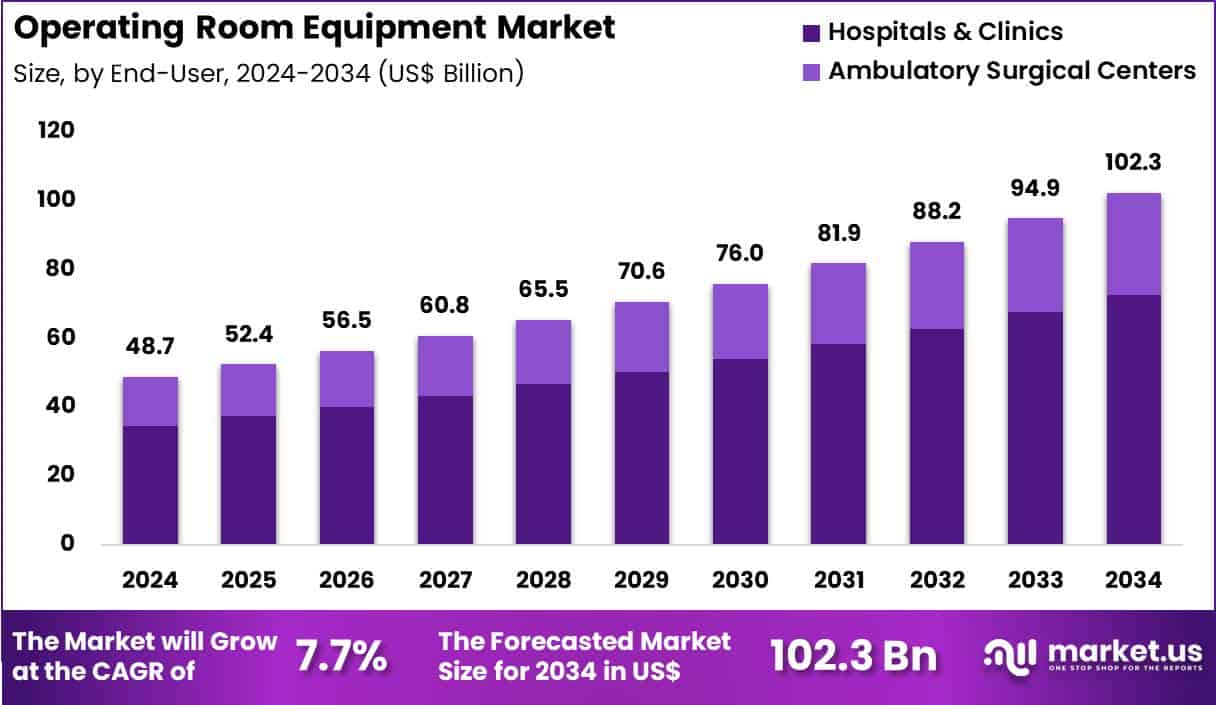
New York, NY – Oct 28, 2026 – Global Operating Room Equipment Market size is expected to be worth around US$ 102.3 Billion by 2034 from US$ 48.7 Billion in 2024, growing at a CAGR of 7.7% during the forecast period 2025 to 2034. In 2024, North America led the market, achieving over 44.6% share with a revenue of US$ 21.7 Billion.
Operating room (OR) equipment plays a vital role in modern healthcare by supporting surgical procedures, patient monitoring, anesthesia administration, and infection control. The equipment category includes operating tables, surgical lights, anesthesia machines, electrosurgical units, patient monitoring systems, surgical imaging systems, and other essential devices used in hospital operating rooms.
The demand for operating room equipment is being driven by the increasing number of surgical procedures, the rising prevalence of chronic diseases, the growing geriatric population, and continuous advancements in medical technology. The expansion of healthcare infrastructure, particularly in emerging economies, is also supporting market development.
Technological innovations, including robotic-assisted surgery, advanced imaging systems, integrated operating rooms, and smart monitoring solutions, are improving surgical precision, workflow efficiency, and patient safety. In addition, increasing investments in hospital modernization and the adoption of minimally invasive surgical procedures are creating new growth opportunities for market participants.
However, high equipment acquisition costs, maintenance expenses, and the need for specialized training may limit adoption, particularly among smaller healthcare facilities and resource-constrained healthcare systems.
Overall, the operating room equipment market is expected to benefit from ongoing healthcare investments, technological advancements, and the growing emphasis on surgical safety and operational efficiency. Manufacturers are increasingly focusing on product innovation, equipment integration, and advanced surgical solutions to address the evolving requirements of healthcare providers worldwide.
Key Takeaways
- In 2024, the market was valued at US$ 48.07 billion and is projected to reach US$ 102.3 billion by 2034, growing at a CAGR of 7.7%.
- By product type, the market is segmented into anesthesia devices, surgical imaging equipment, endoscopes, electrosurgical devices, and others. Anesthesia devices dominated the market, accounting for 34.9% of the total share.
- By end user, the market is categorized into hospitals and clinics and ambulatory surgical centers. Hospitals and clinics held the largest share, accounting for 71.2% of the market.
- North America dominated the global market, accounting for a market share of 44.6%.
Key Market Segments
- Product Type Analysis: Anesthesia devices dominated the operating room equipment market, accounting for 34.9% of the segment share. Their essential role in anesthesia delivery, ventilation, and patient monitoring supports consistent demand. Rising surgical volumes, increasing complex procedures, and hospital investments in advanced, automated anesthesia systems are further driving segment growth.
- End-User Analysis: Hospitals and clinics dominated the operating room equipment market, accounting for 71.2% of the end-user segment. High surgical volumes, complex procedures, and comprehensive healthcare facilities support their leading position. Increasing investments in operating room modernization, infection control, and advanced surgical technologies are further strengthening demand across hospitals and clinics.
Regional Analysis
North America Market Analysis
North America held a significant position in the operating room equipment market, accounting for a 38% market share in 2024. Market growth is supported by advanced healthcare infrastructure, increasing surgical volumes, and the adoption of integrated digital operating rooms. Investments in modular surgical tables, ceiling-mounted equipment, robotic-assisted surgery, and hybrid operating rooms are improving surgical efficiency.
The region’s aging population, rising outpatient procedures, and emphasis on infection control are further supporting equipment demand. The United States had 6,394 Medicare-certified ambulatory surgery centers in 2024, reflecting the expansion of outpatient surgical facilities.
Asia Pacific Market Analysis
The Asia Pacific region is expected to register the highest CAGR during the forecast period, driven by healthcare infrastructure expansion and rising surgical demand. Investments in advanced imaging, patient monitoring, anesthesia systems, and energy-efficient surgical equipment are supporting market development.
Countries such as India, China, Japan, and South Korea are strengthening healthcare capabilities through technology adoption and domestic manufacturing initiatives. Growing demand for cost-effective equipment, expanding regional hospitals, and government support for medical device production are expected to create further growth opportunities across the region.
Emerging Trends
- Growing adoption of robotic-assisted surgery: Hospitals are increasingly exploring robotic systems that help surgeons perform complex procedures with greater precision and control. These systems are supporting the development of advanced operating rooms, particularly in specialties such as urology, gynecology, and general surgery.
- Integration of digital and connected equipment: Operating rooms are adopting connected monitors, imaging systems, surgical displays, and electronic data platforms. These technologies help clinical teams access patient information more efficiently, improve coordination, and support informed decisions during surgical procedures.
- Increasing focus on infection prevention: Hospitals are placing greater emphasis on equipment that supports sterile conditions, including advanced sterilization systems, antimicrobial-compatible surfaces, and improved air-handling solutions. This trend is linked to efforts to reduce surgical site infections and strengthen patient safety.
- Expansion of minimally invasive surgery equipment: Demand is growing for laparoscopic instruments, endoscopic systems, specialized cameras, and advanced surgical energy devices. These technologies support procedures performed through smaller incisions and can help reduce tissue damage and recovery time for suitable patients.
- Development of imaging-guided operating rooms: Intraoperative imaging, navigation systems, and advanced visualization technologies are improving access to anatomical information during surgery. These systems are particularly useful in neurosurgery, orthopedics, cardiovascular procedures, and other complex operations requiring accurate instrument positioning.
- Adoption of AI-assisted surgical technologies: Artificial intelligence is being explored for surgical image analysis, anatomical identification, workflow support, and decision assistance. These applications may help clinical teams interpret complex information, although their benefits depend on clinical validation, safe integration, and appropriate oversight.
- Modernization of operating room infrastructure: Hospitals are investing in integrated operating room systems that connect surgical lights, cameras, displays, and control panels. This supports more organized workflows and allows staff to manage multiple technologies from a central interface.
- Greater emphasis on equipment safety and regulatory compliance: Manufacturers are placing greater attention on device testing, software reliability, electrical safety, user training, and risk management. Regulatory guidance for robotic surgical devices highlights the importance of evaluating performance and safety before market entry.
- Growth of outpatient surgical equipment demand: The expansion of ambulatory surgery centers and day-care procedures is creating demand for compact operating tables, portable imaging equipment, anesthesia systems, and space-efficient surgical instruments. These facilities often prioritize equipment that supports efficient procedures and faster room turnover.
- Focus on equipment maintenance and lifecycle management: Hospitals are paying closer attention to preventive maintenance, equipment servicing, replacement planning, and staff training. These practices can help reduce unexpected downtime, maintain equipment performance, and improve the long-term value of capital-intensive operating room investments.
Use Cases
- General and abdominal surgery: Operating tables, surgical lights, electrosurgical units, suction systems, and standard instrument sets are used for procedures such as appendectomy, hernia repair, and gallbladder removal. These devices support surgical access, tissue cutting, bleeding control, and visibility.
- Anesthesia and patient monitoring: Anesthesia workstations, ventilators, infusion pumps, and multiparameter monitors are used to administer anesthesia and track vital signs during surgery. Continuous monitoring helps anesthesia professionals assess oxygen levels, heart rate, blood pressure, and respiratory function.
- Orthopedic and trauma procedures: Orthopedic tables, surgical drills, powered instruments, C-arm imaging systems, and specialized fixation tools support fracture repair, joint replacement, and other bone procedures. Imaging helps clinicians check bone alignment and implant positioning during suitable operations.
- Cardiovascular and neurosurgical procedures: Advanced operating tables, microscopes, imaging equipment, patient monitors, and specialized surgical instruments support procedures involving the heart, blood vessels, brain, and nervous system. High-quality visualization and physiological monitoring are particularly important during these complex operations.
- Sterilization and infection control: Steam sterilizers, instrument washers, surgical instrument trays, and appropriate room ventilation systems support the preparation of reusable equipment and the maintenance of a controlled surgical environment. Correct cleaning and sterilization procedures help reduce contamination risks.
Frequently Asked Questions About Operating Room Equipment
- What are the main types of operating room equipment?
The main types include surgical instruments, operating tables, surgical lighting systems, anesthesia equipment, patient monitoring devices, electrosurgical units, imaging systems, and sterilization equipment. Each category supports specific clinical tasks and helps maintain safe surgical conditions. - Why is operating room equipment important in hospitals?
Operating room equipment supports accurate surgical work, continuous patient monitoring, effective anesthesia delivery, and safe instrument handling. Properly selected and maintained equipment can improve workflow efficiency and help clinical teams manage surgical risks. - How does operating room equipment improve patient safety?
Operating room equipment supports patient safety through vital-sign monitoring, controlled anesthesia delivery, effective lighting, and reliable surgical instruments. When combined with trained staff and safety checklists, these systems help reduce preventable errors and improve communication. - What factors should hospitals consider when purchasing operating room equipment?
Hospitals should assess clinical requirements, equipment quality, regulatory compliance, purchase price, maintenance costs, staff training, compatibility, and after-sales support. Long-term operating costs and the availability of spare parts should also be considered before procurement. - Which technologies are influencing the operating room equipment market?
Robotic-assisted surgery, digital operating room integration, advanced imaging, AI-assisted tools, and improved patient monitoring are influencing equipment development. Adoption depends on clinical evidence, investment capacity, regulatory approval, staff training, and the suitability of each technology for specific procedures. - What opportunities exist in the operating room equipment market?
Opportunities are emerging through hospital modernization, outpatient surgical services, advanced visualization, and demand for efficient equipment management. Manufacturers can also address the needs of smaller healthcare facilities through affordable, reliable, space-efficient equipment and accessible technical support. - How does government regulation affect the operating room equipment market?
Government regulation affects medical device approval, safety testing, manufacturing quality, labeling, and post-market monitoring. Requirements differ by country and device category, influencing product development timelines, compliance costs, market entry, and the commercial availability of new technologies. - What is the future outlook for the operating room equipment market?
The market outlook is supported by ongoing surgical technology development, healthcare infrastructure investment, and demand for safer surgical procedures. However, future growth will depend on affordability, clinical outcomes, regulatory approval, replacement cycles, and hospitals’ ability to fund new equipment.
Conclusion
The operating room equipment market is expected to experience steady growth, supported by rising surgical volumes, increasing healthcare investments, and continuous technological advancements. The market is projected to grow from US$ 48.07 billion in 2024 to US$ 102.3 billion by 2034, at a CAGR of 7.7%.
Anesthesia devices and hospitals and clinics remain important market segments, while North America maintains a strong market position and Asia Pacific offers significant growth opportunities. Robotic-assisted surgery, integrated operating rooms, advanced imaging, and infection control are shaping industry development. However, high costs, maintenance requirements, and training needs remain key challenges for market participants.
Discuss your needs with our analyst
Please share your requirements with more details so our analyst can check if they can solve your problem(s)



