


Overview
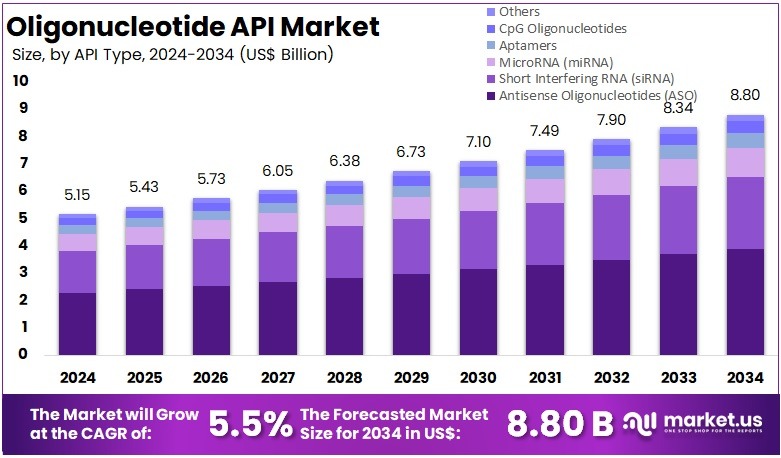
New York, NY – Aug 31, 2026 – The Global Oligonucleotide API Market size is expected to be worth around US$ 8.8 Billion by 2034, from US$ 5.15 Billion in 2024, growing at a CAGR of 5.5% during the forecast period from 2025 to 2034. North America held a dominant market position, capturing more than a 40.2% share and holds US$ 2.07 Billion market value for the year.
The global Oligonucleotide API (Active Pharmaceutical Ingredient) market is gaining strong momentum as demand for RNA-based medicines, gene-targeted therapies, and precision medicine continues to rise. Oligonucleotide APIs are essential components used in the production of antisense oligonucleotides, small interfering RNA (siRNA), messenger RNA (mRNA), and other nucleic acid-based therapeutics for treating rare genetic disorders, cancer, cardiovascular diseases, and infectious diseases.
The market is benefiting from increasing investments in biotechnology research, expanding clinical pipelines, and improvements in large-scale oligonucleotide synthesis technologies. Pharmaceutical and biotechnology companies are also strengthening manufacturing capabilities to meet the growing commercial demand for high-purity APIs.
According to industry reports, more than 20 oligonucleotide-based therapies have received regulatory approval globally, while over 200 candidates are currently in clinical development, reflecting the sector’s rapid innovation. The global oligonucleotide therapeutics pipeline continues to expand, supported by increasing partnerships and contract manufacturing activities.
North America remains a leading regional market due to its advanced biopharmaceutical infrastructure, significant R&D investments, and favorable regulatory environment, while Europe and Asia-Pacific are witnessing rising manufacturing capacity and clinical research activities. Technological advancements in solid-phase synthesis, purification processes, and analytical testing are improving production efficiency and product quality.
As precision medicine and genetic therapies become more widely adopted, the demand for high-quality oligonucleotide APIs is expected to grow steadily, creating long-term opportunities for manufacturers, contract development and manufacturing organizations (CDMOs), and pharmaceutical innovators worldwide.
Key Takeaways
- The global oligonucleotide API market is expected to grow from US$ 5.15 billion in 2024 to approximately US$ 8.8 billion by 2034, registering a CAGR of 5.5% during the forecast period.
- Antisense oligonucleotides emerged as the leading API type in 2024, accounting for over 44.2% of the global market, supported by their increasing use in targeted therapeutic applications.
- In-house manufacturing led the production segment in 2024, capturing more than 65.1% of the market due to enhanced quality control, operational efficiency, and lower production costs.
- Therapeutic applications held the largest market share in 2024, representing over 48.7%, driven by the growing adoption of oligonucleotide-based therapies for complex diseases.
- Pharmaceutical companies dominated the end-user segment in 2024, contributing more than 44.5% of the total market, fueled by expanding R&D activities and investments in nucleic acid therapeutics.
- The opioids segment accounted for the largest share of the drug class category in 2024, holding over 48.5%, supported by its extensive role in oligonucleotide-related research and development.
- North America maintained its leading position in the global oligonucleotide API market in 2024, capturing more than 40.2% of the market and generating approximately US$ 2.07 billion in revenue.
Statistical Information
- A 2025 one-pot liquid-phase oligonucleotide synthesis (OP-LPOS) process achieved 97–100% stepwise filtration yield, demonstrating very high intermediate recovery during API manufacturing.
- The same 2025 manufacturing study reported approximately 72% crude purity after synthesizing an 18-mer 2′–OMe phosphorothioate oligonucleotide, reducing downstream purification requirements.
- The OP-LPOS process reduced reagent consumption by requiring only 1.5 equivalents of phosphoramidites during synthesis, improving material efficiency compared with conventional approaches.
- The membrane-enabled purification process completed intermediate purification in only 5 diavolumes, shortening processing compared with conventional multi-step purification workflows.
- The ceramic membrane system achieved a solvent permeance of 13 L·m⁻²·h⁻¹·bar⁻¹, providing a measurable throughput improvement for oligonucleotide API purification.
- The 2025 OP-LPOS process successfully synthesized both 6-mer and 18-mer phosphorothioate oligonucleotides using the same membrane-enabled manufacturing platform, demonstrating scalability across different oligonucleotide lengths.
- A 2025 review in Nucleic Acids Research highlighted that liquid-phase and chemical ligation approaches are being developed specifically to improve scalable and more sustainable oligonucleotide production, addressing limitations of traditional phosphoramidite chemistry through new manufacturing routes. While primarily qualitative, the review documents the 2025 state of process innovation supporting industrial API production.
Regional Analysis
North America held a leading position in the global oligonucleotide API market in 2024, supported by strong biotechnology infrastructure, advanced drug development capabilities, and increasing demand for nucleic acid-based therapies.
The United States remained the primary growth contributor due to significant investments in RNA therapeutics, antisense oligonucleotides, and gene-targeted treatments. According to the U.S. Food and Drug Administration, approvals and regulatory advancements in innovative therapies have encouraged pharmaceutical companies to expand oligonucleotide-based drug pipelines.
The region also benefits from a well-established contract development and manufacturing organization (CDMO) network, enabling scalable API production with high-quality standards. Growing collaborations between biotechnology firms, research institutes, and healthcare organizations are further accelerating innovation. Canada is also strengthening its biotechnology sector through research initiatives and life science investments, supporting regional market expansion and adoption of advanced oligonucleotide therapeutics.
Emerging Trends
- Growth of RNA-Based Therapeutics Manufacturing: Oligonucleotide API production is expanding due to increasing RNA-based medicines, including antisense oligonucleotides (ASOs) and siRNA therapies. The FDA reported approval of 17 RNA oligonucleotide therapeutics, including 6 siRNA and 11 antisense products, encouraging manufacturers to scale advanced synthesis capabilities.
- Advanced Chemical Modification Technologies: Manufacturers are increasingly adopting chemical modifications to improve oligonucleotide stability, safety, and biological activity. Modern oligos commonly use modified backbones and sugar structures to reduce nuclease degradation. NIH highlights that therapeutic oligonucleotides are generally 15–30 nucleotides long, supporting precision drug development.
- Expansion of Rare Disease Applications: Rare genetic disorders are becoming a major focus area for oligonucleotide APIs because these molecules can regulate disease-causing genes. NIH identifies oligonucleotide therapeutics as an emerging approach mainly used for rare genetic diseases, with applications including ASOs, siRNAs, and microRNA-based treatments.
- Increasing Regulatory Focus on Oligonucleotide Safety: Regulatory agencies are developing stronger evaluation frameworks for oligonucleotide therapies. In 2024, the FDA issued clinical pharmacology guidance covering areas such as immunogenicity, renal and hepatic impairment, QTc risks, and drug interactions to support safer development pathways.
- AI and Data-Based Toxicity Prediction Research: Artificial intelligence and large biological datasets are becoming important tools for improving oligonucleotide API development. NIH launched the OligoTox Open Data Challenge with $500,000 in total prizes to encourage better prediction models for oligonucleotide toxicity using sequence and chemical modification data.
Use Cases
- Treatment of Neurological Genetic Disorders: Oligonucleotide APIs are widely used in neurological disease treatments by modifying gene expression pathways. Approved therapies demonstrate applications in disorders caused by genetic mutations, where targeted RNA regulation can improve disease management and provide longer-lasting therapeutic effects compared with conventional medicines.
- Cardiovascular Disease Management: Oligonucleotide-based APIs are being developed for cardiovascular conditions by targeting specific RNA sequences involved in disease pathways. siRNA technologies are gaining attention for reducing harmful protein production, enabling precision approaches for cholesterol-related and metabolic cardiovascular disorders.
- Cancer Research and Targeted Gene Regulation: Oligonucleotide APIs support oncology research by controlling gene expression linked with tumor growth and disease progression. Researchers are exploring antisense and RNA interference technologies to selectively target cancer-related pathways while improving treatment precision and reducing unwanted biological effects.
- Personalized Medicine and Precision Therapies: The ability of oligonucleotides to bind specific genetic sequences makes them suitable for personalized healthcare applications. API manufacturers are developing customized production approaches for patient-specific and mutation-targeted therapies, supporting the growing adoption of precision medicine strategies globally.
- Drug Development for Metabolic and Rare Conditions: Oligonucleotide APIs are increasingly applied in metabolic disorders and rare diseases where conventional drugs may have limited effectiveness. Their ability to regulate RNA activity provides opportunities for developing therapies against previously difficult-to-treat conditions, expanding future pharmaceutical innovation.
Frequently Asked Questions on Oligonucleotide API
- What are the major applications of Oligonucleotide APIs?
Oligonucleotide APIs are mainly used in therapies for genetic disorders, cancer, cardiovascular diseases, neurological conditions, and rare diseases. They support treatments such as antisense oligonucleotides, small interfering RNA therapies, and other nucleic acid-based medicines. - How is the Oligonucleotide API Market growing?
The Oligonucleotide API Market is expanding due to increasing research in gene-based therapies, rising clinical trials, and growing approvals of RNA and DNA medicines. Pharmaceutical companies are investing in advanced manufacturing capabilities to meet rising therapeutic demand. - What are the key types of Oligonucleotide APIs?
The major types of Oligonucleotide APIs include antisense oligonucleotides, small interfering RNA (siRNA), aptamers, and other synthetic nucleic acid molecules. Each type works differently by targeting genetic mechanisms involved in disease development and treatment. - What factors are driving the Oligonucleotide API Market growth?
Market growth is driven by increasing investments in biotechnology research, rising demand for personalized medicine, expanding clinical pipelines, and technological improvements in oligonucleotide synthesis. Growing regulatory support for innovative therapies also encourages pharmaceutical companies to develop new products. - What are the challenges faced by the Oligonucleotide API industry?
The industry faces challenges, including complex manufacturing processes, high production costs, strict quality requirements, and difficulties in large-scale commercialization. Maintaining product stability, purity, and consistent quality remains important for successful oligonucleotide API development. - Which manufacturing approach is commonly used for Oligonucleotide APIs?
Oligonucleotide APIs can be manufactured through in-house production or outsourced to contract manufacturing organizations. Companies choose these approaches based on production requirements, technical expertise, investment capacity, and the need for flexible manufacturing solutions. - What is the future outlook for the Oligonucleotide API Market?
The future of the Oligonucleotide API Market is expected to remain positive due to expanding gene therapy research, increasing approvals of nucleic acid medicines, and continuous improvements in synthesis technologies. Emerging applications may further increase demand across healthcare sectors.
Conclusion
The global Oligonucleotide API Market is expected to witness steady expansion, driven by increasing demand for RNA-based therapies, gene-targeted medicines, and precision healthcare solutions.Rising adoption of antisense oligonucleotides, siRNA technologies, and advanced manufacturing capabilities is strengthening industry growth.
Pharmaceutical companies, biotechnology firms, and contract manufacturers are investing in scalable production and innovative synthesis technologies. With continuous advancements in nucleic acid therapeutics, the market is positioned for sustained development and broader clinical applications worldwide.
Discuss your needs with our analyst
Please share your requirements with more details so our analyst can check if they can solve your problem(s)




