


Overview
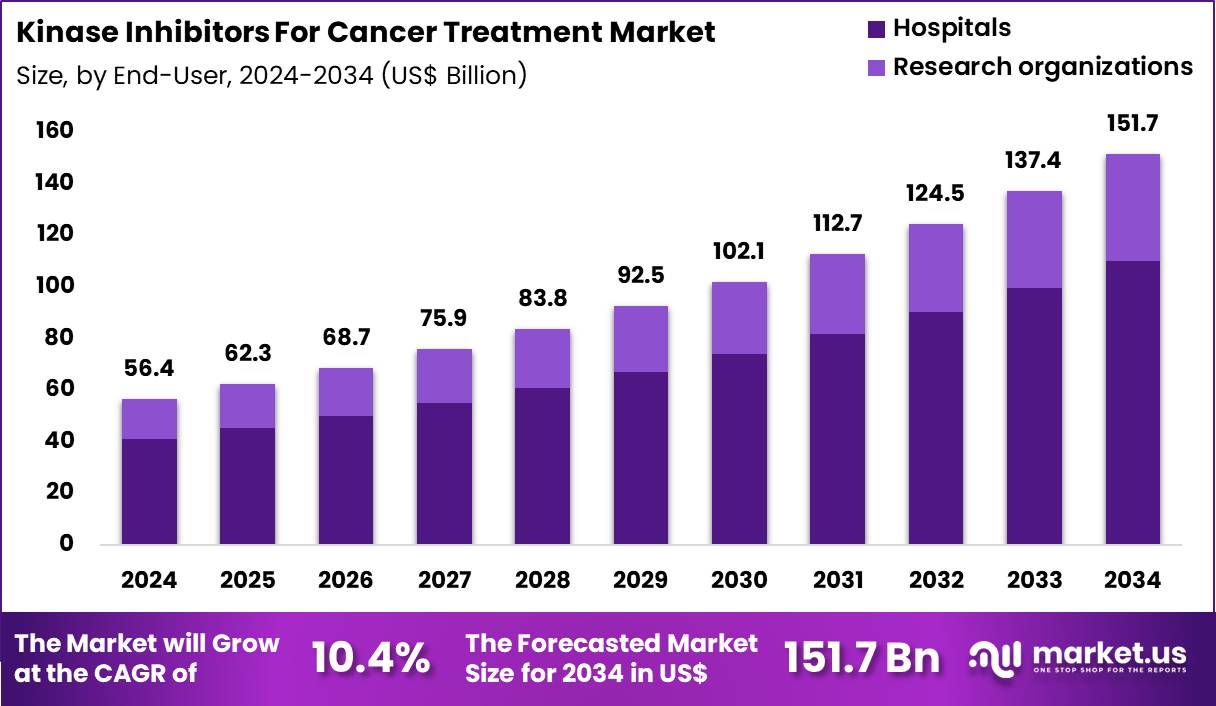
New York, NY – Oct 08, 2026 – The Global Kinase Inhibitors For Cancer Treatment Market size is expected to be worth around US$ 151.7 Billion by 2034 from US$ 56.4 Billion in 2024, growing at a CAGR of 10.4% during the forecast period 2025 to 2034. In 2024, North America led the market, achieving over 38.5% share with a revenue of US$ 21.7 Billion.
The global Kinase Inhibitors for Cancer Treatment Market is gaining significant attention as targeted cancer therapies continue to expand. Kinase inhibitors are medicines designed to block specific enzymes, known as kinases, that play an important role in cancer cell growth, proliferation, and survival. Their ability to target specific molecular pathways has supported their increasing adoption across several cancer types.
Market growth is being driven by the rising global burden of cancer, increasing investment in oncology research, and continued development of targeted therapies. Advances in precision medicine and molecular diagnostics are also supporting the identification of patients who may benefit from kinase inhibitor treatments. In addition, pharmaceutical companies are focusing on developing next-generation inhibitors with improved selectivity and therapeutic effectiveness.
The market is supported by growing demand for innovative cancer treatments and expanding research pipelines. However, high treatment costs, drug resistance, adverse effects, and complex regulatory requirements may affect market expansion.
North America is expected to remain an important market due to advanced healthcare infrastructure, strong pharmaceutical research capabilities, and high adoption of targeted cancer therapies. Meanwhile, opportunities in Asia-Pacific are increasing as healthcare investment, cancer awareness, and access to advanced treatments improve.
Key Takeaways
- In 2024, the market generated US$ 56.4 billion in revenue and is projected to grow at a CAGR of 10.4%, reaching approximately US$ 151.7 billion by 2034.
- By product type, the market is segmented into EGFR inhibitors, m-TOR inhibitors, BRAF and MEK inhibitors, angiogenesis inhibitors, and others. EGFR inhibitors dominated the market in 2024, accounting for 38.9% of the total market share.
- Based on end users, the market is categorized into hospitals and research organizations. Hospitals accounted for the largest share, representing 72.6% of the market in 2024.
- North America dominated the global market in 2024, accounting for a significant 38.5% market share.
Key Market Segments
- Product Type Analysis: EGFR inhibitors held a 38.9% share, supported by the high prevalence of EGFR-mutated cancers, particularly lung and colorectal tumors. Growing precision oncology adoption, expanded biomarker testing, improved treatment outcomes, combination therapies, and ongoing development of selective next-generation inhibitors continue to strengthen demand.
- End-User Analysis: Hospitals accounted for 72.6% of the end-user segment, supported by their central role in cancer diagnosis and treatment. Advanced oncology infrastructure, multidisciplinary teams, molecular testing, adverse-event monitoring, treatment supervision, hospital pharmacies, and clinical trial participation continue to reinforce hospital dominance in targeted cancer care.
Regional Analysis
North America dominated the Kinase Inhibitors for Cancer Treatment Market in 2024, accounting for 38.5% of the global market. Growth has been supported by the increasing cancer burden, rapid regulatory approvals, advanced precision medicine, and wider adoption of targeted therapies.
Growing use of biomarker-based treatment, next-generation tyrosine kinase inhibitors, companion diagnostics, and combination therapies has further strengthened regional demand. Expanded reimbursement coverage and advanced oncology infrastructure have also supported adoption across hospitals and community practices. According to the National Cancer Institute, 2,001,140 new cancer cases were estimated in the United States in 2024.
Asia Pacific is projected to register the highest CAGR during the forecast period. Market expansion is being driven by the rising cancer burden, increasing healthcare investments, improving access to targeted therapies, and growing adoption of molecular diagnostics.
Government support, local pharmaceutical manufacturing, clinical research, and expanded biomarker testing are expected to further accelerate the regional market. The Global Cancer Observatory reported 9,826,539 new cancer cases in Asia in 2022.
Emerging Trends
- Growth in precision-based treatment: Kinase inhibitors are increasingly being developed for cancers carrying specific gene changes, such as HER2, RET, ROS1, BRAF, and FGFR alterations. This supports more targeted treatment and improves patient selection through biomarker testing.
- Rise of next-generation kinase inhibitors: Newer inhibitors are being designed to work against resistant cancer cells and provide activity after earlier kinase treatments stop working. Recent FDA approvals, including zidesamtinib for ROS1-positive NSCLC, reflect this trend.
- Increasing use of combination therapy: Kinase inhibitors are increasingly being studied and used with other targeted medicines, hormone therapies, immunotherapies, or chemotherapy. Combination approaches are intended to improve treatment response and reduce the impact of resistance.
- Expansion across cancer types: The application of kinase inhibitors is moving beyond a limited group of cancers. NCI lists approved targeted therapies involving kinase pathways across lung, breast, thyroid, brain, bladder, gastric, blood, and other cancers.
- Faster development of molecularly selected drugs: Regulatory activity is supporting faster development of drugs aimed at narrowly defined patient groups. FDA approvals in 2026 included kinase inhibitors for HER2-mutated NSCLC and FGFR2-altered cholangiocarcinoma, showing continued movement toward molecularly defined treatment.
Use Cases
- Treatment of non-small cell lung cancer: Kinase inhibitors are used when tumors contain actionable changes such as EGFR, ALK, ROS1, RET, or HER2 alterations. Molecular testing allows treatment to be matched with the specific driver present in the tumor.
- Treatment of breast cancer: CDK4/6 inhibitors and other pathway-targeting medicines are used in selected breast cancer patients. Newer treatment strategies are also combining kinase inhibitors with endocrine therapies to address disease progression and molecular resistance.
- Treatment of blood cancers: Kinase inhibitors have an established role in several hematologic cancers. Examples include imatinib in selected diseases and newer inhibitors targeting specific signaling pathways involved in leukemia and lymphoma.
- Treatment of thyroid and other solid tumors: Kinase inhibitors targeting pathways such as VEGFR, RET, BRAF, and MEK are used for selected thyroid and other solid tumors. Their use is generally guided by cancer type and molecular characteristics.
- Treatment of rare molecular subgroups: Kinase inhibitors are increasingly being used for cancers defined by uncommon genetic alterations. This creates opportunities for highly targeted therapies in smaller patient populations where conventional treatment options may be limited.
Frequently Asked Questions About Kinase Inhibitors For Cancer Treatment
- How do kinase inhibitors treat cancer?
Kinase inhibitors work by blocking specific signaling proteins or pathways that cancer cells depend on for growth and survival. The treatment is therefore more focused than therapies that affect rapidly dividing cells throughout the body. - Which cancers can be treated with kinase inhibitors?
Kinase inhibitors are used across several cancers, including certain lung, breast, thyroid, brain, bladder, blood, stomach, and other solid tumors. Their suitability depends on the cancer type and the molecular changes identified in the tumor. - Are kinase inhibitors considered targeted cancer therapies?
Yes. Kinase inhibitors are generally considered targeted therapies because they act on specific proteins or signaling pathways involved in cancer. NCI describes targeted therapy as an important part of precision medicine, where treatment is matched to cancer biology. - What are common side effects of kinase inhibitors?
Side effects vary according to the specific medicine and target. Targeted therapies can cause diarrhea, liver problems, high blood pressure, fatigue, mouth sores, skin problems, and nail changes. Monitoring and supportive treatment are commonly used during therapy. - Which cancer segment offers strong opportunities for kinase inhibitors?
Non-small cell lung cancer represents an important opportunity because several actionable molecular targets have established treatment strategies. Recent FDA approvals targeting HER2 and ROS1 demonstrate continued innovation in this area and support further market expansion. - How are pharmaceutical companies addressing treatment resistance?
Companies are developing next-generation inhibitors that can target resistant forms of cancer-driving proteins. Combination treatment is another important strategy because blocking multiple pathways can reduce the ability of cancer cells to bypass the original treatment. - What is the outlook for the kinase inhibitors market?
The market outlook remains positive because the pipeline is expanding toward new molecular targets, resistant disease, and additional cancer types. However, treatment resistance, side effects, high costs, and unequal access remain important challenges for long-term market development.
Conclusion
The global Kinase Inhibitors for Cancer Treatment Market is expected to maintain strong growth, supported by the rising cancer burden, increasing adoption of precision medicine, and continued development of targeted therapies.
EGFR inhibitors and hospital-based treatment currently represent major market segments, while North America remains a leading regional market. Asia Pacific is expected to provide significant growth opportunities due to improving healthcare infrastructure, rising cancer incidence, and expanding access to advanced treatments.
Ongoing innovation in next-generation inhibitors, biomarker testing, and combination therapies is expected to strengthen market development. However, drug resistance, treatment costs, adverse effects, and regulatory challenges may continue to influence future expansion.
Discuss your needs with our analyst
Please share your requirements with more details so our analyst can check if they can solve your problem(s)




