


Overview
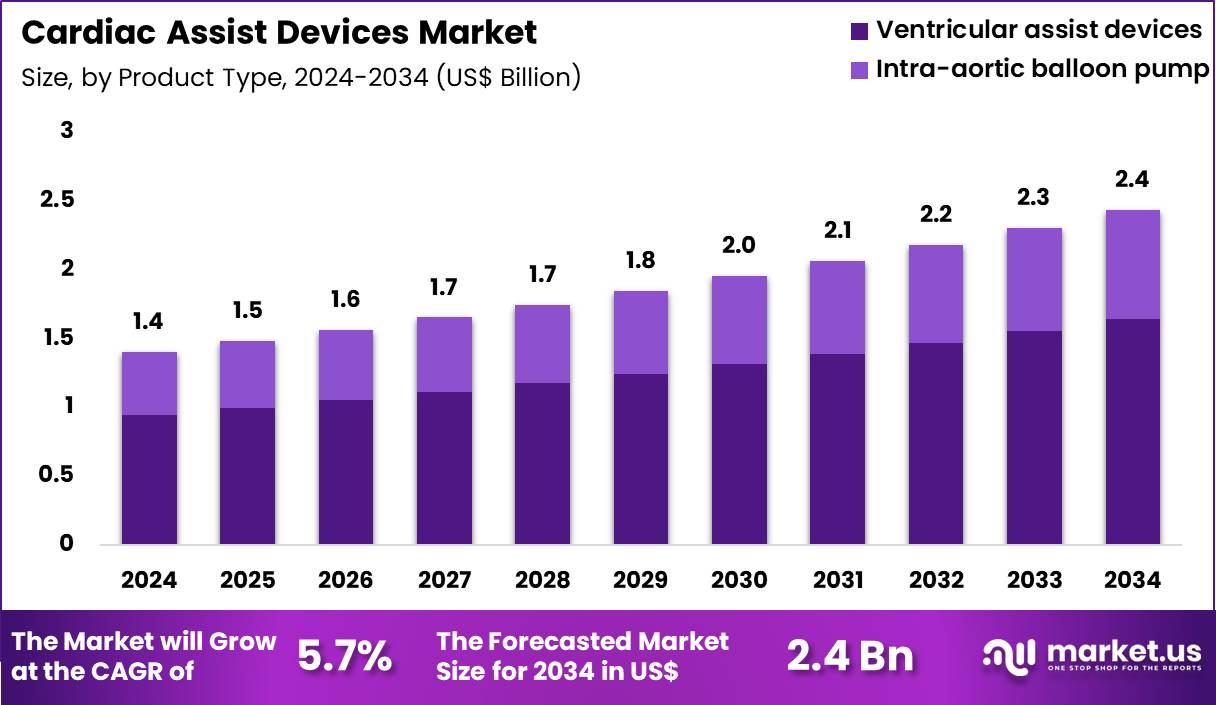
New York, NY – Oct 09, 2026 – The Global Cardiac Assist Devices Market size is expected to be worth around US$ 2.4 Billion by 2034 from US$ 1.4 Billion in 2024, growing at a CAGR of 5.7% during the forecast period 2025 to 2034. In 2024, North America led the market, achieving over 43.6% share with a revenue of US$ 0.6 Billion.
Cardiac assist devices are advanced medical technologies designed to support heart function in patients with severe heart failure and other cardiovascular conditions. These devices help maintain adequate blood circulation when the heart is unable to pump sufficient blood independently. Common types include ventricular assist devices (VADs), intra-aortic balloon pumps (IABPs), and total artificial hearts.
The growing prevalence of cardiovascular diseases, an aging population, and increasing demand for advanced heart failure treatments are supporting the adoption of cardiac assist devices. Technological advancements, including miniaturized device designs, improved biocompatible materials, enhanced battery life, and remote monitoring capabilities, are further contributing to market development.
Ventricular assist devices are increasingly used as a bridge to heart transplantation, a bridge to recovery, or as long-term therapy for selected patients who are not eligible for transplantation. Improvements in surgical techniques and patient management are also helping expand clinical applications.
However, high device and treatment costs, risks of complications, and the need for specialized medical expertise remain key challenges. North America represents an important market due to its advanced healthcare infrastructure and established cardiovascular treatment facilities, while expanding healthcare access in Asia-Pacific is creating additional growth opportunities.
Overall, continued innovation, rising awareness, and increasing investment in cardiovascular care are expected to shape the future development of the cardiac assist devices market.
Key Takeaways
- In 2024, the cardiac assist devices market was valued at US$ 1.4 billion and is projected to reach US$ 2.4 billion by 2034, growing at a CAGR of 5.7% during the forecast period.
- By product type, the market is segmented into intra-aortic balloon pumps and ventricular assist devices (VADs). VADs dominated the market in 2024, accounting for 67.4% of the total market share.
- Based on modality, the market is categorized into implantable and transcutaneous devices, with the transcutaneous segment holding a significant market share of 59.8%.
- By end user, the market is divided into hospitals & clinics and ambulatory surgical centers. Hospitals & clinics dominated the market in 2024, capturing the largest revenue share of 71.6%.
- Regionally, North America led the cardiac assist devices market in 2024, accounting for 43.6% of the total market share.
Key Market Segments
- Product Type Analysis: Ventricular assist devices (VADs) dominated the product type segment with a 67.4% market share. Rising heart failure cases, improved device durability, reduced complications, and advances in pump design are supporting adoption. Increasing use as destination therapy is expected to sustain segment growth.
- Modality Type Analysis: Transcutaneous devices accounted for 59.8% of the modality segment. Their less invasive approach, rapid deployment, and suitability for temporary circulatory support are driving adoption. Increasing cases of cardiogenic shock, improved catheter-based technologies, and procedural flexibility are expected to support continued demand.
- End-User Analysis: Hospitals and clinics held a 71.6% market share in the end-user segment. Their advanced cardiac facilities, specialized medical teams, intensive monitoring capabilities, and ability to manage complex cardiovascular emergencies support adoption. Growing cardiac treatment volumes and established hospital-based care pathways are expected to maintain segment dominance.
Regional Analysis
North America Leads the Cardiac Assist Devices Market
North America accounted for 43.6% of the cardiac assist devices market in 2024, supported by advanced healthcare infrastructure, established reimbursement systems, and widespread adoption of mechanical circulatory support.
The rising prevalence of advanced heart failure has increased demand for ventricular assist devices as bridge-to-transplant and destination therapy options. Established transplant facilities, technological advancements, and improvements in device durability and portability have further supported market expansion. Additionally, specialized cardiac centers and trained healthcare professionals contribute to broader clinical adoption.
Asia Pacific Expected to Record the Highest CAGR
Asia Pacific is expected to register the highest CAGR during the forecast period, driven by the increasing burden of cardiovascular diseases, aging populations, and improving access to advanced cardiac care.
Government investments in specialized cardiac centers and expanding healthcare infrastructure are supporting market development. Growing clinical awareness, expanding heart transplantation programs, and improved device availability through local manufacturing and strategic partnerships are further creating growth opportunities.
These factors are expected to strengthen regional demand for cardiac assist devices throughout the forecast period.
Emerging Trends
- Development of more advanced ventricular assist devices (VADs): Device development is increasingly focused on improving the performance and reliability of mechanical pumps that support a weakened heart. The continued regulatory review of the HeartMate 3 Left Ventricular Assist System reflects ongoing product and manufacturing updates in this segment.
- Increasing use of long-term heart support: Ventricular assist devices are being used not only to support patients awaiting heart transplantation but also to provide long-term treatment for eligible patients who cannot undergo transplantation. This creates demand for durable devices and related patient-management services.
- Greater focus on temporary mechanical circulatory support: Temporary circulatory support systems are important in critical-care settings where the heart cannot maintain sufficient blood flow. Their use in selected high-risk patients and complex cardiac cases supports the need for devices that can provide short-term assistance while doctors assess the next treatment step.
- Stronger emphasis on device safety and risk managemen: Device safety remains a major development priority because complications can include bleeding, infection, blood clots, and right-sided heart failure. Manufacturers and healthcare providers must consider these risks when improving device design, patient monitoring, and long-term treatment procedures.
- Expansion of coordinated care beyond specialist hospitals: Long-term device use requires continued patient education, follow-up appointments, and coordination between specialist centres and local healthcare providers. This creates opportunities for services that support device monitoring, caregiver training, emergency preparedness, and patient management after discharge.
Use Cases
- Support while waiting for a heart transplant: Left ventricular assist devices (LVADs) can maintain blood circulation in eligible patients with advanced heart failure while they wait for a donor heart. This application is known as bridge-to-transplant therapy.
- Long-term treatment for patients who cannot receive a transplant: selected patients who are not eligible for heart transplantation, an LVAD can provide ongoing mechanical support. This approach, known as destination therapy, represents an important application of durable cardiac assist devices.
- Temporary support during severe cardiac failure: Temporary mechanical circulatory support devices can assist blood flow when the heart becomes unable to pump enough blood. They may be used in selected critical-care situations while medical teams evaluate recovery, further treatment, or transplantation options.
- Support following major heart surgery: Selected patients who experience severe heart-pumping problems after cardiac surgery may require mechanical circulatory support. These devices can help maintain blood flow while the patient’s condition is stabilised and the medical team determines the next stage of care.
- Support for recovery of heart function: In selected cases, a ventricular assist device can be used to support circulation while the heart recovers from temporary damage or severe dysfunction. This application is known as bridge-to-recovery therapy, although recovery depends on the underlying condition.
Frequently Asked Questions About Cardiac Assist Devices
- What are the main types of cardiac assist devices?
The main categories include ventricular assist devices, such as left and right ventricular assist devices, biventricular support systems, and temporary mechanical circulatory support devices. Each category serves different clinical needs depending on the severity and nature of heart dysfunction. - Who may need a cardiac assist device?
Cardiac assist devices may be considered for patients with advanced heart failure or severe heart-pumping problems when standard treatments are insufficient. Eligibility is assessed by specialist teams using the patient’s overall health, heart function, treatment goals, and surgical risks. - How does a ventricular assist device work?
A ventricular assist device uses a mechanical pump to move blood from a heart chamber into the circulation. The system generally includes a pump, connecting tubes, a power source, and a controller that helps monitor device operation. - Can patients live at home with cardiac assist devices?
Some patients with implanted long-term ventricular assist devices can return home after hospital recovery and training. Continued care is necessary, including device checks, wound care, medication management, and regular follow-up with the specialist treatment team. - What factors are driving the cardiac assist devices market?
Market demand is supported by the need for advanced heart failure treatment, improvements in mechanical circulatory support, and the use of ventricular assist devices for transplantation support or long-term care. Clinical suitability, affordability, and access to specialist centres also influence adoption. - What role does the FDA play in this market?
The US Food and Drug Administration evaluates applicable cardiac assist devices for safety and effectiveness before marketing approval. Its approval records and subsequent regulatory decisions help healthcare providers and manufacturers understand authorised uses, product changes, and applicable device requirements. - What opportunities exist for cardiac assist device manufacturers?
Manufacturers may find opportunities in improving pump reliability, reducing complications, developing temporary support technologies, and strengthening monitoring and patient-care solutions. However, commercial success depends on clinical evidence, regulatory approval, treatment costs, hospital adoption, and demonstrated benefits for eligible patients. - How is technology development influencing the market?
Technology development is supporting improvements in mechanical pump systems, device components, and long-term circulatory support. Continued product updates and regulatory review demonstrate ongoing innovation, although the clinical and commercial value of individual advances must be established through appropriate evidence.
Conclusion
The cardiac assist devices market is expected to witness steady growth, driven by the rising prevalence of cardiovascular diseases, increasing demand for advanced heart failure treatments, and continuous technological advancements.
Valued at US$ 1.4 billion in 2024, the market is projected to reach US$ 2.4 billion by 2034, at a CAGR of 5.7%. Ventricular assist devices are expected to remain a key growth segment, supported by their expanding clinical applications.
North America will continue to hold a significant market position, while Asia Pacific offers promising growth opportunities. However, high treatment costs and clinical complications remain important challenges.
Discuss your needs with our analyst
Please share your requirements with more details so our analyst can check if they can solve your problem(s)




