


Overview
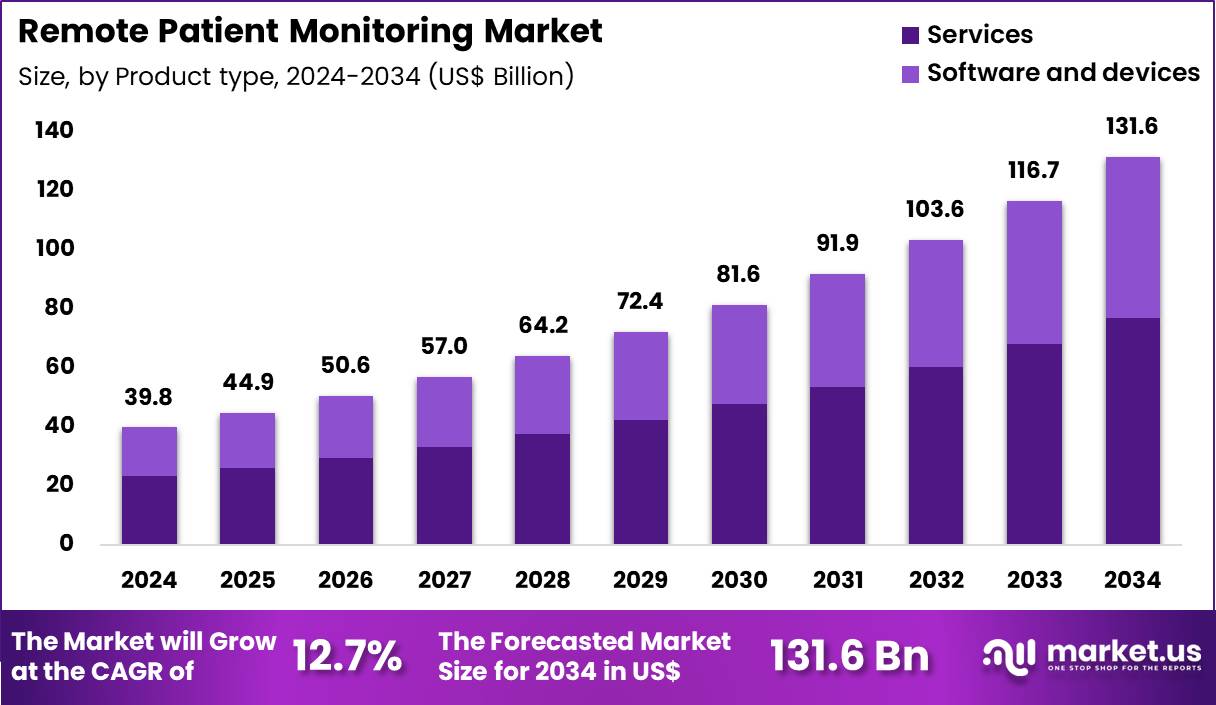
New York, NY – Oct 19, 2026 – The Global Remote Patient Monitoring Market size is expected to be worth around US$ 131.6 Billion by 2034 from US$ 39.8 Billion in 2024, growing at a CAGR of 12.7% during the forecast period 2025 to 2034. In 2024, North America led the market, achieving over 42.2% share with a revenue of US$ 16.8 Billion.
Remote Patient Monitoring (RPM) is an emerging healthcare approach that uses digital technologies to collect and transmit patients’ health data from outside traditional clinical settings. It enables healthcare providers to monitor patients’ vital signs and health conditions remotely, supporting continuous care, timely intervention, and improved patient management.
RPM solutions commonly include wearable devices, blood pressure monitors, glucose meters, pulse oximeters, and connected weight scales. These devices collect health information, which is transmitted through secure digital platforms to healthcare professionals for assessment and follow-up. The technology is increasingly being used to manage chronic conditions such as diabetes, hypertension, cardiovascular diseases, and respiratory disorders.
The growth of the remote patient monitoring market is being supported by the rising prevalence of chronic diseases, an aging population, increasing demand for home-based healthcare, and the wider adoption of telehealth services. Advances in connected medical devices, cloud computing, and artificial intelligence are further improving the accuracy and efficiency of remote monitoring systems.
Remote Patient Monitoring offers several benefits, including reduced hospital visits, improved patient engagement, early identification of potential health complications, and more efficient use of healthcare resources. However, data privacy concerns, device costs, technology integration challenges, and reimbursement limitations remain important barriers.
As healthcare systems increasingly prioritize personalized and value-based care, RPM is expected to play an important role in expanding access to healthcare services and strengthening long-term patient management.
Key Takeaways
- In 2024, the remote patient monitoring market was valued at US$ 39.8 billion and is projected to reach US$ 131.6 billion by 2034, growing at a CAGR of 12.7%.
- By product type, the market is segmented into services and software & devices, with the services segment dominating with a market share of 58.4%.
- Based on application, the market is categorized into cardiovascular diseases, diabetes, respiratory diseases, musculoskeletal diseases, and others. The cardiovascular diseases segment accounted for a significant market share of 34.7%.
- By end user, the market is divided into hospitals, home healthcare settings, long-term care centers, and ambulatory care settings. Hospitals dominated the market, accounting for the largest revenue share of 42.9%.
- Regionally, North America dominated the remote patient monitoring market, accounting for a market share of 42.2%.
Key Market Segments
- Product Type Analysis: The services segment accounted for 58.4% of the remote patient monitoring market, driven by growing demand for patient enrollment, device setup, clinical monitoring, and follow-up support. Healthcare providers increasingly adopt service-based models to improve patient adherence, streamline workflows, and enable timely interventions. The segment is expected to maintain its leading position through recurring revenue opportunities, operational efficiency, and scalable care delivery.
- Application Analysis: The cardiovascular diseases segment accounted for 34.7% of the remote patient monitoring market, supported by the increasing need for continuous monitoring of hypertension, heart failure, and arrhythmias. Connected devices enable regular tracking of blood pressure, heart rate, and weight. Growing chronic disease prevalence, readmission prevention efforts, and expanding home-based cardiac care are expected to support segment growth.
- End-User Analysis: The hospitals segment accounted for 42.9% of the remote patient monitoring market, driven by increasing efforts to reduce readmissions and improve post-discharge care. Hospitals use RPM solutions to monitor patients remotely, identify complications early, and support chronic disease management. Growing adoption of value-based care, electronic health record integration, and hospital-at-home programs is expected to strengthen segment growth.
Regional Analysis
North America Leads the Remote Patient Monitoring Market
North America accounted for 42.2% of the remote patient monitoring market in 2024, driven by growing adoption across hospitals, physician groups, and home healthcare providers. Increasing cases of chronic diseases, workforce shortages, and the expansion of virtual care services have encouraged healthcare providers to adopt connected monitoring devices.
Value-based care initiatives, reimbursement support, widespread internet access, and integration with electronic health records have further strengthened market adoption. According to the Centers for Medicare & Medicaid Services, more than 570,000 Medicare beneficiaries used remote patient monitoring services in 2022.
Asia Pacific Expected to Record the Highest CAGR
Asia Pacific is expected to register the highest CAGR during the forecast period, supported by rising chronic disease prevalence, aging populations, and expanding digital healthcare infrastructure. Government initiatives, increasing smartphone penetration, and growing telehealth adoption are improving access to remote monitoring solutions, particularly in underserved areas.
Japan’s Ministry of Health, Labour and Welfare reported that people aged 65 and above represented over 29% of its population in 2023, highlighting the growing demand for home-based healthcare services.
Emerging Trends
- Integration of artificial intelligence and predictive analytics: Artificial intelligence (AI) is increasingly being explored to analyse large volumes of patient data and identify unusual changes in vital signs. These tools can help healthcare teams prioritise patients who may need attention, although clinical validation and human oversight remain important.
- Expansion of wearable and connected medical devices: Wearable sensors, connected blood pressure monitors, smart scales, and continuous glucose monitors are expanding the range of health measurements available outside hospitals. Their ability to transmit readings digitally supports more regular monitoring and reduces the need for manual data entry.
- Greater integration with electronic health records: Healthcare providers increasingly need RPM data to fit into existing electronic health records and clinical workflows. Better integration can reduce separate data-entry tasks, improve access to patient history, and support more coordinated decisions across primary care and specialist teams.
- Growth in reimbursement-supported monitoring services: Insurance coverage and reimbursement arrangements are influencing the commercial development of RPM services. In the United States, Medicare covers qualifying remote monitoring services, creating a payment pathway for eligible providers. However, billing rules, service requirements, and payer policies affect adoption.
- Increased focus on data security and regulatory compliance: As more personal health information moves between home devices and healthcare systems, privacy, secure data transfer, and appropriate device oversight are becoming important market priorities. Providers and technology companies must address these requirements to build trust and support responsible adoption.
Use Cases
- Hypertension and cardiovascular disease management: Connected blood pressure monitors and heart rate devices help healthcare providers track cardiovascular health between appointments. Changes in readings can support timely treatment reviews and medication adjustments when clinically appropriate.
- Diabetes and blood glucose management: Glucose meters and continuous glucose monitoring devices provide information about blood sugar levels over time. Healthcare teams can use these readings to review treatment plans and help patients understand how food, physical activity, and medicines affect glucose levels.
- Heart failure monitoring and fluid management: Connected weighing scales and other monitoring devices help track changes that may indicate fluid retention or worsening heart failure. Regular measurements can support earlier clinical assessment and help care teams determine whether treatment needs to be reviewed.
- Respiratory disease and oxygen monitoring: Pulse oximeters and digital breathing devices can help monitor oxygen levels and lung function in patients with respiratory conditions. Healthcare providers can review the results alongside symptoms to determine whether further assessment or treatment is needed.
- Post-surgical recovery and home-based follow-up: RPM can support recovery after surgery by allowing selected patients to share relevant health readings from home. Care teams can assess progress between visits, identify concerns requiring follow-up, and provide guidance without requiring every review to take place in person.
Frequently Asked Questions About Remote Patient Monitoring
- What are the key factors driving the Remote Patient Monitoring market?
Market growth is supported by rising chronic disease needs, increased demand for home-based healthcare, wider availability of connected devices, and digital healthcare adoption. Reimbursement arrangements and the ability to integrate RPM into clinical workflows also influence commercial expansion. - Which technologies are shaping the Remote Patient Monitoring market?
Connected sensors, wearable devices, cloud-based platforms, mobile applications, and artificial intelligence are shaping RPM development. These technologies can improve data collection, accessibility, and analysis, although their clinical value depends on reliable performance, appropriate oversight, and effective integration. - Who are the major stakeholders in the Remote Patient Monitoring market?
Key stakeholders include medical device manufacturers, digital health software companies, hospitals, physician practices, telehealth providers, insurers, and technology service providers. Their roles span equipment development, platform delivery, clinical monitoring, reimbursement, and integration with existing healthcare systems. - How does reimbursement influence the Remote Patient Monitoring market?
Reimbursement affects whether healthcare providers can recover the costs of devices, patient onboarding, data review, and clinical follow-up. In the United States, Medicare provides coverage for qualifying RPM services, while payer requirements and payment arrangements can influence adoption. - What are the major barriers to Remote Patient Monitoring market growth?
Market barriers include high initial implementation costs, inconsistent insurance coverage, limited digital skills, data security concerns, and difficulties integrating information into clinical systems. Providers must also demonstrate meaningful clinical outcomes and develop sustainable workflows to support wider adoption. - What is the future outlook for the Remote Patient Monitoring market?
The outlook is supported by continued interest in connected healthcare, home-based monitoring, and personalised disease management. Further expansion will depend on evidence of clinical benefits, affordable technology, dependable reimbursement, improved interoperability, and healthcare providers’ ability to manage growing volumes of patient data. - How can companies identify opportunities in the Remote Patient Monitoring market?
Companies can assess opportunities by examining disease-specific demand, device adoption, reimbursement policies, healthcare infrastructure, and unmet monitoring needs. Evaluating clinical evidence, competing solutions, regulatory requirements, and total service costs can help identify commercially viable market segments.
Conclusion
The remote patient monitoring market is expected to experience significant growth, driven by the rising prevalence of chronic diseases, increasing demand for home-based healthcare, and advancements in connected medical devices. The market is projected to grow from US$ 39.8 billion in 2024 to US$ 131.6 billion by 2034, reflecting strong adoption potential.
North America currently leads the market, while Asia Pacific is expected to record the highest growth rate. Despite challenges related to data security, reimbursement, and system integration, continued technological innovation and expanding digital healthcare infrastructure are expected to create substantial opportunities for market participants.
Discuss your needs with our analyst
Please share your requirements with more details so our analyst can check if they can solve your problem(s)



