
Overview
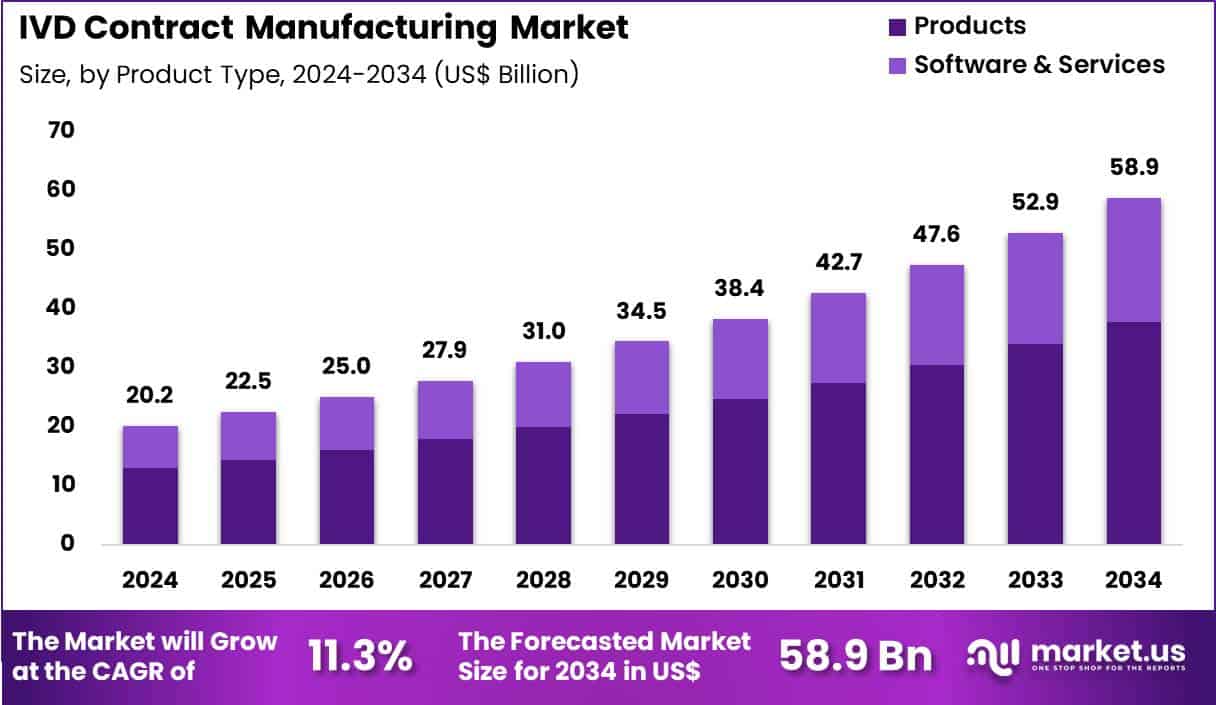
New York, NY – Oct 23, 2026 – Global IVD Contract Manufacturing Market size is expected to be worth around US$ 58.9 Billion by 2034 from US$ 20.2 Billion in 2024, growing at a CAGR of 11.3% during the forecast period 2025 to 2034. In 2024, North America led the market, achieving over 42.5% share with a revenue of US$ 8.6 Billion.
The In Vitro Diagnostics (IVD) contract manufacturing market plays an important role in the development and production of diagnostic products used to detect diseases, monitor health conditions, and support clinical decision-making. Contract manufacturers provide specialized manufacturing services to diagnostic companies, healthcare organizations, and medical technology firms, enabling them to expand production capacity, optimize costs, and accelerate product commercialization.
The market covers the manufacturing of diagnostic reagents, assay kits, test cartridges, consumables, and other components used in laboratory-based and point-of-care testing. Services may include product development support, formulation, component sourcing, assembly, packaging, quality control, and regulatory compliance.
Growing demand for early disease detection, increasing prevalence of chronic and infectious diseases, and rising adoption of molecular diagnostics and point-of-care testing are supporting market growth. Additionally, the need for scalable manufacturing infrastructure and specialized technical expertise is encouraging diagnostic companies to collaborate with contract manufacturing partners.
Technological advancements, including automation, precision manufacturing, and improved quality management systems, are further shaping the competitive landscape. However, manufacturers continue to face challenges related to regulatory requirements, production consistency, supply chain management, and quality assurance.
As diagnostic technologies continue to advance, IVD contract manufacturing is expected to remain an important part of the healthcare value chain, supporting innovation, manufacturing efficiency, and broader access to reliable diagnostic solutions worldwide.
Key Takeaways
- In 2024, the market was valued at US$ 20.2 billion and is projected to reach US$ 58.9 billion by 2034, expanding at a CAGR of 11.3%.
- By product type, the market is segmented into products and software & services, with the products segment dominating with a market share of 64.3%.
- Based on technology, the market is categorized into immunoassay, molecular diagnostics, clinical chemistry, hematology, microbiology, and coagulation & hemostasis. Among these, immunoassay accounted for a significant market share of 36.1%.
- By end user, the market is divided into medical device & biotechnology companies and academic & research institutions. Medical device & biotechnology companies dominated the market, accounting for the largest revenue share of 77.0%.
- Regionally, North America dominated the market, capturing a market share of 42.5%.
Key Market Segments
- Product Type Analysis: Products dominated the IVD contract manufacturing market with a 64.3% share, driven by outsourcing of instruments, reagents, and consumables. Rising testing volumes, recurring demand for disposables, automated production, and scalable manufacturing solutions continue to support segment growth.
- Technology Analysis: Immunoassay led the technology segment with a 36.1% share, supported by applications in infectious disease, oncology, hormonal, and autoimmune testing. High testing volumes, assay innovation, reagent outsourcing, and established manufacturing processes continue to strengthen demand for immunoassay contract manufacturing.
- End-User Analysis: Medical device and biotechnology companies dominated the end-user segment with a 77.0% share, driven by increasing reliance on external manufacturing partners. Outsourcing enables cost optimization, scalable production, reduced capital expenditure, and faster commercialization while allowing companies to focus on diagnostic innovation.
Regional Analysis
North America Leads the IVD Contract Manufacturing Market
North America dominated the IVD contract manufacturing market in 2024, accounting for 42.5% of the global market share. Growth is driven by increasing demand for diagnostic testing, a well-established healthcare infrastructure, and strong quality standards. Leading companies, including Danaher Corporation and QIAGEN, support manufacturing capabilities for reagents, assays, and diagnostic devices.
Rising demand for molecular diagnostics, point-of-care testing, and companion diagnostics further strengthens outsourcing opportunities. Government-supported research initiatives and collaborations between biotechnology firms and contract manufacturers also contribute to regional market expansion.
Asia Pacific Expected to Register the Highest CAGR
The Asia Pacific region is expected to record the highest CAGR during the forecast period, supported by healthcare infrastructure development, foreign investment, and expanding diagnostic demand. Countries such as China, Singapore, Malaysia, and Thailand are strengthening manufacturing capabilities through advanced facilities and supportive policies.
Growing demand for affordable diagnostic solutions, localized production, and improved regulatory processes is attracting contract manufacturing partnerships. Additionally, increasing investments in biotechnology and medical technology are expected to create significant growth opportunities across the region.
Emerging Trends
- Growing demand for molecular diagnostic products: The growing use of PCR and other molecular testing methods is increasing the need for accurately manufactured reagents, assay components and testing kits. Contract manufacturers can support diagnostic companies with batch production, process validation and consistent product quality.
- Greater use of automation in production: Automated filling, dispensing, assembly and inspection processes are becoming important for improving production consistency and reducing manual errors. Manufacturers with automated facilities can support higher production volumes while maintaining tighter process controls.
- Stronger focus on regulatory compliance and quality systems: Diagnostic companies increasingly need manufacturing partners that can maintain traceable records, validate production processes and support regulatory documentation. In the United States, the FDA’s Quality Management System Regulation became effective on February 2, 2026, incorporating ISO 13485:2016 by reference.
- Expansion of point-of-care and rapid testing products: Demand for tests that can be performed close to patients is creating opportunities for manufacturers of rapid test kits, lateral-flow devices and portable testing consumables. WHO identifies point-of-care testing as a way to support faster treatment decisions and improve access where laboratory facilities are limited.
- Increasing importance of flexible and scalable manufacturing: Diagnostic companies may require small initial batches for product launches and larger volumes as demand increases. Contract manufacturers that offer flexible production capacity, packaging and supply planning can help customers expand without investing immediately in their own manufacturing facilities.
Use Cases
- Production of clinical chemistry and immunoassay reagents: Contract manufacturers prepare and fill reagents used to measure substances such as glucose, cholesterol, hormones and disease-related markers. This allows diagnostic brands to access specialized production equipment and batch quality controls without building every manufacturing capability internally.
- Manufacturing of infectious disease test kits: External manufacturing partners can produce components and kits for detecting infections, including respiratory viruses and other pathogens. Multiplex testing, which identifies multiple pathogens in one test, is an important application supported by modern molecular and antigen-based diagnostic technologies.
- Private-label and self-testing product manufacturing: Healthcare brands can outsource the production of pregnancy tests, urine test strips and other self-testing products. Services may include component sourcing, cassette assembly, packaging and label printing, allowing companies to market products under their own brands.
- Manufacturing of diagnostic instruments and consumables: Specialist suppliers can manufacture sample tubes, reaction vessels, cartridges and selected instrument components. Outsourcing these items helps diagnostic companies manage component sourcing, precision production and supply volumes while concentrating internal resources on product development and customer support.
- Regional production and localization for healthcare markets: Diagnostic companies may use manufacturing partners in target regions to improve supply flexibility and serve local procurement requirements. In India, manufacturers must assess applicable CDSCO requirements, product risk classification and relevant manufacturing licences before commercial production.
Frequently Asked Questions About IVD Contract Manufacturing
- What products are manufactured through IVD contract manufacturing?
IVD contract manufacturers produce diagnostic reagents, rapid test kits, molecular testing kits, immunoassay components, sample collection products, cartridges and laboratory consumables. The product range depends on the manufacturer’s equipment, technical expertise, quality systems and regulatory capabilities. - What quality standards are important for IVD contract manufacturers?
Quality management, process validation, traceability, supplier controls and product performance testing are important considerations. ISO 13485 is a key medical device quality management standard, while applicable regulatory requirements depend on the product, manufacturing role and target market. - How should companies select an IVD contract manufacturing partner?
Companies should assess manufacturing experience, product-specific capabilities, quality systems, regulatory support, production capacity, supply reliability and total cost. Technical audits, sample evaluation, quality agreements and clear ownership of documentation can help reduce risks before a manufacturing contract is signed. - What factors are driving the IVD contract manufacturing market?
Market demand is supported by growing diagnostic testing needs, advances in molecular technologies, increased use of rapid tests and the need for specialized production capabilities. Quality requirements and the cost of establishing manufacturing facilities can also influence outsourcing decisions. - Which technologies create opportunities in this market?
Molecular diagnostics, immunoassays, clinical chemistry, lateral-flow tests and multiplex testing create opportunities for specialized manufacturers. Demand varies by disease area, testing location, product complexity and healthcare infrastructure, making technology-specific capabilities important when evaluating market opportunities. - How does IVD contract manufacturing support small diagnostic companies?
Contract manufacturing enables smaller diagnostic companies to access production facilities, trained personnel and specialized processes without building complete manufacturing operations. This can help them move from development to commercial supply, subject to product validation, regulatory requirements, available funding and manufacturing partner selection. - What is the role of automation in this market?
Automation supports repeatable production, accurate liquid dispensing, component assembly, packaging and inspection. These capabilities can improve manufacturing consistency and throughput while reducing manual handling. The financial benefits depend on production volumes, equipment costs, product design and process validation requirements. - What is the future outlook for the IVD contract manufacturing market?
The market outlook will depend on diagnostic testing demand, technology development, outsourcing strategies and regulatory readiness. Specialized manufacturers with strong quality systems, flexible production capacity and reliable supply chains may be better positioned to serve evolving requirements across clinical laboratories and point-of-care settings.
Conclusion
The IVD contract manufacturing market is positioned for substantial growth, supported by rising demand for diagnostic testing, technological advancements, and increasing outsourcing among medical device and biotechnology companies. Valued at US$ 20.2 billion in 2024, the market is projected to reach US$ 58.9 billion by 2034, reflecting a CAGR of 11.3%.
North America remains the leading regional market, while Asia Pacific offers promising growth opportunities. Increasing adoption of molecular diagnostics, automation, and point-of-care testing is expected to create new business opportunities. However, regulatory compliance, quality assurance, and supply chain efficiency will remain critical to long-term market success.
Discuss your needs with our analyst
Please share your requirements with more details so our analyst can check if they can solve your problem(s)