
Overview
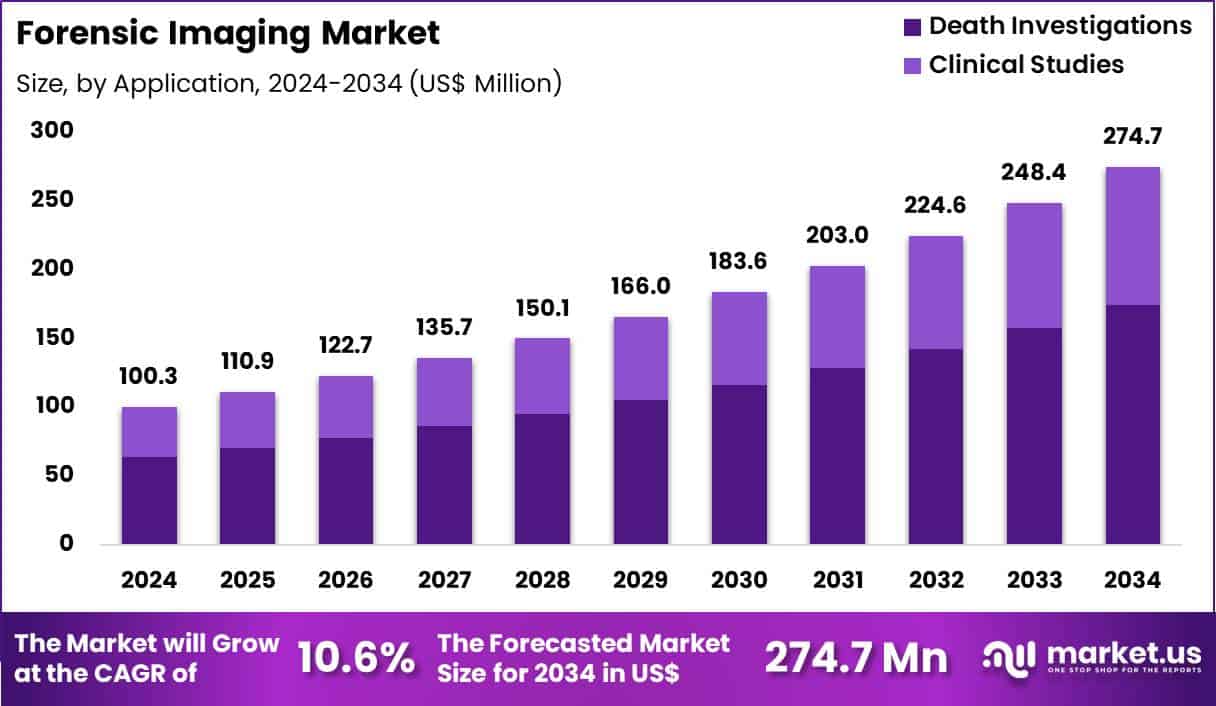
New York, NY – Oct 26, 2026 – Global Forensic Imaging Market size is expected to be worth around US$ 274.7 Million by 2034 from US$ 100.3 Million in 2024, growing at a CAGR of 10.6% during the forecast period 2025 to 2034. In 2024, North America led the market, achieving over 47.6% share with a revenue of US$ 47.7 Million.
Forensic imaging is a specialized process used to capture, preserve, and analyze digital or physical evidence for investigative and legal purposes. In digital forensics, it involves creating an exact, bit-by-bit copy of digital storage devices, including hard drives, smartphones, memory cards, and other electronic media. These copies enable investigators to examine data without altering the original evidence, supporting data integrity and legal admissibility.
The technology plays an important role in criminal investigations, cybersecurity incident response, fraud detection, corporate investigations, and legal proceedings. Forensic imaging tools help recover deleted files, identify hidden information, examine system activities, and preserve digital evidence for further analysis. In medical and crime-scene investigations, forensic imaging also includes specialized imaging techniques used to document injuries, examine physical evidence, and support forensic assessments.
The growing use of digital devices, increasing cybercrime incidents, and rising demand for reliable evidence management are supporting the adoption of forensic imaging solutions across law enforcement agencies, government institutions, legal organizations, and private enterprises.
Technological advancements, including automation, artificial intelligence, and improved image-processing capabilities, are enhancing the speed, accuracy, and efficiency of forensic investigations. As digital evidence becomes increasingly important in legal and security-related matters, forensic imaging is expected to remain a critical component of modern investigative workflows, helping organizations strengthen evidence preservation, improve investigative outcomes, and support informed decision-making.
Key Takeaways
- In 2024, the market was valued at US$ 100.3 million and is projected to grow at a CAGR of 10.6%, reaching US$ 274.7 million by 2034.
- By modality, the market is segmented into CT, X-ray, ultrasound, and MRI, with CT accounting for the largest share of 44.2%.
- Based on application, the market is categorized into death investigations and clinical studies, with death investigations dominating with a 63.4% market share.
- By end user, the market is segmented into forensic institutes, hospitals, and others, with forensic institutes holding the leading share of 48.9%.
- Regionally, North America dominated the market, accounting for a 47.6% share.
Key Market Segments
- Modality Analysis: CT dominated the forensic imaging market with a 44.2% share, supported by rapid, high-resolution imaging and three-dimensional visualization. Its ability to identify internal injuries, document skeletal trauma, and preserve evidence non-invasively strengthens adoption across forensic investigations and virtual autopsy procedures.
- Application Analysis: Death investigations accounted for 63.4% of the forensic imaging market, driven by increasing demand for accurate cause-of-death assessments. Imaging supports trauma detection, injury documentation, and targeted autopsies, improving medico-legal reporting, investigative transparency, and the reliability of evidence presented during judicial proceedings.
- End-User Analysis: Forensic institutes held a 48.9% share of the forensic imaging market, supported by their central role in medico-legal investigations. Investments in specialized imaging systems, standardized protocols, digital evidence management, and expert interpretation are strengthening adoption across forensic institutes handling complex investigative cases.
Regional Analysis
North America Leads the Forensic Imaging Market
North America accounted for 47.6% of the global forensic imaging market in 2024, supported by advanced forensic infrastructure, increasing adoption of imaging technologies, and growing demand for reliable evidence preservation. The integration of CT, X-ray, ultrasound, and AI-enabled imaging systems is improving injury assessment, post-mortem examinations, and forensic documentation.
Investments in forensic science research and digital evidence management are further supporting regional market development. Collaboration among law enforcement agencies, forensic institutes, and technology providers is strengthening investigative efficiency and evidence integrity.
Asia Pacific Expected to Record the Highest CAGR
The Asia Pacific region is projected to register the highest CAGR during the forecast period, driven by increasing investments in forensic infrastructure and modernization of investigative procedures. Governments are strengthening forensic laboratories, adopting advanced imaging technologies, and expanding digital evidence management capabilities.
Growing awareness of non-invasive post-mortem examinations and improved access to CT, X-ray, ultrasound, and MRI systems are supporting regional adoption. Additionally, research collaborations, professional training programs, and technological advancements are expected to create further growth opportunities across the region.
Emerging Trends
- Growing adoption of virtual autopsy: Post-mortem CT and MRI are increasingly being used to examine the body without immediately performing a traditional autopsy. These methods can support death investigations while preserving a permanent record of internal findings.
- Integration of artificial intelligence (AI): AI-based tools are being explored to help detect injuries, process complex scans, and support image interpretation. Wider use will depend on reliable testing, clear validation standards, and expert review before findings are used in legal cases.
- Expansion of 3D image reconstruction: Advanced software is making it possible to convert CT scan data into detailed three-dimensional images. These models can help specialists examine fractures, understand injury patterns, and communicate complex findings more clearly in court.
- Greater use of combined imaging methods: Forensic specialists are exploring the use of CT, MRI, and other imaging techniques together. Combining different sources of information can improve the examination of soft tissues, bones, and internal injuries in selected cases.
- Development of standardized imaging procedures: Greater attention is being given to consistent scanning methods, image quality, interpretation guidelines, and evidence documentation. Standard procedures can improve the reliability of results and support comparisons between forensic laboratories and medical institutions.
Use Cases
- Cause-of-death investigations: CT and X-ray imaging help forensic pathologists identify internal injuries, fractures, foreign objects, and other findings that may explain a death. The images can support conclusions alongside medical history, external examination, and other forensic evidence.
- Identification of unknown individuals: Medical imaging can reveal dental structures, skeletal characteristics, old fractures, and implanted medical devices. These findings may be compared with available medical or dental records to help establish identity, particularly when bodies are badly damaged or decomposed.
- Examination of firearm and weapon injuries: Imaging can help locate bullets, fragments, and bone damage inside the body. These findings support the assessment of injury patterns and projectile locations, while additional evidence is needed to establish the full sequence of events.
- Disaster victim identification: Following transport accidents, fires, or other mass-fatality events, imaging can document skeletal injuries and retained medical devices. These records may assist identification and case documentation when physical examination is difficult or multiple victims require coordinated investigation.
- Courtroom evidence and expert reporting: Digital scans and reconstructed images can present internal injuries in a clear, structured format. Forensic experts may use these visual records to explain medical findings to judges and juries, subject to evidence-quality requirements and applicable court rules.
Frequently Asked Questions About Forensic Imaging
- What technologies are used in forensic imaging?
Common technologies include X-ray radiography, computed tomography (CT), magnetic resonance imaging (MRI), digital photography, and three-dimensional reconstruction software. Each method provides different information about bones, soft tissues, foreign objects, and other features relevant to forensic examinations. - What is a virtual autopsy?
A virtual autopsy uses imaging technologies, particularly CT and sometimes MRI, to examine a deceased person’s body without initially opening it. It can complement traditional autopsy procedures or, in selected cases, provide sufficient information for specific investigative questions. - How does forensic imaging help determine the cause of death?
Forensic imaging reveals internal injuries, fractures, bleeding patterns, and foreign objects that may explain a death. These findings are assessed alongside autopsy results, medical history, toxicology, and scene evidence before a cause of death is established. - Can forensic imaging replace a traditional autopsy?
Forensic imaging can reduce the need for invasive examination in selected cases, but it cannot identify every type of disease, injury, or cause of death. Its suitability depends on the case, imaging findings, and applicable medical and legal requirements. - What factors are driving the growth of the forensic imaging market?
Market growth is supported by greater adoption of virtual autopsy, demand for detailed medical evidence, and improvements in imaging technology. Investment in forensic laboratories and the need for accurate documentation are also expected to support future demand. - Which end users contribute to demand for forensic imaging solutions?
Forensic institutes, hospitals, medical examiner offices, government laboratories, and research institutions use forensic imaging solutions. Demand depends on investigation volumes, equipment availability, funding, specialist expertise, and the need to document injuries or examine human remains. - What challenges affect the forensic imaging market?
High equipment costs, limited specialist training, inconsistent imaging procedures, and difficulties in interpreting complex scans can restrict adoption. Data security, legal acceptance, and the need to validate AI-based tools also remain important considerations for market participants. - What opportunities are emerging in the forensic imaging market?
Opportunities are emerging in AI-assisted image analysis, three-dimensional reconstruction, post-mortem CT, and improved imaging software. Expanding forensic infrastructure and collaborations between hospitals, research institutions, and forensic laboratories may also create additional demand for specialized solutions.
Conclusion
The forensic imaging market is expected to experience significant growth, driven by increasing demand for accurate evidence preservation, advanced investigative technologies, and reliable forensic assessments. CT imaging currently holds a leading position due to its ability to provide detailed internal images and support non-invasive examinations.
Forensic institutes remain key end users, while North America leads the market through its established forensic infrastructure and technological capabilities. Meanwhile, Asia Pacific is expected to offer promising growth opportunities through investments in forensic laboratories and modern imaging systems. Advancements in artificial intelligence, automation, and three-dimensional imaging are expected to further strengthen market development.
Discuss your needs with our analyst
Please share your requirements with more details so our analyst can check if they can solve your problem(s)