


Overview
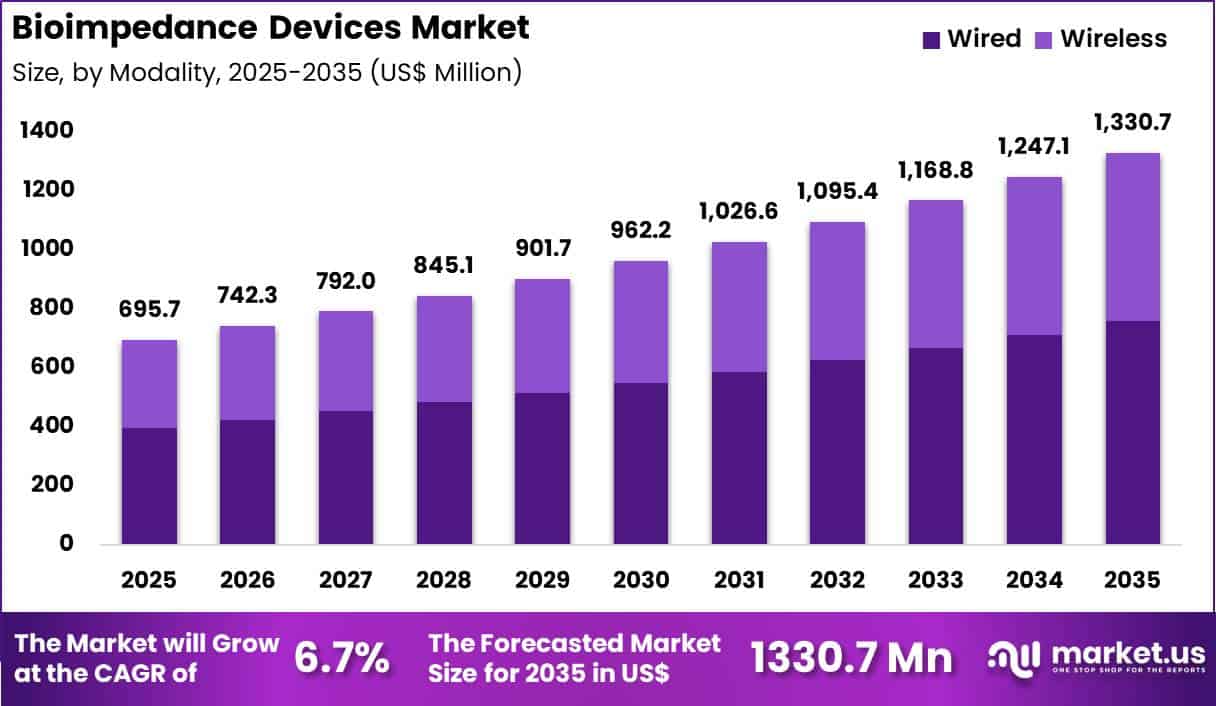
New York, NY – Nov 02, 2026 – The Global Bioimpedance Devices Market size is expected to be worth around US$ 1330.7 Million by 2035 from US$ 695.7 Million in 2025, growing at a CAGR of 6.7% during the forecast period 2026-2035. In 2025, North America led the market, achieving over 36.9% share with a revenue of US$ 256.7 Million.
Bioimpedance devices are medical and healthcare instruments that use low-level electrical currents to measure the resistance and reactance of body tissues. These devices help assess body composition, hydration levels, fat mass, muscle mass, and other important health indicators. Bioimpedance analysis (BIA) is widely used in hospitals, clinics, fitness centers, research institutions, and home healthcare settings.
The technology works by passing a safe, low-intensity electrical signal through the body and measuring how different tissues respond. Since muscle contains more water than fat, electrical signals travel differently through various body tissues, helping estimate body composition. Common applications include obesity management, nutritional assessment, fitness monitoring, kidney disease management, and monitoring fluid balance in patients.
The market is witnessing growing demand due to increasing awareness of preventive healthcare, rising obesity rates, and the growing focus on personalized fitness and wellness. Technological advancements, including portable devices, multi-frequency analysis, smart connectivity, and digital health integration, are further improving measurement accuracy and accessibility.
Additionally, the expansion of home-based health monitoring and wearable healthcare technologies is creating new growth opportunities. As healthcare providers increasingly emphasize early health assessment and continuous patient monitoring, bioimpedance devices are gaining importance in clinical diagnostics, wellness management, and personalized healthcare applications.
Key Takeaways
- In 2025, the Bioimpedance Devices Market generated revenue of US$ 695.7 Million and is projected to reach US$ 1,330.7 Million by 2035, growing at a CAGR of 6.7% during the forecast period.
- By product type, the market is segmented into multi-frequency, dual-frequency, and single-frequency devices. The multi-frequency segment dominated, accounting for a market share of 48.9%.
- Based on modality, the market is categorized into wired and wireless devices, with the wired segment leading with a significant market share of 57.2%.
- By application, the market is divided into whole-body and segmental analysis. The whole-body segment dominated, capturing a revenue share of 62.6%.
- Regionally, North America dominated the Bioimpedance Devices Market, accounting for the largest market share of 36.9%.
Key Market Segments
- Product Type Analysis: The multi-frequency segment dominated the Bioimpedance Devices Market with a 48.9% share, driven by its ability to measure intracellular and extracellular fluid levels accurately. Hospitals and researchers use these devices for body composition analysis, hydration monitoring, renal care, and chronic disease management. Growing demand for precise nutritional assessment and patient monitoring further supports segment growth.
- Modality Analysis: The wired segment accounted for 57.2% of the market, supported by reliable signal transmission, measurement consistency, and easy integration with hospital infrastructure. These systems are widely used in dialysis units and intensive care settings. Established clinical workflows and demand for dependable diagnostic equipment continue to strengthen adoption.
- Application Analysis: The whole-body segment held a leading 62.6% share, driven by increasing demand for comprehensive body composition assessment. These devices help evaluate muscle mass, fat distribution, and hydration levels. Rising obesity, metabolic disorders, preventive healthcare awareness, and growing fitness monitoring activities are further driving adoption across clinical and wellness settings.
Regional Analysis
North America held a 36.9% share of the Bioimpedance Devices Market in 2024, driven by rising demand for noninvasive body composition and fluid monitoring. Hospitals increasingly adopted these devices to assess fluid balance in cardiac and renal patients. Sports medicine centers and weight management clinics also used body composition analyzers for personalized health assessments.
Growing preventive healthcare awareness and integration with digital health platforms further supported adoption. According to the CDC, approximately 37 million Americans were living with chronic kidney disease in 2023, highlighting the need for effective fluid monitoring.
Asia Pacific is expected to register the highest CAGR during the forecast period, supported by expanding healthcare infrastructure and growing awareness of preventive health. Rising cases of cardiovascular and metabolic disorders are encouraging early screening.
Hospitals are incorporating bioimpedance systems into dialysis and heart failure management. Increasing fitness center adoption, rising disposable incomes, and affordable devices from local manufacturers are further creating growth opportunities across the region.
Emerging Trends
- Growing Adoption of Wearable Bioimpedance Devices: Wearable bioimpedance devices are gaining attention as healthcare providers and consumers look for convenient ways to monitor body composition. New wearable technologies support regular measurements outside hospitals, helping users track changes in body water, muscle mass, and overall health. These devices may also improve remote health monitoring.
- Increasing Use of Multi-Frequency Bioimpedance Technology: Multi-frequency bioimpedance technology is becoming an important development in body composition analysis. Unlike traditional single-frequency devices, it uses different electrical frequencies to estimate extracellular and intracellular water separately. This provides more detailed information about fluid distribution and supports improved assessments in patients with abnormal hydration levels.
- Integration of Artificial Intelligence in Bioimpedance Analysis: Artificial intelligence is creating new opportunities to improve bioimpedance data analysis. Advanced algorithms can help identify patterns in electrical measurements and support the interpretation of body composition and physiological changes. Combining AI with bioimpedance technology may improve personalized monitoring, data processing, and clinical decision-making.
- Development of Advanced Bioimpedance Spectroscopy Systems: Bioimpedance spectroscopy is receiving attention because it measures tissue electrical properties across a broad range of frequencies. These systems can provide detailed information about body fluid compartments and tissue characteristics. Growing research in spectroscopy-based measurements is supporting their development for more advanced clinical monitoring and patient assessment.
- Greater Focus on Measurement Accuracy and Standardization: Manufacturers and healthcare researchers are focusing on improving the accuracy and consistency of bioimpedance measurements. New approaches emphasize better electrode designs, population-specific prediction equations, and standardized testing conditions. These improvements are important because hydration, posture, and differences between devices can influence measurement results.
Use Cases
- Body Composition Assessment in Healthcare Facilities: Hospitals, diagnostic centers, and wellness clinics use bioimpedance devices to estimate body fat, skeletal muscle mass, and total body water. Healthcare professionals use these measurements to understand changes in body composition, assess nutritional conditions, and monitor patients during weight management programs.
- Fluid Management in Dialysis Patients: Bioimpedance devices are used in nephrology to evaluate fluid balance in patients receiving dialysis. Measurements can help healthcare professionals assess fluid overload and changes in body water. This information supports decisions about fluid removal and monitoring, particularly among patients with kidney-related fluid management problems.
- Nutritional Assessment and Malnutrition Monitoring: Clinical nutrition specialists use bioimpedance measurements to evaluate body composition and identify possible nutritional problems. These devices can help monitor muscle loss, reduced body cell mass, and changes associated with malnutrition. They also support nutritional assessments among older adults and patients with chronic diseases.
- Sports Performance and Fitness Monitoring: Sports medicine centers, fitness facilities, and athletic training programs use bioimpedance devices to monitor muscle mass, body fat, and hydration changes. Trainers and nutrition professionals can use these measurements to evaluate fitness progress, understand body composition changes, and support individualized exercise and nutrition plans.
- Monitoring Patients With Chronic Diseases: Bioimpedance technology is being investigated and used as a supportive monitoring tool for people with chronic conditions, including heart failure, cancer, and diabetes. Changes in body fluid distribution and tissue characteristics can provide additional information to healthcare professionals during patient monitoring and treatment assessment.
Frequently Asked Questions About Bioimpedance Devices
- How do bioimpedance devices work?
These devices send a small electrical current through the body and measure how tissues respond to it. Since fat, muscle, and body fluids conduct electricity differently, the collected measurements help estimate different body composition components. - What parameters can bioimpedance devices measure?
Bioimpedance devices can estimate body fat percentage, fat-free mass, skeletal muscle mass, total body water, and extracellular water. Some advanced systems also measure phase angle, which provides additional information about tissue electrical properties. - What factors are driving the growth of the Bioimpedance Devices Market?
Market growth is supported by increasing demand for non-invasive health monitoring, rising obesity and chronic disease concerns, growing fitness awareness, and wider adoption of body composition assessment technologies across hospitals, wellness centers, and healthcare facilities. - Which healthcare applications offer opportunities for bioimpedance devices?
Important healthcare opportunities include kidney disease management, nutritional assessment, fluid balance monitoring, obesity management, and chronic disease monitoring. Growing interest in personalized healthcare is also creating opportunities for advanced bioimpedance technologies. - Why is demand for portable bioimpedance devices increasing?
Portable devices provide convenient body composition measurements without requiring large diagnostic equipment. Their compact design supports use in fitness centers, outpatient clinics, and home healthcare environments, making regular health monitoring more accessible. - What role do hospitals play in the Bioimpedance Devices Market?
Hospitals represent an important end-user segment because they require body composition and fluid assessment tools for different patient groups. Bioimpedance devices support nutritional evaluations, dialysis-related fluid monitoring, and selected clinical assessment procedures. - How is digital healthcare influencing the Bioimpedance Devices Market?
Digital healthcare is encouraging the development of connected bioimpedance devices that can transfer measurement results to software platforms. This supports remote monitoring, digital health records, progress tracking, and improved communication between patients and healthcare professionals.
Conclusion
The Bioimpedance Devices Market is expected to experience steady growth, driven by increasing demand for non-invasive body composition analysis, rising chronic disease cases, and growing preventive healthcare awareness. Technological advancements in multi-frequency analysis, wearable devices, artificial intelligence, and wireless connectivity are further expanding market opportunities.
Growing adoption across hospitals, dialysis centers, fitness facilities, and home healthcare settings is strengthening demand. North America currently leads the market, while Asia Pacific offers strong growth potential due to expanding healthcare infrastructure and rising health awareness. Overall, continuous innovation and increasing focus on personalized healthcare will support market expansion through 2035.
Discuss your needs with our analyst
Please share your requirements with more details so our analyst can check if they can solve your problem(s)



