


Overview
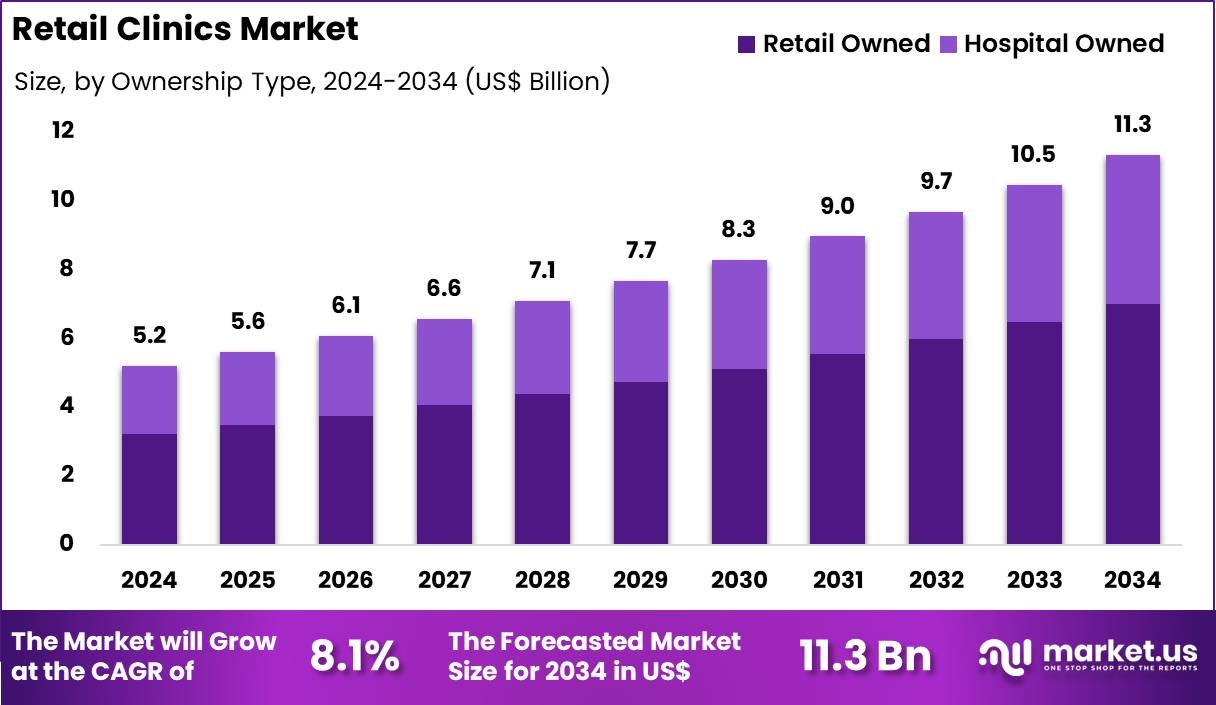
New York, NY – Oct 28, 2026 – Global Retail Clinics Market size is expected to be worth around US$ 11.3 Billion by 2034 from US$ 5.2 Billion in 2024, growing at a CAGR of 8.1% during the forecast period 2025 to 2034. In 2024, North America led the market, achieving over 43.6% share with a revenue of US$ 2.3 Billion.
Retail clinics are healthcare facilities located within retail settings, such as pharmacies, supermarkets, and shopping centers. These clinics provide convenient and affordable access to basic medical services, including routine health screenings, vaccinations, minor illness treatment, preventive care, and selected diagnostic services. Their accessible locations, flexible operating hours, and relatively short waiting times make them an important part of the evolving healthcare delivery system.
The growth of the retail clinics market is being supported by increasing demand for convenient healthcare services, rising healthcare costs, and a growing focus on preventive care. Expanding urban populations, shortages of primary care providers in certain regions, and the adoption of digital health technologies are also creating opportunities for market development. In addition, partnerships between healthcare providers, retail pharmacy chains, and technology companies are helping expand service availability and improve patient access.
North America represents an important market due to its established retail healthcare infrastructure and growing acceptance of convenient care models. Meanwhile, emerging markets are expected to offer opportunities as healthcare accessibility and consumer awareness improve.
Looking ahead, the retail clinics market is expected to benefit from continued investment in healthcare technology, expanded service portfolios, and integration with broader healthcare networks. These developments are likely to strengthen the role of retail clinics in delivering accessible, efficient, and patient-focused healthcare services.
Key Takeaways
- In 2024, the retail clinics market was valued at US$ 5.2 billion and is projected to reach US$ 11.3 billion by 2034, growing at a CAGR of 8.1% during the forecast period.
- By ownership type, the market is segmented into retail-owned and hospital-owned clinics, with retail-owned clinics dominating the market with a 61.8% share.
- Based on location, the market is categorized into stores, malls, and others. Among these, stores accounted for the largest market share of 54.6%.
- By application, the market is divided into point-of-care diagnostics, clinical chemistry, immunoassay, vaccination, and others. Point-of-care diagnostics emerged as the leading segment, accounting for 39.7% of the market revenue.
- Regionally, North America dominated the retail clinics market, accounting for a 43.6% market share.
Key Market Segments
- Ownership Type Analysis: Retail-owned clinics accounted for 61.8% of the ownership type segment, driven by operational flexibility, established retail networks, and convenient healthcare services. Existing customer traffic, extended operating hours, and transparent pricing support patient adoption. Investments in digital systems and expansion into underserved areas are expected to strengthen segment growth.
- Location Analysis: Stores accounted for 54.6% of the location segment, supported by convenient access, high customer footfall, and proximity to daily shopping activities. Store-based clinics provide accessible consultations, basic diagnostics, and preventive services. Increasing healthcare integration within retail outlets is expected to support continued segment expansion.
- Application Analysis: Point-of-care diagnostics held a 39.7% share of the application segment, driven by demand for rapid testing and timely clinical decisions. These services enable quick health assessments and support immediate treatment decisions. Advancements in diagnostic technologies and rising preventive healthcare awareness are expected to sustain segment growth.
Regional Analysis
North America accounted for 43.6% of the global retail clinics market in 2024, driven by rising demand for affordable, accessible, and immediate healthcare services. Primary care workforce shortages have further increased the importance of retail clinics.
Major operators, including CVS Health and Walgreens Boots Alliance, are expanding diagnostic services and chronic disease management programs. Telehealth integration, preventive health screenings, and partnerships with pharmacies have also supported regional growth.
Asia Pacific is expected to register the highest CAGR during the forecast period, supported by improving healthcare infrastructure, rising healthcare awareness, and growing demand for convenient medical services. Public-private partnerships and investments in decentralized healthcare facilities are expected to improve access across densely populated and underserved areas.
Countries such as Japan, Taiwan, and New Zealand are exploring innovative healthcare delivery models, including compact diagnostic facilities and technology-enabled services. Furthermore, expanding primary care capacity, increasing preventive healthcare initiatives, and greater adoption of digital health solutions are expected to create significant growth opportunities for the retail clinics market across the region.
Emerging Trends
- Growing demand for convenient healthcare: Retail clinics allow patients to receive basic medical care without always booking an appointment with a traditional doctor. Their location within pharmacies and supermarkets supports quick access, including for people managing busy work and family schedules.
- Integration of digital healthcare services: Digital appointment systems, online patient records, and virtual consultations can make clinic services easier to access. Combining in-person examinations with remote consultations may improve follow-up care, although availability depends on the provider, technology, and local regulations.
- Greater focus on preventive healthcare: Retail clinics can support preventive care through vaccinations, basic health checks, and screening services. This creates opportunities for providers to serve patients before health concerns become more serious and to expand services around seasonal vaccination demand.
- Expansion of services for routine health needs: Some retail clinics are positioned to provide more than treatment for minor illnesses. Depending on their clinical capabilities, they may offer health assessments, selected diagnostic tests, medication-related support, and follow-up services, increasing their usefulness for routine healthcare needs.
- Greater focus on clinic location and service access: Retailers and healthcare providers can use population and location data to identify areas with demand for convenient care. However, access remains uneven: U.S. Census Bureau research identified approximately 2,000 retail health clinics operating during 2018–2020, mostly in metropolitan areas.
Use Cases
- Treatment of minor illnesses: Retail clinics can assess and treat common, uncomplicated conditions, such as sore throats, mild skin problems, and certain respiratory symptoms. Patients can receive basic medical advice and treatment without necessarily visiting a hospital or specialist.
- Vaccination and immunization: Clinics can administer eligible vaccines, including seasonal influenza vaccinations where offered. Their convenient locations may help patients obtain recommended immunizations while completing routine shopping or collecting medicines, supporting preventive healthcare access.
- Basic health screening: Selected clinics can check measurements such as blood pressure and may provide other screening services. These assessments can help identify possible health concerns and guide patients toward primary care professionals when additional evaluation is needed.
- Point-of-care testing: Where facilities and clinical protocols permit, retail clinics can conduct selected rapid tests for common infections or other health conditions. Results can support timely treatment decisions, while complex cases may require laboratory testing or referral to another healthcare provider.
- Referral and follow-up support: Retail clinics can direct patients to primary care doctors, specialists, or emergency services when their needs exceed the clinic’s scope. Where appropriate, follow-up guidance helps patients understand the next steps in managing their health.
Frequently Asked Questions About Retail Clinics
- What services are provided by retail clinics?
Retail clinics may offer vaccinations, treatment for minor illnesses, basic health screenings, selected diagnostic tests, and health advice. The available services depend on the clinic’s staff, equipment, licensing requirements, and local healthcare regulations. - Who provides treatment at retail clinics?
Retail clinics are commonly staffed by nurse practitioners or physician assistants in the United States. These qualified professionals assess patients, provide permitted treatments, and recommend referrals when necessary, according to their professional scope of practice and applicable regulations. - What are the main benefits of retail clinics?
Retail clinics can improve convenience by offering healthcare in familiar retail locations. They may reduce the need for separate appointments for minor concerns, provide selected preventive services, and help patients access basic medical attention during suitable operating hours. - What is the current adoption rate of retail clinics?
According to the U.S. National Center for Health Statistics, 19.0% of people reported at least one retail health clinic visit during 2024. Adoption differed by age, reaching 25.0% among adults aged 65 and older. - Which factors may limit retail clinics market growth?
Market development may be limited by restrictions on clinical services, shortages of qualified healthcare professionals, uneven geographic coverage, and difficulties coordinating patient records. Limited capacity to manage complex conditions can also restrict the range of services offered. - What opportunities exist for retail clinics in underserved areas?
Retail clinics may improve access to basic healthcare in locations where traditional services are difficult to reach. However, expansion requires assessment of local demand, staffing availability, operating costs, infrastructure, and gaps in existing healthcare services. - What is the future outlook for the retail clinics market?
The outlook will depend on patient demand, healthcare regulations, provider investment, and the ability to deliver convenient, reliable services. Digital health integration and preventive care represent potential development areas, but future growth will vary across locations and healthcare systems.
Conclusion
The retail clinics market is poised for steady growth, driven by increasing demand for convenient, affordable, and accessible healthcare services. Valued at US$ 5.2 billion in 2024, the market is projected to reach US$ 11.3 billion by 2034, expanding at a CAGR of 8.1%. Retail-owned clinics, store-based locations, and point-of-care diagnostics are expected to remain important market segments.
North America will continue to benefit from established healthcare infrastructure, while Asia Pacific offers significant growth opportunities. Furthermore, digital health integration, preventive care, strategic partnerships, and service expansion are expected to strengthen market development and improve patient access to essential healthcare services.
Discuss your needs with our analyst
Please share your requirements with more details so our analyst can check if they can solve your problem(s)



