


Overview
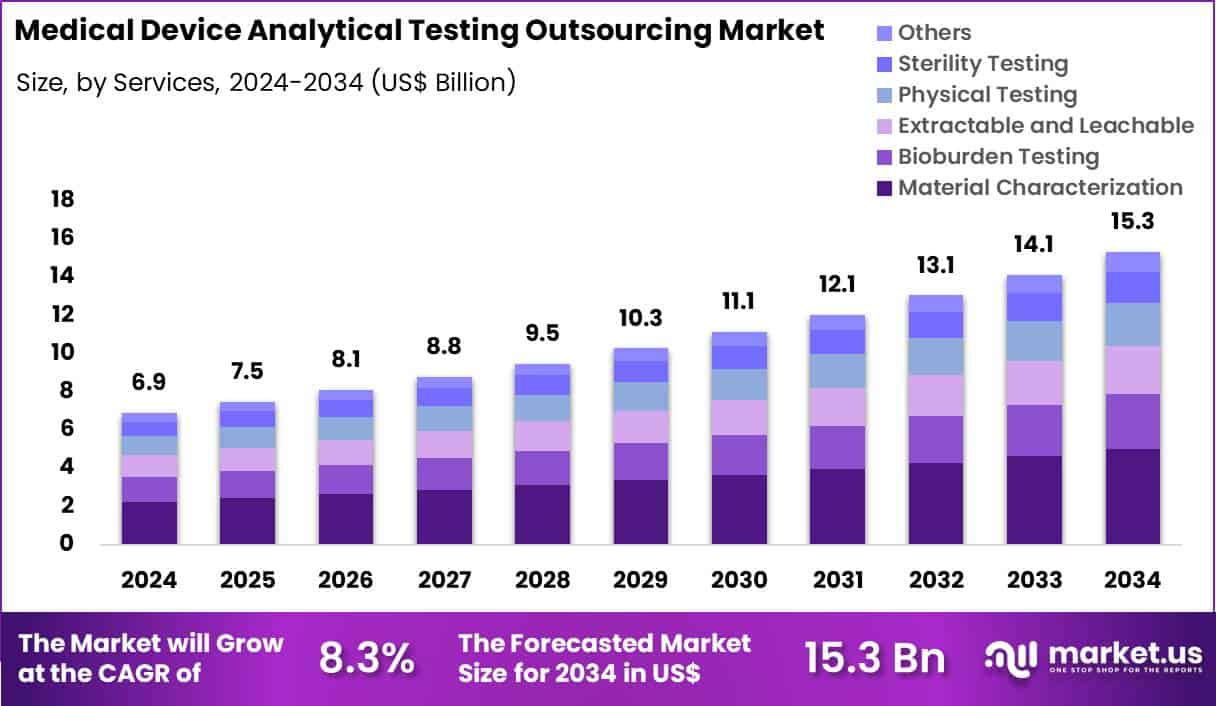
New York, NY – Oct 27, 2026 – Global Medical Device Analytical Testing Outsourcing Market size is expected to be worth around US$ 15.3 Billion by 2034 from US$ 6.9 Billion in 2024, growing at a CAGR of 8.3% during the forecast period 2025 to 2034. In 2024, North America led the market, achieving over 39.4% share with a revenue of US$ 2.7 Billion.
The Medical Device Analytical Testing Outsourcing Market is gaining importance as medical device manufacturers increasingly focus on product safety, quality, regulatory compliance, and performance validation. Analytical testing services are essential for assessing the safety, reliability, and effectiveness of medical devices before and after they enter the market.
These services include chemical characterization, biocompatibility testing, microbiological testing, materials analysis, extractables and leachables testing, and physical and mechanical performance testing. Outsourcing these activities to specialized contract testing laboratories enables manufacturers to access advanced testing technologies, technical expertise, and established quality systems while reducing the need for significant in-house infrastructure investments.
Market growth is supported by the increasing complexity of medical devices, rising demand for implantable and wearable technologies, and stringent regulatory requirements across major markets. Regulatory frameworks and standards, including those established by the U.S. Food and Drug Administration (FDA) and the International Organization for Standardization (ISO), further emphasize the importance of reliable testing and documented evidence of device safety and performance.
Additionally, growing investment in research and development, increasing demand for innovative medical technologies, and the expansion of medical device manufacturing are creating opportunities for outsourced analytical testing providers. However, high testing costs, complex regulatory requirements, and extended testing timelines may present challenges.
Overall, the market is expected to benefit from continued innovation, increasing regulatory scrutiny, and the growing preference for specialized outsourced testing solutions.
Key Takeaways
- In 2024, the Medical Device Analytical Testing Outsourcing Market was valued at US$ 6.9 billion and is projected to grow at a CAGR of 8.3%, reaching US$ 15.3 billion by 2034.
- By service type, the market includes material characterization, bioburden testing, extractables and leachables testing, physical testing, sterility testing, and other services. Material characterization dominated the segment, accounting for 32.8% of the market share.
- Based on therapeutic area, the market is segmented into cardiology, diagnostic imaging, orthopedics, drug delivery, endoscopy, and others. Cardiology held a significant market share of 29.6%.
- By end user, the market is categorized into hospitals, clinics, and others. Hospitals emerged as the leading segment, accounting for 47.9% of the total market revenue.
- Regionally, North America dominated the Medical Device Analytical Testing Outsourcing Market, capturing the largest share of 39.4%.
Key Market Segments
- Services Analysis: Material characterization accounted for 32.8% of the market, driven by the growing complexity of medical device materials and designs. Increasing use of advanced polymers, alloys, and composites has raised demand for detailed safety and performance assessments. Outsourcing enables manufacturers to access specialized equipment, technical expertise, and regulatory-compliant testing services.
- Therapeutic Area Analysis: Cardiology accounted for 29.6% of the market, supported by innovation in cardiovascular devices, including stents, catheters, heart valves, and implantable monitors. Rising cardiovascular disease prevalence and stringent safety requirements have increased demand for analytical testing. Outsourcing helps manufacturers validate device performance, meet regulatory standards, and accelerate product commercialization.
- End-User Analysis: Hospitals accounted for 47.9% of the market, driven by their involvement in medical device evaluation, clinical validation, and post-market surveillance. Increasing adoption of advanced medical technologies has strengthened demand for safety and performance testing. Collaboration between hospitals, manufacturers, and specialized laboratories further supports outsourced analytical testing services.
Regional Analysis
North America dominated the Medical Device Analytical Testing Outsourcing Market in 2024, accounting for 39.4% of the global market share. Growth was supported by stringent FDA regulations, increasing medical device innovation, and rising demand for specialized testing services.
Leading companies, including Eurofins Scientific and Charles River Laboratories, have expanded their testing capabilities to support biocompatibility, sterility, and chemical characterization. Increasing device complexity and demand for regulatory compliance have further encouraged manufacturers to outsource testing activities. The FDA’s Center for Devices and Radiological Health received over 20,700 medical device submissions in 2024, highlighting strong industry activity.
Asia Pacific is expected to register the highest CAGR during the forecast period. Growth is driven by stricter regulatory oversight, expanding medical device manufacturing, and investments in laboratory infrastructure across China, India, and South Korea. Increasing adoption of automated testing technologies and improvements in laboratory accreditation are strengthening regional capabilities. Additionally, the NMPA approved 65 innovative medical devices in 2024, representing a 6.6% increase from 2023, supporting regional market expansion.
Emerging Trends
- Growing demand for chemical characterization testing: Chemical characterization is becoming an important part of medical device safety assessment. Testing laboratories are increasingly required to identify and measure chemical substances in device materials, including possible manufacturing residues. The FDA’s September 2024 draft guidance provides recommendations to improve the consistency of these assessments.
- Greater use of risk-based biocompatibility testing: Testing strategies are increasingly being designed around the type of device, its materials, and the nature and duration of contact with the human body. This approach helps manufacturers select suitable tests instead of applying the same testing programme to every device.
- Increasing focus on cybersecurity testing: Connected medical devices require stronger protection against cyber threats. Testing and assessment services are therefore expanding beyond physical and chemical safety to include security weaknesses, software risks, and device resilience. The FDA’s February 2026 cybersecurity guidance highlights the importance of security-related design and premarket documentation.
- Expansion of testing for AI-enabled medical devices: The use of artificial intelligence in diagnostic and monitoring devices is increasing the need to evaluate software performance, reliability, and changes throughout a product’s life cycle. Specialized service providers can support manufacturers with testing and validation activities for AI-enabled medical device functions.
- Greater emphasis on standardized testing and regulatory documentation: Manufacturers are placing greater importance on testing methods, traceable results, and well-organized technical reports. Outsourced laboratories that follow applicable recognized standards and provide clear documentation can help reduce gaps in regulatory submissions and support more efficient reviews.
Use Cases
- Safety assessment of implants and patient-contact devices: External laboratories can analyze implants, catheters, surgical instruments, and other patient-contact devices to identify potentially harmful chemical substances. The results support biocompatibility assessments and help manufacturers evaluate whether materials are suitable for their intended medical use.
- Testing of sterilization residues and manufacturing contaminants: Testing providers can examine medical devices for chemical residues introduced during manufacturing, processing, or sterilization. This work helps manufacturers assess contamination risks, investigate unexpected test results, and confirm that appropriate controls are maintained throughout production.
- Verification of device performance before market entry: Manufacturers can outsource bench testing to assess whether a device performs according to its intended design and technical specifications. Depending on the product, this may include mechanical strength, durability, accuracy, functionality, and other non-clinical performance measures needed to support regulatory submissions.
- Cybersecurity assessment of connected medical equipment: Independent testing laboratories and specialist service providers can assess connected devices for software vulnerabilities and security weaknesses. These assessments can support risk management and help manufacturers prepare cybersecurity documentation for applicable regulatory submissions.
- Quality investigations and product change assessment: Outsourced analytical testing can be used when a manufacturer changes a raw material, modifies a production process, investigates a product defect, or evaluates an unexpected quality issue. Comparative test results can help determine whether the change affects material characteristics, safety, or device performance.
Frequently Asked Questions About Medical Device Analytical Testing Outsourcing
- Why do medical device manufacturers outsource analytical testing?
Manufacturers outsource analytical testing to access specialized laboratory facilities, manage testing costs, and obtain independent technical support. Outsourcing can also reduce the need for internal investment in expensive equipment and help teams focus on product design and manufacturing. - What services are included in medical device analytical testing?
Common services include chemical characterization, biocompatibility testing, extractables and leachables analysis, material identification, contamination testing, and non-clinical performance assessment. The required services depend on device design, materials, intended use, and applicable regulatory requirements. - Which medical devices require analytical testing?
Analytical testing may be needed for implants, surgical instruments, diagnostic equipment, catheters, wound dressings, and other medical devices. The exact testing requirements depend on material composition, patient contact, intended use, potential risks, and the regulatory pathway applicable to the product. - What are the main factors driving market growth?
Market growth is supported by increasing medical device complexity, stricter attention to product safety, and the need for specialized laboratory capabilities. Regulatory documentation requirements and demand for reliable analytical results also encourage manufacturers to use external testing services. - Which regions offer opportunities for market expansion?
North America and Europe offer opportunities linked to established medical device industries and developed regulatory systems. Asia-Pacific may also offer growth opportunities through expanding manufacturing activity and laboratory capabilities. Actual regional performance depends on investment, regulations, and customer demand. - Who are the major customers of outsourced testing providers?
Major customers include established medical device manufacturers, emerging device developers, contract manufacturers, and companies introducing new materials or product designs. Their requirements vary from individual laboratory tests to comprehensive testing programmes supporting product development and regulatory submissions. - What role does technology play in market development?
Advanced analytical instruments, automated laboratory workflows, and improved data management systems can increase testing efficiency and consistency. In addition, the growth of connected and AI-enabled medical devices is creating specialized needs for software performance, cybersecurity, and device validation services. - What is the future outlook for the market?
The market outlook is supported by continued demand for safe, reliable, and well-documented medical devices. Greater device complexity and specialized testing needs may create opportunities for capable laboratories. However, future growth will depend on regulatory developments, outsourcing decisions, pricing, and investment in testing infrastructure.
Conclusion
The Medical Device Analytical Testing Outsourcing Market is expected to experience steady growth, supported by increasing medical device complexity, stringent regulatory requirements, and rising demand for reliable safety and performance testing. The market, valued at US$ 6.9 billion in 2024, is projected to reach US$ 15.3 billion by 2034, reflecting a CAGR of 8.3%.
Material characterization, cardiology, and hospital-related demand represent important market segments, while North America maintains a leading regional position. Meanwhile, Asia Pacific offers promising growth opportunities. Advancements in analytical technologies and specialized laboratory services are expected to strengthen market development despite cost and regulatory challenges.
Discuss your needs with our analyst
Please share your requirements with more details so our analyst can check if they can solve your problem(s)



