
Overview
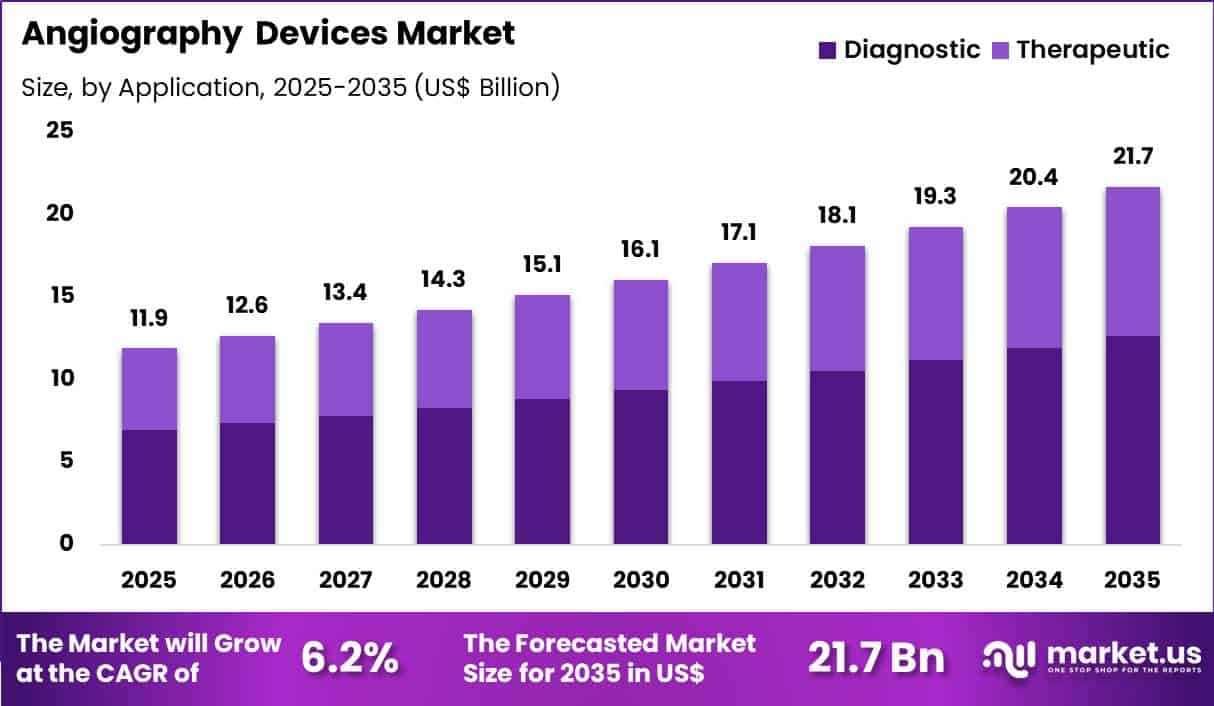
New York, NY – Nov 02, 2026 –The Global Angiography Devices Market size is expected to be worth around US$ 21.7 Billion by 2035 from US$ 11.9 Billion in 2025, growing at a CAGR of 6.2% during the forecast period 2026-2035. In 2025, North America led the market, achieving over 36.3% share with a revenue of US$ 4.3 Billion.
Angiography devices are specialized medical equipment used to visualize blood vessels and assess blood flow throughout the body. These devices play a crucial role in diagnosing and treating cardiovascular diseases, including coronary artery disease, peripheral artery disease, and other vascular disorders.
The technology uses contrast agents and advanced imaging techniques, such as X-ray fluoroscopy, to generate detailed images of blood vessels and identify blockages, narrowing, or abnormalities.
The angiography devices market includes various products, such as angiography systems, catheters, guidewires, contrast media injectors, and vascular closure devices.
These solutions are widely used in hospitals, diagnostic imaging centers, and specialized cardiovascular clinics. Increasing prevalence of cardiovascular diseases, rising demand for minimally invasive procedures, and growing adoption of advanced imaging technologies are driving market growth.
Furthermore, technological advancements, including digital imaging, 3D angiography, AI-assisted image analysis, and hybrid operating room systems, are improving diagnostic accuracy and procedural efficiency.
Growing healthcare expenditure, expanding access to advanced diagnostic facilities, and increasing awareness of early disease detection are also supporting market expansion. However, high equipment costs and stringent regulatory requirements may present challenges to market growth.
Key Takeaways
- In 2025, the Angiography Devices Market was valued at US$ 11.9 Billion and is projected to reach US$ 21.7 Billion by 2035, expanding at a CAGR of 6.2% during the forecast period.
- Based on product type, the market is segmented into angiography systems, vascular closure devices, guidewires, contrast media, catheters, balloons, and angiography accessories. Among these, angiography systems dominated with a 33.7% market share.
- By application, the market is categorized into diagnostic and therapeutic segments, with diagnostic applications accounting for the largest share of 58.2%.
- Based on technology, the market is divided into X-ray angiography, MR angiography, and CT angiography. X-ray angiography emerged as the leading segment, capturing a 54.6% revenue share.
- Regionally, North America dominated the Angiography Devices Market, accounting for a 36.3% market share.
Key Market Segments
- Product Type Analysis: Angiography systems dominated the product type segment with a 33.7% share, driven by increasing cardiovascular procedures, hospital investments in advanced imaging suites, and adoption of digital flat-panel detectors and 3D imaging technologies.
- Application Analysis: Diagnostic applications led with a 58.2% share, supported by rising demand for early vascular disease detection, preventive screening, and accurate diagnostic imaging.
- Technology Analysis: X-ray angiography dominated with a 54.6% share, driven by real-time imaging capabilities, widespread clinical adoption, improved image resolution, and increasing minimally invasive vascular interventions.
Regional Analysis
North America accounted for a 36.3% share of the Angiography Devices Market in 2024, driven by high cardiovascular procedure volumes, advanced hospital infrastructure, and increasing adoption of minimally invasive interventions.
Rising cardiovascular disease prevalence, aging demographics, and favorable reimbursement policies encouraged hospitals to invest in advanced angiography systems, hybrid operating rooms, and modern catheterization laboratories. Growing demand for accurate vascular imaging and improved procedural efficiency further supported regional market growth.
Asia Pacific is expected to register the highest CAGR during the forecast period, supported by expanding healthcare infrastructure, rising cardiovascular disease prevalence, and increasing investments in advanced diagnostic facilities. Growing hypertension, diabetes, and obesity rates are driving demand for angiography procedures.
Additionally, medical tourism in India and Thailand, expanding catheterization laboratories, and improved specialist training are strengthening market adoption. Rising healthcare expenditure and greater access to minimally invasive treatments are expected to accelerate regional growth.
Emerging Trends
- Growing Adoption of AI-Powered Angiography Systems: Artificial intelligence is becoming an important part of medical imaging. AI-based software can help analyze angiographic images, identify abnormal blood vessel conditions, and support clinical decisions. These capabilities are encouraging healthcare providers to adopt advanced imaging technologies for faster and more accurate assessments.
- Increasing Demand for 3D and Advanced Imaging Technology: Hospitals are increasingly adopting 3D rotational angiography and advanced imaging systems to obtain clearer views of complex blood vessels. These technologies help doctors understand vascular structures from different angles and support treatment planning, particularly in complicated cardiac, neurological, and congenital heart procedures.
- Greater Focus on Radiation Dose Reduction: Manufacturers and healthcare providers are focusing on angiography systems with improved radiation management features. Low-dose imaging settings, pulsed fluoroscopy, and advanced image processing help reduce unnecessary radiation exposure while maintaining useful image quality during diagnostic and interventional procedures.
- Development of Advanced CT Angiography Technology: Photon-counting CT and improved detector technologies are attracting attention because they can provide higher-resolution images and potentially lower radiation exposure. These developments are supporting more detailed visualization of coronary arteries and helping clinicians assess cardiovascular conditions with greater precision.
- Expansion of Image-Guided Minimally Invasive Procedures: Healthcare providers are increasingly using image-guided technologies to perform treatments through small incisions rather than conventional open surgery. Angiography systems support catheter navigation, vascular interventions, and targeted treatments, encouraging investment in advanced imaging equipment at specialized hospitals.
Use Cases
- Diagnosis of Coronary Artery Disease: Angiography devices help doctors examine coronary arteries and identify narrowing or blockages that restrict blood flow to the heart. Cardiologists use these images to assess coronary artery disease and determine whether patients may require procedures such as angioplasty or stent placement.
- Detection and Treatment of Brain Aneurysms: Cerebral angiography helps specialists examine blood vessels in the brain and identify abnormalities such as aneurysms and vascular blockages. These imaging systems also support minimally invasive procedures, allowing specialists to guide catheters and treatment devices toward affected blood vessels.
- Management of Peripheral Artery Disease: Angiography systems are used to examine blood vessels supplying the legs and other body regions. Doctors can identify narrowed arteries, evaluate reduced blood circulation, and guide treatments such as balloon angioplasty and stent placement to improve blood flow.
- Guidance During Stroke and Blood Clot Treatment: Angiography equipment helps specialists visualize blood vessels and guide catheters during selected treatments for blocked arteries. In suitable stroke cases, image-guided procedures can help doctors reach and remove blood clots, restoring blood flow to affected areas of the brain.
- Diagnosis and Treatment of Congenital Heart Conditions: Angiography systems help specialists examine abnormal blood vessel structures and complex heart anatomy in patients with congenital heart conditions. Advanced imaging and catheterization techniques support treatment planning and guide selected catheter-based procedures, reducing the need for some open surgical approaches.
Frequently Asked Questions About Angiography Devices
- How do angiography devices work?
Angiography devices use imaging technologies, such as X-rays or computed tomography, to capture pictures of blood vessels. In conventional angiography, a contrast agent is introduced into the bloodstream to make blood vessels more visible during imaging. - What are the different types of angiography devices?
Common angiography technologies include X-ray angiography systems, digital subtraction angiography systems, CT angiography systems, and MR angiography systems. Each technology provides different imaging capabilities for examining blood vessels and supporting specific diagnostic or treatment requirements. - Which diseases can be diagnosed using angiography devices?
Angiography devices help diagnose coronary artery disease, peripheral artery disease, brain aneurysms, blood clots, and certain vascular abnormalities. Doctors use these imaging systems to examine blood flow, identify affected arteries, and determine appropriate treatment approaches. - What are the benefits of angiography devices in healthcare?
Angiography devices provide detailed images of blood vessels, helping doctors identify vascular problems and plan suitable treatments. They also support minimally invasive procedures, improve catheter navigation, and help specialists monitor blood flow during selected interventions. - What factors are driving the angiography devices market?
Rising cardiovascular disease cases, increasing demand for minimally invasive procedures, an aging population, and improvements in medical imaging technology are supporting market demand. Hospitals are also investing in advanced equipment to improve diagnostic capabilities and interventional treatment services. - Which technological advancements are influencing the angiography devices market?
Artificial intelligence, 3D rotational imaging, advanced flat-panel detectors, photon-counting CT, and improved image-processing software are influencing technological development. These innovations aim to enhance image clarity, support complex procedures, and improve radiation management in clinical environments. - What is the future outlook for the angiography devices market?
The market is expected to benefit from continued improvements in medical imaging, growing demand for minimally invasive treatments, and increasing cardiovascular healthcare requirements. AI integration and advanced imaging technologies are also likely to influence future equipment development and adoption.
Conclusion
Angiography devices are specialized medical equipment used to visualize blood vessels and assess blood flow throughout the body. These devices play a crucial role in diagnosing and treating cardiovascular diseases, including coronary artery disease, peripheral artery disease, and other vascular disorders.
The technology uses contrast agents and advanced imaging techniques, such as X-ray fluoroscopy, to generate detailed images of blood vessels and identify blockages, narrowing, or abnormalities.
Discuss your needs with our analyst
Please share your requirements with more details so our analyst can check if they can solve your problem(s)