


Overview
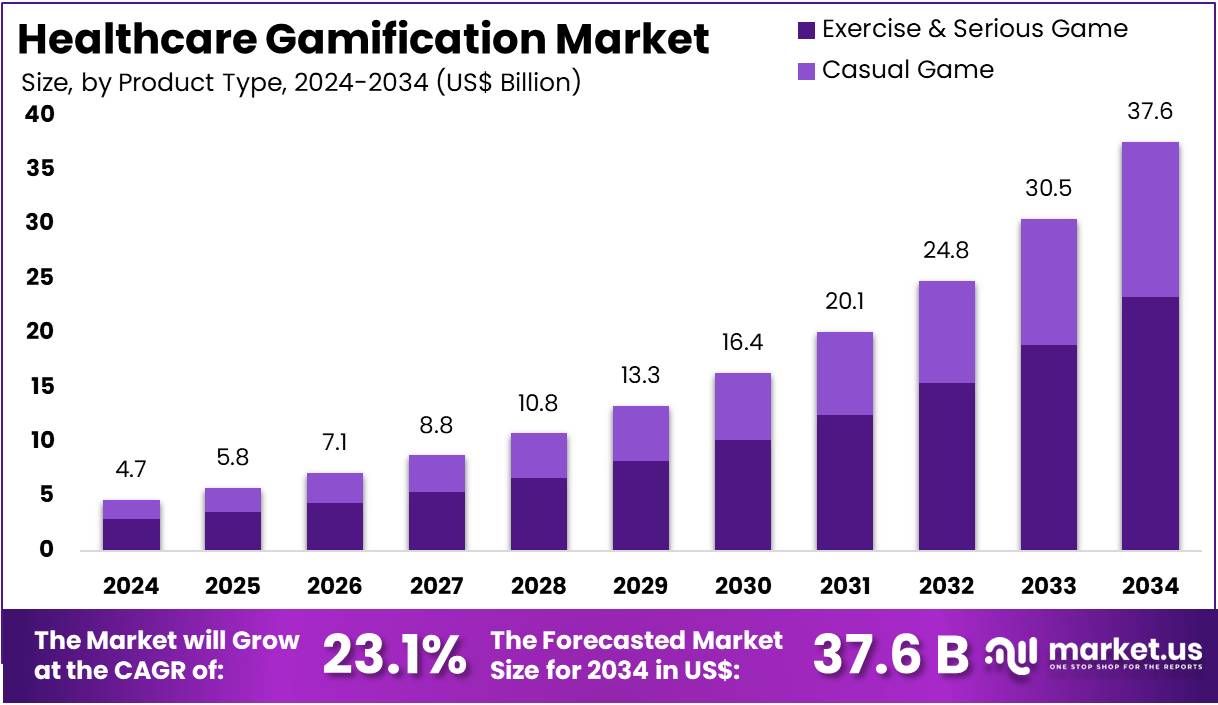
New York, NY – July 03, 2026 – Global Healthcare Gamification Market Size is expected to be worth around US$ 37.6 billion by 2034 from US$ 4.7 billion in 2024, growing at a CAGR of 23.1% during the forecast period 2025 to 2034.
Healthcare gamification refers to the application of game design elements, such as rewards, challenges, points, badges, leaderboards, and progress tracking, in healthcare settings to encourage healthy behaviors, improve patient engagement, and enhance clinical outcomes. It is increasingly being adopted by healthcare providers, insurers, pharmaceutical companies, and digital health platforms to motivate individuals to actively manage their health and wellness. Gamification is widely used in fitness applications, chronic disease management, medication adherence, rehabilitation programs, mental health support, and employee wellness initiatives.
The growing adoption of smartphones, wearable health devices, and digital health technologies has accelerated the use of gamification across the healthcare sector. By making healthcare activities more interactive and engaging, gamification helps improve patient participation, supports preventive healthcare, and encourages long-term lifestyle changes. Healthcare organizations are also leveraging gamified platforms to enhance medical education, train healthcare professionals, and improve patient communication.
The market continues to benefit from the increasing focus on personalized healthcare, rising prevalence of chronic diseases, and expanding investments in digital health solutions. Advances in artificial intelligence, mobile applications, cloud computing, and connected healthcare ecosystems are further strengthening the effectiveness of gamified healthcare platforms through personalized experiences and real-time feedback. As healthcare systems increasingly emphasize patient-centric care and preventive health management, healthcare gamification is expected to remain an important component of digital healthcare transformation, supporting improved health outcomes, greater patient satisfaction, and more efficient healthcare delivery.
Key Takeaways
- The global healthcare gamification market was valued at US$ 4.7 billion in 2024 and is projected to reach US$ 37.6 billion by 2034, expanding at a CAGR of 23.1% during the forecast period.
- Based on product type, the market is segmented into exercise & serious games and casual games. The exercise & serious games segment dominated the market, accounting for 62.1% of the total market share in 2023.
- By application, the market is categorized into education/training of physicians, education/training of hospital staff, commercial gains for patients, pharmaceutical sales training, insurance companies using gamification, and gamification in clinical trials. Among these, education/training of physicians emerged as the leading segment, capturing 34.5% of the market share.
- Based on end user, the market is classified into enterprise-based, consumer-based, and others. The enterprise-based segment held the largest share, representing 69.4% of the healthcare gamification market.
- North America remained the leading regional market, accounting for 41.8% of the global healthcare gamification market share in 2023.
Regional Analysis
North America dominated the healthcare gamification market with the largest revenue share, supported by the increasing adoption of patient-centric care models and digital health technologies. Healthcare providers and insurers across the region are integrating gamification into wellness programs, chronic disease management, and preventive care to improve patient engagement, treatment adherence, and long-term health outcomes.
The widespread use of smartphones, wearable devices, and digital health applications has further strengthened market growth by enabling personalized health tracking and interactive experiences. Strong investments in healthcare innovation, along with the expansion of digital care services by leading healthcare organizations, continue to accelerate market development.
Asia Pacific is projected to register the fastest growth during the forecast period, driven by rapid digitalization, expanding internet and smartphone penetration, rising healthcare awareness, and supportive government initiatives. Countries such as China, India, and Japan are actively promoting digital healthcare through national health transformation programs and investments in connected healthcare infrastructure.
The growing adoption of mobile health applications and wearable technologies is encouraging consumers to participate in fitness, preventive healthcare, and chronic disease management programs. Increasing disposable incomes, a large digitally connected population, and rising demand for personalized healthcare solutions are expected to further boost the adoption of healthcare gamification across the region, making Asia Pacific a key growth market over the coming years.
Emerging Trends
- Integration with Wearable Devices: Gamification is increasingly integrated with wearable devices such as fitness trackers and smartwatches to encourage physical activity. By combining movement tracking with points, challenges, and rewards, these solutions improve user engagement, increase daily step counts, and strengthen long-term adherence to exercise programs.
- AI-Driven Personalization: Artificial intelligence is enabling personalized gamified healthcare experiences by adapting game difficulty, feedback, and rewards according to user performance. AI-powered serious games enhance engagement and effectiveness, with recent studies identifying numerous applications addressing diverse health conditions through adaptive learning and evaluation systems.
- Focus on Mental Health Interventions: Gamification is expanding into mental healthcare through dedicated treatment applications and game elements embedded within therapy programs. These approaches improve motivation, engagement, and treatment adherence while supporting individuals managing anxiety, depression, and other mental health conditions with interactive digital experiences.
- Adoption of Virtual and Augmented Reality: Virtual and augmented reality technologies are gradually becoming part of healthcare gamification, providing immersive learning and therapeutic experiences. Although current adoption remains limited, declining hardware costs and easier development processes are expected to accelerate the use of VR and AR solutions.
- Gamification in Clinical Education and Training: Healthcare education increasingly incorporates gamified learning modules that strengthen clinical reasoning and decision-making skills. AI-enhanced simulations, adaptive quizzes, and interactive scenarios create engaging, low-risk environments where medical and nursing students can practice realistic situations before clinical application.
Use Cases
- Promoting Physical Activity: Gamification effectively encourages physical activity by combining points, badges, leaderboards, and challenges with wearable devices and mobile applications. Research demonstrates improved exercise participation, with activity-monitoring interventions increasing daily movement and motivating users to consistently achieve predefined fitness and walking goals.
- Improving Medication Adherence: Gamified medication reminder systems improve adherence by integrating reminders, rewards, and engaging gameplay into daily treatment routines. Studies show these interactive approaches significantly increase the likelihood of patients taking prescribed medications consistently, supporting better health outcomes and long-term treatment compliance.
- Enhancing Inhaler Technique and Adherence in COPD: Gamified digital platforms improve inhaler adherence and disease knowledge among patients with chronic obstructive pulmonary disease. Interactive educational content, behavioral motivation techniques, and progress tracking encourage proper inhaler use while increasing patient understanding of disease management and treatment effectiveness over time.
- Educating Patients About Medication Use and Safety: Serious games are increasingly used to educate patients about proper medication use, storage, and safety practices. Gamified educational tools strengthen understanding, encourage responsible medicine management, and improve adherence without relying on financial incentives, making healthcare learning more engaging and effective.
- Designing More Engaging Digital Health Apps: Digital health applications increasingly adopt gamification principles such as meaningful goals, user choice, personalized feedback, progress visibility, and player-centered design. These features create more engaging user experiences, improve motivation, and encourage sustained participation while supporting better health behavior and intervention outcomes.
Frequently Asked Questions on Healthcare Gamification
- What is the healthcare gamification market?
The healthcare gamification market comprises companies that develop and provide gamified digital health solutions, including software platforms, mobile applications, wearable integrations, and training tools. The market serves healthcare providers, pharmaceutical companies, insurers, enterprises, and consumers seeking improved engagement, education, and health management. - What factors are driving the growth of the healthcare gamification market?
The market is primarily driven by the growing adoption of digital health technologies, increasing smartphone and wearable device usage, rising prevalence of chronic diseases, and greater emphasis on preventive healthcare. Growing investments in personalized healthcare, artificial intelligence, and patient-centric care models are also supporting market expansion worldwide. - Which applications are driving demand for healthcare gamification?
Healthcare gamification is increasingly used in physician training, hospital staff education, chronic disease management, rehabilitation, patient engagement, pharmaceutical sales training, insurance wellness programs, and clinical trials. These applications improve learning outcomes, treatment adherence, employee performance, and overall healthcare efficiency through interactive and engaging digital experiences. - Which end-user segment dominates the healthcare gamification market?
The enterprise-based segment accounts for the largest share of the healthcare gamification market due to widespread adoption by hospitals, healthcare providers, pharmaceutical companies, insurance firms, and corporate wellness programs. Organizations are increasingly investing in gamified platforms to improve operational efficiency, employee training, and patient outcomes. - Which region leads the healthcare gamification market?
North America holds the leading position in the healthcare gamification market, supported by advanced healthcare infrastructure, high digital health adoption, widespread use of wearable devices, and strong investments in healthcare technology. The region also benefits from favorable reimbursement policies and growing emphasis on patient-centered care. - How does artificial intelligence enhance healthcare gamification?
Artificial intelligence improves healthcare gamification by delivering personalized recommendations, adaptive health challenges, predictive analytics, and real-time feedback. AI-powered platforms analyze user behavior and health data to create customized experiences that improve patient engagement, encourage long-term participation, and support better healthcare outcomes. - What is the future outlook for the healthcare gamification market?
The healthcare gamification market is expected to witness strong long-term growth, driven by continuous advancements in digital health technologies, artificial intelligence, wearable devices, and mobile health applications. Increasing demand for personalized healthcare, preventive care, and remote patient monitoring will continue to create new growth opportunities across global markets.
Conclusion
The healthcare gamification market is poised for substantial growth as healthcare systems increasingly prioritize patient engagement, preventive care, and personalized treatment approaches. Rising adoption of digital health platforms, wearable devices, artificial intelligence, and mobile applications is strengthening the effectiveness of gamified healthcare solutions across clinical, educational, and wellness settings.
North America currently leads the market, while Asia Pacific is expected to experience the fastest growth due to rapid digital transformation and expanding healthcare investments. As organizations continue to focus on improving health outcomes, treatment adherence, and operational efficiency, healthcare gamification will remain a key driver of innovation and digital healthcare transformation worldwide.
Discuss your needs with our analyst
Please share your requirements with more details so our analyst can check if they can solve your problem(s)




