


Overview
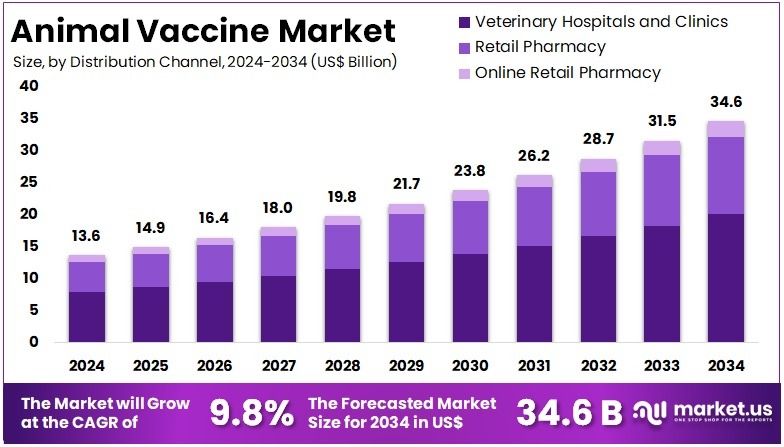
New York, NY – July 07, 2026 – The Global Animal Vaccine Market Size is expected to be worth around US$ 34.6 Billion by 2034, from US$ 13.6 Billion in 2024, growing at a CAGR of 9.8% during the forecast period from 2025 to 2034. North America held a dominant market position, capturing more than a 30.2% share and holds US$ 4.1 Billion market value for the year.
Animal vaccines play a vital role in protecting livestock and companion animals from infectious diseases, improving animal health, and supporting sustainable food production. These vaccines stimulate the immune system to develop protection against harmful bacteria, viruses, and other pathogens, reducing the incidence and severity of diseases. Vaccination programs contribute to higher productivity, improved animal welfare, and lower economic losses for farmers and animal owners.
The increasing demand for animal-derived food products, growing awareness of preventive animal healthcare, and rising concerns over zoonotic diseases have strengthened the adoption of animal vaccination worldwide. Vaccines are widely used in cattle, poultry, swine, sheep, goats, aquaculture species, and companion animals such as dogs and cats. They help minimize disease outbreaks, reduce mortality rates, and decrease reliance on antibiotics, supporting global efforts to address antimicrobial resistance.
Advancements in veterinary biotechnology have led to the development of innovative vaccine technologies, including recombinant, DNA, RNA, and vector-based vaccines, offering enhanced safety and effectiveness. Government vaccination initiatives, expanding veterinary healthcare infrastructure, and increased investments in animal health research continue to drive innovation in this field.
As the livestock industry expands and pet ownership continues to rise, the importance of animal vaccination is expected to increase further. Ongoing research and technological advancements are anticipated to improve vaccine accessibility, efficacy, and disease prevention, reinforcing the critical role of animal vaccines in safeguarding animal health, public health, and global food security.
Key Takeaways
- In 2024, the animal vaccines market generated revenue of US$ 13.6 billion. The market is projected to expand at a CAGR of 9.8% from 2025 to 2034, reaching US$ 34.6 billion by 2034.
- Based on product type, the market is segmented into attenuated live vaccine, inactivated vaccine, subunit vaccine, toxoid vaccine, recombinant vaccine, and DNA vaccine. Among these, the attenuated live vaccine segment dominated the market in 2024, accounting for 38.2% of the total market share.
- By animal species, the market is categorized into livestock animals and companion animals. The livestock animals segment held the largest share, contributing 56.4% of the global market revenue in 2024.
- Based on route of administration, the market is divided into subcutaneous, intramuscular, oral, intraocular, intranasal, parenteral, and others. The subcutaneous segment emerged as the leading route of administration, capturing 42.7% of the market share in 2024.
- By distribution channel, the veterinary hospitals and clinics segment dominated the global animal vaccines market, accounting for 57.8% of the total revenue in 2024.
- North America was the leading regional market in 2024, holding a 30.2% share of the global animal vaccines market.
Regional Analysis
North America dominated the animal vaccines market in 2024 and is expected to maintain its leading position throughout the forecast period. Market growth is supported by the high prevalence of livestock and zoonotic diseases, increasing awareness of animal health, and the presence of well-established veterinary healthcare infrastructure. Strong investments in research and development, coupled with the presence of major pharmaceutical and biotechnology companies, continue to drive innovation and commercialization of advanced animal vaccines across the region.
The United States represents the largest market within North America, supported by its extensive livestock industry, rising companion animal ownership, and increasing focus on preventive animal healthcare. Government initiatives, vaccination campaigns, and favorable regulatory support have encouraged widespread vaccine adoption for both livestock and companion animals. The country also benefits from advanced research capabilities that enable the development of next-generation vaccines to address emerging animal diseases.
Canada further contributes to regional market growth through its large-scale commercial livestock production and emphasis on disease prevention. Intensive animal farming practices increase the need for effective vaccination programs to reduce the risk of infectious and zoonotic diseases. Although human rabies cases in the United States remain rare, the virus continues to circulate among wildlife populations, highlighting the ongoing importance of vaccination and surveillance programs. These factors collectively support sustained growth of the North American animal vaccines market.
Emerging Trends
- Next-Generation Vaccines: Next-generation veterinary vaccines, including DNA, subunit, and viral vectored platforms, are improving disease prevention through targeted immune responses. These advanced technologies provide enhanced protection, greater safety, and longer-lasting immunity, supporting effective control of infectious diseases in livestock, poultry, companion animals, and wildlife populations worldwide.
- DIVA Vaccines: Differentiating Infected from Vaccinated Animals (DIVA) vaccines are becoming increasingly important for disease surveillance and eradication programs. They enable authorities to distinguish infected animals from vaccinated ones, improving outbreak monitoring, supporting trade compliance, strengthening biosecurity measures, and accelerating disease control efforts across livestock industries.
- Autogenous Vaccines: Autogenous vaccines are custom-developed using pathogens isolated from specific animal populations, providing targeted protection against localized disease outbreaks. They offer effective solutions when commercial vaccines are unavailable or ineffective, improving herd health, minimizing production losses, and supporting disease management in veterinary practice.
- mRNA Vaccine Technology: mRNA vaccine technology is emerging as a promising innovation in veterinary medicine, offering rapid vaccine development against evolving animal diseases. Ongoing research focuses on protecting livestock, companion animals, and endangered wildlife while improving vaccine effectiveness, production efficiency, and response to emerging disease threats.
- Avian Influenza Vaccination: Growing concerns over avian influenza outbreaks are driving investment in poultry vaccination strategies worldwide. Vaccination programs help reduce disease transmission, protect commercial flocks, support food security, minimize economic losses, and strengthen biosecurity measures while contributing to the long-term stability of poultry production systems.
Use Cases
- Poultry Industry: Vaccination is essential in poultry production for preventing infectious diseases such as Newcastle disease and avian influenza. Effective immunization reduces bird mortality, improves flock productivity, strengthens food security, enhances farmer incomes, and minimizes economic losses by maintaining healthier and more resilient poultry populations.
- Livestock Health: Vaccination programs are widely used to protect cattle, sheep, goats, and other livestock from infectious diseases that reduce productivity. Improved immunization enhances animal survival, increases meat and dairy production, supports rural livelihoods, strengthens food security, and reduces economic losses across livestock farming operations.
- Companion Animals: Routine vaccination protects companion animals against serious diseases including rabies, distemper, parvovirus, and feline infections. Immunization improves pet health, extends lifespan, reduces veterinary treatment costs, prevents zoonotic disease transmission, and supports responsible pet ownership while promoting overall public health and safety.
- Wildlife Conservation: Vaccination plays an important role in wildlife conservation by controlling infectious diseases that threaten wild animal populations. Oral vaccination programs reduce disease transmission, protect endangered species, preserve biodiversity, minimize risks to domestic animals, and strengthen ecosystem health through effective wildlife disease management strategies.
- Aquaculture: Vaccines are increasingly adopted in aquaculture to prevent bacterial and viral diseases affecting farmed fish. Effective vaccination reduces antibiotic dependence, improves fish survival and productivity, supports sustainable seafood production, enhances farm profitability, and contributes to global food security through healthier aquatic animal populations.
Frequently Asked Questions on Animal Vaccine
- Why are animal vaccines important?
Animal vaccines are essential because they protect livestock and companion animals from contagious diseases, reduce mortality rates, improve production efficiency, and limit economic losses for farmers. They also contribute to food safety and reduce the risk of zoonotic disease transmission from animals to humans. - What are the major types of animal vaccines?
Animal vaccines are available in several forms, including live attenuated vaccines, inactivated vaccines, recombinant vaccines, DNA vaccines, and subunit vaccines. Each vaccine type offers different advantages depending on the target disease, animal species, required immune response, and veterinary treatment strategy. - Which animals commonly receive vaccines?
Vaccination programs are commonly implemented for livestock such as cattle, poultry, pigs, sheep, and goats, as well as companion animals including dogs, cats, and horses. Wildlife vaccination is also conducted in specific regions to control disease outbreaks and protect biodiversity. - What diseases can animal vaccines prevent?
Animal vaccines help prevent numerous diseases, including rabies, foot-and-mouth disease, avian influenza, Newcastle disease, brucellosis, canine distemper, parvovirus infection, and bovine respiratory diseases. Vaccination significantly lowers disease incidence and supports healthier animal populations across commercial and domestic settings. - What factors are driving the growth of the animal vaccine market?
The animal vaccine market is expanding due to increasing livestock production, rising pet ownership, growing awareness of animal health, government disease control initiatives, and advancements in vaccine technologies. Strong demand for safe animal-derived food products also supports sustained market growth worldwide. - Which regions dominate the animal vaccine market?
North America and Europe hold significant shares of the animal vaccine market because of advanced veterinary infrastructure, high pet healthcare spending, and established livestock industries. Meanwhile, Asia-Pacific is experiencing rapid growth due to increasing animal farming, urbanization, and expanding veterinary healthcare investments. - Who are the major end users in the animal vaccine market?
Major end users include livestock farmers, veterinary hospitals, veterinary clinics, animal healthcare organizations, government veterinary departments, poultry producers, dairy farms, and pet owners. These stakeholders use vaccines to improve animal welfare, productivity, disease prevention, and long-term economic sustainability. - What is the future outlook for the animal vaccine market?
The future of the animal vaccine market remains positive, supported by continuous technological innovations, increasing investments in veterinary healthcare, expanding livestock populations, and growing emphasis on disease prevention. Development of next-generation recombinant and mRNA-based vaccines is expected to create new market opportunities globally.
Conclusion
The animal vaccines market is positioned for sustained growth, driven by increasing demand for livestock productivity, rising companion animal ownership, and growing emphasis on disease prevention. Advances in vaccine technologies, including recombinant, DNA, and mRNA platforms, are enhancing immunization effectiveness while supporting improved animal health and food security.
Government vaccination initiatives, expanding veterinary infrastructure, and greater awareness of zoonotic disease control continue to strengthen market adoption globally. North America remains the leading regional market, while emerging economies present significant growth opportunities. Continued innovation and strategic investments are expected to improve vaccine accessibility, supporting healthier animal populations and sustainable agricultural development worldwide.
Discuss your needs with our analyst
Please share your requirements with more details so our analyst can check if they can solve your problem(s)




