


Overview
New York, NY – Aug 05, 2026 – The Global Optical Lens Edger Market size is expected to be worth around US$ 1.2 Billion by 2034 from US$ 0.7 Billion in 2024, growing at a CAGR of 5.5% during the forecast period 2025 to 2034. In 2024, North America led the market, achieving over 38.6% share with a revenue of US$ 0.3 Billion.
The optical lens edger market is experiencing steady growth due to the rising prevalence of vision disorders, increasing eyewear customization demand, and rapid adoption of automated lens processing technologies. According to the World Health Organization (WHO), at least 2.2 billion people worldwide suffer from vision impairment, with uncorrected refractive errors being a major contributor. This growing patient population is creating continuous demand for accurate and efficient lens manufacturing solutions.
Modern optical lens edgers are transforming vision care laboratories through automation, artificial intelligence (AI), and advanced CAD/CAM integration. These technologies enable precise cutting, shaping, drilling, and polishing of lenses while reducing processing time and minimizing human errors. The increasing popularity of progressive lenses, high-index lenses, and freeform lens designs is further driving the need for high-precision edging equipment.
The market is also benefiting from strategic expansion and vertical integration among eyewear companies. In September 2022, FYi Health Group acquired WestGroupe to strengthen its eyewear portfolio and improve supply chain capabilities in Canada. Such developments are encouraging investments in advanced in-house laboratories and automated production facilities.
Additionally, rising eye-care demand is supporting market growth. In the United States, vision-related healthcare visits account for millions of outpatient encounters annually, highlighting the consistent need for corrective eyewear and lens-processing equipment. With increasing digitalization, automation, and consumer preference for customized eyewear, the optical lens edger market is expected to witness continued technological advancement and expansion.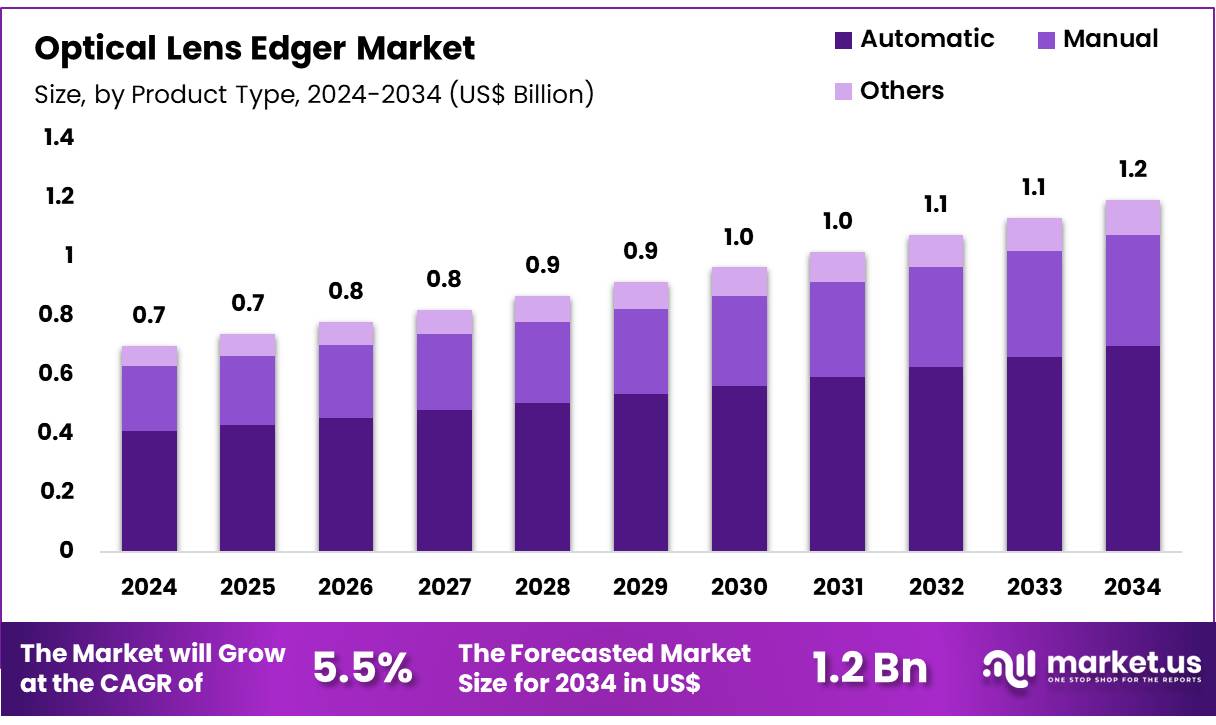
Key Takeaways
- The optical lens edger market generated US$ 0.7 billion in revenue in 2024 and is projected to reach US$ 1.2 billion by 2034, expanding at a CAGR of 5.5% during the forecast period.
- Based on product type, the market is segmented into automatic, manual, and other lens edgers. The automatic optical lens edger segment dominated in 2023, accounting for a 58.4% market share due to higher efficiency, precision, and automation capabilities.
- By application, the optical lens edger market is categorized into eyeglass lenses, microscope lenses, and others. The eyeglass lens segment held the leading position in 2023, capturing a significant 63.2% market share.
- Based on end-user, the market is segmented into ophthalmology hospitals & clinics, independent optical stores, and others. The ophthalmology hospitals & clinics segment dominated the market, holding the largest revenue share of 55.7%.
- Regionally, North America led the optical lens edger market in 2023, accounting for a 38.6% market share due to advanced eye-care infrastructure, increasing adoption of automated optical equipment, and strong demand for customized eyewear.
Statistical Information
- Global Vision Impairment Creates Strong Demand for Corrective Lens Manufacturing: The growing burden of vision impairment is increasing the need for prescription eyewear and advanced lens processing equipment. According to the World Health Organization (WHO), at least 2.2 billion people globally have near or distance vision impairment, and at least 1 billion cases could have been prevented or remain unaddressed. The high demand for corrective lenses supports the requirement for efficient optical lens edging technologies.
- Rising Vision Problems in the United States Support Optical Equipment Demand: The United States has a significant population requiring vision correction. According to the CDC, approximately 7 million Americans have vision impairment, including nearly 1 million people with blindness. The continuous need for corrective eyewear increases demand for optical laboratories and advanced lens edging systems.
- High-Risk Adults in the United States Show Continued Need for Eye Care Services: CDC data shows that around 93 million U.S. adults aged 18 years and older were at high risk for vision loss in 2017, and approximately 40% of these adults did not receive an eye examination in the previous year. Improving access to eye care and corrective solutions can increase demand for prescription lenses.
- Prevalence of Uncorrected Refractive Error in High‑Income Regions: A large pooled analysis in high‑income regions cited by WHO shows that uncorrected refractive error accounts for roughly 50% of moderate to severe vision impairment, highlighting the scale of corrective‑lens need in markets that invest heavily in in‑house edging capacity.
- Eyeglass Utilization in Developed Markets: In Europe, data compiled by the European Council of Optometry and Optics indicate that more than 50% of adults in many EU countries wear spectacles, with some markets exceeding 70% usage among older age groups, underpinning stable volumes for prescription lens edging.
- Aging Population Increasing Demand for Prescription Eyewear: The aging population is a major factor increasing the requirement for corrective lenses. According to the CDC, approximately 20% of people aged over 85 years in the United States experience permanent vision loss. As older adults require more frequent vision correction, optical laboratories need advanced lens edging equipment for customized prescriptions.
- Millions of Americans Require Vision Correction Solutions: Vision impairment continues to create a large demand base for eyeglasses and optical services. CDC data shows that approximately 7 million people in the United States have vision impairment, including nearly 1 million people living with blindness. This ongoing need supports demand for precision lens manufacturing and edging technologies.
- Unaddressed Refractive Errors Create Continuous Need for Lens Production: Uncorrected refractive errors remain one of the largest causes of avoidable vision problems worldwide. WHO estimates that among the 1 billion people with preventable or unaddressed vision impairment, uncorrected refractive errors represent approximately 123.7 million cases. This creates a strong requirement for scalable prescription lens production.
Regional Analysis
North America led the market by securing a market share of 38.6% in 2023.
North America remains a major region for optical lens edger adoption due to advanced eye-care infrastructure, high demand for prescription eyewear, and rapid adoption of automated optical technologies. The United States has a large vision-care demand base, with millions of adults requiring corrective lenses. According to the CDC, approximately 34 million Americans aged 40 years and older have myopia, while millions require treatment for other refractive conditions.
The increasing preference for customized eyewear, faster lens processing, and digital optical laboratories is supporting demand for advanced lens edging systems. The Asia Pacific region is expected to experience significant growth due to a large population base, increasing awareness of eye care, and rising cases of refractive errors. According to WHO, nearly 30% of the world’s 2.2 billion people with vision impairment live in the South-East Asia region.
Uncorrected refractive errors and aging-related eye conditions are increasing the need for affordable and efficient vision correction services. Expanding eye-care programs and investments in optical infrastructure are creating opportunities for advanced lens edging equipment across the region.
Emerging Trends
- Increasing Adoption of Automated Lens Edging Systems: Optical laboratories are rapidly adopting automated lens edgers to improve accuracy, reduce manual errors, and increase production efficiency. Advanced systems support progressive, freeform, and high-index lenses. According to WHO, 2.2 billion people globally experience vision impairment, creating strong demand for efficient lens processing technologies.
- Growing Demand for Customized Eyewear Solutions: Consumer preference for personalized eyewear is increasing due to demand for better comfort, aesthetics, and advanced prescriptions. Optical lens edgers enable precise customization of lenses based on individual requirements. WHO identifies uncorrected refractive errors as a major cause of vision impairment worldwide.
- Integration of AI and Digital Technologies in Optical Processing: AI-based measurement tools, digital tracing, and CAD/CAM technologies are improving lens edging accuracy and workflow automation. These technologies help laboratories process complex lens designs faster. WHO reports that approximately 1 billion vision impairment cases are preventable or unaddressed, increasing the need for efficient eye-care solutions.
- Expansion of Automated Optical Laboratories: Hospitals, ophthalmology clinics, and optical retailers are investing in automated edging equipment to manage increasing prescription volumes. CDC data shows approximately 7 million Americans have vision impairment, supporting continued demand for advanced optical equipment.
- Rising Focus on Myopia and Specialty Lens Production: Growing myopia prevalence is increasing demand for specialized lenses requiring high-precision edging. WHO highlights refractive errors as a leading contributor to global vision problems, encouraging adoption of advanced lens manufacturing technologies.
Use Cases
- Prescription Eyeglass Lens Manufacturing: Optical lens edgers are widely used for cutting, shaping, and finishing prescription lenses according to individual eye measurements. With 2.2 billion people affected by vision impairment globally, efficient lens manufacturing equipment plays an important role in meeting corrective eyewear demand.
- Progressive and Multifocal Lens Processing: Advanced lens edgers enable accurate production of progressive and multifocal lenses for aging populations. WHO reports that most vision impairment cases occur among people aged 50 years and older, increasing demand for advanced vision correction products.
- High-Index and Specialty Lens Manufacturing: Optical laboratories use precision edgers for high-index, thin, and specialty lenses that require accurate shaping. WHO estimates that 123.7 million people globally have unaddressed distance vision impairment due to refractive errors, creating demand for specialized lens solutions.
- Faster Optical Laboratory Production: Automated lens edgers help optical facilities increase throughput and reduce processing time. CDC reports around 93 million U.S. adults were at high risk for vision loss, highlighting the need for improved eye-care service capacity.
- Supporting Large-Scale Vision Correction Programs: Optical lens edgers assist healthcare programs by enabling faster production of affordable corrective glasses. WHO reports that more than 1 billion people require eye-care services but lack access to necessary vision correction, creating opportunities for scalable optical manufacturing.
Frequently Asked Questions on Optical Lens Edger
- What factors are driving the growth of the optical lens edger market?
The optical lens edger market is driven by rising vision impairment cases, increasing demand for customized eyewear, growing adoption of automated technologies, and expanding optical laboratory infrastructure. The global burden of refractive errors is encouraging investments in advanced lens processing equipment. - Why is automation important in optical lens edgers?
Automation improves lens edging accuracy, reduces manual errors, and increases production efficiency. Automated systems equipped with digital tracing, AI-based measurement, and CAD/CAM integration enable laboratories to process complex lenses, including progressive and freeform designs, with faster turnaround times. - Which product type dominates the optical lens edger market?
Automatic optical lens edgers represent the leading product segment due to their ability to deliver higher precision, faster processing, and consistent quality. Optical laboratories and healthcare facilities increasingly prefer automated systems to handle growing prescription volumes and customized lens requirements. - What are the major applications of optical lens edgers?
Optical lens edgers are mainly used for manufacturing eyeglass lenses, including single-vision, progressive, high-index, and specialty lenses. They are also used in applications requiring precise optical shaping, helping manufacturers and laboratories meet diverse consumer vision correction needs. - How does rising vision impairment impact the optical lens edger market?
Increasing cases of vision impairment worldwide are creating higher demand for corrective eyewear. According to WHO, approximately 2.2 billion people globally experience vision impairment, increasing the need for efficient lens manufacturing and advanced optical edging technologies. - Which end-users are adopting optical lens edgers?
Major end-users include ophthalmology hospitals, optical clinics, independent optical stores, and large optical laboratories. These facilities use lens edgers to improve workflow efficiency, reduce production time, and provide customized eyewear solutions for increasing numbers of patients. - What role does AI play in optical lens edging technology?
Artificial intelligence helps improve lens measurement accuracy, automate workflow processes, and optimize production quality. AI-enabled optical systems can analyze lens designs, reduce processing errors, and support advanced customization, making optical laboratories more efficient and technology-driven. - Why is North America a leading region in the optical lens edger market?
North America leads due to advanced healthcare infrastructure, high adoption of automated optical equipment, and strong demand for prescription eyewear. The region benefits from established optical retail networks, technological innovation, and increasing awareness regarding regular vision examinations.
Conclusion
The optical lens edger market is witnessing steady growth due to increasing vision impairment, rising demand for customized eyewear, and rapid advancements in automated optical technologies. The growing adoption of AI-based systems, digital workflows, and high-precision edging solutions is improving lens production efficiency and accuracy.
North America continues to hold a strong position due to advanced healthcare infrastructure, while Asia Pacific is expected to experience significant growth driven by expanding eye-care needs. Increasing demand for progressive, specialty, and personalized lenses, along with investments from optical laboratories and healthcare facilities, will continue to support market expansion in the coming years.
Discuss your needs with our analyst
Please share your requirements with more details so our analyst can check if they can solve your problem(s)




