


Overview
New York, NY – Aug 17, 2026 – The Global Personal Emergency Response System (PERS) Market size is expected to be worth around US$ 11.0 Billion by 2034 from US$ 5.9 Billion in 2024, growing at a CAGR of 6.4% during the forecast period 2025 to 2034. In 2024, North America led the market, achieving over 41.2% share with a revenue of US$ 2.4 billion.
The Personal Emergency Response System (PERS) market is expanding rapidly due to the rising aging population, increasing prevalence of chronic diseases, and growing preference for independent living among older adults. PERS solutions, including wearable emergency buttons, fall detection devices, GPS-enabled systems, and mobile-based monitoring platforms, are becoming essential tools for improving patient safety and reducing emergency response times. According to the U.S. Census Bureau, the population aged 65 years and older reached more than 55 million in the United States in 2020 and is projected to exceed 80 million by 2040, creating significant demand for senior safety technologies.
Falls remain one of the major drivers for PERS adoption. The CDC reports that approximately 28% of adults aged 65 and older experience at least one fall every year, with falls contributing to more than 3 million emergency department visits annually in the United States. These statistics highlight the importance of real-time alert systems that enable faster medical intervention and reduce the risk of severe injuries.
The increasing burden of chronic diseases is further supporting PERS adoption. According to the CDC, 6 in 10 adults in the U.S. live with at least one chronic disease, while 4 in 10 adults have two or more chronic conditions, increasing the need for continuous health monitoring and emergency support solutions. Modern PERS platforms integrate IoT sensors, artificial intelligence, and wearable technologies to monitor heart rate, activity patterns, medication schedules, and emergency events.
Healthcare providers, caregivers, nursing homes, and assisted living facilities are increasingly deploying PERS to enhance remote patient monitoring and aging-in-place programs. Voice-enabled systems, smartphone connectivity, and automated caregiver notifications are improving accessibility for elderly users. These advancements are positioning PERS as a key technology for preventive care, independent living, and connected healthcare management worldwide.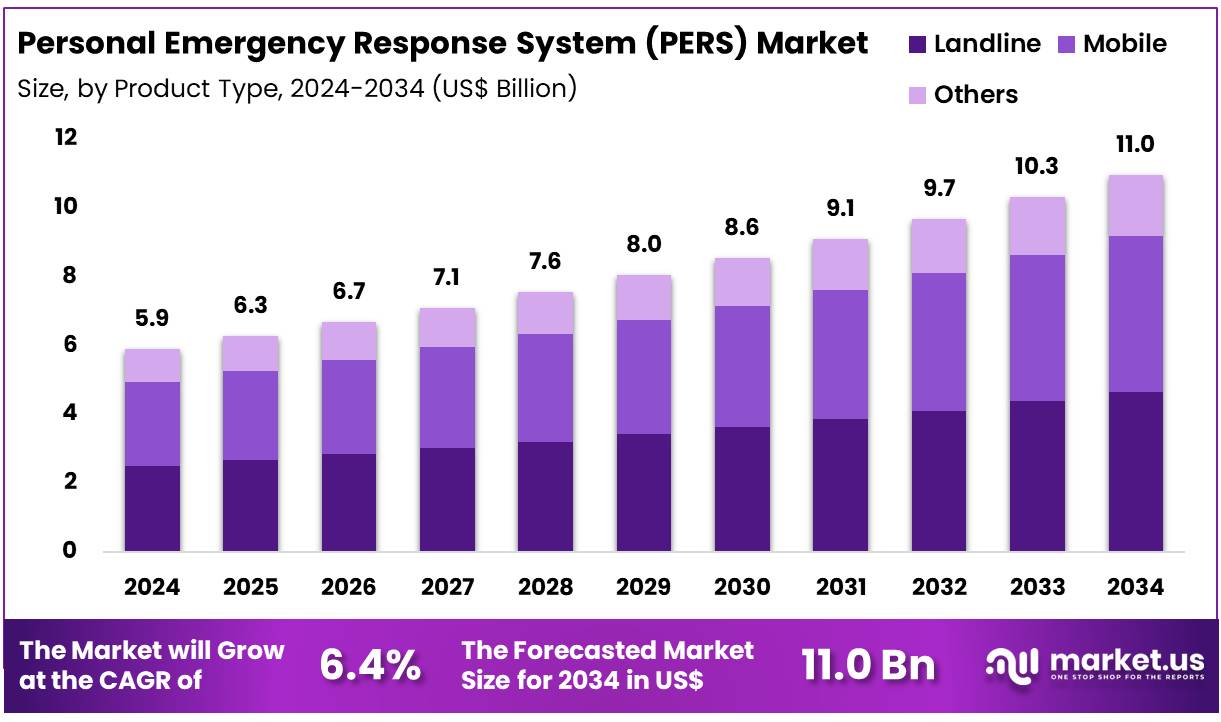
Key Takeaways
- In 2024, the Personal Emergency Response System (PERS) market generated revenue of US$ 5.9 billion and is projected to grow at a CAGR of 6.4%, reaching approximately US$ 11.0 billion by 2034.
- Based on product type, the market is segmented into landline, mobile, and other systems. The landline segment dominated in 2023, accounting for a market share of 42.4%.
- By end-user, the PERS market is categorized into home-based healthcare, assisted living facilities, and other users. The home-based healthcare segment held a leading position in 2023, capturing 58.7% of the market share.
- Regionally, North America emerged as the leading market in 2023, holding a significant share of 41.2%, driven by higher adoption of senior safety technologies and remote healthcare solutions.
Statistical Information
- High Fall Incidence Among Older Adults Driving Emergency Alert Adoption: Falls are one of the strongest healthcare drivers for PERS adoption. According to the CDC, approximately 28% of adults aged 65 years and older reported experiencing a fall in 2020–2021. In 2021, more than 38,700 older adults died due to unintentional fall-related injuries, showing the importance of rapid emergency communication and fall detection technologies.
- Caregiver Technology Adoption Supports PERS Integration: Caregivers are increasingly using digital tools to support older adults living independently. A 2024 study published through JMIR Aging surveyed 486 unpaid caregivers of older adults and found that caregivers used an average of 3.4 technology devices and 4.2 technology functions, demonstrating growing acceptance of technology-assisted caregiving.
- Nearly 3 Million Fall-Related Emergency Visits Highlight Need for Fall Detection: Falls remain a significant health risk among older adults and are a key driver for personal emergency response adoption. The CDC reported that in 2021, older adults experienced nearly 3 million emergency department visits due to falls. Additionally, falls caused more than 38,000 deaths among adults aged 65 years and older during 2021, emphasizing the importance of rapid emergency notification systems.
- 75% of Adults Prefer Aging at Home Increasing Demand for Home-Based PERS: Consumer preference for independent living is accelerating adoption of home safety technologies. AARP research found that approximately 75% of adults aged 50 and older want to remain in their current homes as they age, while 73% prefer to stay in their communities. PERS devices support this preference by providing emergency communication while maintaining independence.
- Around 80% of Adults Want Aging-in-Place Solutions: AARP research indicates that approximately 80% of adults aged 45 years and older prefer to remain in their homes and communities as they age. This behavioral shift is increasing interest in technologies such as wearable emergency buttons, smart sensors, medication reminders, and caregiver communication platforms.
- Older Adult Falls Affect More Than 14 Million People Annually: Falls are a major healthcare challenge among older adults and directly support demand for fall detection-enabled PERS solutions. According to the CDC, more than 14 million adults aged 65 years and older, or approximately 1 in 4 older adults, report falling every year. Around 37% of older adults who fall experience injuries requiring medical treatment or activity restrictions, increasing the need for immediate emergency communication.
- Aging-in-Place Preference Supports Home-Based Healthcare Growth: Consumer preference for remaining at home is increasing demand for safety technologies. AARP research indicates that approximately 77% of adults aged 50 and older prefer to remain in their current homes as they age. PERS solutions support this preference by enabling emergency communication while reducing dependence on institutional care.
- Around 9 Million Fall Injuries Require Medical Attention or Activity Restriction: Not all falls lead to hospitalization, but many create serious health challenges. CDC data indicates that approximately 37% of older adults who fall report injuries requiring medical treatment or limiting normal activities for at least one day, resulting in an estimated 9 million fall injuries annually. This increases demand for PERS systems with automatic alerts and emergency communication capabilities.
Regional Analysis
North America led the market by securing a market share of 41.2% in 2023.
North America remains a major region for PERS adoption due to its aging population, advanced healthcare infrastructure, and increasing demand for aging-in-place solutions. The region’s growth is supported by rising fall-related risks among older adults, with the CDC reporting that adults aged 65 years and older had an unintentional fall death rate of 69.9 per 100,000 population in 2023, including 74.2 for men and 66.3 for women.
Growing adoption of wearable emergency alerts, GPS-enabled devices, remote monitoring, and smart home integrations is improving senior safety and caregiver support. Medicare-supported remote monitoring programs and increasing healthcare technology adoption are further encouraging connected care solutions. Asia Pacific is expected to witness strong growth in PERS adoption due to rapid population aging, expanding digital healthcare infrastructure, and government focus on elderly support systems.
According to UN ESCAP, the region had approximately 670 million people aged 60 years or older in 2022, representing about one in seven people, and this number is projected to reach 1.3 billion by 2050. Countries such as Japan and South Korea are increasing investments in smart elderly care, remote monitoring, and community-based safety programs. Rising use of mobile connectivity, IoT-enabled devices, and AI-based monitoring solutions is creating new opportunities for PERS providers across urban and rural communities.
Emerging Trends
- AI-Based Fall Detection and Predictive Safety Monitoring: Artificial intelligence is improving PERS platforms by enabling faster and more accurate fall detection. Advanced sensors analyze movement patterns, balance changes, and abnormal activity before emergencies occur. CDC data shows over 14 million adults aged 65+ experience falls annually, creating demand for predictive monitoring technologies that can reduce injury risks.
- Integration of Wearables With Remote Health Monitoring: Wearable-based PERS devices are evolving from emergency buttons into connected health platforms. These systems monitor vital signs such as heart rate, blood pressure, glucose, and activity levels. CMS supports remote patient monitoring using connected devices that transmit health information, including blood pressure, weight, and glucose data, for chronic care management.
- Growth of Aging-in-Place Technologies: The preference for independent living is increasing adoption of PERS solutions among older adults. The National Institute on Aging recommends emergency medical alert systems, wearable monitors, and electronic safety devices to help seniors manage emergencies while living at home. These technologies support safer aging and reduce caregiver concerns.
- Smart Home and IoT-Based Emergency Response Ecosystems: IoT integration is transforming PERS by connecting wearable devices, home sensors, smartphones, and caregiver platforms. Smart systems can automatically detect unusual activity, send alerts, and support remote supervision. With more than 14 million annual fall incidents among older adults, connected home safety solutions are becoming increasingly important for elderly care.
- Expansion of Remote Patient Monitoring for Chronic Diseases: PERS providers are adding chronic disease monitoring features to support patients with long-term conditions. CMS states that remote monitoring programs use internet-connected medical devices and require health data transmission at least 2 days within 30 days for eligible Medicare services. This supports integration of PERS with healthcare workflows.
Use Cases
- Fall Detection for Elderly Individuals Living Independently: Fall detection remains one of the largest applications of PERS technology. Devices using motion sensors, artificial intelligence, and automatic alerts help seniors receive immediate assistance after falls. CDC reports that falls are the leading cause of injury among adults aged 65 years and older, with approximately 1 in 4 seniors falling annually.
- Chronic Disease Monitoring for Home Healthcare Patients: PERS systems are increasingly used for patients managing cardiovascular disease, diabetes, and hypertension. Connected devices collect health information and transmit it to healthcare providers for remote assessment. CMS recognizes remote monitoring solutions for managing chronic and acute conditions using connected medical devices.
- Assisted Living Facility Safety Management: Assisted living centers are adopting PERS solutions to improve resident monitoring and emergency response. Wearable devices, location tracking, and automated alerts help caregivers respond quickly to falls, wandering incidents, and medical emergencies. CDC data showing 69.9 fall deaths per 100,000 adults aged 65+ in 2023 highlights the need for improved safety systems
- Post-Hospitalization Remote Follow-Up Programs: Healthcare providers are using connected PERS solutions for monitoring patients after discharge. Remote monitoring enables early identification of health deterioration and supports follow-up care outside hospitals. CMS highlights that connected monitoring devices allow providers to review patient data remotely and make treatment decisions for chronic and acute conditions.
- Caregiver Support and Emergency Communication: PERS platforms are increasingly supporting family caregivers through real-time alerts, location tracking, and communication features. The National Institute on Aging identifies emergency alert systems as useful tools for older adults who may experience falls, medical emergencies, or situations requiring urgent assistance while living at home.
Frequently Asked Questions on Personal Emergency Response System (PERS)
- What factors are driving the growth of the PERS Market?
The PERS market is growing due to rising elderly populations, increasing fall incidents, chronic disease prevalence, demand for aging-in-place solutions, and adoption of wearable healthcare technologies that provide real-time monitoring, emergency alerts, and caregiver communication. - How do PERS devices improve elderly safety?
PERS devices improve elderly safety by providing immediate emergency communication during falls, medical events, or accidents. Features such as automatic fall detection, GPS tracking, voice assistance, and caregiver alerts help reduce response times and support independent living. - Who are the major end-users of PERS solutions?
Major end-users of PERS solutions include home-based healthcare users, elderly individuals living independently, assisted living facilities, nursing homes, caregivers, and healthcare providers. These systems support emergency response, chronic disease monitoring, and improved patient safety. - How does remote patient monitoring support the PERS Market?
Remote patient monitoring expands PERS capabilities by allowing healthcare providers to track patient health information remotely. Integration of connected devices enables monitoring of vital signs, early identification of health changes, and improved management of chronic conditions. - Why is home-based healthcare a significant segment in the PERS Market?
Home-based healthcare represents a significant PERS segment because many older adults prefer aging independently at home. Emergency response systems provide safety assurance by enabling quick assistance, reducing caregiver concerns, and supporting long-term independent living. - What technological advancements are shaping the PERS Market?
Technological advancements shaping the PERS market include artificial intelligence-based fall detection, smart wearables, voice-enabled systems, cloud connectivity, mobile applications, GPS tracking, and integration with healthcare platforms for personalized and preventive care. - What is the future outlook for the PERS Market?
The future of the PERS market is expected to focus on connected healthcare ecosystems combining artificial intelligence, wearable devices, IoT platforms, and remote monitoring solutions. These advancements will support personalized care, preventive healthcare, and improved emergency response services.
Conclusion
The Personal Emergency Response System (PERS) market is evolving rapidly due to increasing elderly populations, rising fall-related risks, and growing demand for independent living solutions. Advancements in wearable technology, artificial intelligence, IoT connectivity, and remote patient monitoring are transforming traditional emergency alert systems into advanced healthcare support platforms.
PERS solutions are improving safety for seniors, chronic disease patients, and individuals requiring continuous monitoring. Growing adoption across home healthcare, assisted living facilities, and healthcare organizations highlights the importance of connected care models. With increasing focus on preventive healthcare and aging-in-place strategies, PERS technologies will continue to play a vital role in enhancing patient safety and independence.
Discuss your needs with our analyst
Please share your requirements with more details so our analyst can check if they can solve your problem(s)




