


Overview
New York, NY – Aug 07, 2026 – The Global Digital Telepathology Market Size is expected to be worth around US$ 2.3 Billion by 2034 from US$ 0.9 Billion in 2024, growing at a CAGR of 9.6% during the forecast period 2025 to 2034. North America held a dominant market position, capturing more than a 35.7% share and a US$ 0.3 Billion market value for the year.
The digital telepathology market is expanding rapidly due to the increasing cancer burden, shortage of qualified pathologists, and growing demand for faster diagnostic services. Traditional pathology workflows rely heavily on manual slide examination, which creates delays as testing volumes continue to increase. According to the CDC, more than 2.0 million new cancer cases are projected in the United States in 2025, along with approximately 618,000 cancer-related deaths, increasing the need for efficient digital diagnostic platforms.
The shortage of pathology specialists is further accelerating adoption of telepathology solutions. Digital platforms enable pathologists to review whole-slide images remotely, collaborate across locations, and provide faster expert opinions. According to the Association of American Medical Colleges (AAMC), the United States could face a shortage of up to 86,000 physicians by 2036, including shortages in specialized medical fields that impact diagnostic services.
Cloud-based infrastructure and strategic technology partnerships are becoming important market trends. High-resolution whole-slide imaging systems generate large datasets, with a single digital pathology slide often requiring 1–5 gigabytes (GB) of storage capacity. In March 2024, AWS and Philips collaborated to develop secure cloud-based digital pathology solutions, supporting scalable data management and remote diagnostic collaboration.
Artificial intelligence (AI) is creating new opportunities by improving image analysis, tumor detection, and workflow automation. As of August 2024, the FDA’s Center for Devices and Radiological Health had authorized more than 950 AI-enabled medical devices, demonstrating increasing acceptance of AI-driven healthcare technologies. AI integration in telepathology is expected to support applications including cancer diagnosis, second opinions, clinical research, and medical education.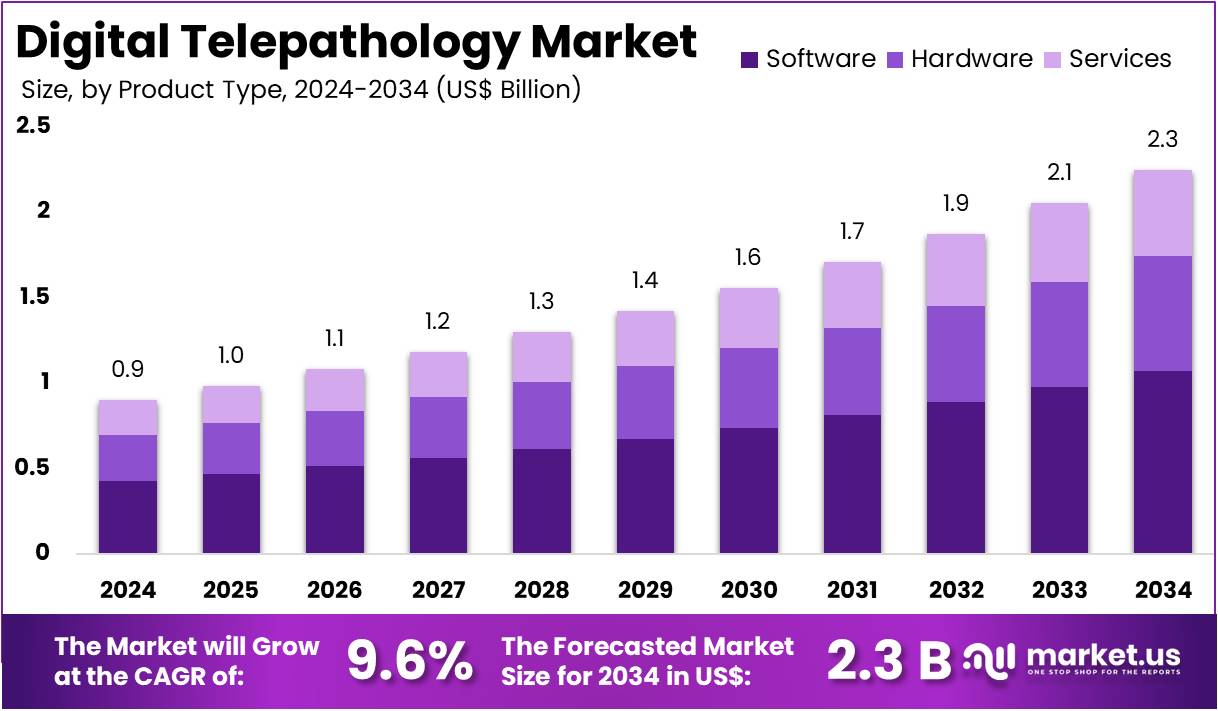
Key Takeaways
- In 2024, the digital telepathology market generated revenue of US$ 0.9 billion and is projected to grow at a CAGR of 9.6%, reaching US$ 2.3 billion by 2034.
- Based on product type, the market is segmented into software, hardware, and services. The software segment dominated in 2023, accounting for a market share of 47.5%.
- By application, the market is categorized into primary diagnosis, second opinion, research, and education & training. The primary diagnosis segment held the leading position in 2023, with a significant market share of 38.3%.
- Based on end-user, the market is divided into hospitals & clinics, diagnostic laboratories, and academic & research institutes. The hospitals & clinics segment dominated the market, capturing the largest revenue share of 45.0%.
- Regionally, North America emerged as the leading market in 2023, holding a dominant revenue share of 35.7%.
Statistical Information
- Increasing Cancer Incidence Creating Higher Demand for Digital Telepathology Solutions: The growing cancer burden is increasing the number of pathology examinations and creating pressure on diagnostic laboratories. According to the National Cancer Institute (NCI), approximately 2,041,910 new cancer cases and 618,120 cancer deaths are estimated in the United States in 2025. Cancer diagnosis depends heavily on pathology services, increasing demand for faster slide analysis, remote consultation, and digital pathology workflows.
- Rising Cancer Screening Volume Increasing Pathology Workload: Higher screening and diagnostic testing volumes are increasing demand for efficient pathology systems. The American Cancer Society estimates that in 2024, approximately 2,001,140 new cancer cases and 611,720 cancer deaths occurred in the United States. The growing number of biopsies and tissue examinations is encouraging healthcare providers to adopt digital solutions that improve diagnostic speed and collaboration.
- Growing Adoption of Digital Pathology Among Healthcare Organizations: Digital pathology adoption is increasing as hospitals and laboratories move from traditional microscopes toward whole-slide imaging systems. A College of American Pathologists (CAP) survey involving 879 pathology professionals reported that 6.9% of respondents were using whole-slide imaging systems, showing early adoption and significant future expansion opportunities
- Increasing Use of Digital Pathology for Remote Consultation and Second Opinions: Digital pathology is improving access to specialist opinions and supporting collaboration between healthcare institutions. Research published through PubMed reported that 92% of pathology trainees considered whole-slide images suitable for primary diagnosis, while 93% considered them useful for second opinions. These findings demonstrate growing confidence in digital pathology-based consultations.
- Increasing Number of Cancer Survivors Creating Long-Term Diagnostic Demand: The growing population of cancer survivors is increasing the need for continuous monitoring, follow-up testing, and pathology-based evaluations. According to the National Cancer Institute (NCI), the United States had approximately 18.1 million cancer survivors in January 2022, representing about 5.4% of the population. The rising survivor population is increasing demand for efficient pathology services, including digital slide review and remote consultations.
- Digital Pathology Adoption Still Has Significant Growth Potential: Although digital pathology adoption is increasing, many laboratories are still transitioning from traditional microscopy. According to the College of American Pathologists (CAP), a 2025 Pathologist Leadership Survey showed that only 26% of 378 practice leaders reported digitizing glass slides using whole-slide imaging, while 74% had not yet implemented WSI digitization. This indicates substantial future adoption opportunities.
- Increasing Role of AI in Pathology Image Analysis: AI-based image analysis is improving the ability to detect patterns in pathology slides. Research studies have demonstrated that deep-learning systems trained on thousands of pathology images can support cancer classification and diagnostic assistance. One study developed an AI system using 5,070 training images and evaluated performance on 13,537 images from three test laboratories, demonstrating potential for scalable pathology automation.
Regional Analysis
North America led the market by securing a market share of 35.7% in 2023.
North America holds a leading position in the digital telepathology market due to advanced healthcare infrastructure, increasing cancer diagnosis volumes, and strong regulatory support for digital pathology adoption. The U.S. FDA has supported clinical adoption of whole-slide imaging technologies, with the first digital pathology whole-slide imaging system authorized in 2017.
In 2024, the FDA’s oncology device program authorized 76 oncology devices, including digital pathology solutions such as whole-slide imaging systems and interoperable viewing software, strengthening innovation in AI-assisted diagnostics. Asia Pacific is expected to witness significant growth as governments and healthcare organizations increase investment in digital health, artificial intelligence, and remote diagnostic infrastructure.
Countries such as Japan, South Korea, Singapore, and Australia are expanding digital healthcare programs to improve specialist access and diagnostic efficiency. The Australian Government allocated approximately $107.2 million in the 2022–23 Budget for digital health programs and innovations to modernize healthcare delivery.
Emerging Trends
- Artificial Intelligence (AI) Integration in Digital Pathology Diagnosis: AI-powered digital telepathology is becoming a major trend as healthcare providers use algorithms for faster slide analysis, tumor identification, and diagnostic support. A 2024 systematic review analyzed 100 AI digital pathology studies involving more than 152,000 whole-slide images (WSIs) and reported average AI sensitivity of 96.3% and specificity of 93.3%.
- Expansion of Whole-Slide Imaging for Remote Diagnosis: Whole-slide imaging (WSI) is transforming pathology by converting glass slides into high-resolution digital images that can be reviewed remotely. The FDA authorized the first whole-slide imaging system for primary diagnosis in 2017 after evaluating approximately 2,000 surgical pathology cases, supporting wider adoption of digital pathology workflows.
- Cloud-Based Digital Pathology Platforms Supporting Remote Collaboration: Cloud infrastructure is becoming essential for digital telepathology because whole-slide images generate very large datasets, often reaching gigabyte-level file sizes. Cloud platforms allow hospitals, research centers, and pathology specialists to securely share images, support second opinions, and conduct remote consultations across different locations.
- AI Foundation Models Improving Cancer Research and Precision Medicine: Large-scale AI models are emerging as a new trend in computational pathology. The Virchow pathology AI model was trained using 1.5 million hematoxylin and eosin (H&E) whole-slide images and contains 632 million parameters, enabling advanced cancer detection, biomarker analysis, and precision medicine research applications.
- Increasing Use of Digital Pathology in Clinical Trials and Drug Development: Pharmaceutical companies are increasingly using digital pathology for clinical research, biomarker discovery, and treatment response evaluation. The National Cancer Institute (NCI) highlights digital pathology imaging as an important tool for cancer clinical trials, enabling centralized pathology reviews, AI-based biomarker assessment, and improved analysis of tumor characteristics.
Use Cases
- Remote Primary Diagnosis and Second Opinion Services: Digital telepathology enables pathologists to review slides remotely without transporting physical glass slides. Studies found 92% of pathology trainees considered whole-slide images suitable for primary diagnosis, while 93% considered them useful for second opinions.
- AI-Assisted Cancer Detection and Tumor Analysis: AI-based telepathology solutions support cancer identification, biomarker measurement, and treatment planning. AI systems analyze large pathology datasets to improve workflow efficiency, especially in breast, prostate, and lung cancer diagnosis applications.
- Virtual Tumor Boards and Multidisciplinary Consultations: Hospitals are using digital pathology platforms for virtual tumor boards, allowing oncologists, surgeons, radiologists, and pathologists to review complex cases remotely. These systems improve specialist collaboration and reduce geographic limitations in cancer care.
- Pathology Education and Medical Training: Digital telepathology supports online pathology education by allowing multiple students and trainees to review high-resolution slides simultaneously. Digital platforms improve access to training resources and support standardized education programs across medical institutions.
- Interoperability and Standardized Digital Pathology Systems: Healthcare providers are focusing on integrating digital pathology with electronic health records and laboratory systems. In the United States, approximately 10 whole-slide imaging systems have received FDA clearance or approval, supporting wider clinical implementation.
Frequently Asked Questions on Digital Telepathology
- What factors are driving the growth of the digital telepathology market?
The digital telepathology market is driven by rising cancer cases, shortage of specialized pathologists, increasing demand for remote diagnosis, and adoption of artificial intelligence. Healthcare organizations are using digital solutions to improve diagnostic speed, accuracy, collaboration, and workflow efficiency. - How is artificial intelligence impacting digital telepathology?
Artificial intelligence is transforming digital telepathology by enabling automated image analysis, tumor detection, biomarker identification, and diagnostic assistance. AI algorithms help pathologists analyze large volumes of pathology images faster while improving consistency and supporting precision medicine applications. - What role does whole-slide imaging play in digital telepathology?
Whole-slide imaging is a key technology in digital telepathology that converts glass slides into high-resolution digital images. These images allow remote review, second opinions, multidisciplinary collaboration, and integration with artificial intelligence tools for advanced pathology analysis. - What are the major applications of digital telepathology?
Major applications include primary diagnosis, second opinions, cancer research, clinical trials, pathology education, and remote consultations. Digital telepathology helps healthcare providers improve access to pathology expertise, especially in regions facing specialist shortages and increasing diagnostic workloads. - Why are hospitals adopting digital telepathology solutions?
Hospitals are adopting digital telepathology to reduce diagnostic delays, improve specialist collaboration, and manage increasing pathology workloads. These systems support remote consultations, virtual tumor boards, faster case reviews, and better utilization of limited pathology resources across healthcare networks. - How is digital telepathology used in cancer diagnosis?
Digital telepathology supports cancer diagnosis by allowing pathologists to analyze tumor samples remotely using high-resolution digital slides. AI-based tools assist in identifying cancer patterns, evaluating biomarkers, and supporting treatment decisions, particularly in oncology and precision medicine applications. - What is the future outlook for the digital telepathology market?
The future of digital telepathology is expected to focus on AI integration, cloud-based platforms, interoperability, and remote diagnostic networks. Increasing healthcare digitization, rising disease burden, and demand for faster pathology services will continue supporting market expansion.
Conclusion
The digital telepathology market is evolving rapidly due to increasing cancer cases, shortage of skilled pathologists, and growing demand for faster diagnostic solutions. Advancements in whole-slide imaging, cloud computing, artificial intelligence, and interoperability are improving remote pathology services and enabling more accurate clinical decisions.
Hospitals, research institutions, and pharmaceutical companies are increasingly adopting digital platforms for diagnosis, clinical trials, education, and collaboration. Supportive regulatory frameworks and rising healthcare digitalization are further accelerating adoption. With continuous technological innovation and increasing demand for efficient pathology workflows, digital telepathology is expected to become an essential component of modern healthcare systems worldwide.
Discuss your needs with our analyst
Please share your requirements with more details so our analyst can check if they can solve your problem(s)




