


Overview
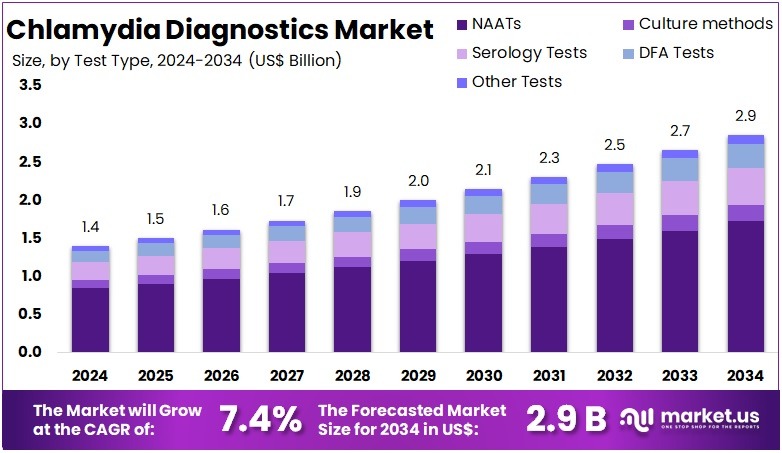
The Global Chlamydia Diagnostics Market size is expected to be worth around US$ 2.9 Billion by 2034, from US$ 1.4 Billion in 2024, growing at a CAGR of 7.4% during the forecast period from 2025 to 2034. North America held a dominant market position, capturing more than a 37.7% share and holding US$ 527.8 million market value for the year.
The global Chlamydia Diagnostics Market is witnessing steady growth as healthcare systems increase screening programs, sexually transmitted infection (STI) awareness, and adoption of advanced molecular testing technologies. Chlamydia, caused by Chlamydia trachomatis, remains one of the most commonly reported bacterial STIs worldwide, creating significant demand for accurate and rapid diagnostic solutions.
According to the World Health Organization, an estimated 129 million new chlamydia infections occur globally each year, highlighting the need for effective testing strategies. Nucleic acid amplification tests (NAATs), including polymerase chain reaction (PCR)-based platforms, have become the preferred diagnostic approach due to their high sensitivity and ability to detect infections from urine and swab samples.
The market is supported by increasing government-led screening initiatives, particularly among sexually active young adults. In the United States, the Centers for Disease Control and Prevention reported more than 1.6 million chlamydial infections in 2022, demonstrating the continued burden of the disease and the importance of routine testing.
Technological advancements are improving diagnostic efficiency through automated molecular platforms, multiplex STI panels, and point-of-care testing solutions that deliver results within hours. Growing healthcare expenditure, rising awareness campaigns, and improved access to sexual health services are further accelerating market expansion.
With increasing emphasis on early detection to prevent complications such as pelvic inflammatory disease and infertility, the Chlamydia Diagnostics Market is expected to experience sustained growth. Manufacturers are focusing on developing faster, cost-effective, and user-friendly diagnostic platforms to address the rising global demand for STI testing.
Key Takeaways
- The Global Chlamydia Diagnostics Market is expected to expand to approximately US$ 2.9 billion by 2034, increasing from US$ 1.4 billion in 2024, with a CAGR of 7.4% during the forecast period.
- Nucleic Acid Amplification Tests (NAATs) emerged as the dominant test type segment in 2024, accounting for more than 60.3% of the overall Chlamydia Diagnostics Market share.
- Swabs held the largest share among sample types in 2024, representing over 43.5% of the global chlamydia diagnostics market.
- Hospitals were the leading end-user segment in 2024, contributing more than 39.8% of the total Chlamydia Diagnostics Market revenue.
- North America maintained its leading position in the regional market in 2024, capturing over 37.7% of the global market share and generating a market value of US$ 527.8 million.
Statistical Information
- A 2025 multicenter evaluation of the Cobas Liat CT/NG/MG nucleic acid amplification test (NAAT) included 4,800 evaluable participants across 13 point-of-care (POC) sites to assess Chlamydia trachomatis diagnostic performance.
- The Cobas Liat CT/NG/MG test demonstrated Chlamydia trachomatis sensitivity of ≥92% for evaluated specimen types except female urine (≥87%) in the 2025 clinical performance study.
- The same 2025 study reported specificity above 97% for each tested pathogen target, including Chlamydia trachomatis, showing high diagnostic accuracy in point-of-care testing environments.
- The Cobas Liat CT/NG/MG point-of-care molecular assay delivered results in approximately 20 minutes, reducing the waiting period compared with conventional centralized NAAT workflows.
- The 2025 Cobas Liat evaluation found no statistically significant performance difference between trained and untrained users, indicating consistent operation across different user skill levels.
- A 2026 review of laboratory-based molecular diagnostics for Chlamydia trachomatis and Neisseria gonorrhoeae evaluated current NAAT technologies and included performance comparisons from clinical laboratory systems used in STI testing programs.
- The 2025 Journal of Clinical Microbiology study used three FDA-approved NAATs plus one laboratory-developed test as a composite reference standard for validating Chlamydia diagnostic performance.
- The Cobas Liat clinical study included 1,941 symptomatic participants (40.4%) and 2,489 participants female at birth (51.9%), providing performance data across diverse testing populations.
- The 2025 point-of-care NAAT evaluation tested both clinician-collected and self-collected urine/vaginal swab specimens, demonstrating operational flexibility across 2 major sample collection approaches.
Regional Analysis
North America dominated the Chlamydia Diagnostics Market in 2024, accounting for more than 37.7% share with a market value of US$ 527.8 million. The region’s leadership is driven by advanced healthcare infrastructure, widespread STI screening programs, and strong awareness regarding early detection. Government initiatives promoting sexually transmitted infection prevention and routine testing have improved diagnostic adoption across hospitals, clinics, and laboratories.
The increasing use of nucleic acid amplification tests (NAATs) has strengthened diagnostic accuracy, offering faster and more reliable detection compared with traditional methods. Supportive reimbursement policies, healthcare investments, and expanded access to testing services have further accelerated market growth.
Continuous research activities, technological advancements, and the presence of established diagnostic companies in the United States and Canada are expected to maintain North America’s leading position in the global Chlamydia Diagnostics Market.
Emerging Trends
- Increasing Adoption of Molecular NAAT-Based Diagnostics: Nucleic Acid Amplification Tests (NAATs) are becoming the leading diagnostic technology for chlamydia detection due to high sensitivity and specificity. WHO recommends NAAT-based methods as preferred testing approaches. With approximately 128.5 million new chlamydia infections reported globally in 2020, demand for accurate molecular diagnostics continues to increase.
- Rising Demand for Self-Sampling Diagnostic Methods: Self-collected samples, including vaginal swabs and urine specimens, are gaining importance as they improve privacy, accessibility, and patient participation. WHO supports self-sampling approaches because they provide comparable diagnostic performance. This trend is expanding screening opportunities among populations where clinic-based testing participation remains limited.
- Expansion of Government-Led Screening Programs: National healthcare agencies are increasing routine chlamydia screening initiatives to improve early detection and reduce complications. The CDC recommends annual screening for sexually active women aged under 25 years and targeted testing for high-risk populations, supporting continuous demand for diagnostic solutions.
- Advancement of Rapid Point-of-Care Testing Technologies: Point-of-care molecular platforms are emerging to provide faster diagnosis and enable immediate treatment decisions. Healthcare systems are focusing on reducing diagnostic delays, as untreated chlamydia can lead to complications. WHO identifies rapid STI testing as a key requirement for improving access in resource-limited settings.
- Growth of Multiplex STI Diagnostic Platforms: Multiplex testing systems that detect chlamydia along with gonorrhea and other sexually transmitted infections are gaining adoption. WHO estimates that more than 1 million curable STIs are acquired every day worldwide, encouraging healthcare providers to use comprehensive testing platforms for efficient disease management.
Use Cases
- Screening of Sexually Active Young Adults: Chlamydia diagnostic tests are widely used for routine screening among young adults due to higher infection risks and frequent asymptomatic cases. CDC recommends annual screening for sexually active women below 25 years, making diagnostic testing essential in preventive healthcare programs.
- Prenatal Testing to Prevent Pregnancy Complications: Chlamydia diagnostics are increasingly used during pregnancy screening to reduce risks such as premature birth and neonatal infections. CDC recommends testing pregnant women at increased risk and retesting during pregnancy when necessary, supporting the use of reliable diagnostic methods in maternal healthcare.
- Sexual Health Clinic Testing Programs: Sexual health clinics use molecular diagnostic tests for identifying chlamydia infections and preventing transmission. Testing programs help detect infections that often show no symptoms. Public health organizations emphasize early diagnosis because untreated infections can contribute to reproductive health complications.
- Population-Level Public Health Surveillance: Chlamydia diagnostics support government surveillance programs by providing infection data for monitoring disease trends. In the United States, CDC reported more than 1.6 million chlamydia cases in 2022, demonstrating the continued need for effective diagnostic monitoring and prevention strategies.
- Decentralized Testing in Community Healthcare Settings: Chlamydia diagnostics are increasingly deployed in community clinics, mobile health programs, and outreach settings to improve testing access. Portable molecular platforms and self-collection methods help reach underserved populations, supporting broader STI control initiatives and improving early treatment opportunities.
Frequently Asked Questions on Chlamydia Diagnostics
- Which diagnostic method is commonly used for Chlamydia detection?
Nucleic acid amplification tests (NAATs) are the most commonly used diagnostic method for chlamydia detection because they provide high sensitivity and specificity. These tests can detect bacterial genetic material from urine or swab samples and support faster, more reliable clinical decisions. - Why is early Chlamydia diagnosis important?
Early chlamydia diagnosis is important because many infections show no symptoms but can cause serious complications if untreated. Timely detection helps prevent pelvic inflammatory disease, infertility risks, and transmission to sexual partners while improving overall sexual healthcare management. - What samples are used in Chlamydia Diagnostic testing?
Chlamydia diagnostic testing commonly uses urine samples, vaginal swabs, cervical swabs, urethral swabs, and rectal or throat specimens. Sample selection depends on patient risk factors, infection location, and healthcare guidelines to ensure accurate detection of Chlamydia trachomatis. - What factors are driving the growth of the Chlamydia Diagnostics Market?
The chlamydia diagnostics market is expanding due to increasing sexually transmitted infection awareness, rising screening programs, advanced molecular technologies, and improved healthcare access. Growing demand for rapid, accurate, and convenient testing solutions is encouraging healthcare providers to adopt modern diagnostic platforms. - What role do NAATs play in the Chlamydia Diagnostics Market?
NAATs play a major role in the chlamydia diagnostics market because they offer high accuracy, faster turnaround time, and reliable detection compared with traditional methods. Their ability to test multiple sample types has increased adoption across hospitals, diagnostic laboratories, and screening programs. - What are the challenges affecting the Chlamydia Diagnostics Market?
The chlamydia diagnostics market faces challenges including limited awareness, low screening rates among asymptomatic individuals, restricted healthcare access, and diagnostic infrastructure gaps in developing regions. These factors can delay infection detection and reduce the effectiveness of prevention and treatment programs. - How do government initiatives support Chlamydia Diagnostics adoption?
Government initiatives support chlamydia diagnostics adoption through STI screening recommendations, awareness campaigns, prevention programs, and investments in healthcare infrastructure. Public health organizations encourage regular testing and early detection strategies to reduce infection spread and improve population health outcomes.
Conclusion
The Chlamydia Diagnostics Market is witnessing continuous expansion as healthcare systems focus on improving sexually transmitted infection detection, prevention, and treatment outcomes. Growing awareness regarding asymptomatic infections, increasing screening programs, and technological advancements in molecular diagnostic platforms are enhancing market adoption.
NAAT-based testing solutions are gaining importance due to their high sensitivity, accuracy, and faster results compared with conventional methods. Supportive government initiatives, improved laboratory capabilities, and rising demand for cost-effective diagnostic solutions are expected to create new opportunities. Future market growth will depend on innovation in rapid testing technologies, wider accessibility, and integration of advanced diagnostic approaches across healthcare settings.
Discuss your needs with our analyst
Please share your requirements with more details so our analyst can check if they can solve your problem(s)




