


Overview
New York, NY – Aug 12, 2026 – The Global Organ Preservation Market size is expected to reach around US$ 364.4 Million by 2034, up from US$ 183.5 Million in 2024, growing at a CAGR of 7.1% during the forecast period from 2025 to 2034. North America held a dominant market position, capturing more than a 44.2% share and holding a US$ 81.107 Million market value for the year.
The global organ preservation market is witnessing significant growth due to increasing organ transplantation procedures, rising donor activity, and advancements in preservation technologies. Organ preservation systems, including static cold storage, hypothermic machine perfusion, normothermic machine perfusion, and advanced preservation solutions, help maintain organ viability, reduce ischemic damage, and improve transplant outcomes.
According to global transplant data, more than 172,000 organ transplants were performed worldwide in 2023, representing a 9.5% increase compared with 2022. In the United States, deceased donor activity continued expanding, with 40,588 deceased-donor organ transplants in 2023, compared with 37,316 in 2022. The country also recorded 16,335 deceased organ donors in 2023, showing a 9.6% year-over-year increase.
The rising number of recovered and transplanted organs is encouraging hospitals and transplant centers to adopt advanced preservation technologies. The U.S. recorded 48,149 total transplants in 2024, including 41,119 deceased-donor transplants and 7,030 living-donor transplants. Kidney transplantation reached a record 27,759 procedures in 2024, highlighting the need for efficient preservation solutions.
Technological developments in machine perfusion are further transforming the market by enabling longer preservation periods and real-time organ quality assessment. Growing adoption of donation-after-circulatory-death (DCD) programs, increasing government support, and persistent transplant waiting lists are expected to accelerate demand for reliable organ preservation systems. With more than 107,000 candidates on the U.S. transplant waiting list in 2024, advanced preservation technologies remain essential for improving organ utilization and patient outcomes.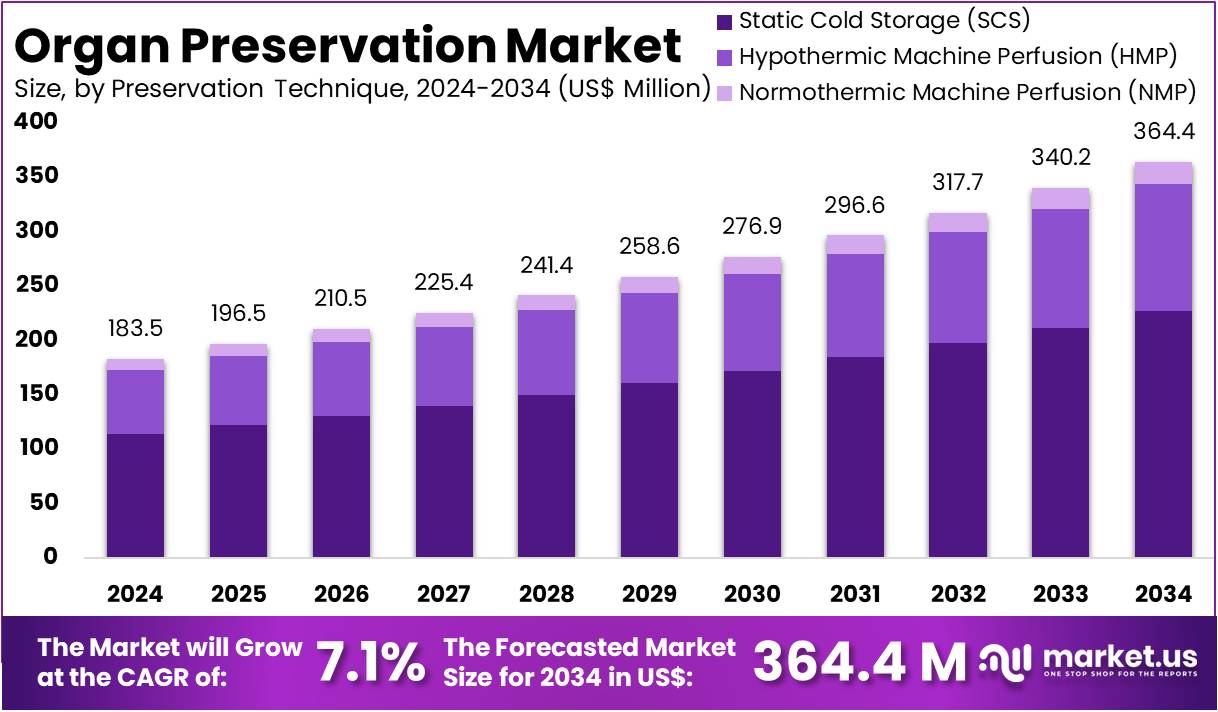
Key Takeaways
- The global Organ Preservation Market is estimated to increase from US$ 183.5 million in 2024 to US$ 364.4 million by 2034.
- The market is expected to expand at a CAGR of 7.1% from 2025 to 2034, supported by rising transplant procedures and advancements in preservation technologies.
- In 2024, the Opioids segment dominated the Drug Class category, accounting for more than 48.5% of the overall market share.
- The Kidney segment held the leading position in the Organ Type category in 2024, representing over 47.6% of the Organ Preservation Market share.
- The University of Wisconsin (UW) Solution emerged as the leading Preservation Solution segment in 2024, capturing more than 47.5% of the segment share.
- Organ Transplant Centers were the largest end-user segment in 2024, holding a dominant market share of over 42.8%.
- North America accounted for the largest share of the global Organ Preservation Market in 2024, capturing 44.2% of the market with a valuation of US$ 81.107 million.
Statistical Information
- United States Recorded Record Organ Transplant Numbers Supporting Preservation System Adoption: The U.S. transplant system reported strong growth in 2024, with 42,048 organs transplanted from deceased donors, compared with 40,614 in 2023. The number of deceased donors also increased to 16,989 in 2024, up from 16,335 in 2023, strengthening the requirement for advanced preservation meth
- Kidney Transplants Remain the Largest Application Area for Organ Preservation Solutions: Kidney transplantation represents the largest transplant category, creating significant demand for preservation solutions such as cold storage fluids and machine perfusion systems. In 2024, the U.S. performed 27,660 kidney transplants, including 21,473 deceased-donor kidney transplants and 6,187 living-donor kidney transplants.
- Increasing Organ Recovery but Continued Non-Utilization Creates Demand for Better Preservation: Despite growth in organ recovery, some organs are still not transplanted because of quality concerns and preservation limitations. In 2024, the U.S. reported 11,244 recovered organs that were not transplanted, representing approximately 20.7% of recovered organs. Improved preservation systems can help reduce organ discard rates.
- Organ-Specific Growth Supports Demand for Specialized Preservation Systems: Different organ types require specialized preservation approaches. In 2024, U.S. deceased donor transplantation included 10,773 liver transplants, 4,623 heart transplants, and 3,334 lung transplants, highlighting demand for organ-specific preservation technologies.
- Increasing Liver Transplant Activity Supports Advanced Preservation Adoption: Liver transplantation continues to grow globally, increasing the need for improved preservation methods. In the United States, liver transplants reached 11,458 procedures in 2024, compared with 10,688 procedures in 2023, reflecting increased demand for reliable preservation systems that maintain liver quality during transportation.
- Lung Transplant Expansion Encourages Development of Normothermic Preservation Technologies: Lung transplantation is one of the most sensitive transplant procedures due to organ vulnerability. The U.S. recorded 3,340 lung transplants in 2024, increasing from 3,026 in 2023. Ex-vivo lung perfusion technologies are being used to evaluate and recover donor lungs previously considered unsuitable.
- U.S. Organ Transplant Volume Reached a Record Level in 2024: The United States achieved a new record in solid organ transplantation in 2024, with 42,048 total organs transplanted, compared with 40,614 in 2023. Growth in transplant volume increases demand for preservation solutions, transportation systems, and organ monitoring technologies
- Deceased Donor Growth Expands the Need for Organ Preservation Infrastructure: The number of deceased organ donors in the U.S. increased to 16,989 in 2024, representing a 4% increase from 16,335 donors in 2023. Higher donor availability requires efficient preservation and logistics systems to ensure recovered organs remain suitable for transplantation.
Regional Analysis
North America led the global Organ Preservation Market in 2024, with a commanding 44.2% share
North America maintained a leading position in the organ preservation market in 2024, supported by advanced healthcare infrastructure, high transplantation volumes, and strong adoption of innovative preservation technologies. The United States recorded 48,149 organ transplants in 2024, including 41,119 deceased-donor transplants and 7,030 living-donor transplants, creating significant demand for effective organ storage and perfusion systems.
The region’s growth is further supported by well-established transplant centers, government-supported allocation networks, and continuous investment in medical innovation. The U.S. transplant system achieved record activity, with 16,988 deceased donors in 2024, enabling more organs to become available for transplantation. Increasing adoption of hypothermic and normothermic machine perfusion technologies is helping improve organ assessment, reduce ischemic injury, and expand the use of higher-risk donor organs.
Rising kidney, liver, heart, and lung transplant procedures continue to strengthen demand for preservation solutions. Kidney transplantation reached 27,759 procedures in 2024, while liver and lung transplants also recorded growth, highlighting the need for reliable preservation infrastructure. With strong regulatory support, skilled healthcare professionals, and ongoing research collaborations, North America is expected to remain a key hub for organ preservation technology adoption.
Emerging Trends
- Growing Adoption of Machine Perfusion Technologies: Machine perfusion is becoming a major trend in organ preservation as transplant centers move beyond traditional cold storage. Hypothermic and normothermic perfusion systems allow continuous circulation, organ monitoring, and viability assessment. In the U.S., 46,750 solid organ transplants were performed in 2024, increasing demand for advanced preservation solutions.
- Increasing Use of Donation After Circulatory Death (DCD) Preservation Methods: DCD programs are expanding the donor pool and increasing the need for advanced preservation technologies. In 2024, the U.S. recorded 7,284 DCD donors, contributing significantly to transplant growth. Machine perfusion helps evaluate and improve the utilization of organs from these donors.
- Portable Organ Preservation Systems Improving Organ Transport: Portable perfusion devices are emerging as a key innovation by allowing organs to remain in controlled physiological conditions during transportation. These systems support longer travel distances and real-time monitoring. In 2024, the U.S. achieved 48,149 organ transplants, increasing demand for flexible transport solutions.
- Artificial Intelligence and Digital Monitoring in Organ Preservation: Digital technologies are increasingly being integrated into preservation systems to monitor temperature, pressure, oxygen levels, and organ performance. Advanced monitoring can support better decision-making before transplantation. With 62,112 organs recovered in the U.S. during 2024, improving assessment accuracy has become increasingly important.
- Expansion of Normothermic Machine Perfusion for Marginal Organs: Normothermic machine perfusion is gaining attention because it keeps organs closer to normal body conditions and enables functional testing before transplantation. This approach is especially useful for higher-risk kidneys, livers, hearts, and lungs. Kidney transplants reached 28,492 procedures in the U.S. in 2024, supporting demand for better preservation methods.
Use Cases
- Kidney Preservation for Increasing Transplant Volumes: Kidney transplantation represents the largest application area for preservation technologies. In 2024, the U.S. performed 28,492 kidney transplants, creating strong demand for cold storage solutions and machine perfusion systems that improve kidney quality assessment and reduce organ discard.
- Liver Preservation for Extended Donor Utilization: Liver preservation technologies are increasingly used to support complex transplantation cases and improve utilization of marginal donor organs. The U.S. recorded 11,458 liver transplants in 2024, highlighting the need for reliable preservation systems that maintain liver function before implantation.
- Lung Reconditioning Through Ex-Vivo Lung Perfusion: Ex-vivo lung perfusion (EVLP) is being used to evaluate, repair, and improve donor lungs before transplantation. This technology helps address limited lung availability by allowing assessment outside the body. The U.S. performed 3,404 lung transplants in 2024, supporting adoption of advanced lung preservation methods.
- Heart Preservation During Long-Distance Transportation: Portable heart preservation systems are being used to maintain donor heart quality during transportation and provide continuous monitoring. The U.S. completed 4,636 heart transplants in 2024, increasing the requirement for advanced technologies that extend preservation time and improve transplant coordination.
- Reducing Organ Discard Through Viability Testing: Organ preservation technologies are increasingly used to reduce the number of recovered organs that cannot be transplanted. In 2024, 29.3% of recovered kidneys were not transplanted, highlighting the need for improved assessment tools such as machine perfusion and biomarker-based evaluation.
Frequently Asked Questions on Organ Preservation
- Why is organ preservation important in transplantation?
Organ preservation is essential because it protects organs from ischemic injury during the period between donation and transplantation. Effective preservation methods maintain cellular function, extend transportation time, improve graft survival, and increase the chances of successful transplantation for recipients. - What are the major types of organ preservation methods?
The major organ preservation methods include static cold storage, hypothermic machine perfusion, normothermic machine perfusion, and controlled oxygenated rewarming. These techniques differ in temperature control, monitoring capability, and ability to assess organ quality before transplantation. - What factors are driving the growth of the organ preservation market?
The organ preservation market is growing due to increasing transplant procedures, rising organ donation programs, technological advancements, and higher demand for improved graft outcomes. Growth in kidney, liver, heart, and lung transplantation is encouraging healthcare providers to adopt advanced preservation systems. - Which organ segment dominates the organ preservation market?
The kidney segment represents a major application area in the organ preservation market because kidney transplantation has the highest procedure volume globally. Increasing kidney failure cases, donor shortages, and the need to reduce organ rejection are supporting demand for kidney preservation technologies. - What role do preservation solutions play in transplantation?
Preservation solutions maintain organ cells during storage by controlling temperature, preventing swelling, and reducing metabolic damage. Solutions such as University of Wisconsin (UW) solution are widely used for kidney, liver, and pancreas preservation before transplantation procedures. - How is technology influencing the organ preservation market?
Technological advancements are transforming organ preservation through portable perfusion devices, digital monitoring systems, and improved viability assessment tools. These innovations help extend preservation time, support long-distance transportation, and increase the successful utilization of donated organs. - How do government initiatives support the organ preservation market?
Government initiatives support organ preservation by improving donation systems, transplant coordination, and healthcare infrastructure. Programs managed by organizations such as OPTN and HRSA help increase organ availability, strengthen allocation systems, and encourage adoption of advanced preservation technologies.
Conclusion
The organ preservation market is experiencing steady growth due to increasing transplantation activities, rising organ donation rates, and advancements in preservation technologies. Growing adoption of machine perfusion, portable preservation systems, and advanced solutions is improving organ quality, extending preservation time, and reducing transplant failures.
Rising demand for kidney, liver, heart, and lung transplants continues to create new opportunities for healthcare providers and technology developers. Government support, improved transplant infrastructure, and ongoing clinical research are further strengthening market expansion. As organ shortages remain a global challenge, innovative preservation methods will play a critical role in increasing organ availability and improving patient outcomes.
Discuss your needs with our analyst
Please share your requirements with more details so our analyst can check if they can solve your problem(s)




