


Overview
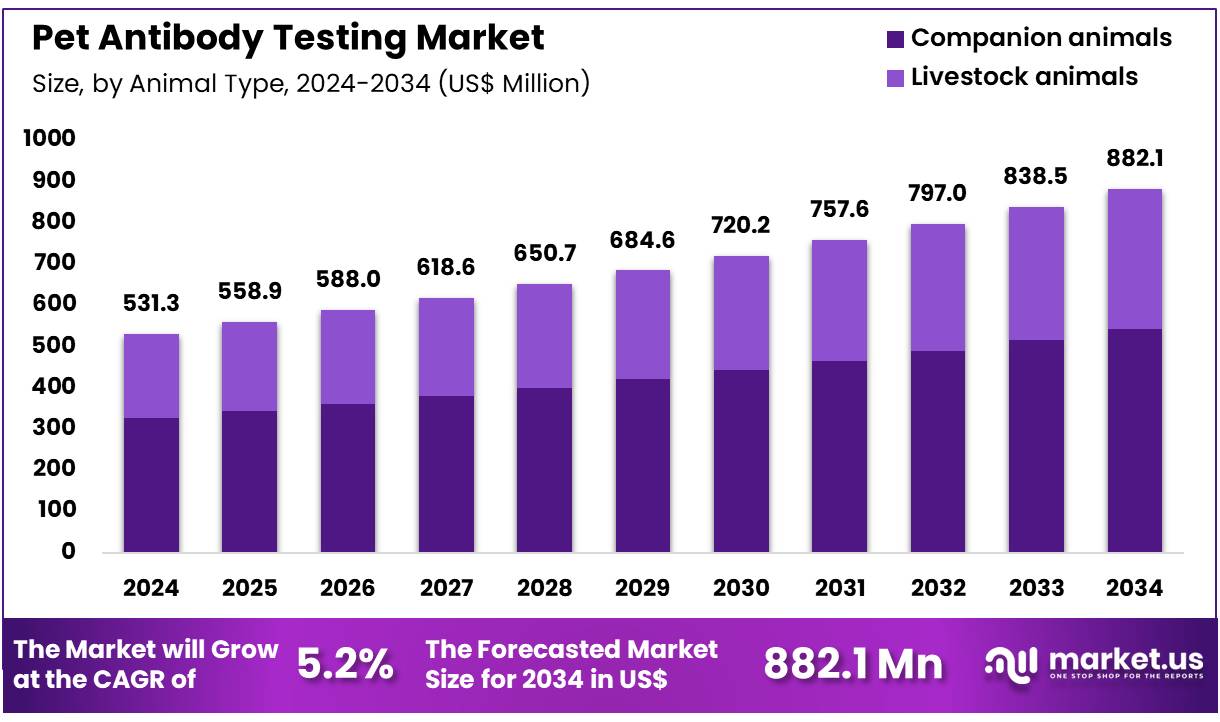
The Global Pet Antibody Testing Market size is expected to be worth around US$ 882.1 Million by 2034 from US$ 531.3 Million in 2024, growing at a CAGR of 5.2% during the forecast period 2025 to 2034. In 2024, North America led the market, achieving over 39.8% share with a revenue of US$ 211.5 Million.
The Pet Antibody Testing Market is witnessing steady growth as pet owners, veterinary professionals, and animal healthcare organizations increasingly focus on preventive healthcare, infectious disease monitoring, and accurate diagnosis.
Pet antibody testing helps detect immune responses against pathogens by measuring antibody levels in blood samples, supporting the diagnosis and management of diseases such as canine parvovirus, feline panleukopenia, rabies, and other viral infections.
The rising global pet population and increasing spending on veterinary care are key factors driving market expansion. According to the American Pet Products Association, approximately 66% of U.S. households owned a pet in 2024, representing nearly 86.9 million homes, highlighting the growing demand for advanced veterinary diagnostic solutions. Additionally, companion animal healthcare spending continues to increase as owners seek early disease detection and improved pet longevity.
Technological advancements such as rapid test kits, enzyme-linked immunosorbent assays (ELISA), and point-of-care diagnostic platforms are improving testing speed and accessibility. Many modern antibody tests can deliver results within 10–30 minutes, enabling veterinarians to make faster treatment decisions.
The market is also supported by increasing vaccination monitoring requirements, with antibody testing helping evaluate immune protection after vaccination. Growing adoption of veterinary diagnostics, rising awareness about zoonotic diseases, and expansion of animal healthcare infrastructure are expected to create new opportunities for manufacturers developing accurate, affordable, and easy-to-use pet antibody testing solutions.
Key Takeaways
- In 2024, the market generated US$ 531.3 million in revenue and is projected to expand at a CAGR of 5.2%, reaching approximately US$ 882.1 million by 2034.
- Based on product type, the market is segmented into kits, instruments & readers, and reagents & controls. The kits segment dominated the market in 2023, accounting for a 54.2% market share.
- By animal type, the market is categorized into companion animals and livestock animals. The companion animals segment held a significant position, capturing a 61.4% share of the market.
- In terms of application, the market is segmented into chronic conditions and infectious diseases. The chronic conditions segment emerged as the leading segment, holding the largest revenue share of 57.9%.
- Based on end users, the market is divided into veterinary clinics, veterinary hospitals & specialty centers, and diagnostic laboratories. The veterinary clinics segment led the market, accounting for a 48.7% revenue share.
- Regionally, North America dominated the market in 2023, securing a 39.8% share due to increasing adoption of advanced veterinary diagnostic solutions and strong animal healthcare infrastructure.
Statistical Information
- A 2026 evaluation of feline immunodeficiency virus (FIV) antibody lateral-flow tests found that 2 out of 9 tested assays achieved 100% sensitivity and 100% overall accuracy, while all evaluated tests showed 100% specificity in the study dataset.
- In the same 2026 FIV antibody testing comparison, some commercial assays detected 38 out of 39 positive samples, resulting in 97.44% sensitivity and 98% overall accuracy.
- A 2026 study evaluating a canine Brucella canis antibody point-of-care testing approach analyzed 50 serum samples from 50 client-owned dogs, including 10 culture-positive dogs and 40 healthy dogs for diagnostic performance assessment.
- A 2026 veterinary antibody ELISA study for parrot bornavirus reported that the optimized assay achieved 92.9% sensitivity and 96.7% specificity for antibody detection.
- A 2025 veterinary diagnostic quality-assurance paper identified 4 major validation areas for AI-supported diagnostic systems: bias investigation, calibration and uncertainty prediction, safety monitoring, and repeatability/robustness assessment.
- A 2026 FIV antibody assay comparison evaluated 9 lateral-flow antibody tests using an in-house ELISA reference method to measure sensitivity, specificity, and accuracy differences among veterinary antibody diagnostics.
- A 2025 veterinary serology publication described multiplex antibody testing as capable of simultaneously analyzing responses against several specific antigens in a single patient sample, improving the interpretation of multi-pathogen antibody profiles.
Regional Analysis
North America leads the Pet Antibody Testing Market due to increasing adoption of preventive veterinary diagnostics, rising pet healthcare spending, and demand for immunity verification tests. In 2024, the region accounted for a 39.8% market share, supported by growing use of antibody assays for rabies, parvovirus, and feline infectious disease monitoring.
Veterinary visits remained a major driver, with AVMA reporting strong pet healthcare engagement in 2024, including 69.4% of pet owners visiting veterinary practices. Advanced ELISA and multiplex testing platforms are gaining adoption among clinics and shelters for faster disease surveillance and vaccination assessment.
Asia Pacific is expected to register the highest CAGR during the forecast period, supported by expanding companion animal ownership, rising awareness of preventive care, and government focus on zoonotic disease control. Countries including China, India, Japan, and South Korea are increasing investments in veterinary diagnostics and digital animal health systems.
The region’s large livestock ecosystem, with Asia and the Pacific representing more than 60% of global livestock populations in several FAO assessments, further supports demand for integrated antibody surveillance solutions. Growing adoption of affordable serology kits and portable testing technologies is expected to accelerate market expansion.
Emerging Trends
- Rising Adoption of Antibody Titer Testing After Vaccination:Veterinary professionals are increasingly using antibody titer tests to evaluate immune protection instead of relying only on fixed vaccination schedules. These tests measure antibodies against diseases such as rabies, parvovirus, and distemper. CDC guidelines recognize 0.5 IU/mL as the required rabies antibody level for international dog movement.
- Growing Demand for Rabies Serology Due to Pet Travel Regulations:International pet travel requirements are creating higher demand for certified antibody testing. Many countries require rabies antibody reports before allowing animal entry. CDC regulations specify that dogs without proper vaccination documentation and testing may face additional compliance procedures, including quarantine periods of up to 28 days.
- Development of Rapid Point-of-Care Antibody Testing Platforms:Veterinary diagnostics are shifting toward faster testing solutions that deliver results directly in clinics. New antibody testing kits help veterinarians make vaccination decisions during a single visit. These rapid methods improve workflow efficiency and support preventive healthcare programs for millions of companion animals.
- Shift Toward Personalized Vaccination Management:Pet healthcare is moving toward individualized vaccination strategies based on age, lifestyle, exposure risks, and immune response. Antibody testing allows veterinarians to identify pets that already have protective immunity and avoid unnecessary booster doses. Professional veterinary guidelines support risk-based vaccination approaches for dogs and cats.
- Increasing Use of Antibody Testing in Animal Shelters:Animal shelters and rescue organizations are adopting antibody testing to manage infectious disease risks among large groups of animals. Testing helps determine immunity status before adoption or relocation programs. Faster screening supports better outbreak prevention, especially in facilities housing hundreds of animals.
Use Cases
- Rabies Antibody Testing for International Pet Transportation: One of the major applications of pet antibody testing is verifying rabies immunity before international travel. Approved laboratories analyze blood samples to confirm antibody levels. The CDC recommends documented rabies vaccination and antibody testing procedures for dogs entering the United States from certain high-risk countries.
- Monitoring Immunity Against Canine Viral Diseases: Veterinary clinics use antibody testing to detect immunity against diseases including canine parvovirus, distemper virus, and adenovirus. These tests help determine whether a pet requires additional vaccination. Studies and veterinary guidelines support serological testing as a useful tool for evaluating protective immune responses.
- Vaccination Decision Support in Veterinary Clinics: Antibody testing assists veterinarians in developing personalized vaccination schedules. Instead of administering boosters automatically, clinics can measure existing antibody protection and provide targeted recommendations. This approach improves preventive healthcare efficiency and reduces unnecessary medical interventions for companion animals.
- Disease Control Programs in Breeding Facilities: Breeders use antibody testing to monitor disease protection among breeding animals and newborn puppies. Testing helps identify maternal antibody transfer levels and supports healthier early-life management. Monitoring immunity is particularly important because puppies depend on maternal antibodies during the first weeks after birth.
- Research and Development of Advanced Veterinary Diagnostics: Pet antibody testing is increasingly used in veterinary research for developing improved vaccines and diagnostic technologies. Laboratories analyze immune responses to evaluate vaccine effectiveness, with studies measuring antibody levels across different breeds, ages, and health conditions to improve companion animal disease prevention strategies.
Frequently Asked Questions on Pet Antibody Testing
- What is pet antibody testing?
Pet antibody testing is a veterinary diagnostic procedure that measures antibody levels present in an animal’s blood. It helps determine immune response after vaccination or infection and supports veterinarians in making effective decisions regarding disease prevention and pet healthcare management. - Why is pet antibody testing used in veterinary care?
Pet antibody testing is used to evaluate whether animals have developed adequate immunity against specific diseases. It helps reduce unnecessary vaccinations, confirms vaccine effectiveness, supports preventive healthcare programs, and enables veterinarians to create personalized treatment and monitoring plans. - How are pet antibody tests performed?
Pet antibody tests are performed by collecting a blood sample from animals and analyzing it using diagnostic technologies such as ELISA, immunofluorescence, or rapid test kits. These methods detect antibody levels and provide information about the pet’s immune protection status. - Which diseases can pet antibody testing detect?
Pet antibody testing is commonly used for detecting immunity against diseases such as rabies, canine parvovirus, canine distemper, and feline panleukopenia. These tests help monitor vaccination status and support disease prevention strategies for companion animals. - Who are the key end users of pet antibody testing solutions?
Key end users of pet antibody testing solutions include veterinary hospitals, animal clinics, diagnostic laboratories, research institutions, and pet owners. These users apply antibody testing for vaccination assessment, disease monitoring, health screening, and international travel certification requirements. - What technologies are used in pet antibody testing?
Pet antibody testing uses technologies including enzyme-linked immunosorbent assay (ELISA), lateral flow immunoassays, fluorescence-based testing, and automated diagnostic platforms. These technologies improve testing accuracy, reduce processing time, and enable efficient immune response evaluation in companion animals. - What is the future outlook of the pet antibody testing market?
The future of the pet antibody testing market is expected to be supported by innovations in rapid testing devices, digital veterinary solutions, and personalized pet healthcare. Increasing focus on preventive medicine will continue driving demand for reliable antibody testing technologies.
Conclusion
The Pet Antibody Testing Market is expected to witness steady growth as pet owners, veterinarians, and animal health organizations increasingly focus on preventive healthcare, vaccination monitoring, and early disease detection. Rising pet adoption, growing awareness of zoonotic diseases, and advancements in immunodiagnostic technologies are supporting demand for accurate antibody-based testing solutions.
The integration of rapid testing platforms, improved laboratory capabilities, and point-of-care diagnostics is further enhancing market expansion. Companion animal healthcare continues to gain importance, encouraging innovation among diagnostic companies. Overall, pet antibody testing will remain a vital tool for improving animal health outcomes and strengthening veterinary care worldwide.
Discuss your needs with our analyst
Please share your requirements with more details so our analyst can check if they can solve your problem(s)




