


Overview
New York, NY – Aug 11, 2026 – The Global Aromatherapy Market size is expected to be worth around US$ 18.5 Billion by 2034 from US$ 9.5 Billion in 2024, growing at a CAGR of 6.9% during the forecast period from 2025 to 2034. In 2024, North America led the market, achieving over 36.8% share with a revenue of US$ 3.5 billion.
The global aromatherapy market is expanding as consumers increasingly prefer natural and plant-based wellness solutions for stress management, relaxation, sleep improvement, and pain relief. Aromatherapy involves the use of concentrated essential oils extracted from flowers, leaves, bark, and other plant parts. More than 90 essential oils are commonly used in wellness and supportive healthcare applications, including lavender, peppermint, eucalyptus, tea tree, and chamomile oils.
Clinical studies indicate that aromatherapy may provide benefits in managing specific health concerns. Evidence supports its role in reducing menstrual pain, improving sleep quality, easing anxiety in perioperative settings, and supporting blood pressure control. Rising mental health challenges are contributing to increased interest in complementary therapies. In the United States, 19.1% of adults, representing nearly 49 million people, experienced an anxiety disorder in 2021, while 8.3% of adults, or about 21 million people, experienced a major depressive episode.
Chronic pain management is another important growth factor for aromatherapy adoption. Around 20% of U.S. adults, equivalent to more than 51 million individuals, experience chronic pain. Additionally, approximately 20% of adults with chronic pain receive opioid prescriptions, encouraging demand for safer supportive approaches such as essential oil-based therapies.
Product safety and quality remain critical factors in market development. Certain essential oils are recognized as Generally Recognized as Safe (GRAS) under 21 CFR 182.20 for approved uses. The World Health Organization (WHO) supports global efforts across 190+ member countries to promote safe practices for traditional and complementary medicine. Growing awareness, wellness trends, and evidence-based adoption are expected to strengthen the aromatherapy industry.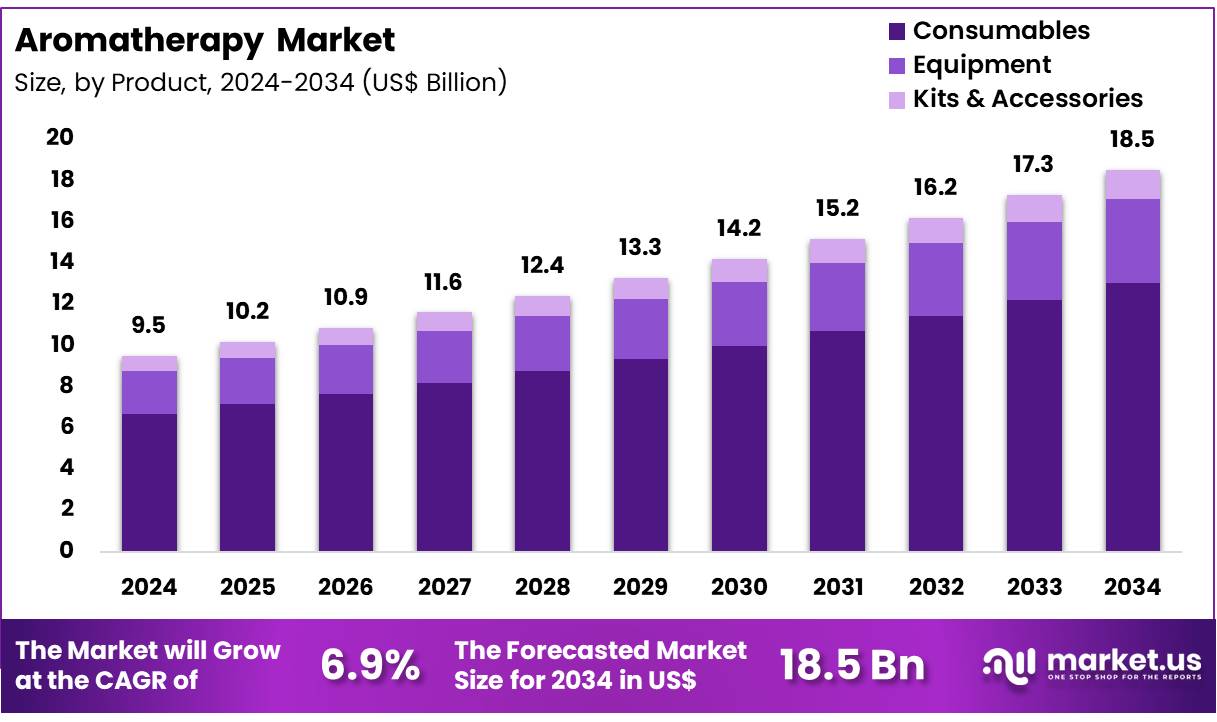
Key Takeaways
- Market Size: The global aromatherapy market is projected to reach approximately US$ 18.5 billion by 2034, increasing from US$ 9.5 billion in 2024 and expanding at a CAGR of 6.9% between 2025 and 2034.
- Market Growth: In 2024, North America emerged as the leading region in the aromatherapy market, capturing over 36.8% market share with a revenue contribution of approximately US$ 3.5 billion.
- Product Analysis: The consumables segment dominated the market in 2024, accounting for 70.5% of the total market share, driven by rising demand for essential oils, blends, and related aromatherapy products.
- Mode of Delivery Analysis: Topical application held the leading position in 2024, representing 41.0% of the market share, supported by increasing use of essential oils in massage therapies and personal wellness routines.
- Application Analysis: The relaxation segment accounted for the largest market share of 24.7% in 2024, driven by growing consumer adoption of aromatherapy for stress reduction, mood improvement, and mental wellness support.
- End-Use Analysis: Spa and wellness centers dominated the aromatherapy market in 2024, capturing a 44.2% share, as these facilities continue to play a major role in promoting aromatherapy-based relaxation and therapeutic services.
- Sales Channel Analysis: Offline stores led the sales channel segment in 2024, holding 54.8% market share due to consumer preference for physical product evaluation, expert guidance, and trusted retail purchasing experiences.
- Regional Analysis: North America maintained a dominant market position in 2024, accounting for more than 36.8% share and generating a market value of approximately US$ 3.5 billion, supported by strong consumer awareness and demand for natural wellness products.
Statistical Information
- Growing Adoption of Complementary Wellness Practices Supporting Aromatherapy Demand: Consumer preference for natural and complementary wellness solutions is increasing, supporting the use of essential oils for relaxation, stress management, and overall well-being. According to the National Center for Complementary and Integrative Health (NCCIH), 33% of U.S. adults and nearly 12% of children used complementary health approaches. Around 59 million Americans aged 4 years and older reported out-of-pocket spending on complementary health approaches, with total annual spending reaching US$30.2 billion. Of this amount, adults contributed approximately US$28.3 billion, while children accounted for US$1.9 billion.
- Rising Anxiety and Mental Wellness Concerns Increasing Relaxation Application Demand: Aromatherapy is increasingly used as a supportive wellness approach for stress reduction and emotional balance. The National Institute of Mental Health (NIMH) reported that 19.1% of U.S. adults (approximately 48.3 million people) experienced an anxiety disorder in 2021. In the same year, 8.3% of adults (around 21 million people) experienced a major depressive episode. Growing mental health challenges are encouraging consumers to explore relaxation-based approaches, including lavender and other essential oils.
- Chronic Pain Burden Supporting Demand for Non-Drug Supportive Therapies: Chronic pain management is becoming an important application area for complementary therapies. According to the Centers for Disease Control and Prevention (CDC), approximately 20.9% of U.S. adults (51.6 million people) experienced chronic pain in 2021. Additionally, 6.9% of adults (17.1 million people) experienced high-impact chronic pain that significantly affected daily activities. This increasing disease burden is encouraging interest in supportive approaches such as aromatherapy massage and essential oil-based therapies.
- Increasing Research Evidence for Aromatherapy-Based Sleep Improvement: Sleep wellness is becoming a major application area for aromatherapy products. A review published by NCCIH analyzed 16 studies involving 1,346 participants and found that aromatherapy showed potential benefits in improving sleep quality and reducing insomnia symptoms. Another systematic review analyzed 27 publications involving 2,072 patients, reporting improvements in insomnia symptoms, anxiety, and depression measures following inhalation aromatherapy interventions.
- Growing Wellness Spending Supporting Aromatherapy Product Adoption: Consumer spending on wellness-related products and services continues to support demand for complementary approaches. NCCIH data shows that Americans spent US$30.2 billion annually out-of-pocket on complementary health approaches. Natural product purchases accounted for approximately US$12.8 billion, representing a major share of consumer spending in complementary health categories.
- Increasing Use of Essential Oils for Stress, Sleep, and Emotional Wellness: Consumer interest in aromatherapy is strongly linked with rising demand for stress-relief and relaxation solutions. The National Center for Complementary and Integrative Health (NCCIH) reported that complementary health approaches are used by millions of Americans, with 59 million U.S. residents spending money on these approaches annually. Total consumer spending reached US$30.2 billion, including US$12.8 billion spent on natural product supplements, which includes categories related to plant-based wellness products.
- North America Growth Supported by High Complementary Health Awareness: North America’s aromatherapy adoption is supported by strong consumer awareness of complementary wellness practices. In the United States, approximately 59 million people spent money on complementary health approaches, demonstrating significant consumer participation in natural wellness categories. Average out-of-pocket spending among users reached approximately US$510 per person annually for complementary approaches.
- Growing Consumer Interest in Plant-Based Natural Products: Natural products represent a significant component of complementary healthcare spending. According to NCCIH and CDC analysis, U.S. consumers spent US$12.8 billion on natural product supplements, representing approximately 42% of adult complementary health spending. Among adults, total complementary health spending reached US$28.3 billion, while children accounted for US$1.9 billion in spending.
- Rising Consumer Spending on Wellness and Self-Care Products: Self-care spending is contributing to the growth of natural wellness categories. NCCIH data shows U.S. consumers spent US$2.7 billion on self-care approaches related to complementary health, while spending on natural product supplements reached US$12.8 billion. The average annual spending per complementary health user was approximately US$510.
Regional Analysis
North America held a dominant market position, capturing more than a 36.8% share
North America remains a key region for aromatherapy adoption due to increasing consumer interest in complementary health practices, natural products, and wellness-focused lifestyles. In the United States, millions of consumers use complementary health approaches, with the National Center for Complementary and Integrative Health (NCCIH) reporting that 33% of adults and nearly 12% of children use complementary health practices.
Consumer spending on these approaches reached approximately US$30.2 billion annually, reflecting strong demand for natural wellness solutions. The region’s growth is also supported by rising mental health and sleep-related concerns. The National Institute of Mental Health (NIMH) reported that 19.1% of U.S. adults experienced an anxiety disorder in 2021, increasing interest in relaxation-based solutions such as essential oils.
Strong retail availability through pharmacies, specialty wellness stores, online platforms, and professional spa services further improves product accessibility. Canada also contributes to regional growth through increasing demand for natural personal care and clean-label wellness products.
Emerging Trends
- Increasing Use of Aromatherapy for Mental Health and Stress Relief: Aromatherapy is becoming popular as a complementary approach for managing stress and anxiety. Research reviewed by NIH’s NCCIH evaluated lavender-based interventions across 65 randomized controlled trials involving 7,993 participants, showing potential benefits for anxiety reduction. Consumers are increasingly using lavender, bergamot, and chamomile oils for relaxation and emotional wellness.
- Growing Adoption of Aromatherapy for Sleep Support: Sleep improvement is emerging as a major application area for essential oils, especially lavender aromatherapy. NCCIH reported that a review of 16 studies involving 1,346 participants found aromatherapy may improve sleep quality and reduce insomnia symptoms. Increasing sleep-related concerns are encouraging consumers to use diffusers, inhalers, and essential oil blends.
- Expansion of Natural Pain Management Applications: Aromatherapy is gaining attention as a supportive option for pain relief, particularly menstrual pain, muscle discomfort, and relaxation therapy. Evidence mapping from NCBI found moderate-confidence evidence for inhaled essential oils in reducing dysmenorrhea pain. The rising burden of chronic pain, affecting 51.6 million U.S. adults (20.9%), supports demand for complementary solutions.
- Increasing Integration into Healthcare and Supportive Care Settings: Hospitals and healthcare providers are exploring aromatherapy as a supportive therapy for improving patient comfort, reducing anxiety, and supporting symptom management. NCCIH highlights the use of essential oils through inhalation and diluted topical application, including applications in massage therapy for pain, anxiety, and cancer-related symptoms.
- Rising Demand for Safe and Quality-Tested Essential Oils: Consumers are becoming more focused on essential oil safety, purity, and proper usage. NCCIH highlights that essential oils may cause allergic reactions, skin irritation, or photosensitivity if incorrectly used. This is increasing demand for transparent labeling, dilution guidance, and quality-controlled products from manufacturers.
- Expansion of Complementary Wellness Spending and Consumer Awareness: Consumer adoption of complementary health approaches is supporting demand for aromatherapy products. NIH’s NCCIH reported that approximately 59 million Americans used complementary health approaches, with annual out-of-pocket spending reaching about $30.2 billion. Rising wellness awareness is encouraging greater use of natural products, including essential oils.
Use Cases
- Stress and Anxiety Management: Aromatherapy is widely used as a complementary approach for managing stress, anxiety, and emotional discomfort. Essential oils such as lavender, bergamot, and chamomile are commonly used through inhalation methods. NIH’s NCCIH reviewed research on lavender aromatherapy, including 65 randomized controlled trials involving 7,993 participants, showing potential benefits for anxiety symptoms.
- Sleep Improvement and Insomnia Support: Essential oils are increasingly used to support better sleep quality and relaxation. Lavender aromatherapy is one of the most studied applications for sleep-related concerns. NCCIH reported evidence from 16 studies involving 1,346 participants, suggesting aromatherapy may improve sleep quality and reduce insomnia symptoms in different populations.
- Pain Relief and Symptom Management: Aromatherapy is used as a supportive therapy for pain management, including menstrual pain, muscle discomfort, and chronic pain conditions. Evidence reviews from NCBI identified moderate-confidence evidence supporting aromatherapy for dysmenorrhea pain relief. This application is gaining attention as chronic pain affects 51.6 million U.S. adults (20.9%).
- Hospital and Clinical Supportive Care: Healthcare facilities are exploring aromatherapy to improve patient comfort and manage symptoms such as anxiety, nausea, and treatment-related stress. The National Cancer Institute recognizes aromatherapy as a complementary approach used alongside conventional cancer care. Essential oils are commonly delivered through inhalation or diluted topical application.
- Spa, Massage, and Wellness Therapy: Aromatherapy is widely incorporated into spa treatments, massage therapy, and wellness programs. Essential oils are used to enhance relaxation, improve mood, and support stress management. NCCIH identifies aromatherapy as a complementary practice frequently combined with massage therapy for symptoms related to pain, anxiety, and stress.
- Home-Based Self-Care and Lifestyle Applications: Consumers are using aromatherapy products at home for daily relaxation, meditation, mood enhancement, and sleep routines. NCCIH identifies inhalation and diluted topical application as the primary methods of use. The U.S. complementary health sector includes approximately 59 million users, reflecting strong consumer participation in natural wellness practices.
Frequently Asked Questions on Aromatherapy
- How does aromatherapy work?
Aromatherapy works by stimulating the sense of smell and interacting with the nervous system. Essential oil aromas may influence mood, relaxation, and stress responses, while topical applications are used in supportive wellness practices. - What are the most commonly used essential oils in aromatherapy?
Common essential oils include lavender, peppermint, eucalyptus, tea tree, chamomile, bergamot, and rosemary. These oils are widely used for relaxation, sleep support, stress management, skincare, and overall wellness applications. - What are the major applications driving the aromatherapy market?
Major applications include relaxation, anxiety management, sleep improvement, pain relief, skincare, spa treatments, and supportive healthcare. Increasing consumer preference for natural wellness solutions is expanding aromatherapy adoption across residential and professional environments. - How is aromatherapy delivered to consumers?
Aromatherapy is mainly delivered through inhalation and topical application methods. Diffusers, inhalers, and sprays are used for inhalation, while diluted essential oils are applied through massage, skincare products, and wellness therapies. - Why is relaxation an important application in the aromatherapy market?
The relaxation segment is growing due to increasing stress levels, anxiety concerns, and demand for natural emotional wellness solutions. Essential oils such as lavender and chamomile are commonly used for relaxation, meditation, mood enhancement, and stress reduction. - What factors are driving the growth of the aromatherapy market?
Growth is supported by rising demand for natural products, increasing awareness of complementary healthcare, expanding spa and wellness services, growing self-care trends, and consumer interest in non-pharmaceutical approaches for stress and pain management. - Which region dominates the aromatherapy market?
North America represents a leading region for aromatherapy adoption due to strong consumer awareness of natural wellness products, high use of complementary health practices, developed retail networks, and increasing demand for essential oils. - How are consumers purchasing aromatherapy products?
Consumers purchase aromatherapy products through offline stores, pharmacies, wellness centers, specialty retailers, and online platforms. E-commerce growth is improving accessibility by offering wider product choices, convenience, and easy comparison of essential oil products.
Conclusion
The aromatherapy market is witnessing steady growth as consumers increasingly adopt natural wellness solutions for stress management, relaxation, sleep improvement, and supportive pain care. Rising awareness of complementary healthcare, growing demand for plant-based products, and expanding applications in spas, personal care, and healthcare settings are driving market development.
Scientific research supporting selected benefits of essential oils, along with increasing focus on product safety and quality standards, is strengthening consumer confidence. With growing wellness trends, home-based usage, and continued innovation in essential oil products, aromatherapy is expected to remain an important segment within the global natural health and wellness industry.
Discuss your needs with our analyst
Please share your requirements with more details so our analyst can check if they can solve your problem(s)




