


Overview
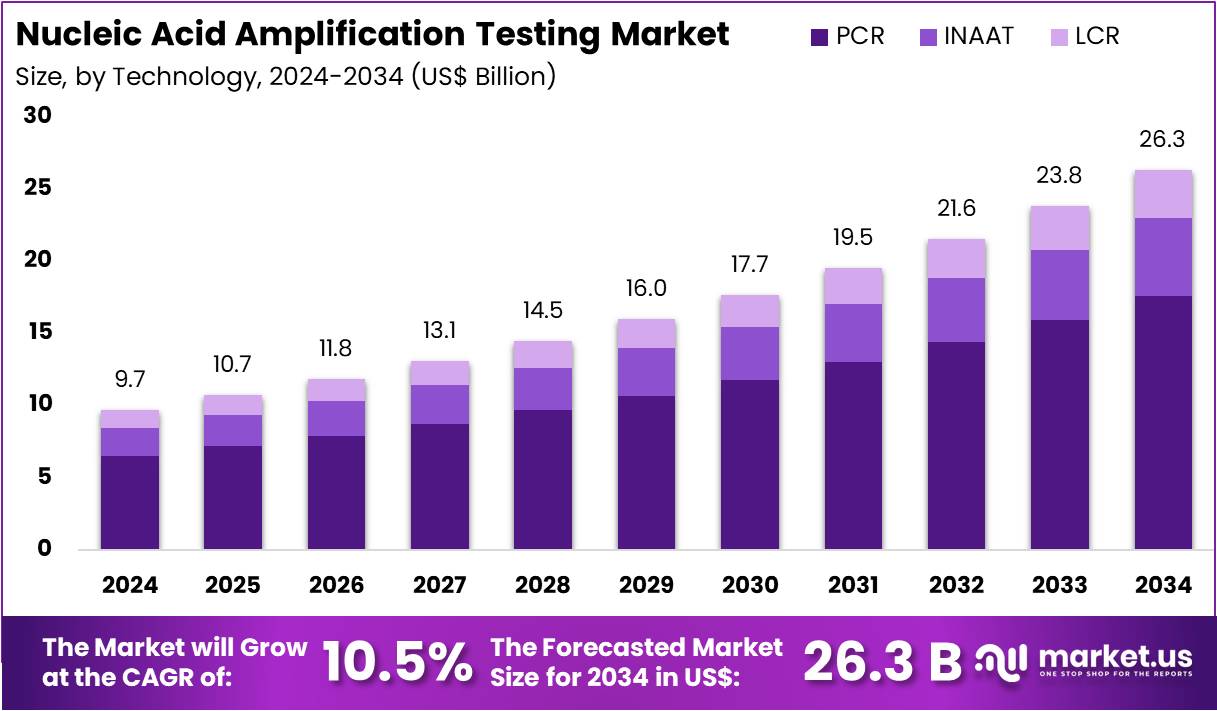
The Global Nucleic Acid Amplification Testing Market size is expected to be worth around US$ 26.3 Billion by 2034, from US$ 9.7 Billion in 2024, growing at a CAGR of 10.5% during the forecast period from 2025 to 2034. North America held a dominant market position, capturing more than a 39.4% share and holds US$ 3.8 Billion market value for the year.
Nucleic Acid Amplification Testing (NAAT) is an advanced molecular diagnostic technology used to detect genetic material, including DNA or RNA, from pathogens, enabling rapid and accurate disease identification. NAATs are widely used for diagnosing infectious diseases such as sexually transmitted infections (STIs), respiratory infections, tuberculosis, and viral diseases. These tests work by amplifying small amounts of nucleic acid, allowing detection even when pathogen levels are very low.
The increasing demand for early disease detection and precision diagnostics is driving the adoption of NAAT solutions across healthcare systems. According to the Centers for Disease Control and Prevention, molecular tests such as NAATs are among the most sensitive diagnostic methods for detecting infections like chlamydia and gonorrhea. NAATs can achieve sensitivity rates above 90% for several infectious disease applications, improving diagnostic accuracy compared with traditional testing methods.
The technology has gained importance due to its rapid turnaround time, with many automated NAAT platforms providing results within 1–3 hours depending on the test format. During the COVID-19 pandemic, molecular amplification technologies became essential, with billions of PCR-based tests performed globally to support infection monitoring and public health responses.
NAAT applications continue expanding through multiplex testing, point-of-care platforms, and automated laboratory systems. The growing prevalence of infectious diseases, rising screening programs, and increasing investment in molecular diagnostics are expected to strengthen the role of NAATs in modern healthcare, supporting faster treatment decisions and improved patient outcomes.
Key Takeaways
- The global nucleic acid amplification testing market is expected to reach approximately US$ 26.3 billion by 2034, expanding at a CAGR of 10.5% from 2025 onward.
- The polymerase chain reaction segment dominated the technology category in 2024, accounting for more than 66.8% of the market share due to its strong clinical acceptance and high diagnostic accuracy.
- Consumables and kits represented the leading product segment in 2024, capturing over 58.1% of the share, driven by continuous usage in molecular diagnostic procedures.
- Infectious disease testing emerged as the largest application segment in 2024, holding more than 47.5% share due to increasing demand for disease detection and screening programs.
- Hospitals accounted for the highest end-user share in 2024, representing over 40.2% of the market, supported by their extensive adoption of advanced molecular testing solutions.
- North America maintained a leading position in the global nucleic acid amplification testing market in 2024, securing more than 39.4% share with a market value of approximately US$ 3.8 billion.
Statistical Information
- A 2025 study on rapid molecular tuberculosis diagnosis reported that nucleic acid amplification testing (NAAT) produced results in 1.3 days on average, compared with 18 days for positive culture methods, reducing diagnostic waiting time by 16 days.
- The same NAAT tuberculosis workflow used a rapid molecular assay with a reported processing time of 80 minutes, enabling faster confirmation compared with conventional laboratory culture workflows.
- A 2026 point-of-care NAAT technology review reported that isothermal nucleic acid amplification platforms can provide molecular diagnostic results within ≤60 minutes for rapid pathogen detection workflows.
- A 2026 evaluation of an automated PCR-based nucleic acid testing platform reported detection signals at concentrations as low as 50 copies/mL for SARS-CoV-2 reference materials.
- The same 2026 automated NAAT evaluation reported a positive percent agreement (PPA) of 97.3% and a negative percent agreement (NPA) of 100% compared with the reference comparison system.
- A 2026 study of a new universal probe-based nucleic acid amplification method demonstrated a PCR detection range from 10¹–10⁶ copies/µL and LAMP detection range from 10²–10⁶ copies/µL.
- The same 2026 nucleic acid amplification research reported limits of detection ranging from 10 copies/µL to 100 copies/µL, showing analytical sensitivity improvements for molecular testing workflows.
- A 2026 high-throughput isothermal NAAT platform, ThermiQuant MegaScan, was designed to process 160 reactions per cartridge while maintaining incubation control at 65 ± 0.5°C.
- A 2026 clinical evaluation of a multiplex PCR capillary electrophoresis NAAT method assessed detection capability for 7 sexually transmitted pathogens in a single testing workflow.
Regional Analysis
In 2024, North America maintained a leading position in the nucleic acid amplification testing market, supported by advanced healthcare infrastructure, strong laboratory networks, and widespread adoption of molecular diagnostic technologies. The region accounted for more than 39.4% market share, valued at approximately US$ 3.8 billion, driven by high testing demand across hospitals, diagnostic centers, and research institutions.
Growth was supported by increasing infectious disease surveillance, rising demand for rapid and accurate diagnostics, and expanding point-of-care testing capabilities. Favorable regulatory support, healthcare investments, and reimbursement coverage encouraged the adoption of advanced amplification platforms.
Continuous research and development activities focused on improving test accuracy, automation, and turnaround time further strengthened regional growth. With ongoing technological advancements and increasing integration of high-throughput diagnostic systems, North America is expected to remain a key contributor to the global nucleic acid amplification testing market.
Emerging Trends
- Growing Adoption of Point-of-Care NAAT Systems: Point-of-care NAAT platforms are becoming more important as healthcare providers demand faster molecular diagnosis near patients. These systems reduce dependence on central laboratories and support rapid infection management. WHO highlights low-complexity NAAT solutions for tuberculosis diagnosis, including platforms such as Xpert MTB/RIF Ultra and Truenat.
- Increasing Use of Multiplex NAAT for Multiple Pathogen Detection: Multiplex NAAT is expanding because one test can identify multiple infections from a single sample. CDC reports molecular multiplex tests that detect influenza viruses, SARS-CoV-2, and RSV together, helping clinicians select appropriate treatment faster. These assays improve workflow efficiency by reducing separate testing requirements.
- Demand for Faster Molecular Testing Results: Healthcare facilities are adopting rapid NAAT technologies that provide results within minutes instead of hours. CDC reports rapid molecular influenza assays can deliver results in approximately 15–30 minutes, while some RT-PCR methods may require 1–8 hours depending on the platform.
- Expansion of NAAT Applications in Tuberculosis Diagnosis: Tuberculosis remains a major application area for NAAT due to its ability to detect bacterial genetic material and drug resistance markers. WHO’s 2025 TB diagnostic handbook includes low-complexity NAAT categories using technologies such as Xpert MTB/RIF Ultra, Truenat MTB Plus, and TB-LAMP.
- Development of Automated Sample-to-Answer Platforms: Automation is becoming a key trend in NAAT laboratories. Modern systems combine sample preparation, nucleic acid amplification, and detection in a single workflow. These platforms reduce manual handling, improve laboratory productivity, and support high-volume molecular testing environments.
Use Cases
- Respiratory Infection Diagnosis: NAAT is widely used for detecting respiratory infections, including COVID-19, influenza, and respiratory syncytial virus (RSV). Molecular tests identify viral genetic material with high sensitivity and support timely clinical decisions. CDC recommends molecular testing methods for suspected respiratory infections requiring accurate diagnosis.
- Sexually Transmitted Infection (STI) Testing: NAAT plays a major role in diagnosing sexually transmitted infections because of its ability to detect very small amounts of pathogen genetic material. Common applications include testing for Chlamydia trachomatis and Neisseria gonorrhoeae, supporting early treatment and reducing transmission risks.
- Infectious Disease Surveillance and Outbreak Monitoring: Public health organizations use NAAT technologies for monitoring infectious disease spread and identifying emerging pathogens. Molecular detection helps track pathogen circulation by identifying genetic material from clinical samples, supporting outbreak response programs and disease control strategies.
- Drug Resistance Detection: NAAT is increasingly used to identify genetic markers associated with antimicrobial resistance. In tuberculosis care, molecular platforms can detect resistance-related mutations, enabling faster treatment decisions compared with traditional culture-based methods. WHO includes resistance detection as an important component of modern TB diagnostic strategies.
- Precision Medicine and Genetic Testing: NAAT technologies are expanding into precision medicine applications, including biomarker identification and genetic analysis. Advanced amplification methods help quantify nucleic acids and support applications in oncology, inherited disease testing, and personalized treatment planning.
Frequently Asked Questions on Nucleic Acid Amplification Testing
- What is Nucleic Acid Amplification Testing (NAAT)?
Nucleic Acid Amplification Testing is a molecular diagnostic technique used to detect genetic materials such as DNA or RNA from microorganisms. It amplifies targeted nucleic acid sequences, allowing healthcare professionals to identify infections with high accuracy and sensitivity. - How does Nucleic Acid Amplification Testing improve disease diagnosis?
NAAT improves disease diagnosis by detecting pathogens at very low concentrations, often before symptoms become severe. Its high sensitivity and specificity support early infection identification, faster treatment decisions, and improved management of infectious diseases in healthcare settings. - What technologies are commonly used in NAAT?
Common NAAT technologies include polymerase chain reaction (PCR), reverse transcription PCR (RT-PCR), loop-mediated isothermal amplification (LAMP), and transcription-mediated amplification (TMA). These methods provide reliable molecular detection for infectious diseases, genetic testing, and clinical diagnostic applications. - What are the major applications of Nucleic Acid Amplification Testing?
NAAT is widely applied in infectious disease testing, including respiratory infections, sexually transmitted infections, tuberculosis, and viral diseases. It is also used in blood screening, genetic analysis, research laboratories, and public health surveillance programs worldwide. - Why is PCR important in the Nucleic Acid Amplification Testing Market?
PCR plays a significant role in the NAAT market because of its accuracy, reliability, and widespread clinical acceptance. PCR-based systems are extensively used in hospitals and laboratories for detecting infectious agents and supporting molecular diagnostics. - What factors are driving the growth of the Nucleic Acid Amplification Testing Market?
The NAAT market is growing due to increasing infectious disease cases, rising demand for rapid diagnostics, technological advancements, expanding healthcare infrastructure, and government initiatives supporting molecular testing capabilities for disease prevention and early detection. - What challenges affect the adoption of NAAT technologies?
NAAT adoption can be limited by high equipment costs, complex laboratory requirements, skilled workforce needs, and maintenance expenses. Developing regions may experience challenges due to limited diagnostic infrastructure and restricted access to advanced molecular testing technologies. - How are point-of-care NAAT devices changing diagnostics?
Point-of-care NAAT devices are improving healthcare by enabling rapid molecular testing near patients. These portable systems reduce waiting times, support faster clinical decisions, and expand diagnostic access in emergency departments, clinics, and remote healthcare environments.
Conclusion
The Nucleic Acid Amplification Testing (NAAT) market is expected to witness strong growth due to increasing demand for rapid, accurate, and sensitive molecular diagnostics across infectious diseases, oncology, genetic testing, and public health applications. Advancements in PCR, isothermal amplification technologies, automation, and point-of-care testing are improving accessibility and clinical efficiency.
Growing disease surveillance programs and the need for early detection are further supporting market expansion. With continuous innovation, integration of advanced diagnostic platforms, and rising healthcare investments, NAAT is positioned to remain a critical technology in modern healthcare systems, enabling faster decision-making and improved patient outcomes globally.
Discuss your needs with our analyst
Please share your requirements with more details so our analyst can check if they can solve your problem(s)




