


Overview
New York, NY – Aug 11, 2026 – The Global Dental Implantology Software Market Size is expected to be worth around US$ 406.7 million by 2034 from US$ 238.1 million in 2024, growing at a CAGR of 5.5% during the forecast period 2025 to 2034. North America held a dominant market position, capturing more than a 40% share and holds US$ 95.2 million market value for the year.
The dental implantology software market is experiencing strong growth as dental professionals increasingly adopt digital solutions to improve implant accuracy, surgical planning, and restorative outcomes. Advanced platforms using 3D imaging, artificial intelligence (AI), CAD/CAM integration, and cloud-based workflows enable clinicians to analyze bone structures, predict implant placement, and design customized prosthetic solutions with higher precision. According to the CDC, nearly 47% of adults aged 30 years and older in the United States, representing about 64.7 million people, are affected by periodontal disease, increasing the demand for advanced dental treatment technologies.
The growing prevalence of tooth loss is also supporting adoption. Data from the National Institute of Dental and Craniofacial Research indicates that approximately 26% of adults aged 65 years and older have 8 or fewer teeth, while around 17% have lost all natural teeth, creating significant demand for implant-supported restorations and digital planning systems. AI-based implantology software is improving automated treatment planning, implant positioning, and full-arch rehabilitation procedures. Additionally, the integration of 3D printing and digital dentistry workflows is helping reduce production time and improve customization of dental prosthetics.
Cloud platforms are enabling faster collaboration between dentists and laboratories for efficient case management. In October 2024, Open Dental collaborated with Bola AI to integrate voice-based periodontal charting technology, reducing manual documentation efforts. With increasing adoption of AI, VR training, and interoperable CAD/CAM solutions, dental implantology software is becoming essential for delivering accurate, personalized, and efficient dental implant procedures.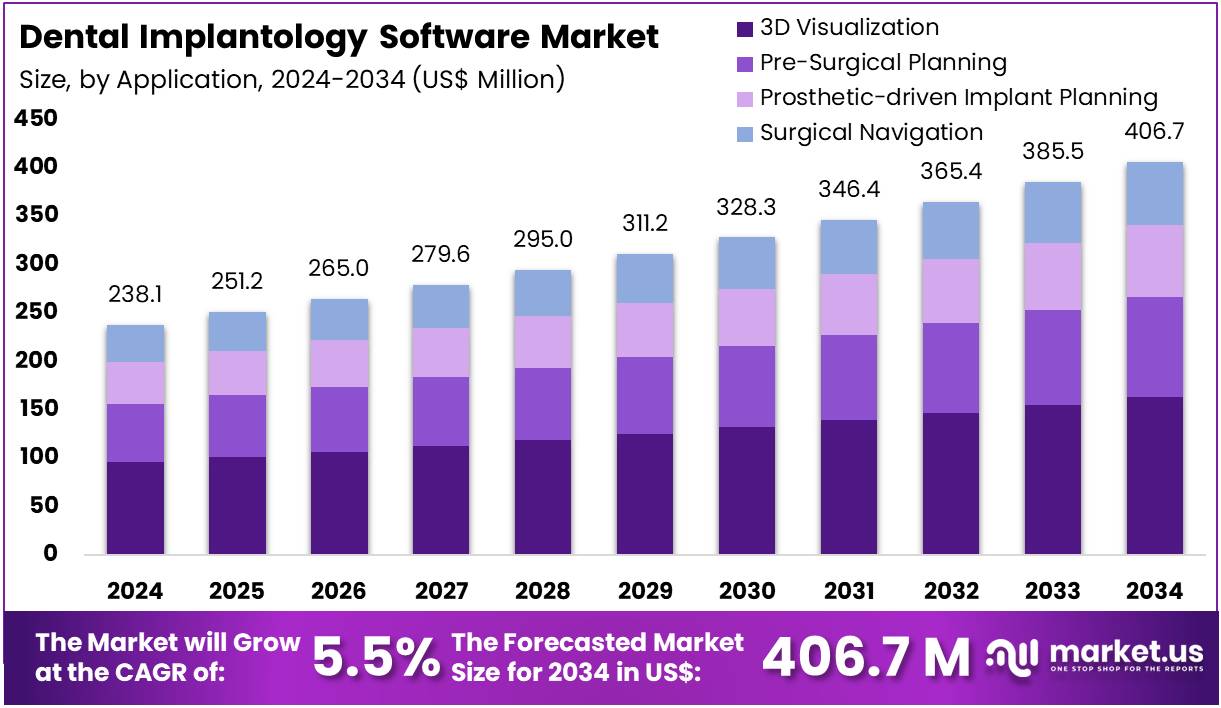
Key Takeaways
- In 2024, the dental implantology software market generated US$ 238.1 million in revenue and is projected to grow at a CAGR of 5.5%, reaching approximately US$ 406.7 million by 2034.
- Based on product type, the market is segmented into complete integrated solutions, modular implant planning solutions, and stand-alone implant planning solutions. Complete integrated solutions dominated in 2024, accounting for a 42.5% market share.
- By application, the dental implantology software market is categorized into 3D visualization, pre-surgical planning, prosthetic-driven implant planning, and surgical navigation. Among these, 3D visualization held a leading position with a 40.3% market share in 2024.
- By end-user, the market is segmented into dental clinics, academic and research institutes, hospitals, and other users. Dental clinics emerged as the largest segment, capturing the highest revenue share of 51.7% in 2024.
- Regionally, North America dominated the dental implantology software market in 2024, accounting for a significant 40.0% market share due to strong adoption of digital dentistry technologies and advanced dental care solutions.
Statistical Information
- High Prevalence of Periodontal Disease Increasing Demand for Advanced Implant Planning Software: Periodontal disease remains a major oral health concern in the United States and increases the need for accurate diagnosis, treatment planning, and implant procedures. According to the CDC, around 4 in 10 U.S. adults aged 30 years and older had periodontitis during 2009–2014. The prevalence increases with age, affecting nearly 60% of adults aged 65 years and older. These conditions contribute to tooth loss and increase demand for digital implantology solutions such as 3D visualization and surgical planning software.
- Tooth Loss Statistics Supporting Growth of Implant Restoration Solutions: Tooth loss among older adults is a major factor increasing demand for dental implants and digital treatment planning software. According to the National Institute of Dental and Craniofacial Research (NIDCR), approximately 26% of adults aged 65 years and older have 8 or fewer remaining teeth, while around 13.7% of adults aged 65 years and older have complete tooth loss. These conditions increase the requirement for implant planning, prosthetic design, and restorative procedures.
- Aging Population Creating Higher Demand for Restorative Dental Procedures: The aging population is a major driver for dental implant procedures. According to the U.S. Census Bureau, the U.S. population aged 65 years and older reached 55.8 million people in 2020, representing approximately 16.8% of the total population. The Census Bureau projects that this age group will reach nearly 73 milliobn people by 2030, increasing demand for restorative dental care.
- Large Number of Adults Requiring Tooth Replacement Solutions: Tooth loss continues to create demand for dental implant procedures and digital implant planning technologies. According to NIDCR, adults aged 20–64 years in the United States have an average of 26 remaining teeth out of 32, meaning millions of adults experience missing teeth that may require restorative solutions. Approximately 2% of adults aged 20b–64 years have no remaining natural teeth.
- Older Adults Represent a Major Patient Group for Implant-Supported Restorations: The aging population is increasing the need for dental implant planning software. NIDCR data shows that U.S. seniors aged 65 years and older have an average of 21 remaining teeth, compared with the normal adult dentition of 32 teeth. Around 15.2% of seniors have complete tooth loss, creating demand for full-arch implants and prosthetic planning tools.
- Dental Implant Planning Demand Supported by High Number of Missing Teeth Cases: Tooth loss remains a major oral health challenge among adults and seniors in the United States. According to NIDCR data from NHANES 2017–March 2020, adults aged 20–64 years have an average of 26 remaining teeth out of 32, while approximately 2% of adults in this age group have no natural teeth. These conditions create demand for implant-supported restoration planning and digital implantology software.
- Senior Population Needs More Advanced Implant and Prosthetic Planning Solutions: Older adults represent one of the largest groups requiring restorative dental treatments. NIDCR reports that adults aged 65 years and older have an average of approximately 21 remaining teeth, compared with younger adults. Around 15.2% of U.S. seniors have complete tooth loss, increasing the need for implant-supported dentures, full-arch rehabilitation, and digital treatment simulation.
- Periodontal Disease Affects More Than 40% of U.S. Adults: Periodontal disease is a major contributor to tooth loss and implant procedures. NIDCR data shows that 42.2% of U.S. adults aged 30 years and older have some form of periodontitis. Among them, 7.8% have severe periodontitis, while 34.4% have nonsevere periodontitis, increasing the requirement for advanced diagnosis and treatment planning technologies.
Regional Analysis
North America led the market by securing a market share of 40.0% in 2024.
North America dominated the dental implantology software market in 2024, supported by strong adoption of digital dentistry technologies, advanced healthcare infrastructure, and increasing demand for implant procedures among aging populations. According to the CDC, approximately 47% of adults aged 30 years and older in the United States have periodontal disease, increasing the need for accurate implant planning and restorative solutions.
The region also benefits from a large dental workforce, with the American Dental Association reporting more than 200,000 dentists in the U.S. Digital technologies such as 3D imaging, CAD/CAM systems, and AI-assisted treatment planning are increasingly integrated into dental practices to improve surgical precision and patient outcomes. FDA guidance on dental CBCT imaging has further supported the adoption of advanced imaging-based implant workflows.
Asia Pacific is expected to experience significant growth in dental implantology software adoption due to rising healthcare investments, increasing dental awareness, and expanding demand for cosmetic and restorative dentistry. Countries such as Japan, South Korea, Singapore, and Australia are adopting digital dentistry solutions, including 3D imaging, CAD/CAM workflows, and AI-based treatment planning.
According to the Australian Institute of Health and Welfare, dental conditions contributed 4.5% of Australia’s non-fatal disease burden in 2022, highlighting the need for improved oral healthcare solutions. Growing dental infrastructure, technology adoption, and increasing demand for personalized implant procedures are encouraging clinics to implement advanced software platforms for efficient diagnosis, planning, and treatment management.
Emerging Trends
- AI-Based Implant Planning and Predictive Analytics: Artificial intelligence is becoming a major trend in dental implantology software, helping dentists analyze CBCT scans, identify anatomical structures, and predict implant outcomes. Recent studies show AI models achieved accuracy levels above 90% in implant identification and treatment planning applications.
- Advanced 3D Imaging and CBCT Integration: Dental implant software is increasingly integrating with cone-beam computed tomography (CBCT) systems to improve surgical planning. The FDA states that CBCT provides 3D images of teeth, jaw, and oral structures and is used for implant planning, anatomical evaluation, and complex dental procedures.
- Cloud-Based Digital Dentistry Platforms: Cloud-based implantology software is gaining adoption as dental clinics move toward connected workflows. These platforms allow dentists, specialists, and laboratories to share digital scans, treatment plans, and restoration designs remotely, improving collaboration and reducing manual data exchange.
- AI-Assisted Automated Treatment Design: AI algorithms are being integrated into implant planning platforms to automate tasks such as tooth segmentation, nerve tracing, implant positioning, and surgical guide design. Research highlights applications in CBCT analysis, digital patient models, and automated implant workflows.
- Integration With CAD/CAM and 3D Printing Technologies: Dental implant software is increasingly connected with CAD/CAM and 3D printing systems to create customized surgical guides, crowns, bridges, and implant-supported restorations. These digital workflows improve customization, reduce production time, and support same-day dental restoration procedures.
- Virtual Simulation and Digital Training in Dental Education: Dental institutions are adopting virtual simulation technologies for implantology training. These platforms allow students to practice complex procedures digitally before clinical application, improving technical skills and supporting advanced dental education programs.
Use Cases
- Pre-Surgical Implant Planning: Dental implantology software is widely used for pre-operative planning by combining CBCT scans, digital impressions, and 3D models. Dentists can evaluate bone volume, nerve locations, and implant positions before surgery, improving accuracy and reducing risks in complex implant procedures.
- 3D Visualization of Implant Procedures: Clinicians use implant software to create detailed 3D models of a patient’s oral anatomy. These visualizations help dentists analyze implant placement options, simulate treatment outcomes, and explain procedures to patients before surgery, improving communication and treatment acceptance.
- Computer-Guided Implant Surgery: Implant planning platforms support guided surgery by generating digital surgical guides based on patient-specific anatomy. These guides help dentists place implants at the planned angle and depth, especially in complex cases involving limited bone availability or anatomical challenges.
- Bone Assessment and Implant Site Evaluation: Dental implant software assists clinicians in evaluating bone density, height, and width using 3D imaging data. This helps determine whether patients require bone grafting procedures before implant placement and supports more predictable treatment outcomes.
- Prosthetic-Driven Implant Planning: Software enables dentists to design crowns, bridges, and implant-supported dentures before surgery. By planning the final restoration first, clinicians can optimize implant positioning for better function, aesthetics, and long-term stability.
- AI-Assisted Diagnostic Support: Artificial intelligence-based tools analyze dental images to identify anatomical structures, detect abnormalities, and support implant planning decisions. AI applications help improve workflow efficiency by reducing manual analysis time and assisting clinicians with data-driven treatment strategies.
Frequently Asked Questions on Dental Implantology Software
- What factors are driving the growth of the dental implantology software market?
The market growth is driven by increasing tooth loss cases, rising periodontal disease prevalence, adoption of digital dentistry, and demand for precise implant procedures. Advanced technologies such as AI, 3D imaging, and cloud-based collaboration are further improving dental treatment planning. - How does AI impact dental implantology software?
AI enhances dental implantology software by supporting automated image analysis, implant positioning predictions, and treatment planning. AI algorithms can analyze dental scans, identify anatomical structures, and assist clinicians in developing personalized implant strategies for improved accuracy and efficiency. - How do dental clinics benefit from implantology software?
Dental clinics benefit from implantology software by improving workflow efficiency, reducing treatment planning errors, and enhancing patient communication. These solutions allow dentists to digitally design implants, collaborate with laboratories, and provide more predictable outcomes for complex restorative procedures. - What role does CAD/CAM integration play in dental implant software?
CAD/CAM integration allows seamless transfer of digital implant plans into restoration manufacturing processes. Dentists and laboratories can design and produce customized crowns, bridges, and implant-supported prosthetics with improved accuracy, faster turnaround times, and better coordination between clinical and laboratory teams. - How does cloud-based dental implant software improve workflows?
Cloud-based implant software enables secure sharing of digital scans, treatment plans, and patient records between dentists, specialists, and laboratories. These platforms support remote collaboration, faster decision-making, and efficient management of complex implant cases across multiple healthcare professionals. - What are the challenges affecting dental implantology software adoption?
Adoption challenges include high software costs, training requirements, integration difficulties with existing dental systems, and the need for skilled professionals. Smaller dental practices may face financial barriers when investing in advanced digital imaging and implant planning technologies. - Who are the key end users of dental implantology software?
The primary end users of dental implantology software include dental clinics, hospitals, academic institutions, research organizations, and dental laboratories. Dental clinics represent a major user group because they increasingly adopt digital tools for implant planning, surgical guidance, and restorative procedures.
Conclusion
The dental implantology software market is evolving rapidly due to the increasing adoption of digital dentistry, AI-powered solutions, 3D imaging, and CAD/CAM technologies. Rising cases of periodontal disease, tooth loss, and demand for aesthetic dental procedures are encouraging dental professionals to implement advanced implant planning platforms. These solutions improve surgical accuracy, treatment personalization, workflow efficiency, and patient communication.
North America remains a leading region due to strong healthcare infrastructure and technology adoption, while Asia Pacific shows significant growth potential. With continuous innovation in cloud platforms, automation, and virtual simulation, dental implantology software is expected to play a crucial role in future restorative dental care.
Discuss your needs with our analyst
Please share your requirements with more details so our analyst can check if they can solve your problem(s)




