


Overview
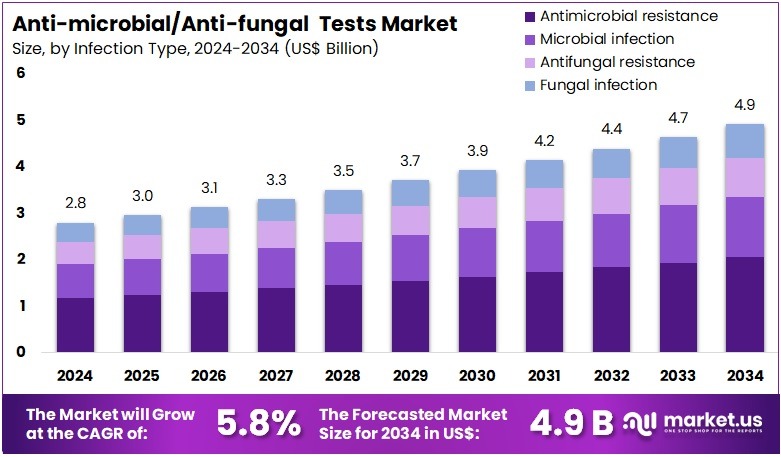
The Anti-microbial/Anti-fungal Tests Market size is expected to be worth around US$ 4.9 Billion by 2034 from US$ 2.8 Billion in 2024, growing at a CAGR of 5.8% during the forecast period 2025 to 2034. North America held a dominant market position, capturing more than a 37.4% share and holds US$ 1.0 Billion market value for the year.
The global Anti-microbial/Anti-fungal Tests Market is witnessing steady growth due to the rising burden of infectious diseases, increasing antimicrobial resistance (AMR), and growing demand for rapid diagnostic solutions.
These tests are used to identify bacterial and fungal infections, determine pathogen sensitivity, and support targeted treatment decisions. According to the World Health Organization (WHO), antimicrobial resistance is a major global health challenge, with bacterial AMR directly associated with approximately 1.27 million deaths annually worldwide.
The market is expanding with the adoption of advanced diagnostic technologies, including polymerase chain reaction (PCR), mass spectrometry, automated susceptibility testing systems, and rapid immunoassays.
Hospitals, clinical laboratories, and research institutes are increasingly implementing these solutions to reduce diagnostic delays and improve patient outcomes. Rapid testing platforms can provide pathogen identification results within a few hours compared with traditional culture-based methods that may require 24–72 hours.
The increasing prevalence of fungal infections among immunocompromised patients, cancer patients, and individuals undergoing organ transplantation is further supporting market growth. The Centers for Disease Control and Prevention (CDC) highlights that invasive fungal infections contribute to significant healthcare challenges, particularly with emerging drug-resistant fungal pathogens.
North America and Europe remain key regions due to strong healthcare infrastructure, high diagnostic adoption, and government initiatives addressing antimicrobial resistance. Additionally, rising healthcare expenditure, technological advancements, and increasing awareness about infection control are expected to drive future demand. The market is projected to experience continuous expansion as healthcare systems prioritize faster, accurate, and cost-effective antimicrobial and antifungal diagnostic testing solutions.
Key Takeaways
- In 2024, the market recorded a revenue of US$ 2.8 billion and is projected to grow at a CAGR of 5.8%, reaching US$ 4.9 billion by 2034.
- Based on test type, the market is categorized into molecular-based tests, rapid diagnostic tests, phenotypic resistance tests, mass spectrometry, and complex test panels. Among these, molecular-based tests dominated in 2023, accounting for a 38.9% market share.
- By infection type, the market is segmented into antimicrobial resistance, microbial infection, antifungal resistance, and fungal infection. The antimicrobial resistance segment held the largest share at 41.8%.
- By end-user, the market is classified into hospitals & clinics, reference laboratories, community health centers, and ambulatory surgical centers. The hospitals & clinics segment led the market with a 47.5% revenue share.
- Regionally, North America emerged as the leading market in 2023, capturing a 37.4% share of the global market.
Statistical Information
- A 2025 study evaluating the QuickMIC rapid antimicrobial susceptibility testing (AST) system reported a mean turnaround time (TAT) of 192 ± 18 minutes, delivering antimicrobial susceptibility results in less than 4 hours from positive blood cultures.
- A 2025 comparison of rapid AST platforms showed that the VITEK REVEAL system produced results in 6 hours 32 minutes, compared with 13 hours 51 minutes for VITEK 2-RAST, reducing reporting time by approximately 7 hours 19 minutes.
- A 2025 evaluation of EUCAST rapid antimicrobial susceptibility testing analyzed Gram-negative isolates using readings at 4 hours, 6 hours, and 16–20 hours, demonstrating shorter testing workflows compared with conventional susceptibility methods.
- The QuickMIC AST evaluation published in 2025 reported 89.5% essential agreement (EA) and 93.3% categorical agreement (CA) for antimicrobial susceptibility testing performance.
- A 2025 multi-system AST comparison reported that rapid testing platforms achieved categorical agreement rates of ≥98.2%, with very major error rates of ≤1.8% across evaluated antimicrobial combinations.
- A 2026 real-world evaluation of EUCAST rapid AST for Gram-negative bloodstream infections found categorical agreement of 99.4% at 6 hours and 100.0% at 16–20 hours for susceptibility results.
- The 2026 EUCAST rapid AST clinical study reported that 70% of results were interpretable at 6 hours, enabling earlier antimicrobial decision-making compared with traditional methods.
- A 2025 direct antifungal susceptibility testing study using E-test methods for candidemia evaluated 160 yeast-positive blood cultures and found categorical agreement above 90% for tested antifungal agents.
- The 2026 FUNGAR antifungal resistance detection pipeline was developed to identify antifungal resistance mutations directly from metagenomic short reads and analyze resistance-related variants across all 6 open reading frames.
- In the same 2026 study, rapid AST results supported antimicrobial therapy modification in 32.1% of patients, including 7.5% de-escalation and 24.6% escalation decisions.
- A 2025 rapid urinary antibiotic susceptibility testing (U-AST) development reported infection detection and antibiotic sensitivity results in 9 hours, compared with traditional workflows requiring 36–72 hours; the reported manufacturing cost was ₹50 per kit.
Regional Analysis
North America Leading the Anti-microbial/Anti-fungal Tests Market
North America dominated the anti-microbial/anti-fungal tests market in 2024, accounting for a 37.4% share of the global market. The region’s growth is supported by strong infection surveillance programs, advanced laboratory infrastructure, and increasing demand for rapid antimicrobial susceptibility testing.
The Centers for Disease Control and Prevention continues to emphasize antimicrobial resistance monitoring, driving adoption of automated testing platforms and molecular diagnostics. Increasing cases of drug-resistant fungal infections, including Candida auris, have accelerated the use of MIC testing and antifungal stewardship programs. Multiplex PCR and automated systems are improving detection speed, with some testing methods delivering results within 24 hours.
Asia Pacific Expected to Record Fastest Growth
Asia Pacific is projected to witness the highest CAGR during the forecast period due to rising healthcare investments, expanding diagnostic facilities, and increasing surveillance of antimicrobial resistance. Countries including India, China, and South Korea are strengthening laboratory networks and adopting advanced susceptibility testing methods.
Growing cases of invasive fungal infections among diabetic and immunocompromised populations are increasing the demand for rapid diagnostic solutions. Regional initiatives aligned with World Health Organization fungal priority pathogen monitoring are supporting the development of resistance detection capabilities and antifungal stewardship practices.
Emerging Trends
- Growth of Rapid Antimicrobial Susceptibility Testing (AST) Technologies: Hospitals are increasingly adopting rapid AST platforms to reduce diagnosis time and improve antibiotic selection. Traditional methods may require 18–24 hours, while newer molecular and automated systems aim to provide resistance information within hours, supporting faster treatment decisions in critical care settings.
- Increasing Demand for Antifungal Resistance Detection: Rising fungal resistance is driving demand for advanced antifungal testing solutions, especially for invasive infections. WHO reported that invasive fungal diseases affect more than 6.5 million people annually and are associated with approximately 3.8 million deaths, increasing the need for accurate fungal susceptibility testing.
- Expansion of Molecular and Genomic-Based Testing: Molecular diagnostics are becoming important for identifying antimicrobial resistance genes and pathogen profiles. In 2025, WHO’s surveillance report analyzed more than 23 million bacteriologically confirmed cases from global AMR monitoring systems, highlighting the growing need for advanced resistance detection technologies.
- Integration of AI and Automated Laboratory Workflows: Artificial intelligence and automation are emerging as key trends in antimicrobial testing by improving result interpretation, reducing manual workload, and increasing laboratory efficiency. Automated AST systems help laboratories process larger sample volumes while supporting antimicrobial stewardship programs in hospitals.
- Rising Adoption of Testing for Antimicrobial Stewardship Programs: Healthcare systems are increasing the use of antimicrobial and antifungal tests to reduce unnecessary drug usage and control resistance. WHO reported that antibiotic resistance increased across more than 40% of monitored pathogen–antibiotic combinations between 2018 and 2023, increasing demand for accurate susceptibility testing.
Use Cases
- ICU and Hospital-Acquired Infection Management: Anti-microbial tests are widely used in intensive care units to identify resistant organisms and guide targeted therapy. Testing supports faster treatment decisions for bloodstream infections, pneumonia, and sepsis cases where delays in selecting effective antibiotics can increase patient risks.
- Fungal Infection Diagnosis in Immunocompromised Patients: Antifungal testing is increasingly applied among cancer patients, transplant recipients, and critically ill individuals. WHO highlighted gaps in fungal diagnostics and emphasized the need for faster, affordable tests that can work beyond specialized laboratories.
- Monitoring Drug Resistance Through Surveillance Programs: Public health laboratories are using antimicrobial testing data to monitor resistance patterns and support infection-control strategies. WHO’s GLASS surveillance system collected data from 110 countries between 2016 and 2023, improving global tracking of resistant infections.
- Point-of-Care and Decentralized Testing Applications: The market is moving toward portable and easy-to-use diagnostic solutions for clinics and resource-limited regions. WHO identified the need for affordable point-of-care fungal diagnostic tools because many current tests require advanced laboratories and trained personnel.
- Personalized Antimicrobial Treatment Selection: Susceptibility testing enables physicians to select the most effective antimicrobial or antifungal therapy based on individual pathogen resistance patterns. In the U.S., CDC estimates more than 2.8 million antimicrobial-resistant infections occur annually, increasing demand for precision diagnostic approaches.
Frequently Asked Questions on Anti-microbial/Anti-fungal Tests
- What are anti-microbial and anti-fungal tests?
Anti-microbial and anti-fungal tests are diagnostic laboratory methods used to identify microorganisms and evaluate their response to antimicrobial or antifungal medicines. These tests help healthcare providers select effective treatments, detect resistance patterns, and improve infection management by supporting accurate and timely therapeutic decisions. - Why is the demand for anti-microbial and anti-fungal tests increasing?
Demand is increasing due to the rising prevalence of drug-resistant infections, growing hospital-acquired infections, and the need for targeted treatment approaches. Healthcare facilities are adopting advanced testing solutions to improve diagnosis accuracy, reduce treatment delays, and support antimicrobial stewardship programs worldwide. - What are the main types of anti-microbial and anti-fungal tests?
Major types include molecular diagnostic tests, rapid diagnostic tests, culture-based susceptibility tests, broth microdilution methods, disk diffusion tests, and automated testing systems. These methods help laboratories identify pathogens, analyze resistance profiles, and determine the most suitable antimicrobial or antifungal therapy. - What factors are driving the anti-microbial/anti-fungal tests market?
Key market growth factors include increasing antimicrobial resistance, rising infectious disease cases, technological advancements in diagnostics, expansion of clinical laboratories, and growing awareness about infection prevention. The adoption of rapid testing platforms is further supporting market development across healthcare systems. - What role do rapid diagnostic tests play in infection control?
Rapid diagnostic tests help healthcare professionals quickly identify pathogens and resistance markers, enabling faster treatment decisions. By reducing diagnosis time compared with traditional methods, these tests support early intervention, improve infection control measures, and help minimize the spread of resistant microorganisms. - Which infections commonly require anti-fungal testing?
Anti-fungal testing is commonly required for infections caused by fungi such as Candida, Aspergillus, and Cryptococcus species. These tests help determine fungal susceptibility to antifungal drugs, especially in patients with severe infections, weakened immune systems, or prolonged hospital stays. - What challenges are limiting the growth of the anti-microbial/anti-fungal tests market?
Market challenges include high costs of advanced diagnostic platforms, limited laboratory facilities in developing regions, complex testing procedures, and shortages of trained professionals. Regulatory requirements and variations in testing guidelines may also influence the adoption of advanced antimicrobial and antifungal testing technologies.
Conclusion
The Anti-microbial/Anti-fungal Tests Market is positioned for steady growth as rising antimicrobial resistance, increasing fungal infections, and the need for faster diagnostic decisions drive technology adoption. Molecular diagnostics, rapid susceptibility testing, and automated platforms are transforming infection management by enabling accurate pathogen identification and targeted therapies.
Hospitals, laboratories, and research institutions continue investing in advanced testing solutions to support antimicrobial stewardship programs. North America maintains market leadership, while Asia Pacific offers significant expansion opportunities through improved healthcare infrastructure and surveillance initiatives. Continuous innovation, regulatory advancements, and growing demand for precision diagnostics will shape the market’s long-term development through 2034.
Discuss your needs with our analyst
Please share your requirements with more details so our analyst can check if they can solve your problem(s)




