


Overview
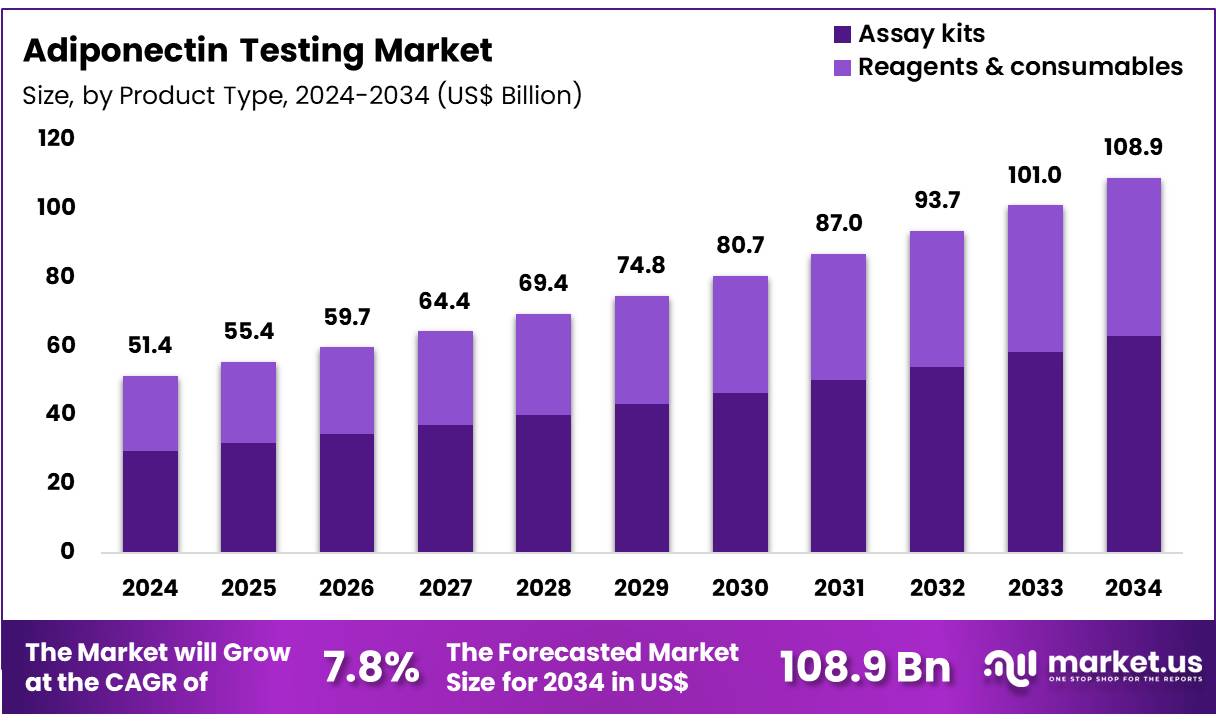
New York, NY – July 30, 2026 – The Global Adiponectin Testing Market size is expected to be worth around US$ 108.9 Billion by 2034 from US$ 51.4 Billion in 2024, growing at a CAGR of 7.8% during the forecast period 2025 to 2034. In 2024, North America led the market, achieving over 41.1% share with a revenue of US$ 21.1 Billion.
Adiponectin testing is a diagnostic assessment used to measure the level of adiponectin, a protein hormone produced by fat cells that plays an important role in regulating glucose levels, insulin sensitivity, and fatty acid metabolism. Healthcare professionals use this test to support the evaluation of metabolic disorders, obesity, type 2 diabetes, cardiovascular diseases, and other conditions linked to insulin resistance. The growing prevalence of chronic metabolic diseases, increasing awareness of preventive healthcare, and rising adoption of personalized medicine are contributing to the demand for adiponectin testing worldwide.
The test is typically performed using a blood sample and is commonly analyzed through laboratory techniques such as enzyme-linked immunosorbent assay (ELISA), radioimmunoassay (RIA), and other immunoassay-based methods. Advances in diagnostic technologies have improved the accuracy, sensitivity, and turnaround time of adiponectin testing, making it a valuable tool in clinical research and routine diagnostics. Researchers are also exploring its role as a biomarker for predicting disease progression and treatment response.
The increasing burden of diabetes and obesity continues to drive interest in metabolic biomarker testing. According to the International Diabetes Federation (IDF), approximately 589 million adults aged 20–79 years were living with diabetes in 2024, while the World Health Organization (WHO) estimates that more than 1 billion people worldwide are living with obesity. These trends are encouraging healthcare providers and research institutions to adopt advanced biomarker-based diagnostic approaches, including adiponectin testing, to enable earlier detection, better risk assessment, and improved disease management. Continuous investments in diagnostic innovation and precision medicine are expected to further support the growth and clinical importance of adiponectin testing.
Key Takeaways
- In 2024, the market generated a revenue of US$ 51.4 billion, with a CAGR of 7.8%, and is expected to reach US$ 108.9 billion by the year 2034.
- The product type segment is divided into assay kits and reagents & consumables, with assay kits taking the lead in 2023 with a market share of 57.8%.
- Considering species type, the market is divided into human, rat, mouse, and others. Among these, humans held a significant share of 63.5%.
- Furthermore, concerning the end-user segment, the market is segregated into research & academic institutes, diagnostic labs, and hospitals. The research & academic institutes sector stands out as the dominant player, holding the largest revenue share of 49.4% in the market.
- North America led the market by securing a market share of 41.1% in 2023.
Statistical Information
- A 2026 electrochemical adiponectin immunosensor achieved an ultra-low limit of detection (LOD) of 0.0093 ng/mL for blood adiponectin measurement, enabling highly sensitive detection for early diabetes screening.
- The same 2026 immunosensor measured adiponectin across a wide linear range of 0.5–25,000 ng/mL, allowing both very low and very high concentrations to be quantified using a single platform.
- The 2026 electrochemical immunosensor maintained a sensitivity of 3.03 μA per decade of concentration change, supporting reliable quantitative measurement across its operating range.
- The regenerable adiponectin immunosensor retained analytical performance through 14 regeneration cycles, reducing the need for single-use sensor replacement during repeated testing.
- A 2025 clinical study measured serum adiponectin using a sandwich ELISA with a detection sensitivity of 0.25 ng/mL and an intra-assay coefficient of variation (CV) of 3.4%, demonstrating high analytical precision.
- In the same 2025 study, the accompanying leptin ELISA used alongside adiponectin testing achieved a sensitivity of 0.50 ng/mL with an intra-assay CV of 4.3%, reflecting consistent multiplex metabolic biomarker testing performance.
- A 2025 ultrasensitive adiponectin ELISA demonstrated a linear calibration range of 5–100 pg/mL with an excellent calibration coefficient (R² = 0.99), indicating highly linear quantitative performance.
- The same ultrasensitive ELISA achieved a limit of detection of 0.81 pg/mL and a limit of quantification of 2.7 pg/mL, allowing reliable measurement of extremely low urinary adiponectin concentrations.
Regional Analysis
North America Leads the Adiponectin Testing Market
North America dominated the adiponectin testing market in 2024, accounting for 41.1% of the global market. The region benefits from a high burden of obesity, type 2 diabetes, metabolic syndrome, and cardiovascular disorders, which has increased the demand for adiponectin biomarker testing in hospitals, diagnostic laboratories, and research institutions. Healthcare providers increasingly use adiponectin assays to assess insulin resistance, metabolic health, and disease progression, particularly among high-risk patients.
Strong funding from organizations such as the National Institute of Diabetes and Digestive and Kidney Diseases (NIDDK) supports research on adipokines and metabolic diseases, while advanced laboratory infrastructure enables widespread adoption of ELISA and chemiluminescent immunoassay technologies. According to the U.S. Centers for Disease Control and Prevention (CDC), the age-adjusted prevalence of obesity among U.S. adults was 40.3% during August 2021–August 2023, highlighting the need for metabolic biomarker testing. Continuous innovation, favorable reimbursement, and extensive clinical research further strengthen North America’s leadership in the adiponectin testing market.
Asia Pacific Expected to Register the Highest CAGR
Asia Pacific is projected to record the fastest growth in the adiponectin testing market during the forecast period, driven by the rapid rise in diabetes, obesity, and other metabolic disorders. Governments across China, India, Japan, and South Korea are expanding chronic disease screening programs and investing in advanced diagnostic laboratory infrastructure. Increasing awareness of preventive healthcare and early metabolic disease detection is encouraging greater use of adiponectin testing in clinical practice and research.
The region is also witnessing growing collaborations between academic institutions, hospitals, and biotechnology companies to improve biomarker-based diagnostics. According to the International Diabetes Federation (IDF), South-East Asia had 92 million adults living with diabetes in 2022, up from 89 million in 2021, demonstrating the increasing need for advanced metabolic biomarkers. Rising healthcare expenditure, expanding laboratory networks, and improved access to immunoassay technologies are expected to accelerate regional market growth.
Emerging Trends
- Growing use in early metabolic disease screening:Healthcare providers are increasingly evaluating adiponectin alongside traditional glucose markers to identify insulin resistance earlier. The CDC estimates 38.4 million Americans have diabetes, while an A1C of 5.7%–6.4% indicates prediabetes, supporting demand for advanced metabolic biomarker testing.
- Integration with multi-biomarker metabolic panels:Laboratories are combining adiponectin with insulin, HbA1c, lipid profile, and inflammatory markers to improve metabolic risk assessment. Clinical research involving 951 participants (376 diabetes patients and 575 high-risk individuals) demonstrated adiponectin’s value as an additional biomarker for diabetes screening.
- Expansion of ELISA-based laboratory testing:Most clinical adiponectin measurements continue to rely on enzyme-linked immunosorbent assay (ELISA) because of its analytical reliability. Commercial laboratories generally report 7–8 day turnaround times, reflecting growing adoption of standardized laboratory workflows for adiponectin analysis.
- Greater focus on cardiovascular and obesity risk assessment:Researchers increasingly recognize adiponectin as a biomarker linking obesity, inflammation, and cardiovascular disease. Normal circulating adiponectin concentrations generally range between 3–30 μg/mL, encouraging broader investigation of its role in preventive healthcare and chronic disease management.
- Increasing clinical research supporting personalized medicine:Hospitals and academic centers are studying adiponectin for patient risk stratification. Clinical studies reported an ROC value of 0.740 for diabetes detection, while patients with better glucose control showed adiponectin levels of 8.6 μg/mL versus 7.4 μg/mL, supporting personalized metabolic monitoring.
Use Cases
- Early identification of insulin resistance:Clinicians use adiponectin testing to identify insulin resistance before diabetes develops. Individuals with lower adiponectin levels have demonstrated higher metabolic risk, making the test valuable alongside fasting glucose and HbA1c for preventive healthcare programs.
- Monitoring patients with Type 2 diabetes:Adiponectin testing helps physicians monitor metabolic control during diabetes management. Research found patients with good glycemic control had average adiponectin levels of 8.6 μg/mL, compared with 7.4 μg/mL in patients with poorer glucose control.
- Supporting obesity and metabolic syndrome evaluation:Endocrinologists use adiponectin measurements to evaluate obesity-related metabolic dysfunction. Since adiponectin is strongly associated with insulin sensitivity and inflammation, it provides additional clinical information beyond body mass index and routine blood glucose measurements.
- Cardiovascular risk assessment in high-risk populations:Healthcare providers increasingly investigate adiponectin in patients with obesity, diabetes, and cardiovascular disease because reduced adiponectin levels are associated with greater cardiometabolic risk. This supports comprehensive risk evaluation during preventive health assessments.
- Clinical and translational research applications:Academic institutions and biotechnology researchers use adiponectin testing to evaluate new therapies targeting insulin sensitivity and inflammation. Studies involving 951 participants continue to support its application in biomarker validation, metabolic disease research, and precision medicine development.
Frequently Asked Questions on Adiponectin Testing
- Why is adiponectin testing important?
Adiponectin testing is important because low adiponectin levels are associated with insulin resistance, obesity, metabolic syndrome, and cardiovascular diseases. The test helps clinicians identify metabolic abnormalities at an early stage, allowing better disease monitoring, treatment planning, and lifestyle intervention before complications become severe. - Who should undergo adiponectin testing?
Adiponectin testing is commonly recommended for individuals with obesity, type 2 diabetes, metabolic syndrome, hypertension, or cardiovascular disease risk factors. Researchers also use the test in clinical studies to understand metabolic health and evaluate the effectiveness of new therapies targeting insulin resistance. - What sample is required for adiponectin testing?
Adiponectin testing typically requires a small blood sample collected from a vein. The sample is analyzed using immunoassay-based laboratory techniques such as ELISA or chemiluminescent assays. Results are interpreted alongside other metabolic biomarkers to provide a comprehensive assessment of a patient’s metabolic condition. - Which healthcare settings use adiponectin testing the most?
Hospitals, diagnostic laboratories, academic research institutes, and specialty endocrinology clinics are the primary users of adiponectin testing. These organizations use the test for disease diagnosis, metabolic risk assessment, clinical research, and monitoring patient response to therapies targeting insulin resistance and obesity. - Which regions are leading the adiponectin testing market?
North America currently leads the adiponectin testing market because of its advanced healthcare infrastructure, high adoption of biomarker-based diagnostics, strong research funding, and growing burden of metabolic diseases. Europe and Asia-Pacific are also expanding rapidly due to increased healthcare investments and diagnostic awareness. - What are the future opportunities in the adiponectin testing market?
Future opportunities include the development of highly sensitive diagnostic assays, automated laboratory platforms, multiplex biomarker panels, and precision medicine applications. Expanding research into metabolic diseases, personalized treatment approaches, and preventive healthcare programs is expected to create sustained demand for adiponectin testing solutions.
Conclusion
The adiponectin testing market is expected to witness steady growth as healthcare systems increasingly focus on the early detection and management of metabolic disorders, obesity, type 2 diabetes, and cardiovascular diseases. Rising awareness of biomarker-based diagnostics, expanding research on adiponectin’s role in metabolic health, and the growing adoption of precision medicine are strengthening market demand.
Technological improvements in immunoassays, high-sensitivity ELISA kits, automated laboratory platforms, and emerging point-of-care testing solutions are making adiponectin testing more accurate and accessible. Research institutions, diagnostic laboratories, and hospitals continue to expand the use of these assays for both clinical and research applications.
North America remains the leading regional market, while Asia-Pacific is expected to experience significant growth due to increasing healthcare investments and a growing burden of chronic diseases. Although challenges such as high testing costs and limited reimbursement remain, continuous innovation, expanding biomarker research, and greater emphasis on preventive healthcare are expected to create long-term opportunities for market participants and support sustained industry growth.
Discuss your needs with our analyst
Please share your requirements with more details so our analyst can check if they can solve your problem(s)




