


Overview
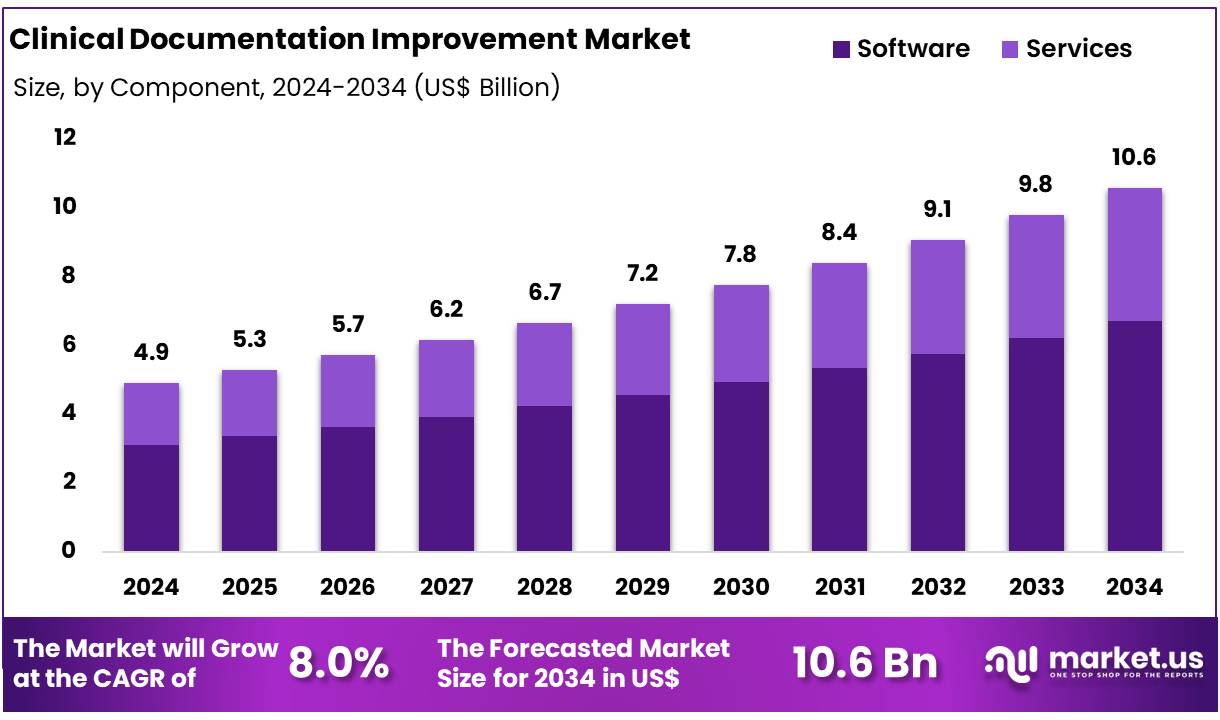
New York, NY – Aug 03, 2026 – The Global Clinical Documentation Improvement Market size is expected to be worth around US$ 10.6 Billion by 2034 from US$ 4.9 Billion in 2024, growing at a CAGR of 8.0% during the forecast period from 2025 to 2034. In 2024, North America led the market, achieving over 40.2% share with a revenue of US$ 2.0 Billion.
Clinical Documentation Improvement (CDI) is a structured healthcare process that focuses on improving the accuracy, completeness, and quality of clinical documentation created by physicians and other healthcare professionals. The goal of CDI is to ensure that patient medical records accurately reflect diagnoses, treatments, severity of illness, and the care provided throughout a patient’s healthcare journey. High-quality documentation supports better clinical decision-making, improves patient safety, and enables effective communication among multidisciplinary care teams.
CDI programs are widely implemented in hospitals, specialty clinics, and healthcare systems to strengthen coding accuracy, support appropriate reimbursement, and meet regulatory and quality reporting requirements. These programs typically involve collaboration between clinical documentation specialists, physicians, nurses, medical coders, and health information management professionals. Advanced technologies, including electronic health records (EHRs), artificial intelligence (AI), natural language processing (NLP), and computer-assisted coding (CAC), are increasingly being integrated into CDI workflows to identify documentation gaps and improve efficiency.
The growing adoption of value-based healthcare, rising regulatory compliance requirements, and the global expansion of digital health infrastructure are driving demand for advanced CDI solutions. Healthcare organizations are investing in cloud-based platforms and AI-powered analytics to enhance documentation quality, reduce claim denials, and optimize revenue cycle management. As healthcare systems continue to prioritize data accuracy, interoperability, and patient-centered care, Clinical Documentation Improvement remains a critical component of modern healthcare operations, supporting improved clinical outcomes, operational efficiency, and sustainable financial performance.
Key Takeaways
- Market Size: The global Clinical Documentation Improvement (CDI) market was valued at US$ 4.9 billion in 2024 and is projected to reach US$ 10.6 billion by 2034.
- Market Growth: The market is anticipated to expand at a compound annual growth rate (CAGR) of 8.0% over the forecast period from 2025 to 2034.
- Product Analysis: In 2024, the Software segment emerged as the leading product category, capturing approximately 63.5% of the global market share.
- Deployment Analysis: The Cloud-Based segment held the largest market share in 2024, accounting for an estimated 51.2% of the overall market.
- End-Use Analysis: The Clinical Coding and Compliance segment dominated the market in 2024, representing around 29.6% of the total market share.
- Regional Analysis: North America maintained its leading position in 2024, contributing more than 40.2% of the global market and generating approximately US$ 2.0 billion in revenue.
Statistical Information
- An AI-powered CDI workflow tool reduced the overall CDI query rate from 9.2% to 7.8%, representing a 14.8% relative reduction after implementation.
- Among active physicians using the AI documentation tool, CDI query rates fell from 10.1% to 8.1%, an absolute reduction of 2.1% points and a 20.4% relative improvement.
- The AI-CDI implementation analyzed 43,597 patient encounters and 3,790 CDI queries, providing one of the largest real-world operational datasets published in 2025.
- The reduction in CDI queries is estimated to save approximately 9–12 physician hours per hospitalist annually because each CDI query typically requires about 15–20 minutes to resolve.
- Researchers estimated that nationwide adoption of the AI-assisted CDI workflow could eliminate approximately 500,000 physician hours each year through fewer documentation queries.
- After mandatory training, 68% of physicians continued using the AI documentation tool as full users, while another 12% used it as a reference tool, resulting in an overall post-training adoption rate of 80%.
- The 2025 implementation involved training 25 hospitalists before deployment of the AI-assisted clinical documentation workflow.
- A 2025 evaluation of AI-generated clinical documentation reviewed notes from 97 patient visits across five medical specialties, with expert-written notes scoring 4.25 out of 5 compared with AI-generated notes scoring 4.20 out of 5 on overall documentation quality (p = 0.04).
- The same 2025 study reported high evaluator agreement, with RWG (within-group agreement) values greater than 0.70 in General Medicine, Orthopedics, and Obstetrics/Gynecology when assessing documentation quality.
- In the clinician survey from the 2025 deployment, 100% of participating clinicians reported that the AI documentation tool improved the quality of care they delivered, while 75% described the improvement as “substantial.”
- A 2026 study evaluating automated clinical documentation from radiology reports processed 414 interventional radiology reports created by nine residents to assess AI-assisted documentation performance.
- The highest-performing AI documentation models achieved F1-scores approaching 0.87 for structured extraction of procedural information from clinical documentation.
Regional Analysis
North America accounted for the leading share of the Clinical Documentation Improvement (CDI) market in 2024, holding over 40.2% of the global market and generating approximately US$ 2.0 billion in revenue. The region’s leadership is supported by a highly developed healthcare infrastructure, widespread adoption of electronic health records (EHRs), and strong emphasis on accurate clinical documentation. Healthcare providers are increasingly implementing CDI solutions to improve coding accuracy, reduce claim denials, strengthen revenue cycle management, and enhance patient care quality.
In the United States, supportive healthcare regulations, value-based care initiatives, and continued investment in artificial intelligence-powered documentation tools have accelerated market adoption. Canada is also experiencing steady growth due to expanding digital health programs, greater awareness of documentation quality, and ongoing investments in healthcare IT modernization. Rising demand for standardized clinical data, regulatory compliance, and workflow automation is expected to sustain North America’s leadership and drive continued growth in the Clinical Documentation Improvement market.
Emerging Trends
- Rapid Adoption of AI-Powered Clinical Documentation: Healthcare providers are increasingly using artificial intelligence (AI) and generative AI to create clinical notes automatically. A 2025 systematic review covering 23 studies found AI significantly reduced documentation workload, with a standardized mean difference (SMD) of -0.71, while documentation time also declined (SMD -0.72). This trend is improving clinician productivity and reducing burnout.
- Growth of Ambient AI Scribes: Ambient AI scribes are becoming a major trend in CDI by capturing clinician-patient conversations and generating structured notes. A 2025 oncology study reported 25 clinicians used the technology across 620 patient visits, with 94% using AI-generated draft content at least sometimes and 61% wanting continued access after the pilot.
- Focus on Reducing Documentation Burden: Healthcare organizations are investing in CDI technologies that reduce clinician workload. The American Medical Informatics Association (AMIA) continues its 25×5 initiative, aiming to reduce documentation burden to 25% of its current level within five years, encouraging better EHR usability and workflow improvements.
- Better EHR Integration for Documentation: Modern CDI solutions are increasingly integrated directly into electronic health records (EHRs). In a 2025 oncology workflow study, AI scribes increased average patient visits by 3.35 visits per working day while increasing physician billing by approximately US$433.61 per working day, without reducing documentation quality.
- Greater Attention to Documentation Quality: Healthcare providers are adopting AI tools with stronger quality monitoring rather than full automation. A 2025 review found AI-generated documentation quality was at least comparable to manually written clinical notes, highlighting the growing importance of clinician review, governance, and quality assurance in CDI programs.
Use Cases
- Automated Clinical Note Generation: Hospitals are using AI to convert clinician-patient conversations into structured documentation automatically. Evidence from 23 clinical studies published in 2025 showed AI consistently reduced documentation workload while maintaining note quality, allowing physicians to spend more time on direct patient care instead of administrative tasks.
- Oncology Documentation Support: Cancer centers are implementing AI-assisted documentation to improve workflow efficiency. During a 2025 pilot, clinicians used ambient AI across 620 outpatient visits, and 44% reported spending less time on documentation outside clinic hours, demonstrating practical value for complex oncology documentation.
- Improving Physician Productivity: CDI solutions help physicians complete records faster without compromising coding quality. A 2025 study found AI-assisted documentation increased physician productivity by 3.35 additional patient visits per day while raising daily billing by around US$433.61, supporting more efficient healthcare delivery.
- Reducing After-Hours Documentation: Ambient clinical intelligence is helping reduce “pajama time” spent completing records after work. A 2025 clinical study reported providers saved approximately 2.5 hours per week of off-hours documentation while also reducing documentation burden and clinician burnout.
- Supporting Burnout Reduction Programs: Healthcare systems are deploying CDI technologies as part of clinician wellness strategies. A 2025 meta-analysis found AI-based documentation tools produced a moderate reduction in documentation burden (SMD -0.71), supporting organizational efforts to lower burnout while maintaining accurate clinical records.
Frequently Asked Questions on Clinical Documentation Improvement
- What is Clinical Documentation Improvement (CDI)?
Clinical Documentation Improvement (CDI) is a healthcare process that improves the accuracy, completeness, and clarity of patient medical records. It helps healthcare providers document diagnoses and treatments correctly, supporting better patient care, accurate coding, regulatory compliance, and appropriate reimbursement. - Why is Clinical Documentation Improvement important?
Clinical Documentation Improvement is important because it enhances communication among healthcare teams, reduces documentation errors, supports quality reporting, and ensures proper reimbursement. Accurate clinical records also improve patient safety, strengthen compliance with healthcare regulations, and assist in healthcare performance measurement. - Who is involved in a Clinical Documentation Improvement program?
A CDI program typically involves physicians, clinical documentation specialists, medical coders, nurses, health information management professionals, and hospital administrators. These professionals work together to ensure patient documentation accurately reflects clinical conditions, treatments, and healthcare services delivered. - How does technology support Clinical Documentation Improvement?
Modern CDI programs use electronic health records (EHRs), artificial intelligence, natural language processing, and computer-assisted coding to identify missing or unclear documentation. These technologies help improve documentation quality, reduce manual workload, and increase coding accuracy across healthcare organizations. - What challenges do healthcare providers face in Clinical Documentation Improvement?
Healthcare providers often face challenges such as physician documentation burden, changing coding regulations, limited staff resources, inconsistent clinical terminology, and maintaining documentation accuracy. Continuous education, advanced software, and standardized documentation practices help overcome these common obstacles. - What is the Clinical Documentation Improvement Market?
The Clinical Documentation Improvement Market includes software, consulting services, and technology solutions that help healthcare organizations improve clinical documentation quality. Market growth is supported by digital healthcare adoption, increasing regulatory requirements, and the need for accurate reimbursement and quality reporting. - Which healthcare organizations are the primary users of Clinical Documentation Improvement solutions?
Hospitals, multispecialty clinics, academic medical centers, physician practices, ambulatory care facilities, and integrated healthcare networks are the major users of CDI solutions. These organizations rely on documentation accuracy to improve clinical outcomes, coding quality, reimbursement, and regulatory compliance. - Which region leads the Clinical Documentation Improvement Market?
North America currently leads the Clinical Documentation Improvement Market because of its advanced healthcare infrastructure, widespread electronic health record adoption, supportive reimbursement systems, and strong regulatory emphasis on documentation quality, coding accuracy, and value-based healthcare delivery.
Conclusion
The Clinical Documentation Improvement (CDI) market is expected to witness steady growth as healthcare organizations increasingly prioritize accurate clinical records, regulatory compliance, and efficient reimbursement processes. The expanding adoption of electronic health records, cloud-based platforms, artificial intelligence, and natural language processing is transforming documentation workflows while reducing coding errors and administrative burden.
Strong government initiatives supporting interoperability and value-based care are further encouraging CDI implementation across hospitals and healthcare systems. As providers focus on improving patient outcomes, operational efficiency, and revenue cycle performance, demand for advanced CDI solutions and services is projected to remain strong, creating long-term opportunities for technology providers and healthcare organizations.
Discuss your needs with our analyst
Please share your requirements with more details so our analyst can check if they can solve your problem(s)




