


Overview
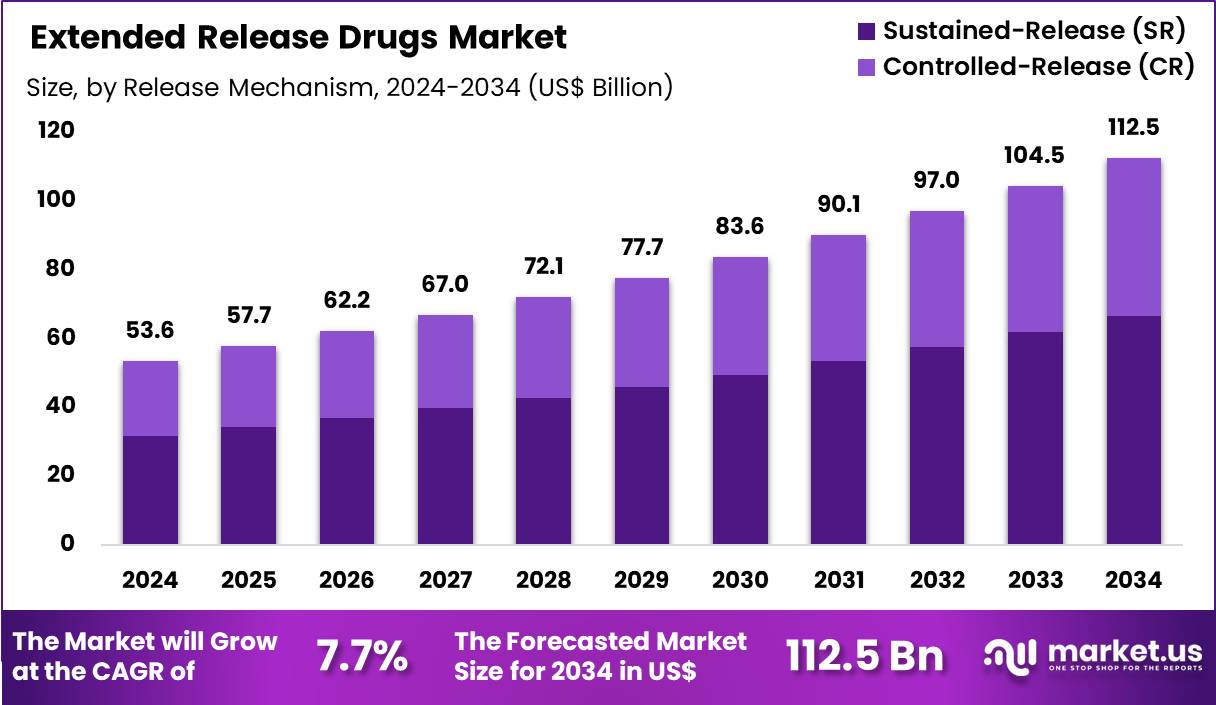
New York, NY – Sep 08, 2026 – The Global Extended Release Drugs Market size is expected to be worth around US$ 112.5 Billion by 2034 from US$ 53.6 Billion in 2024, growing at a CAGR of 7.7% during the forecast period 2025 to 2034. In 2024, North America led the market, achieving over 38.1% share with a revenue of US$ 20.4 Billion.
The global Extended Release Drugs Market is gaining importance as pharmaceutical manufacturers increasingly focus on drug delivery systems that maintain therapeutic drug levels over longer periods. Extended-release formulations are designed to make active pharmaceutical ingredients available gradually, potentially reducing dosing frequency and supporting more consistent treatment.
The U.S. Food and Drug Administration (FDA) defines extended-release products as formulations that make a drug available over an extended period following administration. These medicines are developed across various therapeutic areas, including pain management, cardiovascular disorders, diabetes, neurological conditions, and other chronic diseases.
Technological advances in formulation science, polymer-based drug delivery, dissolution testing, and in-vitro/in-vivo correlation are supporting continued development of extended-release products. The FDA provides specific guidance for oral extended-release dosage forms, highlighting the importance of evaluating dissolution behavior and demonstrating relationships between laboratory performance and drug behavior in the body.
The market is also influenced by growing regulatory attention toward medication safety and appropriate prescribing. In July 2025, the FDA required updated safety labeling for opioid medicines, emphasizing that extended-release/long-acting opioids should be reserved for severe and persistent pain when alternative treatments are inadequate. This reflects the industry’s increasing focus on balancing controlled drug delivery with patient safety and clinical effectiveness.
Overall, demand for extended-release drug technologies is expected to remain linked to the need for convenient dosing, improved adherence, and advanced pharmaceutical formulations, while regulatory oversight and evidence-based product development continue to shape the market.
Key Takeaways
- In 2024, the market generated revenue of US$ 53.6 Billion and is projected to reach US$ 112.5 Billion by 2034, expanding at a CAGR of 7.7% during the forecast period.
- By release mechanism, the market is segmented into sustained-release (SR) and controlled-release (CR). The sustained-release (SR) segment dominated in 2024, accounting for a 59.2% market share.
- Based on therapeutic area, the market is categorized into cardiovascular, central nervous system (CNS) & psychiatric, pain management, endocrine & metabolic, gastrointestinal, anti-infective, respiratory, and others. The cardiovascular segment held a significant 26.5% share in 2024.
- By formulation technique, the market is segmented into matrix formulations, coating techniques, and encapsulation techniques. Matrix formulations emerged as the leading segment, capturing the largest revenue share of 62.7%.
- Based on distribution channel, the market is divided into retail pharmacies, hospital pharmacies, and online pharmacies. Retail pharmacies dominated the segment, accounting for a 55.1% revenue share.
- North America dominated the global market in 2024, accounting for a 38.1% market share.
Statistical Information
- Extended-Release Formulations Show Higher Medication Adherence: A large U.S. retrospective study covering 123,243 patients found that extended-release users had an average medication possession ratio of 80.2%, compared with 74.8% for non-extended-release users. This supports demand for formulations that reduce dosing frequency and improve treatment continuity.
- 2025 FDA Action Highlights Pediatric Safety Monitoring: In June 2025, the FDA revised labeling across extended-release stimulant medicines used for ADHD to address weight-loss and adverse-reaction risks in children younger than 6 years. Although not approved for this age group, off-label prescribing occurs, increasing the importance of safety monitoring.
- Medicare Part D Data Include Up to 12 Standardized 30-Day Fills: CMS standardizes Medicare Part D prescription utilization into 30-day fills, with values above 12 fills top-coded at 12 and values below one standardized fill bottom-coded at one. This measurement framework can support analysis of refill frequency and medication persistence across prescription products.
- 2025 EMA Guidance Strengthened Product-Specific Evaluation of Prolonged-Release Tablets: The EMA adopted product-specific bioequivalence guidance for 9 mg prolonged-release budesonide tablets, with a legal effective date of September 1, 2025. The development reflects continued regulatory attention to demonstrating therapeutic equivalence for prolonged-release products and supporting reliable generic competition.
- Extended-Release Users Demonstrate Higher Overall Adherence: In the same analysis, average adjusted adherence was 56.3% among extended-release users, compared with 46.0% among non-extended-release users, representing a 10.3-percentage-point difference. This highlights adherence as a measurable clinical benefit associated with extended-release drug delivery.
Regional Analysis
North America is leading the Extended Release Drugs Market.
North America held a leading 38.1% market share in 2024, supported by a substantial chronic disease burden and strong pharmaceutical infrastructure. In the United States, chronic conditions remain a major healthcare concern, increasing the need for long-term treatment strategies. Extended-release formulations can support simplified dosing and sustained drug delivery, making them relevant for chronic disease management.
The U.S. FDA also maintains specific regulatory guidance covering extended-release and modified-release dosage forms, supporting standardized development, evaluation, and approval processes. Strong healthcare access, established generic drug distribution, and continued pharmaceutical innovation further strengthen regional adoption. These factors collectively support North America’s continued leadership in the Extended Release Drugs Market.
Asia Pacific is expected to record the fastest growth during the forecast period, driven by the region’s growing burden of noncommunicable diseases and expanding healthcare needs. WHO reports that NCDs account for 52% of all deaths in the South-East Asia Region, while the Western Pacific region recorded 12 million NCD-related deaths in 2019.
This substantial disease burden is increasing demand for effective long-term treatment and adherence-focused therapies. Rising healthcare investment, improving pharmaceutical manufacturing capabilities, and broader access to medicines are also supporting regional expansion. As healthcare systems strengthen chronic disease management, extended-release formulations may gain greater acceptance because of their potential to simplify treatment regimens and support consistent drug delivery.
Emerging Trends
- Growing focus on adherence-friendly therapies: Extended-release medicines are increasingly important in chronic disease care because they can reduce dosing frequency. WHO reports that medication adherence among patients with chronic diseases averages only about 50% in developed countries, creating opportunities for simpler, longer-acting oral treatment options.
- Greater attention to pediatric extended-release formulations: Pediatric use is becoming a key area of formulation development. In 2025, the FDA strengthened labeling for extended-release amphetamine and methylphenidate products, highlighting weight-loss and adverse-effect concerns in children under 6 years and supporting more age-specific treatment decisions.
- Advanced formulation testing is gaining importance: Pharmaceutical developers are increasingly using in-vitro/in-vivo correlation (IVIVC) to understand how laboratory dissolution results relate to drug performance in the body. FDA guidance supports IVIVC for developing and evaluating extended-release oral dosage forms and improving formulation predictability.
- Rising demand for simplified chronic-care treatment: Extended-release formulations can help address challenges linked to frequent medicine administration. WHO estimates that 1.4 billion adults aged 30–79 years had hypertension in 2024, while only about 23% had it controlled, highlighting the need for practical long-term treatment approaches.
- Stronger emphasis on safe handling and labeling: Regulatory agencies are paying closer attention to how modified-release medicines are used. Clear instructions are important because altering some extended-release tablets or capsules can change drug release and potentially affect treatment safety, making patient education an important market consideration.
Use Cases
- Hypertension management: Extended-release formulations can be used in cardiovascular care to maintain drug levels over longer periods. Their potential to reduce dosing frequency makes them useful for patients requiring continuous treatment, particularly those managing hypertension and other long-term cardiovascular conditions.
- ADHD treatment: Extended-release stimulants are widely used as a treatment option for attention-deficit/hyperactivity disorder. Longer drug action can support symptom management throughout the day and reduce the need for repeated administration, although age-specific safety and dosing considerations remain important.
- Chronic pain management: Extended-release formulations are used for selected chronic pain therapies to provide prolonged drug exposure. This approach can help maintain therapeutic effects over longer periods, but products containing opioids require strict prescribing, monitoring, and risk-management practices because of dependence and overdose concerns.
- Diabetes and metabolic disease care: Extended-release medicines are used in metabolic disease treatment, including extended-release versions of certain oral diabetes medicines. These formulations can support convenient dosing schedules and sustained drug delivery, helping patients incorporate medication into long-term disease-management routines.
- Neurological disorder treatment: Extended-release formulations are increasingly relevant in neurological care, where maintaining stable drug exposure may help manage symptoms over extended periods. They are used across selected treatments for conditions such as Parkinson’s disease and epilepsy, depending on the medicine and clinical requirements.
Frequently Asked Questions on Extended Release Drugs
- How do extended release drugs work?
Extended release formulations use specialized technologies that control how quickly medicine is released after administration. Depending on the formulation, the drug may be released gradually through coatings, matrices, osmotic systems, or other delivery mechanisms. - What are the benefits of extended release drugs?
Extended release drugs can reduce the number of daily doses, provide more consistent therapeutic effects, minimize fluctuations in drug concentrations, and improve convenience. These advantages may support better adherence, particularly for patients managing long-term conditions. - Are extended release drugs suitable for everyone?
Extended release medicines are not suitable for every patient or medication. Their use depends on the drug, medical condition, patient characteristics, and treatment requirements. Healthcare professionals should determine whether an extended release formulation is appropriate. - Can extended release tablets be crushed?
Many extended release tablets should not be crushed, split, or chewed because doing so can release the medicine too quickly. Patients should follow product instructions and consult healthcare professionals before altering any extended release medication. - Why are extended release drugs used for chronic diseases?
Extended release formulations are useful in chronic disease management because they can reduce dosing frequency and maintain drug levels for longer periods. This may simplify treatment routines and help patients follow long-term medication schedules more consistently. - What is the difference between immediate release and extended release drugs?
Immediate release medicines generally release their active ingredients more quickly, while extended release formulations are designed to release medicine gradually. Extended release products can therefore provide longer-lasting effects and may require fewer doses during the day.
Conclusion
The Global Extended Release Drugs Market is poised for sustained growth as pharmaceutical companies increasingly prioritize longer-lasting, adherence-friendly drug delivery solutions. Rising chronic disease prevalence, advances in formulation technologies, and growing demand for simplified dosing schedules are expected to support market expansion through 2034. North America currently leads due to its established healthcare infrastructure, pharmaceutical capabilities, and regulatory framework, while Asia Pacific offers strong future growth potential.
At the same time, evolving safety regulations, pediatric considerations, and stricter requirements for opioid products highlight the importance of responsible development. Overall, innovation, clinical effectiveness, patient convenience, and regulatory compliance will shape the market’s future.
Discuss your needs with our analyst
Please share your requirements with more details so our analyst can check if they can solve your problem(s)




