


Overview
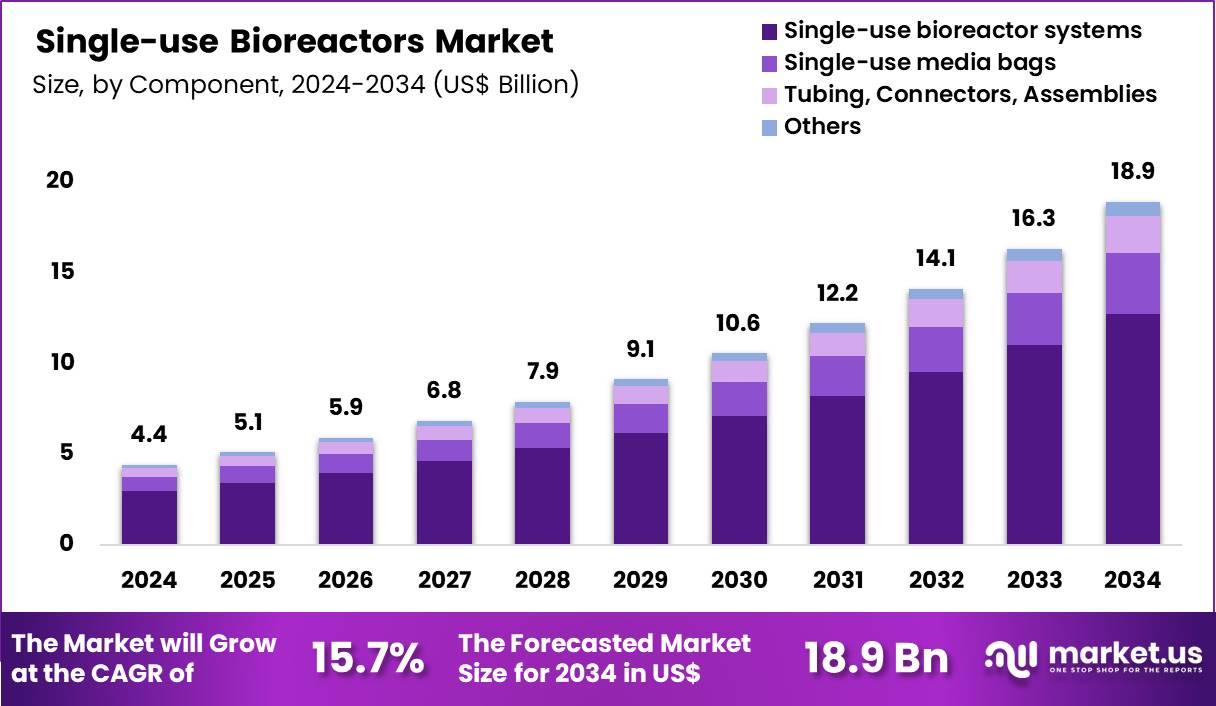
New York, NY – Sep 30, 2026 – Global Single-use Bioreactors Market size is expected to be worth around US$ 18.9 Billion by 2034 from US$ 4.4 Billion in 2024, growing at a CAGR of 15.7% during the forecast period 2025 to 2034. In 2024, North America led the market, achieving over 38.1% share with a revenue of US$ 1.7 Billion.
Single-use bioreactors are increasingly being adopted across the biopharmaceutical industry as manufacturers seek flexible, efficient, and cost-effective solutions for biologics production. These systems use disposable bags, liners, and other components that come into direct contact with the biological material, reducing the need for extensive cleaning, sterilization, and validation between production batches.
The adoption of single-use bioreactors is being supported by the growing production of monoclonal antibodies, vaccines, recombinant proteins, cell therapies, and other advanced biologics. Compared with conventional stainless-steel bioreactors, single-use systems can reduce cross-contamination risks, shorten equipment turnaround times, and lower water and energy consumption associated with cleaning and sterilization processes.
The technology is particularly suitable for small- and medium-scale manufacturing, clinical production, contract development and manufacturing organizations (CDMOs), and facilities requiring rapid production changes. Technological developments in sensors, automation, process monitoring, and bioprocess control are further improving system performance and scalability.
North America and Europe have historically represented important markets due to established biopharmaceutical manufacturing capabilities, while Asia-Pacific is gaining importance through expanding biologics production capacity, increasing healthcare investments, and growing adoption of advanced manufacturing technologies.
As biopharmaceutical pipelines continue to expand and manufacturers prioritize operational flexibility, single-use bioreactors are expected to remain an important component of modern bioprocessing infrastructure.
Key Takeaways
- In 2024, the market generated revenue of US$ 4.4 billion and is projected to grow at a CAGR of 15.7%, reaching US$ 18.9 billion by 2034.
- By component, the market is segmented into single-use bioreactor systems, single-use media bags, tubing, connectors, assemblies, and others. Single-use bioreactor systems dominated the segment in 2023, accounting for a 67.4% market share.
- Based on bioreactor type, the market is categorized into stirred-tank bioreactors, rocker bioreactors, air lift bioreactors, fixed-bed bioreactors, and others. Stirred-tank bioreactors held the largest share, at 56.2%.
- By cell culture type, the market is segmented into mammalian cells, insect cells, microbial cells, and others. Mammalian cells accounted for the largest revenue share of 58.8%.
- Based on application, the market is divided into monoclonal antibody production, vaccine manufacturing, viral vector manufacturing, cell therapy and stem-cell expansion, recombinant protein production, and others. Monoclonal antibody production led the segment with a 39.5% revenue share.
- By workflow stage, the market is categorized into research & development, process development/scale-up, clinical manufacturing, and commercial biomanufacturing. Commercial biomanufacturing dominated in 2023, accounting for 46.3% of the market.
- By end user, the market is segmented into pharmaceutical and biopharmaceutical companies, CROs and CDMOs, and academic institutes and research centers. Pharmaceutical and biopharmaceutical companies held the largest share at 51.6%.
- Regionally, North America dominated the market in 2024, accounting for a 38.1% market share.
Key Market Segments
- Component Analysis: Single-use bioreactor systems accounted for 67.4% of the market, supported by their ability to reduce cleaning requirements, downtime, and contamination risks. Faster setup, modular scalability, standardized designs, integrated sensors, and simplified maintenance further strengthen adoption across biopharmaceutical manufacturing facilities.
- Bioreactor Type Analysis: Stirred-tank bioreactors represented 56.2% of the market, supported by precise control of mixing, oxygen transfer, and temperature. Their compatibility with mammalian cultures, predictable scalability, established process models, automated controls, and broad supplier availability reinforce their continued use in biologics manufacturing.
- Cell Culture Type Analysis: Mammalian cell culture accounted for 58.8% of the market, driven by increasing biologics production and demand for complex therapeutic proteins. Growing monoclonal antibody and recombinant protein manufacturing, alongside CHO-based platforms, optimized media, and flexible processes, continues supporting segment expansion.
- Application Analysis: Monoclonal antibody production represented 39.5% of the market, supported by sustained demand for antibody-based therapies. Single-use systems provide flexible capacity, faster processing, contamination control, and standardized manufacturing. Rising therapeutic pipelines and contract manufacturing activities further strengthen demand within this application segment.
- Workflow Stage Analysis: Commercial biomanufacturing accounted for 46.3% of the market, reflecting growing adoption of disposable technologies at production scale. Reduced capital requirements, faster facility deployment, simplified validation, flexible manufacturing, and lower resource consumption support adoption across multi-product commercial biopharmaceutical facilities globally.
- End-User Analysis: Pharmaceutical and biopharmaceutical companies held 51.6% of the market, supported by expanding biologics pipelines and manufacturing investments. Single-use technologies enable flexible capacity, faster development timelines, regulatory compliance, and operational efficiency, while supporting portfolio diversification and commercial-scale production requirements.
Regional Analysis
North America
North America accounted for 38.1% of the global single-use bioreactors market in 2024, supported by strong biopharmaceutical manufacturing and rising demand for flexible, scalable production technologies. Adoption has been encouraged by the need to reduce contamination risks, accelerate production timelines, and support monoclonal antibody, vaccine, and cell therapy manufacturing.
Increasing investments in upstream bioprocessing, automated monitoring, and disposable systems have further strengthened regional demand. Contract development and manufacturing organizations are also expanding single-use capabilities to support smaller production batches and personalized medicine.
Regulatory emphasis on sterility, process efficiency, and product quality continues to support technology adoption.
Asia Pacific
Asia Pacific is projected to register the highest CAGR during the forecast period, driven by expanding biologics manufacturing, government initiatives, and increasing healthcare investments. Pharmaceutical companies are adopting single-use systems to improve production flexibility, reduce infrastructure requirements, and support vaccines, viral vectors, and cell therapies.
Technology transfers, workforce training, facility modernization, and growing biosimilar production are further contributing to regional market expansion. Increasing adoption across China and other emerging manufacturing hubs is expected to strengthen demand for disposable bioprocessing technologies.
Emerging Trends
- Growing use in cell and gene therapy manufacturing: Single-use bioreactors are increasingly being applied in cell and gene therapy production because these processes often require flexible and controlled manufacturing systems. The technology can support smaller production batches and reduce the need for complex fixed equipment.
- Integration with real-time monitoring and automation: The integration of sensors, process monitoring, and automated controls is becoming more important. These technologies allow manufacturers to monitor key conditions such as pH, oxygen, temperature, and cell growth more closely during production.
- Expansion of modular and flexible manufacturing facilities: Manufacturers are increasingly adopting modular production concepts that can be changed or expanded according to product demand. Single-use equipment supports this approach because it requires less fixed infrastructure and can reduce facility changeover requirements.
- Movement toward larger single-use production systems: Improvements in bag materials, reactor design, mixing, sensors, and process control are supporting the use of single-use bioreactors at progressively larger scales. However, very large volumes continue to present handling, pressure, and material-related challenges.
- Greater focus on material quality and regulatory control: As adoption increases, greater attention is being given to extractables, leachables, supplier qualification, system integrity, and manufacturing changes. FDA guidance specifically covers disposable manufacturing materials, including bioreactor bags, tubing, filters, and single-use assemblies.
Use Cases
- Monoclonal antibody production: Single-use bioreactors are widely used for mammalian cell culture processes that produce monoclonal antibodies. Their flexibility makes them suitable for development, pilot production, and commercial manufacturing where different products may need to be produced in the same facility.
- Vaccine manufacturing: Vaccine developers can use single-use bioreactors for the cultivation of cells or microorganisms used in vaccine production. The systems can provide flexible production capacity and reduce cleaning and sterilization requirements between manufacturing campaigns.
- Cell therapy production: Cell therapy manufacturing requires controlled expansion of cells under defined conditions. Single-use bioreactors can provide closed or contained cultivation environments and can be adapted to different cell expansion processes.
- Viral vector production for gene therapy: Single-use systems are increasingly used in viral-vector manufacturing because they can support flexible production and help reduce cross-contamination concerns between batches. Fixed-bed and other single-use reactor designs are being evaluated for scalable virus production.
- Research, process development, and clinical manufacturing: Single-use bioreactors are used across research, process development, clinical production, and commercial manufacturing. Their relatively fast setup and flexible scale make them useful when processes are still being optimized or when production volumes can change.
Frequently Asked Questions About Single-use Bioreactors
- How does a single-use bioreactor work?
A sterile disposable bag is placed inside a supporting vessel and connected to sensors, gas supplies, feeding lines, and control systems. Cells or microorganisms are then cultivated under controlled conditions such as temperature, oxygen, mixing, and pH. - Are single-use bioreactors suitable for large-scale manufacturing?
Single-use bioreactors are suitable for many small- and medium-scale manufacturing applications, with systems reaching substantial working volumes. However, very large systems can face challenges involving bag handling, pressure limits, material performance, and process scalability. - Why are single-use bioreactors important for cell and gene therapy?
Cell and gene therapy manufacturing often requires flexible processes, controlled cell expansion, and production of relatively specialized batches. Single-use systems can support contained processing and flexible facility configurations, making them useful for these developing manufacturing applications. - What is driving growth in the single-use bioreactors market?
Market development is being supported by increasing biologics production, demand for flexible manufacturing capacity, reduced cleaning requirements, shorter facility setup times, and growing adoption of advanced therapies. These factors support wider use across development and manufacturing facilities. - Why are pharmaceutical companies adopting single-use bioreactors?
Pharmaceutical companies are adopting these systems to obtain more flexible manufacturing operations and reduce activities associated with cleaning and sterilization. The systems can also support faster changeovers and smaller facility footprints compared with some conventional fixed equipment. - What is the future outlook for single-use bioreactors?
The technology is expected to remain important as biopharmaceutical manufacturing becomes more flexible and increasingly supports cell and gene therapies. Future development is likely to focus on larger systems, improved materials, automation, process monitoring, and integrated manufacturing platforms. - What factors should manufacturers consider when selecting a single-use bioreactor?
Manufacturers generally consider working volume, cell type, mixing performance, oxygen transfer, sensor configuration, bag material, supplier qualification, process requirements, scalability, and regulatory controls. Compatibility with upstream and downstream operations is also important for overall process design.
Conclusion
The single-use bioreactors market is expected to experience strong growth as biopharmaceutical manufacturers increasingly prioritize flexible, scalable, and efficient production systems. Rising demand for monoclonal antibodies, vaccines, recombinant proteins, cell therapies, and viral vectors is supporting technology adoption across research, clinical, and commercial manufacturing.
Single-use systems offer advantages such as reduced cleaning requirements, faster changeovers, lower infrastructure needs, and improved manufacturing flexibility. North America currently represents a major market, while Asia Pacific is expected to expand rapidly due to increasing biologics production and healthcare investments.
Advancements in automation, monitoring, materials, and larger-scale systems are expected to further support market development.
Discuss your needs with our analyst
Please share your requirements with more details so our analyst can check if they can solve your problem(s)




