


Overview
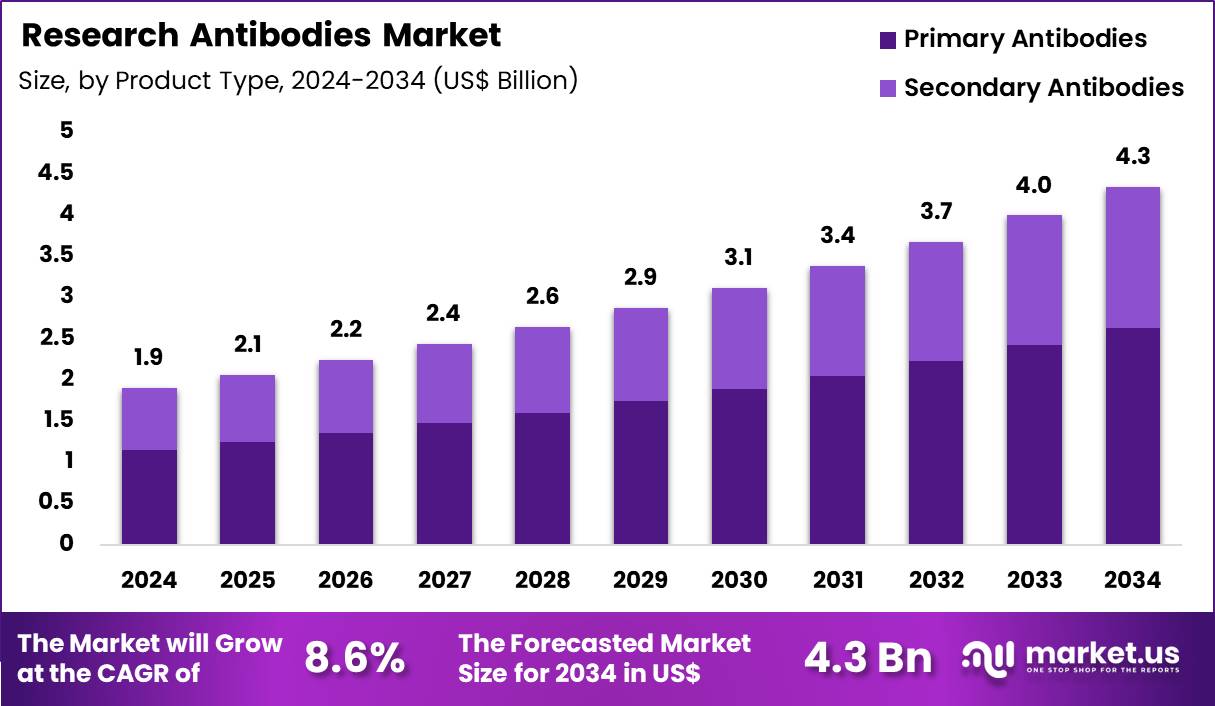
New York, NY – Oct 01, 2026 – The Global Research Antibodies Market size is expected to be worth around US$ 4.3 Billion by 2034 from US$ 1.9 Billion in 2024, growing at a CAGR of 8.6% during the forecast period 2025 to 2034. In 2024, North America led the market, achieving over 39.4% share with a revenue of US$ 748.6 Million.
Research antibodies are specialized proteins used in scientific research to detect, identify, and measure specific molecules, particularly proteins, in biological samples. These antibodies play a vital role in life science research, drug discovery, disease diagnosis development, and biomedical studies. They are widely used in techniques such as Western blotting, immunohistochemistry, flow cytometry, enzyme-linked immunosorbent assays (ELISA), and immunofluorescence.
The research antibodies market is supported by increasing investments in pharmaceutical and biotechnology research, growing demand for targeted therapies, and advancements in proteomics and molecular biology. The rising focus on cancer research, infectious diseases, neurological disorders, and personalized medicine has further increased the need for reliable and highly specific antibodies.
Based on type, research antibodies are broadly classified into monoclonal and polyclonal antibodies. Monoclonal antibodies offer high specificity, while polyclonal antibodies can recognize multiple epitopes of a target molecule. Both types are widely used across academic institutions, pharmaceutical companies, biotechnology firms, and contract research organizations.
North America represents a significant market, supported by established research infrastructure, strong healthcare investment, and the presence of leading biotechnology companies. Meanwhile, expanding research capabilities across Asia-Pacific are creating additional growth opportunities. Continuous improvements in antibody validation, production technologies, and recombinant antibody development are expected to support market advancement.
Key Takeaways
- In 2024, the research antibodies market was valued at US$ 1.9 billion and is projected to reach US$ 4.3 billion by 2034, expanding at a CAGR of 8.6%.
- By product type, the market is segmented into primary and secondary antibodies. Primary antibodies dominated the segment in 2024, accounting for a market share of 60.6%.
- Based on antibody type, the market is categorized into monoclonal, polyclonal, and recombinant antibodies. Monoclonal antibodies held a significant market share of 62.3%.
- By source, the market is classified into mouse, rabbit, goat, and other sources. Mouse-derived antibodies dominated the segment, capturing the largest revenue share of 41.8%.
- By technology, the market includes western blotting, immunohistochemistry, flow cytometry, ELISA, immunofluorescence, immunoprecipitation, and other technologies. Western blotting led the segment with a revenue share of 28.5%.
- By research area, the market is segmented into immunology, oncology, neuroscience, infectious diseases, cell and molecular biology, stem cell research, and others. Oncology led the segment in 2023, accounting for 34.4% of the market.
- By end user, the market comprises academic and research institutes, pharmaceutical and biotechnology companies, contract research organizations (CROs), and others. Academic and research institutes dominated, with a revenue share of 49.8%.
- Regionally, North America led the research antibodies market in 2024, accounting for 39.4% of the global market.
Key Market Segments
- Product Type Analysis: Primary antibodies accounted for 60.6% of the research antibodies market, supported by their direct role in antigen detection, protein identification, and quantification. Growing proteomics, biomarker discovery, molecular biology research, and demand for validated, application-specific antibodies continue to strengthen segment adoption.
- Antibody Type Analysis: Monoclonal antibodies represented 62.3% of the research antibodies market, primarily due to their high specificity, consistency, and reproducibility. Advancements in hybridoma and recombinant technologies, alongside increasing oncology and immunology research, continue to support demand for reliable target-specific research reagents.
- Source Analysis: Mouse-sourced antibodies accounted for 41.8% of the research antibodies market, supported by extensive antibody libraries, established validation protocols, and broad commercial availability. Cost-effective production, proven performance, and compatibility with widely used experimental platforms continue to support the segment’s leading position.
- Technology Analysis: Western blotting represented 28.5% of the research antibodies market, driven by its widespread application in protein expression analysis, validation, and relative quantification. Standardized protocols, cost efficiency, extensive laboratory familiarity, and improved detection reagents continue to support its broad adoption across research institutions.
- Research Area Analysis: Oncology accounted for 34.4% of the research antibodies market, supported by extensive cancer biology research, biomarker discovery, and therapeutic target identification. Increasing investment in precision oncology, translational studies, and cancer-focused research programs continues to generate substantial demand for antibody-based applications.
- End-User Analysis: Academic and research institutes held 49.8% of the research antibodies market, reflecting their extensive involvement in basic and applied research. Grant-funded projects, diverse research programs, training activities, and publication-driven experimentation contribute to recurring antibody consumption across universities and research laboratories.
Regional Analysis
North America led the Research Antibodies Market, accounting for 39.4% of the global market in 2024. This leadership was supported by strong biomedical research funding, advanced drug discovery activities, and expanding applications in diagnostics, oncology, immunology, and therapeutic development.
Academic institutions and biopharmaceutical companies increasingly utilized monoclonal and polyclonal antibodies for biomarker validation, high-throughput screening, and preclinical research. Advancements in recombinant antibody technologies, precision medicine, gene-editing research, and next-generation sequencing further supported regional demand. In fiscal year 2024, the National Institutes of Health provided US$36.94 billion in extramural research funding across the United States.
Asia Pacific is projected to register the highest CAGR during the forecast period. Market growth is being supported by increasing investments in life sciences, biotechnology infrastructure, chronic disease research, and vaccine development.
Expanding hybridoma and phage display capabilities are strengthening regional antibody production. Growing adoption of proteomics, flow cytometry, immunoblotting, and biosimilar development is further supporting demand. R&D expenditure in East Asia and Pacific reached 2.82% of GDP in 2022.
Emerging Trends
- Greater focus on antibody validation and reproducibility – NIH and scientific literature increasingly emphasize rigorous validation because poorly characterized antibodies can produce unreliable or non-reproducible results.
- Growth of application-specific validation – Researchers are increasingly expected to validate antibodies according to the specific technique being used, such as Western blotting, immunohistochemistry, or flow cytometry.
- Increasing use of recombinant and engineered antibodies – Antibody engineering is moving toward more controlled and specialized antibody formats, supporting research in protein detection, target identification, and drug discovery.
- Use of AI in antibody discovery and engineering – Recent scientific literature reports increasing use of AI and machine learning for antibody structure prediction, antibody–antigen interaction prediction, affinity optimization, and candidate design.
- Greater adoption of advanced research methods – The FDA has highlighted AI-based models, cell-based methods, organoids, and other new approach methodologies as emerging tools in drug development, particularly for reducing dependence on traditional animal testing.
Use Cases
- Western blotting – Antibodies are used to identify specific proteins in biological samples and measure changes in protein expression. Validation is important because antibody performance can directly affect the reliability of Western blot results.
- Immunohistochemistry – Antibodies help researchers identify proteins within tissue samples. This is useful for studying tissue structure, disease mechanisms, biomarkers, and protein distribution.
- Immunofluorescence – Fluorescent antibodies are used to locate proteins inside cells and tissues. This supports research into cell structure, protein movement, signaling pathways, and disease-related cellular changes.
- Flow cytometry – Antibodies are used to identify specific markers on or inside cells. This allows researchers to separate and study different cell populations, particularly in immunology, cancer, and cell biology research.
- Drug-target and biomarker research – Research antibodies are used to identify and measure proteins involved in disease pathways. They therefore support target validation, biomarker studies, disease-mechanism research, and pharmaceutical R&D.
Frequently Asked Questions About Research Antibodies
- What are research antibodies used for?
Research antibodies are used in techniques including Western blotting, immunohistochemistry, immunofluorescence, immunoprecipitation, and related protein-analysis methods. They help researchers study protein expression, location, biological pathways, disease mechanisms, and potential therapeutic targets. - Why is antibody validation important?
Antibody validation is important because an antibody should recognize its intended target accurately and provide consistent results. Scientific recommendations emphasize specificity, selectivity, and reproducibility because unsuitable antibodies can reduce research reliability and make experiments difficult to reproduce. - What factors should be considered when selecting a research antibody?
Researchers should consider the target, antibody type, host species, intended application, sample type, validation evidence, sensitivity, and reproducibility. Application-specific evidence is important because antibody performance can change between experimental methods, sample conditions, and biological systems. - How are research antibodies used in immunohistochemistry?
In immunohistochemistry, antibodies are used to identify specific proteins within tissue sections. Researchers can examine where target proteins are located and study changes associated with tissue structure, disease mechanisms, and biological processes. - What factors are influencing the research antibodies market?
Demand is closely linked with biomedical research activity and the need for reliable protein-analysis tools. Increasing attention to research reproducibility, antibody characterization, application-specific validation, and transparent reporting is also influencing antibody selection and usage practices. - How is antibody validation affecting market development?
Greater emphasis on validation is increasing the importance of application-specific performance evidence. Researchers increasingly need information demonstrating that an antibody works reliably for a particular technique, species, and sample type before using it in experiments. - Why is transparency becoming important in the research antibodies market?
Transparent reporting helps researchers identify exactly which antibody was used and evaluate its supporting evidence. Reporting product identifiers, suppliers, experimental conditions, and validation information improves reproducibility and makes scientific findings easier for other laboratories to assess. - How is technology changing the research antibodies market?
Technology is supporting improved antibody development, characterization, and validation. Recombinant approaches, genetic validation methods, orthogonal testing, and data-sharing initiatives are being used to improve confidence in antibody performance and support more reproducible biomedical research.
Conclusion
The research antibodies market is supported by expanding biomedical research, increasing pharmaceutical and biotechnology R&D, and growing demand for reliable protein detection and analysis tools. Monoclonal and primary antibodies remain important across oncology, immunology, proteomics, and molecular biology applications.
North America continues to hold a significant position due to strong research infrastructure and funding, while Asia-Pacific is supported by expanding biotechnology capabilities and research investments.
Increasing emphasis on antibody validation, reproducibility, recombinant technologies, and application-specific performance is shaping market development. At the same time, AI-assisted antibody engineering and advanced research methods are creating new opportunities for improving antibody development, characterization, and research efficiency.
Discuss your needs with our analyst
Please share your requirements with more details so our analyst can check if they can solve your problem(s)




