


Overview
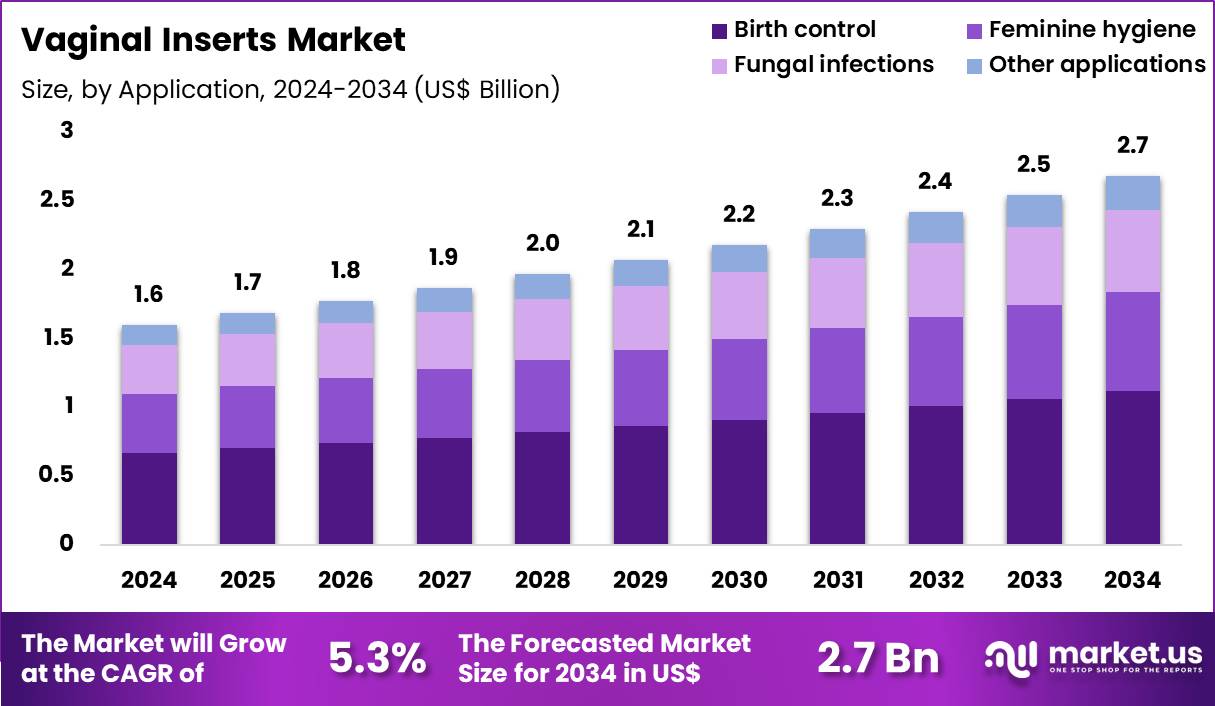
New York, NY – Oct 01, 2026 – The Global Vaginal Inserts Market size is expected to be worth around US$ 2.7 Billion by 2034 from US$ 1.6 Billion in 2024, growing at a CAGR of 5.3% during the forecast period 2025 to 2034. In 2024, North America led the market, achieving over 43.6% share with a revenue of US$ 0.7 Billion.
Vaginal inserts are pharmaceutical or therapeutic products designed to be placed inside the vagina to deliver active ingredients directly to the vaginal area. They are available in several forms, including tablets, capsules, suppositories, gels, creams, and other drug-delivery formats. These products are used for a range of applications, including the treatment of vaginal infections, hormonal conditions, vaginal dryness, and other gynecological disorders.
The growing prevalence of vaginal infections and increasing awareness of women’s reproductive and vaginal health are supporting demand for vaginal inserts. Their localized delivery mechanism can enable targeted treatment while potentially reducing systemic exposure compared with some oral medications. Technological advancements in drug formulation and controlled-release systems are further contributing to product development.
The market is also being influenced by the increasing adoption of self-administered treatments, improved healthcare access, and growing emphasis on women’s healthcare. Pharmaceutical companies are focusing on innovative formulations, improved patient convenience, and enhanced therapeutic efficacy to address evolving healthcare needs.
Key Takeaways
- In 2024, the vaginal inserts market generated revenue of US$ 1.6 billion and is projected to expand at a CAGR of 5.3%, reaching US$ 2.7 billion by 2034.
- By product type, the market is segmented into vaginal tablets, vaginal suppositories, and vaginal capsules. Vaginal tablets dominated the segment in 2024, accounting for a 46.8% market share.
- Based on application, the market is categorized into birth control, feminine hygiene, fungal infections, and other applications. The birth control segment held a significant 41.6% share in 2024.
- By distribution channel, the market is segmented into retail pharmacies, online pharmacies, hospital pharmacies, and fertilization centers. Retail pharmacies accounted for the largest revenue share of 48.7%.
- North America dominated the global vaginal inserts market in 2024, capturing a 43.6% market share.
Key Market Segments
- Product Type Analysis: Vaginal tablets dominated the vaginal inserts market in 2024, accounting for 46.8%. Their precise dosing, predictable drug release, minimal leakage, and patient convenience support widespread adoption. Advances in formulation stability, cost-efficient manufacturing, and growing women’s healthcare access further strengthen segment demand.
- Application Analysis: Birth control led the vaginal inserts market in 2024, representing 41.6%. Growth is supported by increasing family planning awareness and demand for convenient non-oral contraceptive options. Pharmaceutical innovation, reproductive health programs, improved patient education, and broader product availability are further supporting adoption.
- Distribution Channel Analysis: Retail pharmacies accounted for the largest distribution channel share, reaching 48.7% in 2024. Easy accessibility, privacy, pharmacist guidance, and reliable prescription fulfillment support their dominance. Expanding retail networks, dedicated women’s health sections, digital prescription services, and affordable private-label products are further driving adoption.
Regional Analysis
North America Leads the Vaginal Inserts Market
North America accounted for 43.6% of the global vaginal inserts market in 2024. Growth has been supported by rising awareness of reproductive and menopausal health, greater access to healthcare services, telehealth adoption, and demand for discreet treatment options.
Increasing use of hormone-releasing inserts for menopause-related vaginal dryness and atrophy, along with improved insurance coverage, has supported market penetration. Pharmaceutical innovation in extended-release, biodegradable, antifungal, and pH-balancing formulations is further contributing to regional growth. Expanding pharmacy and online distribution channels has also improved product accessibility.
Asia Pacific to Register the Highest CAGR
Asia Pacific is expected to record the highest CAGR during the forecast period. Market expansion is being supported by improving healthcare infrastructure, rising reproductive health awareness, economic development, and government-supported family planning initiatives.
Increasing treatment of vaginal infections, growing demand for contraceptive inserts, and expanding infertility care are creating additional opportunities. Pharmaceutical companies are also developing formulations suited to regional healthcare needs, while community education programs are improving awareness and acceptance of vaginal insert products.
Emerging Trends
- Growth of local drug delivery: Vaginal inserts are increasingly being used to deliver medicines directly to vaginal tissues. This approach can provide local treatment while potentially reducing exposure to the wider body. Vaginal delivery also avoids some of the drug-processing effects associated with oral administration.
- Expansion of hormone-based vaginal inserts: Hormonal inserts are gaining importance in women’s health, particularly for menopause-related vaginal dryness, irritation, and painful intercourse. The FDA approved the first generic estradiol vaginal insert in December 2025, expanding access to this treatment category.
- Development of controlled-release systems: Research is moving beyond conventional tablets and suppositories toward systems that can release medicines gradually over longer periods. Vaginal rings are an important example, with research focused on controlled release, improved materials, and longer-lasting treatment.
- Multi-purpose prevention technologies: A growing research area is the development of vaginal products capable of addressing more than one health need. Multi-purpose prevention technologies are being studied for combinations such as pregnancy prevention and protection against sexually transmitted infections.
- Advanced materials and personalized delivery: New research is examining nanoparticles, microparticles, vesicular systems, microneedles, advanced polymers, and 3D-printed vaginal rings. These technologies could allow more controlled drug release and, in the longer term, more personalized treatment approaches.
Use Cases
- Treatment of vaginal yeast infections: Vaginal inserts such as suppositories and pessaries are widely used for local treatment of vaginal yeast infections. Medicines such as miconazole and terconazole can be supplied in vaginal dosage forms that deliver the antifungal medicine directly to the affected area.
- Treatment of bacterial vaginosis: Some vaginal medicines are used for bacterial vaginosis. Vaginal clindamycin, for example, is available as a suppository and as other vaginal formulations. Treatment selection depends on the specific infection, medicine, patient condition, and healthcare-provider guidance.
- Management of menopause-related symptoms: Vaginal estrogen inserts can be used for symptoms such as vaginal dryness, irritation, and painful intercourse associated with menopause. These products provide estrogen locally to vaginal tissues, with relatively limited absorption into the wider body.
- Fertility and reproductive health: Vaginal progesterone is used in certain fertility-treatment settings and may be supplied as a vaginal tablet or gel. It is used under medical supervision for specific reproductive-health indications, with dosing and treatment duration determined by the healthcare provider.
- Long-acting drug delivery and prevention: Vaginal rings represent an important related use case within vaginal drug delivery. They have been developed for contraception and hormone therapy, while newer research is investigating applications involving HIV, sexually transmitted infections, and multi-purpose prevention.
Frequently Asked Questions About Vaginal Inserts
- What are vaginal inserts used for?
Vaginal inserts are used for several medical purposes, including treating yeast infections, bacterial vaginosis, menopause-related vaginal symptoms, and selected reproductive-health conditions. The exact use depends on the active ingredient, product formulation, and medical indication. - How are vaginal inserts administered?
Most vaginal inserts are gently placed inside the vagina using clean fingers or an applicator supplied with the product. Users should follow the product instructions carefully and insert the medicine only as far as is comfortable. - Can vaginal inserts be used during menstruation?
Whether an insert should be continued during menstruation depends on the specific medicine and product instructions. Some treatments can be continued, while others may recommend waiting. Patients should follow the package directions or advice provided by their healthcare professional. - Are vaginal inserts different from vaginal rings?
Yes. Vaginal inserts generally refer to medicines such as tablets, pessaries, or suppositories placed inside the vagina and used according to a dosing schedule. Vaginal rings are devices designed to remain in place and release medicine over longer periods. - Can vaginal inserts be used for menopause symptoms?
Yes. Certain vaginal inserts containing estrogen are used to manage menopause-related vaginal dryness, irritation, and painful intercourse. These products provide local treatment, and the dosage schedule depends on the specific product prescribed or recommended. - Are vaginal inserts used for fertility treatment?
Yes. Vaginal progesterone is used in certain assisted reproductive technology treatments and other reproductive-health situations. It can be supplied as a vaginal tablet or gel. Treatment should be used exactly according to the healthcare provider’s instructions. - Can vaginal inserts treat vaginal infections?
Yes. Several vaginal medicines are designed to treat specific infections. Antifungal inserts can treat vaginal yeast infections, while certain antibiotic vaginal formulations can treat bacterial vaginosis. Correct diagnosis is important because different infections require different medicines.
Conclusion
The vaginal inserts market is experiencing steady growth, supported by increasing awareness of vaginal and reproductive health, rising prevalence of vaginal infections, and growing demand for convenient localized treatments. Vaginal tablets currently represent a major product segment, while birth control and retail pharmacies remain important market areas.
North America holds a leading position, whereas Asia Pacific is expected to witness strong expansion during the forecast period. Technological developments in controlled-release systems, hormone delivery, advanced formulations, and multi-purpose prevention products are creating new opportunities. Increasing self-administration, improved healthcare access, and pharmaceutical innovation are expected to further support market development through 2034.
Discuss your needs with our analyst
Please share your requirements with more details so our analyst can check if they can solve your problem(s)




