


Overview
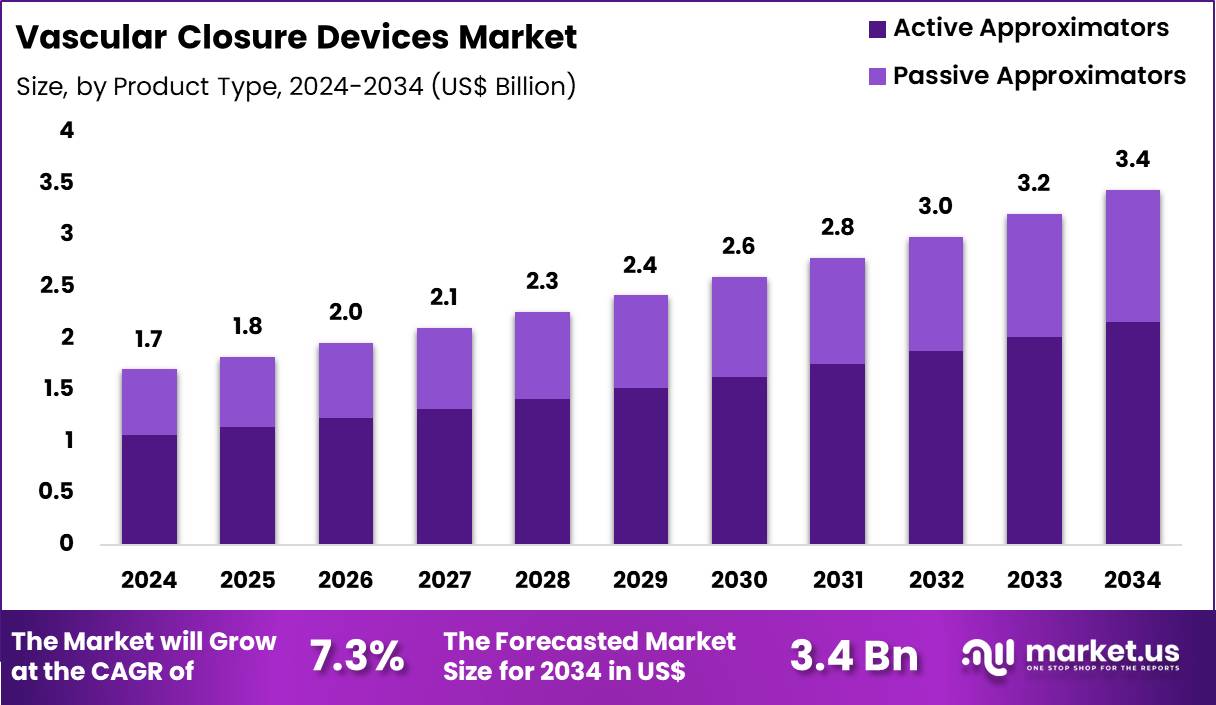
New York, NY – Oct 01, 2026 – The Global Vascular Closure Devices Market size is expected to be worth around US$ 3.4 Billion by 2034 from US$ 1.7 Billion in 2024, growing at a CAGR of 7.3% during the forecast period 2025 to 2034. In 2024, North America led the market, achieving over 43.6% share with a revenue of US$ 741.2 Million.
The vascular closure devices market represents an important segment of the medical devices industry, supporting the safe and efficient closure of arterial access sites following minimally invasive cardiovascular and endovascular procedures. These devices are primarily used to achieve hemostasis after catheter-based interventions, including coronary angiography, percutaneous coronary intervention (PCI), and peripheral vascular procedures.
Vascular closure devices are broadly categorized into active closure devices, passive closure devices, and external hemostatic devices. Active devices use sutures, clips, plugs, or other mechanisms to close the puncture site, while passive devices primarily support natural clot formation and compression. The selection of a device depends on factors such as access-site characteristics, procedure type, vessel size, and clinical requirements.
Market growth is being supported by the increasing adoption of minimally invasive procedures, the rising prevalence of cardiovascular diseases, and the growing number of diagnostic and interventional catheterization procedures. Demand for devices that can reduce time to hemostasis, facilitate earlier patient ambulation, and potentially shorten hospital stays is also contributing to market development.
Technological advancements, including improved closure mechanisms, enhanced device delivery systems, and products designed to improve procedural efficiency, are expected to support continued innovation. North America and Europe remain significant markets, while increasing healthcare expenditure and expanding access to advanced cardiovascular care are creating opportunities across emerging economies in Asia-Pacific and other regions.
Key Takeaways
- In 2024, the vascular closure devices market was valued at US$ 1.7 billion and is projected to grow at a CAGR of 7.3%, reaching approximately US$ 3.4 billion by 2034.
- Based on product type, the market is segmented into active approximators and passive approximators. Active approximators dominated the market in 2024, accounting for a 62.8% market share.
- By access site, the market is categorized into femoral and radial segments. The femoral segment held the leading position in 2024, with a 60.6% market share.
- By procedure type, the market is segmented into interventional cardiology, interventional radiology, and interventional vascular surgery. Interventional cardiology accounted for the largest revenue share of 41.1% in 2024.
- Based on end user, the market is segmented into hospitals and clinics, ambulatory surgical centers (ASCs), and cardiac cath labs. Hospitals and clinics dominated the market, accounting for 63.5% of total revenue in 2024.
- North America dominated the global vascular closure devices market in 2024, accounting for a 43.6% market share.
Key Market Segments
- Product Type Analysis: Active approximators held a 62.8% market share, supported by their ability to provide rapid and reliable hemostasis following catheterization. Precise tissue closure, reduced bleeding risks, shorter recovery periods, improved workflow efficiency, and technological advancements are supporting their adoption across high-volume interventional centers.
- Access Site Analysis: Femoral access accounted for 60.6% of the market, supported by its extensive use in complex cardiovascular and peripheral interventions. Larger vessel size and sheath requirements increase demand for effective closure solutions, while established clinical protocols and operator familiarity continue supporting femoral access utilization.
- Procedure Type Analysis: Interventional cardiology represented 41.1% of the market, driven by increasing catheter-based cardiac procedures and the growing prevalence of cardiovascular diseases. Rising PCI volumes, structural heart interventions, early ambulation protocols, and demand for efficient access-site management continue supporting adoption of vascular closure devices.
- End-User Analysis: Hospitals and clinics accounted for 63.5% of the market, reflecting their role as major centers for cardiovascular and catheter-based procedures. High patient volumes, skilled healthcare professionals, centralized procurement, established clinical workflows, and increasing emphasis on patient safety continue supporting vascular closure device utilization.
Regional Analysis
North America is leading the Vascular Closure Devices Market
North America accounted for 43.6% of the global vascular closure devices market in 2024, supported by increasing percutaneous coronary interventions, peripheral vascular procedures, and demand for effective arterial access-site management.
Growing adoption of active approximators and collagen-based closure systems is being supported by the need for rapid hemostasis, reduced complications, and faster patient recovery. The region’s advanced healthcare infrastructure, skilled interventional workforce, and established regulatory framework further support market development.
Increasing cardiovascular disease prevalence and an aging population continue to generate demand for catheter-based interventions. Hospitals are also emphasizing cost-efficient technologies that improve procedural outcomes and resource utilization.
Asia Pacific is expected to register the highest CAGR
Asia Pacific is expected to record the highest CAGR during the forecast period, driven by expanding interventional cardiology services and increasing cardiovascular disease burden. Investments in tertiary healthcare infrastructure, rising procedure volumes, improved physician training, and greater adoption of advanced closure technologies are supporting regional growth.
Local manufacturing and cost-effective device development are also expected to improve accessibility across emerging markets. Increased adoption of minimally invasive cardiovascular procedures is further creating opportunities for vascular closure device manufacturers.
Emerging Trends
- Greater use in electrophysiology procedures: Vascular closure devices are increasingly being used after femoral access during electrophysiology procedures, including catheter ablation. Recent evidence covering 40,632 patients found that these devices reduced time to hemostasis, ambulation, and discharge compared with manual compression.
- Expansion into femoral venous closure: The market is moving beyond arterial closure toward femoral venous applications. Recent clinical evidence found that venous closure devices reduced time to hemostasis and walking and lowered minor vascular complications in interventional cardiology procedures.
- Development of devices for larger access sites: Demand for large-bore closure solutions is increasing as complex catheter-based procedures require larger femoral access. FDA-approved devices such as MANTA are indicated for closing femoral arterial access sites following procedures using large devices or sheaths.
- New product approvals and expanded indications: Product innovation remains active, with new devices and expanded indications entering the market. In June 2026, the FDA approved the AbsorbaSeal 5.6.7F device for femoral arterial access closure, with indications focused on reducing hemostasis and ambulation time.
- Increasing focus on faster patient recovery: Hospitals are placing greater importance on reducing post-procedure recovery time and improving workflow. Clinical studies have associated vascular closure devices with faster hemostasis and ambulation, supporting their use where early patient movement and efficient care are important.
Use Cases
- Percutaneous coronary interventions: Vascular closure devices are used to close femoral access sites after diagnostic and interventional catheterization procedures. Their use can reduce the time required to achieve hemostasis and may support earlier patient movement following cardiovascular procedures.
- Electrophysiology and catheter ablation: The devices are used after femoral access during electrophysiology studies and catheter ablation. Recent evidence indicates that VCD use can shorten hemostasis, ambulation, and discharge times compared with manual compression.
- Transcatheter aortic valve replacement: Large-bore vascular closure is an important application in transfemoral TAVR because the procedure requires relatively large femoral access. Multiple closure approaches, including suture-based and plug-based devices, are used to manage these access sites.
- Peripheral vascular interventions: VCDs are used following endovascular procedures involving femoral arterial access. Their application includes closure after peripheral interventions, although evidence shows that complication rates can vary according to device type, access location, and clinical conditions.
- Femoral venous access procedures: Venous closure systems are used after procedures requiring femoral venous access, including selected cardiac interventions. Recent studies indicate that these devices can reduce time to hemostasis and ambulation while maintaining a similar rate of major vascular complications.
Frequently Asked Questions About Vascular Closure Devices
- Why are vascular closure devices used?
Vascular closure devices are used to achieve faster and controlled closure of catheter access sites. They can reduce the need for prolonged manual compression and may support earlier ambulation, improved patient comfort, and more efficient use of hospital resources. - Where are vascular closure devices commonly used?
Most vascular closure devices are used at femoral artery or femoral vein access sites following catheter-based procedures. Applications include interventional cardiology, electrophysiology, peripheral vascular procedures, and selected structural heart interventions. - How do vascular closure devices work?
Depending on the design, a device may use a suture, collagen plug, sealant, or mechanical component to close the access opening. The objective is to achieve reliable hemostasis while limiting bleeding and supporting earlier patient movement. - Are vascular closure devices safe?
Clinical evidence generally supports their use in appropriately selected patients, although complications can occur. Reported risks include bleeding, hematoma, pseudoaneurysm, infection, vessel narrowing, thrombosis, and device failure, with rates varying by procedure and device. - Do vascular closure devices reduce recovery time?
Evidence indicates that vascular closure devices can reduce time to hemostasis and ambulation compared with manual compression in several clinical settings. The actual benefit depends on the procedure, access site, patient characteristics, and device used. - What factors affect the choice of a vascular closure device?
Device selection depends on access location, vessel size, sheath size, procedure type, anatomy, anticoagulation, and patient condition. Clinicians also consider device indications, technical requirements, previous access complications, and their experience with the closure system. - What is driving growth in the vascular closure devices market?
Market development is being supported by increasing catheter-based procedures, demand for faster hemostasis, greater focus on early ambulation, expansion of electrophysiology procedures, and wider use of venous and large-bore vascular access technologies - What is the outlook for vascular closure devices?
The market outlook is linked to continued adoption of minimally invasive cardiovascular procedures, electrophysiology interventions, structural heart treatments, and venous closure technologies. Product development is also focused on larger access sizes and faster patient recovery.
Conclusion
The vascular closure devices market is expected to witness sustained growth, driven by the increasing adoption of minimally invasive cardiovascular and endovascular procedures. Rising procedure volumes, demand for faster hemostasis, earlier patient ambulation, and improved healthcare efficiency are supporting market expansion.
Active approximators, femoral access, interventional cardiology, and hospitals and clinics are expected to remain key market segments. North America currently leads the market, while Asia Pacific is projected to experience the fastest growth.
Technological advancements, large-bore closure solutions, venous applications, and expanding use in electrophysiology are creating new opportunities. Continued product innovation and broader clinical adoption are expected to strengthen market development through 2034.
Discuss your needs with our analyst
Please share your requirements with more details so our analyst can check if they can solve your problem(s)




