
Overview
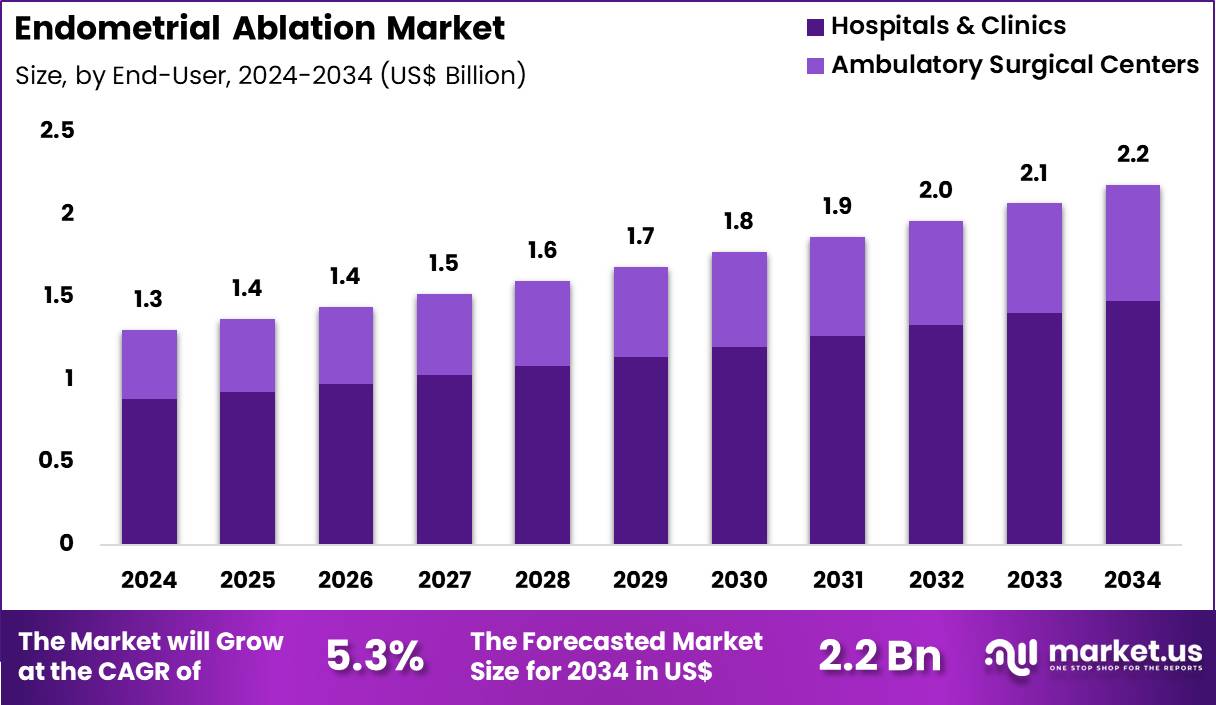
New York, NY – Oct 23, 2026 – Global Endometrial Ablation Market size is expected to be worth around US$ 2.2 Billion by 2034 from US$ 1.3 Billion in 2024, growing at a CAGR of 5.3% during the forecast period 2025 to 2034. In 2024, North America led the market, achieving over 33.9% share with a revenue of US$ 0.4 Billion.
Endometrial ablation is a minimally invasive medical procedure used to treat heavy menstrual bleeding. It involves removing or destroying the endometrium, the inner lining of the uterus, to reduce or stop menstrual blood flow. The procedure is generally considered for women experiencing heavy periods that have not responded adequately to medication or other conservative treatments.
Several techniques are available for endometrial ablation, including radiofrequency energy, heated fluids, thermal balloons, and other specialized methods. The choice of technique depends on the patient’s medical condition, uterine anatomy, and the healthcare provider’s assessment.
The procedure is usually performed without major surgery and may offer benefits such as reduced menstrual bleeding, shorter recovery time, and improved quality of life. It is not suitable for everyone, and patients require an appropriate medical evaluation before treatment.
Endometrial ablation is generally not recommended for women who wish to become pregnant in the future, as pregnancy after the procedure can be dangerous. Effective contraception is necessary if pregnancy remains possible.
The growing focus on minimally invasive gynecological treatments has increased interest in procedures such as endometrial ablation. Advances in treatment technologies and improved clinical assessment are supporting its role in the management of heavy menstrual bleeding.
However, treatment outcomes vary, and some patients may continue to experience bleeding or require additional medical intervention. Consultation with a qualified gynecologist is essential to determine the most appropriate treatment option.
Key Takeaways
- In 2024, the market was valued at US$ 1.3 billion and is projected to reach US$ 2.2 billion by 2034, growing at a CAGR of 5.3%.
- By product type, the market is segmented into radiofrequency ablation, thermal balloon, hydrothermal ablation, cryoablation, and others. Radiofrequency ablation dominated the market, accounting for 39.4% of the total share.
- By end-user, the market is categorized into hospitals & clinics and ambulatory surgical centers. Hospitals & clinics held the largest share, accounting for 67.8% of the market.
- Regionally, North America dominated the market, accounting for 33.9% of the total market share.
Key Market Segments
- Product Type Analysis: Radiofrequency ablation held a 39.4% market share, supported by its clinical effectiveness, shorter procedure times, and consistent outcomes in treating abnormal uterine bleeding. Its minimally invasive approach, uterus-preserving benefits, and potential for faster recovery have strengthened adoption across hospitals and outpatient settings. Technological improvements, simplified device handling, and enhanced safety features are expected to support continued segment growth.
- End-User Analysis: Hospitals and clinics accounted for 67.8% of the market, driven by their advanced gynecological facilities, specialist availability, and high patient volumes. These settings provide comprehensive diagnostic services, anesthesia support, and post-procedure monitoring. Their role as primary referral centers and continued investment in minimally invasive surgical infrastructure are expected to sustain their dominance in the endometrial ablation market.
Regional Analysis
North America accounted for 33.9% of the global endometrial ablation market in 2024, supported by advanced healthcare infrastructure, rising awareness of minimally invasive treatments, and increasing demand for heavy menstrual bleeding management.
The presence of established companies, including Boston Scientific and CooperSurgical, has supported technological development. Strong specialist networks, ambulatory surgical centers, and established reimbursement systems have further encouraged adoption across the region.
Asia Pacific is projected to register the highest CAGR during the forecast period, driven by healthcare infrastructure development, improving awareness of women’s health, and rising diagnosis of uterine disorders. Countries such as China, Japan, and South Korea are supporting medical technology innovation and expanding access to gynecological treatments.
Growing investments in cost-effective devices, wider distribution networks, and improved clinical capabilities are expected to strengthen regional adoption. Government initiatives, patient education campaigns, and collaborations between healthcare providers and manufacturers are also anticipated to support market expansion throughout the forecast period.
Emerging Trends
- Growing use of minimally invasive treatment methods: Endometrial ablation offers an alternative to major surgery for eligible patients with heavy menstrual bleeding. Greater interest in less invasive treatment may support demand for devices that reduce bleeding without removing the uterus.
- Development of different energy-based technologies: Device manufacturers are working across established technologies, including radiofrequency, heated-fluid systems, steam, and cryoablation. These approaches provide different ways to destroy the uterine lining, allowing healthcare providers to select suitable options based on patient needs and device indications.
- Expansion of outpatient treatment settings: Most endometrial ablation procedures are performed on an outpatient basis. The potential to avoid an overnight hospital stay may support adoption in suitable clinics and ambulatory surgical centres, depending on local facilities, patient condition, and anesthesia requirements.
- Greater focus on procedure safety and device design: Device development is shaped by the need to reduce complications and deliver consistent treatment. Manufacturers have opportunities to improve insertion, treatment controls, and usability, while regulatory approval and evidence of safety remain important requirements for market access.
- Increasing attention to women’s health and treatment awareness: Better awareness of heavy menstrual bleeding and available treatment choices may encourage more patients to seek medical advice. Education about the benefits, limitations, and risks of ablation can support informed decisions and improve discussion of treatment options.
Use Cases
- Treatment of heavy menstrual bleeding: The primary use is to reduce menstrual bleeding when periods are excessively heavy or prolonged. The procedure may be considered when medication has not provided sufficient relief and the underlying cause is suitable for ablation.
- Improving quality of life: Reducing excessive bleeding may help eligible patients manage daily activities, work, and social commitments more comfortably. Treatment decisions should consider how bleeding affects the individual and whether expected benefits outweigh the possible risks.
- An alternative to more extensive surgery: For suitable patients who have completed childbearing, ablation may provide bleeding control without removing the uterus. It is less extensive than a hysterectomy, although some patients may eventually require additional treatment or surgery.
- Managing benign causes of abnormal uterine bleeding: Ablation may be used for heavy bleeding caused by non-cancerous conditions when clinical assessment confirms suitability. Unexplained bleeding must be investigated first, and suspected uterine cancer requires appropriate evaluation rather than routine ablation.
- Outpatient gynecological treatment: In suitable cases, the procedure can be delivered without an overnight hospital stay. This creates a practical use case for outpatient gynecology services and ambulatory surgical centres equipped to perform the procedure and manage recovery safely.
Frequently Asked Questions About Endometrial Ablation
- Who is eligible for endometrial ablation?
The procedure is generally intended for premenopausal patients with heavy menstrual bleeding caused by non-cancerous conditions who have completed childbearing. A healthcare professional must evaluate the cause of bleeding, uterine condition, medical history, and suitability before treatment. - What technologies are used in endometrial ablation?
Endometrial ablation devices use different methods to destroy the uterine lining, including radiofrequency energy, heated fluid, thermal balloons, steam, microwave energy, and freezing. The appropriate technology depends on device approval, clinical assessment, and the patient’s specific condition. - Can pregnancy occur after endometrial ablation?
Pregnancy remains possible after endometrial ablation, although it is less likely. Pregnancy afterward can cause serious complications for the mother and fetus. Effective contraception should be continued until menopause, as advised by a healthcare professional. - How long does recovery take after endometrial ablation?
Recovery varies according to the patient, treatment method, and anesthesia used. Many procedures are performed on an outpatient basis, but cramping, spotting, or watery discharge may occur afterward. Patients should follow their clinician’s instructions regarding recovery and follow-up. - Does endometrial ablation permanently stop periods?
Endometrial ablation can reduce menstrual bleeding substantially, and some patients stop having periods completely. However, outcomes differ, and bleeding may return over time. The procedure should not be considered a guaranteed permanent solution or a method of contraception. - What factors are driving market growth?
Market growth is supported by demand for less invasive treatment, greater awareness of heavy menstrual bleeding, improvements in ablation technologies, and wider access to outpatient gynecological services. Device approvals, affordability, reimbursement, and physician training also influence adoption across healthcare systems. - Which healthcare facilities use endometrial ablation devices?
Endometrial ablation devices are used in hospitals, gynecology clinics, and ambulatory surgical centres. Facility selection depends on equipment availability, provider expertise, patient needs, anesthesia requirements, and local healthcare regulations. Outpatient settings offer opportunities for appropriate procedures without overnight admission. - How is the Endometrial Ablation Market segmented?
The market can be segmented by technology, device type, end user, and geography. Technology categories include radiofrequency, thermal balloon, hydrothermal, and cryoablation systems, while end users include hospitals, clinics, and ambulatory surgical centres, depending on the report’s defined scope.
Conclusion
The endometrial ablation market is expected to experience steady growth, supported by increasing demand for minimally invasive treatments for heavy menstrual bleeding, technological advancements, and expanding access to outpatient gynecological care. Radiofrequency ablation and hospitals and clinics remain important market segments, while North America holds a leading regional position.
Asia Pacific is expected to offer significant growth opportunities due to improving healthcare infrastructure and greater awareness of women’s health. However, treatment costs, regulatory requirements, patient eligibility, and clinical risks may influence market expansion. Continued innovation, improved patient education, and wider access to effective treatment are expected to support the market’s long-term development.
Discuss your needs with our analyst
Please share your requirements with more details so our analyst can check if they can solve your problem(s)