


Overview
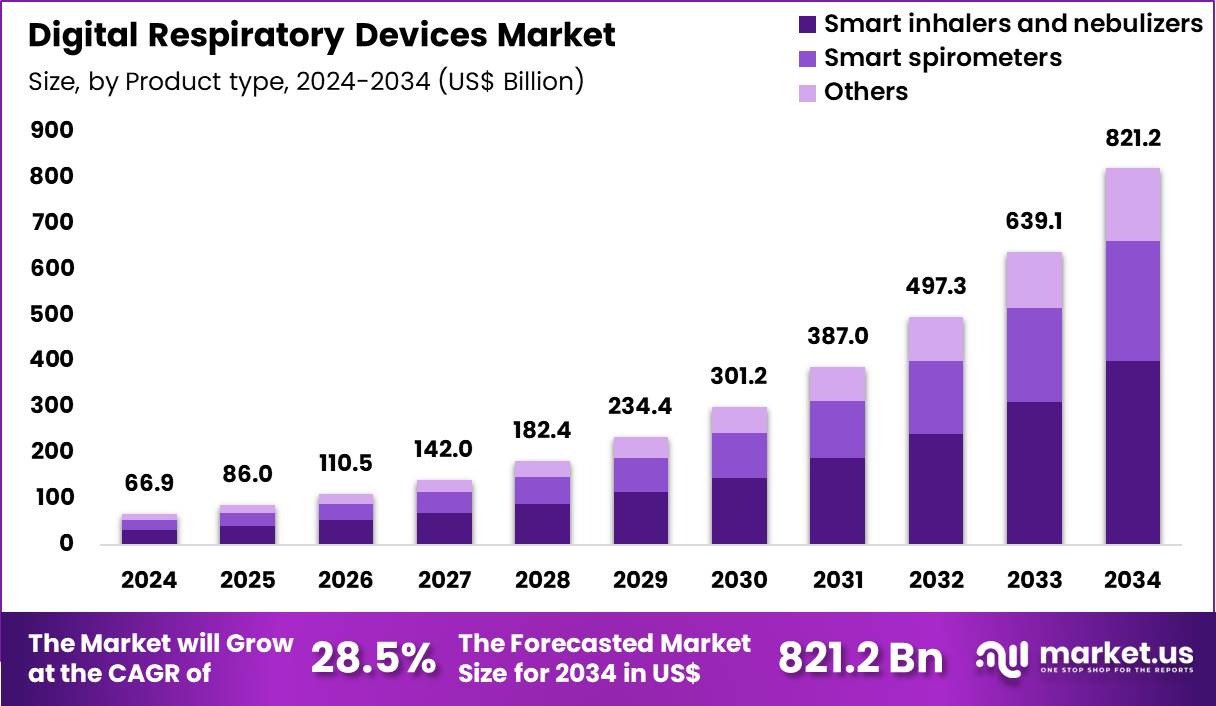
New York, NY – Oct 21, 2026 – Global Digital Respiratory Devices Market size is expected to be worth around US$ 821.2 Billion by 2034 from US$ 66.9 Billion in 2024, growing at a CAGR of 28.5% during the forecast period 2025 to 2034. In 2024, North America led the market, achieving over 45.8% share with a revenue of US$ 30.6 Billion.
Digital respiratory devices are emerging as an important part of modern healthcare, supporting the monitoring, diagnosis, and management of respiratory conditions. These devices combine medical technology with digital connectivity to help healthcare professionals and patients monitor respiratory health more effectively.
Digital respiratory devices include smart inhalers, digital spirometers, connected nebulizers, portable oxygen monitoring systems, and other connected respiratory monitoring solutions. These technologies can collect, record, and transmit health-related data, enabling improved tracking of symptoms, medication use, lung function, and treatment progress.
The growing adoption of digital healthcare solutions, increasing prevalence of respiratory disorders such as asthma and chronic obstructive pulmonary disease (COPD), and rising demand for remote patient monitoring are supporting interest in this market. Integration with mobile applications, cloud-based platforms, and data analytics is also creating opportunities for more personalized and accessible respiratory care.
Furthermore, digital respiratory devices can support better patient engagement, treatment adherence, and clinical decision-making when used appropriately alongside professional medical guidance. Healthcare providers are increasingly exploring connected solutions to improve care delivery, particularly for patients requiring long-term respiratory management.
However, factors such as device costs, data privacy concerns, regulatory requirements, and the need for clinical validation may influence market adoption.
As digital health technologies continue to advance, digital respiratory devices are expected to play an increasingly important role in connected healthcare, offering opportunities for manufacturers, healthcare providers, and technology developers to improve respiratory disease management.
Key Takeaways
- In 2024, the digital respiratory devices market generated revenue of US$ 66.9 billion and is projected to grow at a CAGR of 28.5%, reaching US$ 821.2 billion by 2034.
- By product type, the market is segmented into smart inhalers and nebulizers, smart spirometers, and others. Smart inhalers and nebulizers dominated the market, accounting for a share of 48.7%.
- By distribution channel, the market is categorized into hospital pharmacies, online pharmacies, and retail pharmacies. Hospital pharmacies held a significant market share of 43.8%.
- By application, the market is divided into chronic obstructive pulmonary disease (COPD), asthma, and others. COPD emerged as the leading application segment, accounting for 46.4% of the market revenue.
- By end user, the market is segmented into hospitals, ambulatory care settings, and home care settings. Hospitals led the market, capturing a revenue share of 44.6%.
- Regionally, North America dominated the digital respiratory devices market, accounting for the largest market share of 45.8%.
Key Market Segments
- Product Type Analysis: Smart inhalers and nebulizers dominated the product type segment, accounting for 48.7% of the market. Their adoption is supported by medication tracking, dose reminders, inhalation monitoring, and improved treatment adherence. Bluetooth connectivity and mobile applications enable real-time data sharing, supporting personalized treatment and remote patient monitoring.
- Distribution Channel Analysis: Hospital pharmacies held a 43.8% market share, driven by centralized procurement, clinical supervision, and integration with hospital treatment protocols. Bulk purchasing, quality assurance, and coordination with respiratory specialists further strengthen this channel. Hospital pharmacies also support device availability and patient education during discharge.
- Application Analysis: Chronic obstructive pulmonary disease (COPD) accounted for 46.4% of the market. The segment is driven by long-term treatment requirements, high exacerbation risks, and the need for continuous adherence monitoring. Digital respiratory devices support timely intervention and improved disease management.
- End-User Analysis: Hospitals led the end-user segment with a 44.6% share. High patient volumes, specialized respiratory care, and structured device training support adoption. Integration with discharge planning and remote monitoring programs further strengthens hospital demand for connected respiratory solutions.
Regional Analysis
North America Leads the Digital Respiratory Devices Market
North America dominated the digital respiratory devices market, accounting for 45.8% of the global market share in 2024. Regional growth is supported by the widespread adoption of connected inhalers, remote patient monitoring, and telemedicine solutions for asthma and chronic obstructive pulmonary disease (COPD).
Integration with electronic health records, improved reimbursement for remote monitoring, and growing awareness of respiratory health have further supported market expansion. Technological advancements, including artificial intelligence and enhanced data security, are also strengthening adoption across healthcare settings.
Asia Pacific Expected to Record the Highest CAGR
The Asia Pacific region is expected to register the highest CAGR during the forecast period, driven by increasing healthcare investments, urbanization, and rising respiratory disease prevalence. Government initiatives supporting domestic medical device manufacturing, particularly in India, are improving access to affordable respiratory technologies.
Japan’s aging population is increasing demand for home-based monitoring solutions, while digital healthcare platforms are expanding access to respiratory care in remote areas. Growing investments in healthcare infrastructure, technological innovation, and public health programs are expected to create further regional growth opportunities.
Emerging Trends
- AI-based respiratory data analysis: Artificial intelligence (AI) is increasingly being explored to identify patterns in breathing data, detect possible changes in respiratory health, and support clinical decisions. Integration with digital respiratory devices may help healthcare professionals identify patients who require closer monitoring or further assessment.
- Flexible and wearable respiratory sensors: Research is advancing toward lightweight, flexible sensors that can be attached to the body or integrated into wearable products. These sensors can measure breathing movements and respiratory rate, supporting continuous monitoring outside traditional clinical settings. Improved comfort and reliable measurements remain important development priorities.
- Integration with telehealth platforms: Digital respiratory devices are increasingly being linked with telehealth services, allowing respiratory measurements to be shared with healthcare professionals remotely. This trend supports follow-up consultations, home-based monitoring, and access to specialist advice for patients who face geographical or mobility barriers.
- Greater focus on connected inhaler technology: Smart inhalers and add-on sensors are being developed to record inhaler use and provide feedback on medication routines. This creates opportunities for connected respiratory care platforms that combine medication-use information with patient education and clinical follow-up.
- Improved interoperability and data security: The market is moving toward better connections between respiratory monitoring devices, mobile applications, and healthcare information systems. Standardized data exchange and stronger privacy protections are important for safe information sharing, particularly as remote monitoring expands across hospitals and home-care settings.
Use Cases
- Asthma monitoring and self-management: Digital peak-flow meters, connected inhalers, and mobile applications can help people with asthma track respiratory measurements, record medication use, and follow their prescribed action plans. These tools can support more informed discussions with healthcare providers when symptoms or measurements change.
- COPD monitoring at home: Patients with COPD can use connected monitoring devices to record respiratory measurements and share information with healthcare teams. Remote monitoring may support follow-up care and help clinicians assess changes that could require intervention, although outcomes depend on the monitoring programme and the patient’s condition.
- Sleep-related breathing assessment: Digital respiratory sensors and connected monitoring systems can record breathing patterns during sleep. Such technologies may support the assessment of suspected sleep-related breathing problems and the monitoring of selected patients, although diagnosis may require a clinically appropriate sleep study and professional interpretation.
- Respiratory monitoring in hospitals: Connected respiratory monitors can help healthcare teams observe breathing rate and other relevant physiological measurements in patients receiving care. Digital data can support clinical surveillance and patient records, while device selection must match the required level of monitoring and the patient’s medical needs.
- Remote pulmonary rehabilitation and patient education: Digital platforms can support guided breathing exercises, pulmonary rehabilitation sessions, educational programmes, and follow-up for people with chronic respiratory conditions. These services can improve access to care for patients who cannot regularly attend healthcare facilities, subject to suitable clinical supervision and programme design.
Frequently Asked Questions About Digital Respiratory Devices
- How do digital respiratory devices work?
These devices collect respiratory information using sensors or electronic measurement systems. Depending on the product, the data may be displayed on a screen, stored in a mobile application, or shared with healthcare professionals for review and further assessment. - Which respiratory conditions can these devices help monitor?
Digital respiratory devices can support the monitoring of asthma, COPD, and selected sleep-related breathing disorders. Their usefulness depends on the device’s intended purpose, measurement capability, and clinical validation. They do not all diagnose or monitor every respiratory condition. - What are the main benefits of digital respiratory devices?
Digital respiratory devices can improve access to respiratory measurements, support medication tracking, and make remote follow-up easier. They may also help patients and healthcare professionals identify changes in recorded measurements, although clinical benefits vary by device and application. - Are digital respiratory devices accurate?
Accuracy depends on sensor quality, device design, calibration, testing methods, and correct use. Products intended for medical decisions should have appropriate evidence supporting their intended purpose. Digital readings should be interpreted alongside symptoms and professional medical advice. - What are the major factors driving market growth?
Market growth is supported by the need for chronic respiratory disease management, wider use of remote healthcare, and improvements in connected medical technology. Demand for home monitoring and better access to respiratory services may also create opportunities for manufacturers. - Which product categories are included in this market?
The market may include digital spirometers, connected peak-flow meters, smart inhalers, wearable breathing sensors, respiratory monitoring systems, and supporting software. Exact segmentation varies across research providers, so product definitions should be checked before comparing market estimates. - How does remote patient monitoring create market opportunities?
Remote patient monitoring enables respiratory measurements to be collected outside hospitals and reviewed by healthcare teams when appropriate. This can support follow-up services and home-based care. Commercial adoption depends on clinical workflows, reimbursement arrangements, connectivity, and patient participation. - What is the future outlook for the digital respiratory devices market?
The market outlook is supported by developments in wearable sensors, connected inhalers, remote monitoring, and data analysis. However, future growth will depend on clinical evidence, affordability, healthcare adoption, regulatory approval, and the ability to demonstrate meaningful benefits for patients and providers.
Conclusion
The digital respiratory devices market is poised for substantial growth, driven by the rising prevalence of respiratory disorders, increasing adoption of remote patient monitoring, and advancements in connected healthcare technologies. Smart inhalers and nebulizers, digital spirometers, and connected monitoring systems are expected to support improved disease management, treatment adherence, and patient engagement.
North America currently leads the market, while Asia Pacific offers significant growth opportunities due to expanding healthcare infrastructure and digital health initiatives. However, affordability, data security, regulatory compliance, and clinical validation remain important considerations. Continued technological innovation and wider healthcare adoption are expected to strengthen the market’s long-term growth prospects.
Discuss your needs with our analyst
Please share your requirements with more details so our analyst can check if they can solve your problem(s)



