


Overview
New York, NY – August 20, 2026 – The Global Coronavirus Immunoassay Market size is expected to be worth around US$ 7.2 Billion by 2034 from US$ 4.2 Billion in 2024, growing at a CAGR of 5.6% during the forecast period 2025 to 2034. In 2024, North America led the market, achieving over 39.9% share with a revenue of US$ 1.7 Billion.
The Coronavirus Immunoassay continues to gain importance as healthcare systems prioritize infectious disease surveillance, rapid diagnostics, and preparedness for future respiratory outbreaks. Coronavirus immunoassays detect SARS-CoV-2 antigens or antibodies through technologies such as enzyme-linked immunosorbent assay (ELISA), chemiluminescence immunoassay (CLIA), fluorescence immunoassay, and rapid lateral flow testing. These solutions support clinical diagnosis, antibody response monitoring, vaccine research, and population-level epidemiological studies.
The COVID-19 pandemic created an unprecedented demand for diagnostic testing worldwide. According to the World Health Organization (WHO), more than 775 million confirmed COVID-19 cases and over 7.0 million deaths were reported globally.
During peak pandemic periods, countries conducted billions of diagnostic tests to identify infections and control transmission. The WHO also reported that COVID-19 vaccination programs delivered more than 13 billion vaccine doses globally, increasing the need for antibody and immune response assessment technologies.
Advanced immunoassay platforms are improving laboratory efficiency through automation and high-throughput capabilities. Modern automated analyzers can process approximately 100 to more than 1,000 samples per hour, depending on the system configuration. Rapid immunoassay products can provide results in approximately 10–30 minutes, supporting decentralized testing in clinics, emergency departments, and community healthcare settings.
Growing research on emerging SARS-CoV-2 variants, long COVID monitoring, and respiratory disease surveillance is creating new opportunities for immunoassay innovation. According to the U.S. National Institutes of Health (NIH), long COVID research has involved studying millions of affected individuals, highlighting the continued need for reliable biomarkers and diagnostic methods.
Increasing healthcare investments, laboratory modernization, and demand for scalable infectious disease testing are expected to support the continued adoption of coronavirus immunoassay technologies worldwide.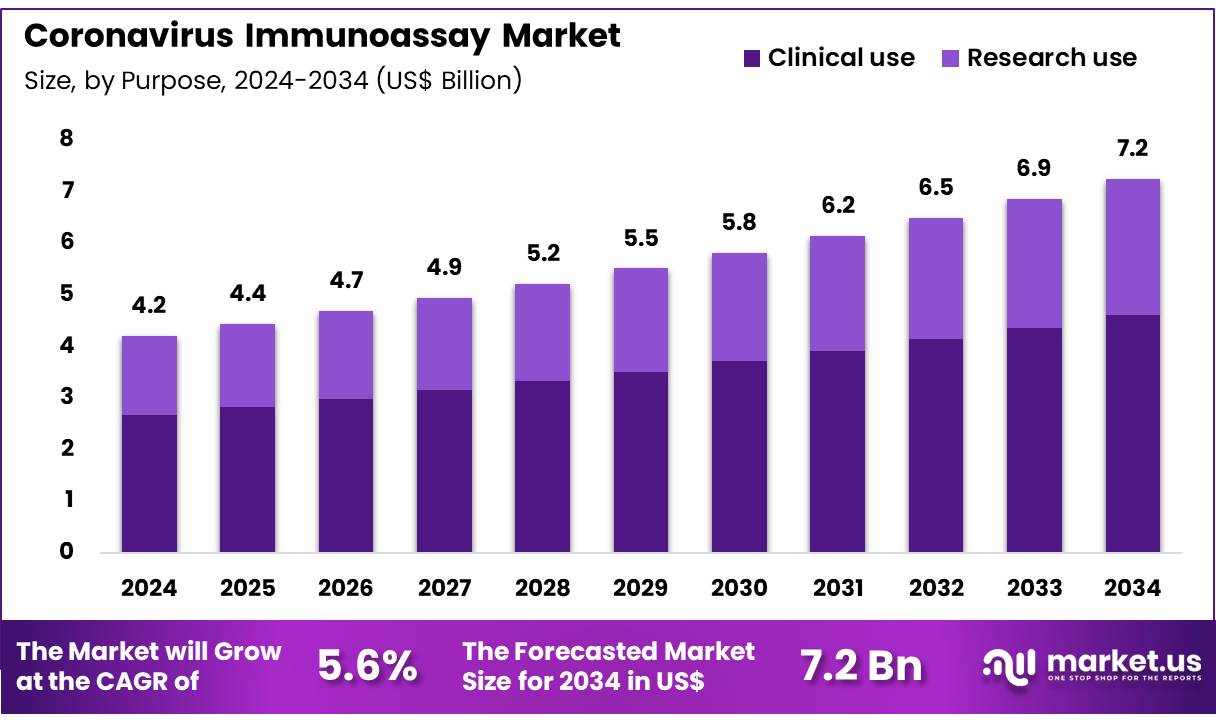
Key Takeaways
- In 2024, the Coronavirus Immunoassay market generated revenue of US$ 4.2 billion and is projected to expand at a CAGR of 5.6%, reaching approximately US$ 7.2 billion by 2034.
- Based on product type, the market is categorized into immunoassay kits & reagents, consumables, analysers & instruments, and software. Among these, immunoassay kits & reagents dominated the market in 2023, accounting for a 51.2% market share.
- By purpose, the Coronavirus Immunoassay market is segmented into clinical use and research use. The clinical use segment held a leading position, capturing a significant 63.7% share of the market.
- Based on application, the market is divided into clinical diagnostics, drug discovery, and screening of diseases & disorders. The clinical diagnostics segment emerged as the largest contributor, representing 54.6% of the total market revenue.
- By assay type, the market is segmented into ELISA, LFA, FIA, CLIA, and other assay technologies. The ELISA segment accounted for the largest revenue share, holding 42.9% of the market.
- According to specimen type, the market is categorized into nasopharyngeal samples, blood samples, saliva samples, and cell culture samples. The nasopharynx specimen segment dominated the market, with a 46.5% share.
- Regionally, North America led the Coronavirus Immunoassay market in 2023, securing a 39.9% market share due to advanced diagnostic infrastructure, high testing capabilities, and strong adoption of immunoassay technologies.
Statistical Information
- Nationwide serology testing for SARS‑CoV‑2 antibodies: CDC’s commercial lab seroprevalence survey tested hundreds of thousands of U.S. serum samples using SARS‑CoV‑2 immunoassays between 2020–2022. Infection‑induced seroprevalence rose from 8.0% in November 2020 to 58.2% by February 2022, reflecting large-scale use of laboratory antibody assays for surveillance rather than diagnosis, and demonstrating sustained demand for high‑throughput immunoassay platforms.
- Early U.S. city-level SARS‑CoV‑2 seroprevalence: A CDC study across 10 U.S. sites in early 2020 found seroprevalence of 1.0% in the San Francisco Bay Area, 1.0% in Washington State, and 6.9% in the New York City metro area, based on enzyme immunoassays of remnant clinical specimens. These low early values implied significant future upside for coronavirus immunoassay testing volumes as the pandemic expanded.
- Near-universal antibody positivity by late 2023: CDC serology surveillance shows that by late 2023, over 95% of U.S. adults and about 90% of children had detectable SARS‑CoV‑2 antibodies from infection, vaccination, or both. These figures come from repeated large-scale immunoassay testing, demonstrating extensive penetration of coronavirus antibody assays into clinical labs and blood collection centers over the 2020–2023 period.
- Infection-induced seroprevalence increase in adults: Using commercial laboratory immunoassays, CDC estimated infection‑induced seroprevalence among adults aged 18–49 years increased from 36.5% to 63.7% between September 2021 and February 2022. Among children 5–11 years, infection‑induced seroprevalence rose from 44.2% to 77.3% in the same period, highlighting rapidly rising exposure and heavy utilization of SARS‑CoV‑2 immunoassays for population-level surveillance.
- Blood donor cohort serology testing scale and results: CDC and partners established a cohort of 142,758 repeat blood donors in July 2021, periodically testing donations with SARS‑CoV‑2 immunoassays. By mid‑2022, 96.4% of persons aged ≥16 years in this cohort had detectable antibodies from prior infection or vaccination, illustrating both very high serologic immunity levels and continued large-scale use of immunoassays in blood services.
- FDA emergency authorizations for COVID diagnostics: A cross‑sectional analysis of U.S. FDA Emergency Use Authorizations found 393 COVID‑19–related products authorized, including 329 diagnostic tests (84%), 54 medical devices (14%), and 10 drugs or vaccines (3%). Many diagnostics were serology or antigen immunoassays, showing rapid expansion of the coronavirus immunoassay and broader diagnostic test portfolio under EUA during the pandemic.
- Global COVID-19 diagnostics revenue and trajectory: Company- and filing-based analysis shows global COVID‑19 diagnostics revenue of USD 33.0 billion in 2023, projected to fall to USD 6.25 billion by 2030, a CAGR of −21.2%. While PCR and rapid antigen segments decline fastest, coronavirus immunoassay applications for seroprevalence, vaccine response, and specialized clinical use remain as smaller but ongoing revenue contributors.
- Total specimens in national CDC serology program: CDC’s national commercial laboratory serosurveillance program analyzed 1,469,792 serum specimens from clinical laboratories across 51 U.S. jurisdictions between October 2020 and February 2022 using FDA‑authorized immunoassays. Infection‑induced seroprevalence increased from 8.0% to 58.2%, demonstrating very large testing volumes and broad utilization of coronavirus immunoassays for repeated cross‑sectional surveillance.
- FDA total authorized serology and immune response tests: The FDA lists 74 antibody and other adaptive immune response tests for SARS‑CoV‑2 authorized under EUA, alongside 25 8 molecular tests and 17 antigen tests. This mix shows that immunoassays represent a significant minority of total COVID‑19 diagnostic authorizations, but still dozens of distinct commercial products competing in the coronavirus serology segment.
Regional Analysis
North America led the market by securing a market share of 39.9% in 2023.
North America maintained a leading position in the Coronavirus Immunoassay market due to advanced diagnostic infrastructure, strong regulatory support, and continuous respiratory disease surveillance programs. The U.S. FDA expanded access to SARS-CoV-2 diagnostic solutions through emergency authorization pathways, supporting rapid antigen, antibody, and multiplex immunoassay adoption. The region’s strong laboratory network enabled large-scale testing and immune monitoring programs.
The CDC continues monitoring COVID-19 activity through surveillance systems, while WHO data shows ongoing vaccine and infection monitoring across the Americas region. Asia Pacific is expected to witness increasing adoption of coronavirus immunoassays due to expanding infectious disease surveillance, vaccination programs, and healthcare infrastructure development.
Countries across the region continue strengthening diagnostic capabilities through laboratory networks and public health monitoring systems. WHO reported continued COVID-19 vaccination data collection and surveillance activities across Asia Pacific countries during 2024. Increasing use of rapid antigen testing, antibody monitoring, and decentralized diagnostic solutions is supporting regional preparedness for respiratory disease outbreaks.
Emerging Trends
- Integration of Wastewater Surveillance with Immunoassay Monitoring: Public health agencies are combining wastewater surveillance and diagnostic technologies to detect SARS-CoV-2 activity early. The CDC’s National Wastewater Surveillance System collects data from approximately 1,500 monitoring sites across the United States, supporting outbreak tracking and public health response.
- Growth of Multiplex Immunoassay Platforms: Multiplex testing solutions are gaining adoption for simultaneous detection of COVID-19 and other respiratory infections, including influenza and RSV. These advanced assays improve laboratory efficiency by analyzing multiple pathogens from a single sample, supporting faster clinical decisions during seasonal respiratory outbreaks.
- Expansion of Long COVID and Immune Response Testing: Coronavirus immunoassays are increasingly used in research to study antibody responses and immune biomarkers. The NIH RECOVER Initiative received approximately US$1.15 billion in funding, with an additional US$515 million investment to advance Long COVID research and diagnostic understanding.
- Increasing Adoption of Rapid Point-of-Care Immunoassays: Rapid antigen immunoassays continue expanding due to their quick results, portability, and suitability for decentralized testing. FDA-authorized COVID-19 antigen tests have enabled testing in healthcare facilities, workplaces, and community settings, often providing results within 15–30 minutes.
- Advanced Serology Testing for Vaccine and Immunity Monitoring: Serological immunoassays are being used to evaluate antibody responses after infection and vaccination. With more than 13 billion COVID-19 vaccine doses administered globally, immune monitoring has become an important research and public health application.
Use Cases
- Clinical Diagnosis of SARS-CoV-2 Infection: Coronavirus immunoassays are used in hospitals and diagnostic laboratories to identify COVID-19 infections through antigen and antibody detection. FDA-authorized immunoassay-based tests support healthcare providers in evaluating patients, especially during periods of increased respiratory disease activity.
- Antibody Response Monitoring After Vaccination: Immunoassays are used to measure antibody levels generated after COVID-19 vaccination or infection. With more than 13 billion COVID-19 vaccine doses administered globally, serological testing supports research studies evaluating immune protection and vaccine effectiveness.
- Population Seroprevalence Studies: Public health organizations use coronavirus immunoassays to estimate previous exposure levels within communities. Antibody testing helps researchers understand infection patterns, immunity trends, and differences among population groups for better public health planning.
- Long COVID Research and Biomarker Identification: Immunoassays support Long COVID studies by analyzing immune markers, antibody responses, and biological changes after infection. The NIH RECOVER Initiative received approximately US$1.15 billion to study Long COVID causes, diagnosis, prevention, and treatment approaches.
- Respiratory Disease Surveillance Programs: Coronavirus immunoassays are used alongside surveillance systems to monitor SARS-CoV-2 circulation. The CDC’s National Wastewater Surveillance System uses data from around 1,500 wastewater monitoring sites to identify changes in community infection levels and support outbreak response.
- What are the major applications of Coronavirus Immunoassays?
Coronavirus immunoassays are mainly used for clinical diagnostics, antibody monitoring, epidemiological studies, vaccine research, and disease surveillance. Healthcare providers use these technologies to evaluate infection status, while researchers apply them for immune response analysis and biomarker discovery. - Why are ELISA-based Coronavirus Immunoassays widely used?
ELISA-based immunoassays are widely used because they provide reliable antibody detection, quantitative results, and suitability for large-scale laboratory studies. Researchers and healthcare institutions use ELISA platforms for serology testing, vaccine evaluation, and population immunity assessments. - How are rapid antigen immunoassays benefiting healthcare systems?
Rapid antigen immunoassays provide faster testing results compared with traditional laboratory methods. Many authorized rapid tests deliver outcomes within approximately 15–30 minutes, supporting point-of-care testing, emergency healthcare decisions, infection control, and community-based screening programs. - What role do Coronavirus Immunoassays play in vaccine research?
Coronavirus immunoassays support vaccine research by measuring antibody generation and immune responses after vaccination. Researchers use these technologies to evaluate vaccine effectiveness, booster responses, immune durability, and protection levels against different SARS-CoV-2 variants. - How does government support influence the Coronavirus Immunoassay Market?
Government agencies support market development through regulatory approvals, diagnostic research funding, surveillance programs, and pandemic preparedness initiatives. Organizations such as the FDA, CDC, WHO, and NIH contribute to improving testing accessibility, innovation, and infectious disease monitoring capabilities. - What are the future opportunities in the Coronavirus Immunoassay Market?
Future opportunities include development of multiplex assays, portable testing devices, digital diagnostic integration, and immune biomarker research. Increasing focus on respiratory disease monitoring, outbreak preparedness, and advanced laboratory technologies is expected to create new growth opportunities. - How are companies improving Coronavirus Immunoassay technologies?
Diagnostic companies are improving coronavirus immunoassays through automation, higher sensitivity, faster turnaround times, and improved reagent technologies. Advanced platforms are being developed to support large-scale testing, variant monitoring, and integration with modern healthcare data systems.
Conclusion
The Coronavirus Immunoassay Market continues to play an important role in global infectious disease management by supporting diagnosis, immune monitoring, research, and surveillance activities. Growing demand for rapid testing, antibody detection, variant tracking, and pandemic preparedness is encouraging innovation in immunoassay technologies.
Government initiatives, advanced healthcare infrastructure, and investments in diagnostic research are strengthening market development. Technologies such as ELISA, CLIA, and rapid antigen platforms are improving testing accessibility and efficiency. With increasing focus on respiratory disease monitoring, Long COVID research, and next-generation diagnostic solutions, coronavirus immunoassays are expected to remain valuable tools in healthcare systems worldwide.
Discuss your needs with our analyst
Please share your requirements with more details so our analyst can check if they can solve your problem(s)




