


Overview
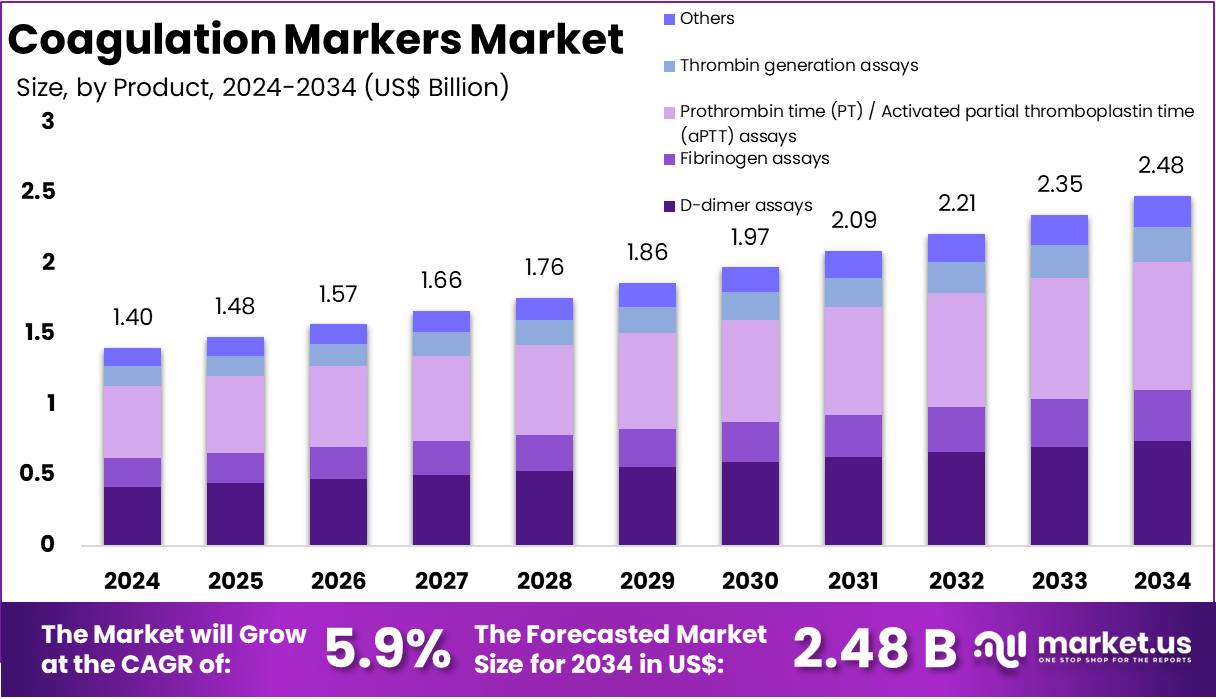
New York, NY – Sep 01, 2026 – The Coagulation Markers Market size is expected to be worth around US$ 2.48 Billion by 2034 from US$ 1.40 Billion in 2024, growing at a CAGR of 5.9% during the forecast period 2025 to 2034. North America held a dominant market position, capturing more than a 38.1% share and holds US$ 533.4 Million market value for the year.
The global Coagulation Markers Market is witnessing steady growth as healthcare providers increasingly rely on laboratory biomarkers for the early detection and monitoring of bleeding disorders, thrombotic diseases, cardiovascular conditions, and sepsis.
Coagulation markers such as D-dimer, fibrinogen, prothrombin fragments, thrombin-antithrombin complexes, and fibrin degradation products have become essential tools in emergency medicine, critical care, and routine diagnostic testing. The growing burden of cardiovascular diseases, venous thromboembolism (VTE), stroke, and trauma cases continues to drive demand for accurate coagulation testing worldwide.
According to the World Health Organization (WHO), cardiovascular diseases cause approximately 17.9 million deaths annually, representing around 32% of all global deaths, highlighting the need for reliable coagulation assessment.
The Centers for Disease Control and Prevention (CDC) estimates that up to 900,000 people in the United States are affected by venous thromboembolism each year, while approximately 60,000 to 100,000 deaths are associated with VTE complications. Rising hospital admissions, aging populations, and increased adoption of automated coagulation analyzers are further supporting market expansion.
Technological advancements, including high-sensitivity immunoassays, point-of-care coagulation testing, multiplex biomarker panels, and AI-assisted laboratory workflows, are improving diagnostic accuracy and reducing turnaround times.
Growing investments in healthcare infrastructure, expanding clinical laboratory networks, and increasing awareness of early disease diagnosis are expected to create significant opportunities for manufacturers and diagnostic service providers, supporting sustained market growth over the coming years.
Key Takeaways
- In 2024, the Coagulation Markers Market was valued at US$ 40 billion and is projected to grow at a CAGR of 5.9%, reaching US$ 2.48 billion by 2034.
- By Product, the market is segmented into D-dimer assays, Fibrinogen assays, Prothrombin Time (PT) / Activated Partial Thromboplastin Time (aPTT) assays, Thrombin Generation assays, and Others. Among these, Prothrombin Time (PT) / Activated Partial Thromboplastin Time (aPTT) assays accounted for the largest share of 36.5% in 2024.
- Based on Sample Type, the market is categorized into Plasma, Serum, Whole Blood, and Others. The Plasma segment dominated the market with a 46.3% share in 2024.
- By End User, the market is classified into Hospitals, Diagnostic Laboratories, Specialty Clinics, and Others. Hospitals emerged as the leading segment, capturing 52.4% of the market in 2024.
- North America held the leading regional position in the Coagulation Markers Market, accounting for 38.1% of the global market share in 2024.
Market segmentation
- Product Analysis: Prothrombin Time (PT) / Activated Partial Thromboplastin Time (aPTT) assays led the coagulation markers market with a 36.5% share in 2024 due to their routine use in diagnosing bleeding disorders, monitoring anticoagulant therapy, evaluating surgical readiness, and delivering rapid, cost-effective results across hospitals and diagnostic laboratories.
- Sample Type Analysis: Plasma accounted for 46.3% of the market in 2024 because it provides a reliable measurement of clotting factors and coagulation biomarkers. Its compatibility with automated analyzers, standardized testing procedures, and high accuracy makes it the preferred sample for routine and advanced coagulation testing.
- End-User Analysis: Hospitals captured 52.4% of the coagulation markers market in 2024 owing to high testing volumes for emergency care, surgeries, cardiovascular diseases, trauma, and anticoagulant monitoring. Advanced laboratory infrastructure and rapid diagnostic capabilities continue to support their market leadership.
Statistical Information
- A 2025 tertiary-care hospital study found that an autoverification system for PT and aPTT achieved a 63.3% overall autoverification pass rate across 159,183 coagulation tests, improving laboratory workflow efficiency.
- In the same 2025 study, outpatient coagulation samples recorded a 69.2% autoverification rate, indicating higher automated reporting efficiency than inpatient testing.
- The 2025 laboratory evaluation reported that inpatient coagulation samples achieved a 56.3% autoverification rate, reflecting the greater complexity of hospitalized patient testing.
- During validation of the 2025 autoverification algorithm, researchers developed the workflow using 70,865 historical PT and aPTT test results before clinical deployment.
- After protocol refinement in the same study, the laboratory validated the workflow using an additional 4,509 coagulation test results before full implementation.
- The 2025 validation established a 98% probability threshold for automated verification decisions, improving confidence in releasing PT and aPTT results without manual review.
- The same study applied a 15% Total Allowable Error (TEa) criterion for both PT and aPTT assays, ensuring standardized analytical performance during automated verification.
Regional Analysis
North America Dominates the Coagulation Markers Market
North America accounted for 38.1% of the global coagulation markers market in 2024, reaching a value of US$ 533.4 million. The region’s leadership is supported by its advanced healthcare infrastructure, widespread access to clinical laboratories, and high adoption of automated coagulation testing technologies.
Hospitals across the United States and Canada routinely perform D-dimer, Prothrombin Time (PT), Activated Partial Thromboplastin Time (aPTT), and fibrinogen testing for diagnosing thrombosis, monitoring anticoagulant therapy, and managing surgical patients. The growing prevalence of cardiovascular diseases, cancer, obesity, and aging populations continues to increase demand for coagulation diagnostics.
In addition, strong regulatory oversight, continuous technological innovation, and the presence of leading diagnostic manufacturers accelerate the adoption of high-sensitivity immunoassays and point-of-care coagulation analyzers. Government support for strengthening laboratory systems and diagnostic capacity further reinforces the region’s leadership in advanced coagulation testing.
Asia Pacific Expected to Register the Fastest Growth
Asia Pacific is projected to record the fastest growth in the coagulation markers market due to expanding healthcare infrastructure, increasing investments in diagnostic laboratories, and rising awareness of thrombotic and cardiovascular disorders. Countries including China, Japan, India, and South Korea are modernizing laboratory services through automation and digital diagnostics to improve testing efficiency and clinical outcomes.
Growing numbers of hospitals, increasing surgical procedures, and broader access to health insurance are driving higher utilization of coagulation marker tests. Government initiatives and WHO-supported programs aimed at strengthening laboratory capacity, quality management, and rapid diagnostic services are further enhancing regional diagnostic capabilities.
Expanding domestic production of diagnostic reagents and laboratory instruments is also improving accessibility while reducing dependence on imported products, supporting sustained regional market growth.
Business Opportunities
The coagulation markers market presents strong business opportunities as healthcare systems increasingly prioritize the early diagnosis and monitoring of thrombotic and bleeding disorders. Rising adoption of point-of-care coagulation testing in emergency departments, ambulances, and outpatient clinics is creating demand for portable, rapid diagnostic devices.
Expanding use of high-sensitivity D-dimer and fibrinogen assays in cardiovascular disease, stroke, cancer, and sepsis management is opening new revenue streams for diagnostic manufacturers. Emerging economies in Asia-Pacific, Latin America, and the Middle East offer significant growth potential due to improving laboratory infrastructure, expanding healthcare coverage, and increasing investments in diagnostic services.
Opportunities are also growing in AI-enabled laboratory automation, cloud-based laboratory information systems, and multiplex coagulation testing platforms that improve workflow efficiency and clinical decision-making.
In addition, the expansion of home healthcare, decentralized testing, and personalized anticoagulant therapy is encouraging innovation in compact analyzers and digital monitoring solutions, allowing companies to strengthen their product portfolios and expand into underserved healthcare markets.
Emerging Trends
- Automation is becoming a major trend in coagulation testing: In 2025, the FDA documented automated analyzers capable of performing clotting, chromogenic, and immunoassay methods on a single platform, supporting faster and more standardized testing of D-dimer, fibrinogen, and related markers.
- Point-of-care coagulation testing is expanding in critical care and surgery: Recent clinical research highlights the use of rapid bedside systems during complex procedures, where timely coagulation results can support immediate treatment decisions and reduce dependence on centralized laboratory workflows.
- Advanced whole-blood testing is gaining attention: A 2025 FDA-cleared coagulation system used four analytical channels to assess clotting factors, fibrinogen, platelets, and clot-lysis activity, supporting broader evaluation of a patient’s hemostatic condition from one sample.
- New biomarker combinations are improving clinical risk assessment: A recent stroke study involving 622 patients examined D-dimer alongside high-sensitivity C-reactive protein, showing growing interest in combining coagulation and inflammatory markers for improved disease severity evaluation.
- Standardization of coagulation testing remains a key market trend: WHO’s 2025 work on the 6th International Standard for coagulation Factor IX reflects increasing efforts to improve assay consistency, reference measurement, and comparability across laboratories and diagnostic platforms.
Use Cases
- D-dimer testing is widely used to support thrombosis assessment: Normal D-dimer values are generally below 500 ng/mL FEU, while elevated levels may indicate increased clot formation and breakdown, supporting evaluation of venous thromboembolism and disseminated intravascular coagulation.
- PT and aPTT testing support faster laboratory workflows: Standard preparation of platelet-poor plasma may require 10–30 minutes of centrifugation, while a 5-minute method at 3,000 g showed comparable results, potentially reducing coagulation-test turnaround time.
- Coagulation markers are used to monitor severe systemic illness: In a recent study of 433 patients, 63.4% had D-dimer levels between 0.5 and 4 µg/mL, while 19.6% recorded levels of 4 µg/mL or higher, supporting disease monitoring.
- Coagulation testing supports anticoagulant therapy management: FDA-reviewed automated systems analyze human plasma containing 3.2% citrate and provide clotting, chromogenic, and immunoassay results that assist clinicians in monitoring anticoagulant treatment and identifying coagulation abnormalities.
- Coagulation markers are increasingly used in surgical care: Point-of-care coagulation systems help assess intraoperative clotting changes during cardiac and other complex surgeries, enabling clinicians to obtain rapid results and make timely decisions regarding bleeding management and blood-product use.
Recent Development
- In March 2025, Werfen announced the commercialization of its ACL TOP Family 70 Series hemostasis testing systems in North America following FDA clearance. These systems introduce automated performance verification and advanced digital connectivity via the HemoHub Intelligent Data Manager to optimize laboratory workflows.
- In April 2025, Diagnostica Stago further solidified its global footprint for the STA R Max3 fully automated coagulation analyzer, boosting high-throughput routine and specialty hemostasis testing capabilities in reference laboratories.
- In December 2025, Sysmex Corporation launched the CN-700 Automated Blood Coagulation Analyzer in Japan. The system was designed for medium-sized laboratories and incorporates technology from the company’s CN-6000 and CN-3000 platforms, expanding Sysmex’s coagulation testing portfolio.
Frequently Asked Questions on Coagulation Markers
- Why are coagulation markers important in healthcare?
Coagulation markers provide critical information about clot formation and breakdown, enabling healthcare professionals to diagnose deep vein thrombosis, pulmonary embolism, disseminated intravascular coagulation, and bleeding disorders. They also support treatment decisions before surgery and during anticoagulant therapy monitoring. - Which coagulation marker is most commonly used?
D-dimer, PT, and aPTT are among the most widely used coagulation markers. D-dimer helps rule out thrombotic conditions, while PT and aPTT assess clotting pathways and monitor anticoagulant medications, making them routine tests in hospitals and diagnostic laboratories. - What factors are driving the growth of the Coagulation Markers Market?
The market is expanding due to rising cases of cardiovascular diseases, stroke, cancer, trauma, and venous thromboembolism. Increasing demand for early diagnosis, automated laboratory systems, point-of-care testing, and improved healthcare infrastructure also supports sustained market growth. - Which end users generate the highest demand for coagulation markers?
Hospitals are the largest users of coagulation markers because they perform high volumes of emergency, surgical, and critical care testing. Diagnostic laboratories and specialty clinics also contribute significantly by providing routine coagulation screening and specialized hemostasis testing services. - What technologies are shaping the Coagulation Markers Market?
Emerging technologies include automated coagulation analyzers, high-sensitivity immunoassays, multiplex testing platforms, artificial intelligence-assisted laboratory workflows, and point-of-care diagnostic devices. These innovations improve testing accuracy, reduce turnaround times, and enhance laboratory productivity. - Which sample type is commonly used for coagulation marker testing?
Plasma is the preferred sample type because it preserves clotting factors needed for accurate analysis. Most coagulation assays, including PT, aPTT, fibrinogen, and D-dimer tests, are validated using plasma to ensure reliable and standardized laboratory results. - Which region leads the Coagulation Markers Market?
North America currently leads the market due to advanced healthcare infrastructure, high diagnostic testing volumes, widespread adoption of automated analyzers, and strong awareness of thrombotic diseases. Continued investment in laboratory technologies further strengthens the region’s leading position.
Conclusion
The global coagulation markers market is expected to witness steady growth, driven by the increasing prevalence of cardiovascular diseases, thrombotic disorders, cancer-related coagulation complications, and the growing need for rapid and accurate diagnostic testing. Rising adoption of automated analyzers, high-sensitivity immunoassays, and point-of-care coagulation testing is improving clinical efficiency and patient outcomes.
Hospitals remain the leading end users due to high testing volumes, while plasma continues to be the preferred sample type for reliable analysis. North America leads the market with advanced healthcare infrastructure and strong diagnostic adoption.
Continued technological innovation, expanding clinical applications, and increasing awareness of early coagulation assessment are expected to support long-term market expansion and improve disease management worldwide.
Discuss your needs with our analyst
Please share your requirements with more details so our analyst can check if they can solve your problem(s)




