


Overview
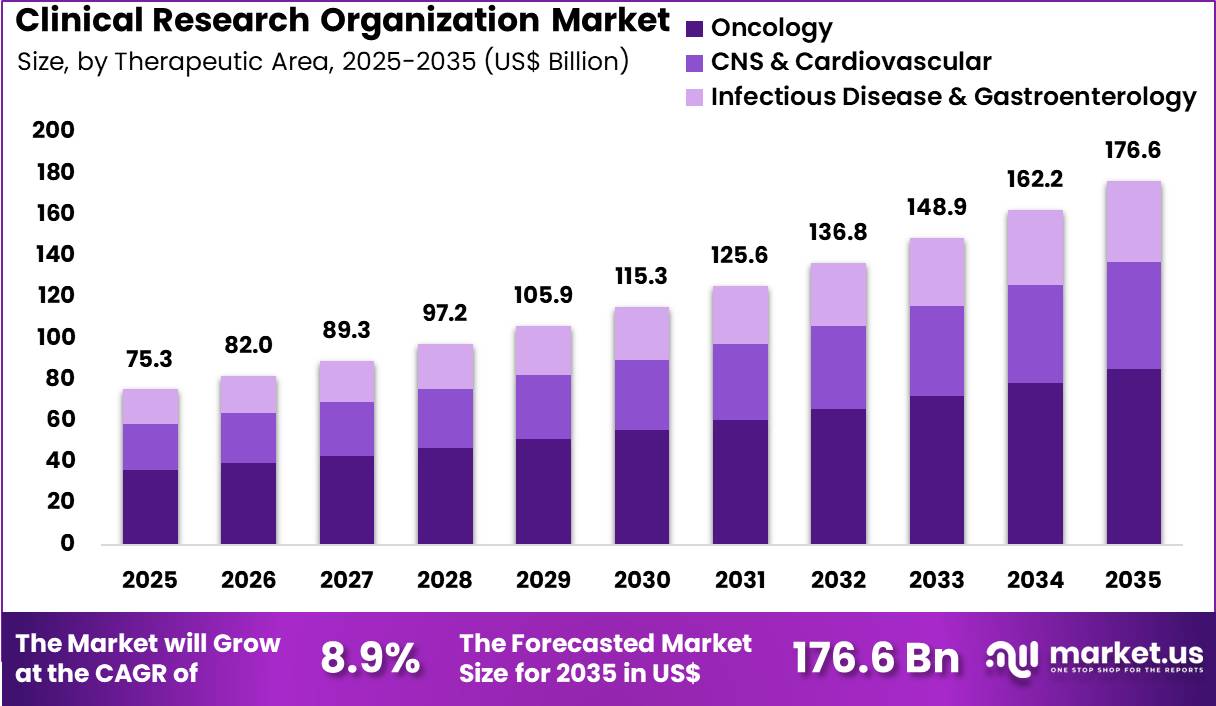
New York, NY – Nov 04 2026 – The Global Clinical Research Organization Market size is expected to be worth around US$ 176.6 Billion by 2035 from US$ 75.3 Billion in 2025, growing at a CAGR of 8.9% during the forecast period 2026-2035. In 2025, North America led the market, achieving over 38.6% share with a revenue of US$ 29.1 Billion.
A Clinical Research Organization (CRO) is a specialized service provider that supports pharmaceutical, biotechnology, medical device, and healthcare companies in conducting clinical trials and research activities. CROs help organizations manage the entire clinical development process, from early-stage research and clinical trial planning to regulatory submissions and post-marketing studies. Their services include clinical trial management, patient recruitment, clinical data management, biostatistics, pharmacovigilance, regulatory affairs, laboratory testing, and medical writing.
CROs play an important role in accelerating drug development by providing scientific expertise, experienced research professionals, advanced technologies, and established clinical trial networks. They help sponsors reduce operational costs, improve research efficiency, and manage complex regulatory requirements. The growing demand for innovative medicines, biologics, personalized treatments, and medical devices is increasing the need for outsourced clinical research services.
Additionally, advancements in artificial intelligence, electronic data capture, decentralized clinical trials, and real-world evidence are transforming CRO operations. These technologies support faster data collection, improved patient monitoring, and more efficient clinical trial management. As pharmaceutical and biotechnology companies continue to expand their research pipelines, CROs are becoming essential partners in bringing safe and effective healthcare treatments to market.
Key Takeaways
- In 2025, the Clinical Research Organization (CRO) market generated US$ 75.3 Billion in revenue and is projected to reach US$ 176.6 Billion by 2035, expanding at a CAGR of 8.9% during the forecast period.
- By service type, the market is segmented into early phase development, clinical trial services, laboratory services, and regulatory consulting. Clinical trial services dominated the segment, accounting for a 35.1% market share.
- Based on therapeutic area, the market is categorized into oncology, CNS & cardiovascular, and infectious disease & gastroenterology. Oncology emerged as the leading segment, capturing a 48.3% market share.
- By end user, the market is divided into pharma/biotech companies, medical device companies, and academic/research institutes. Pharmaceutical and biopharmaceutical companies dominated the segment, holding the largest revenue share of 51.6%.
- Regionally, North America dominated the Clinical Research Organization market, accounting for a 38.6% market share.
Key Market Segments
- Service Type Analysis: Clinical trial services dominated the service type segment, accounting for 35.1% of the market share. This leadership is driven by increasing outsourcing of Phase II and Phase III clinical studies. Pharmaceutical companies increasingly depend on CROs for patient recruitment, site management, clinical monitoring, and data management, supporting efficient trial execution.
- Therapeutic Area Analysis: Oncology dominated the therapeutic area segment, accounting for 48.3% of the market share. The segment’s growth is supported by increasing cancer drug development, rising demand for targeted therapies, and expanding immuno-oncology research. Growing investments in precision medicine and complex clinical trials further strengthen the demand for specialized oncology research services.
- End-User Analysis: Pharmaceutical and biopharmaceutical companies led the end-user segment, capturing 51.6% of the market share. Their dominance is driven by rising research and development investments and expanding drug development pipelines. Increasing reliance on CROs for clinical trial management, regulatory support, and cost-efficient research operations further strengthens demand across this segment.
Regional Analysis
North America is leading the Clinical Research Organization Market
North America dominated the Clinical Research Organization market, accounting for a 38.6% market share in 2024. Regional growth is driven by increasing outsourcing from pharmaceutical and biotechnology companies, rising clinical research investments, and strong demand for specialized trial management services.
Expanding oncology, rare disease, and biologics pipelines further support demand for patient recruitment, data management, and regulatory assistance. Additionally, decentralized clinical trials and advanced digital monitoring technologies strengthen CRO adoption. Strong regulatory frameworks, established research infrastructure, and significant NIH funding further support regional market leadership.
Asia Pacific is expected to register the highest CAGR during the forecast period
Asia Pacific is projected to experience the fastest growth due to expanding clinical trial activities, diverse patient populations, and increasing pharmaceutical investments. Government initiatives to streamline clinical trial approvals, growing research infrastructure, and lower operational costs attract global sponsors.
Furthermore, skilled investigators, academic collaborations, and rising adoption of digital research technologies are strengthening the region’s position as a preferred destination for clinical research outsourcing.
Emerging Trends
- Increasing Adoption of Decentralized Clinical Trials: Clinical Research Organizations are increasingly adopting decentralized and hybrid clinical trial models. These approaches use telehealth consultations, remote patient monitoring, and home-based visits to reduce the need for hospital visits. The FDA’s September 2024 guidance supports decentralized trial activities at locations convenient for participants, improving accessibility and flexibility.
- Growing Use of Artificial Intelligence in Clinical Research: Artificial intelligence is becoming an important tool in clinical research operations. CROs are exploring AI for patient identification, clinical data analysis, trial monitoring, and safety assessment. In January 2026, the FDA and European Medicines Agency published guiding principles for responsible AI use in drug development, highlighting the importance of reliable and risk-based applications.
- Greater Focus on Patient Diversity and Recruitment: CROs are giving greater attention to enrolling participants from different age groups, geographical regions, and health backgrounds. More representative recruitment helps researchers understand how treatments work across patient populations. The FDA’s December 2025 guidance recommends approaches to improve participation through suitable eligibility criteria, enrollment practices, and trial designs.
- Expansion of Real-World Evidence and Data Analytics: Clinical research providers are increasingly using real-world data from electronic health records, medical claims, patient registries, and digital health devices. These sources help researchers evaluate treatment outcomes and safety beyond traditional clinical trials. The FDA’s July 2024 guidance explains how electronic health records and medical claims data can support regulatory decisions.
- Stronger Emphasis on Risk-Based Clinical Trial Management: CROs are adopting risk-based approaches to improve trial quality, protect participants, and manage research activities efficiently. The updated ICH E6(R3) Good Clinical Practice guideline emphasizes quality by design, appropriate oversight, and risk-based trial management. These practices help organizations focus resources on activities that directly affect participant safety and data reliability.
Use Cases
- Clinical Trials for New Drug Development: Pharmaceutical and biotechnology companies use CRO services to conduct clinical trials for new medicines. CROs support study planning, patient recruitment, clinical site coordination, data collection, and reporting. Their involvement helps sponsors evaluate drug safety and effectiveness before submitting products for regulatory approval.
- Development and Testing of Biologics: CROs support clinical research for biologics, including vaccines, monoclonal antibodies, and other advanced therapies. They coordinate specialized studies, monitor patient responses, and collect safety information. These services help biotechnology companies evaluate complex treatments and generate evidence required for regulatory review.
- Medical Device Clinical Investigations: Medical device manufacturers partner with CROs to evaluate the safety and performance of products such as diagnostic equipment, implants, and surgical devices. CROs manage investigation protocols, clinical site activities, patient monitoring, and data analysis to support regulatory submissions and product development.
- Post-Marketing Safety and Surveillance Studies: After a medicine receives regulatory approval, CROs help pharmaceutical companies monitor its safety in wider patient populations. They support observational studies, adverse event reporting, and post-authorization safety research. These activities help identify potential risks and improve understanding of long-term treatment outcomes.
- Clinical Research for Rare Diseases and Specialized Conditions: CROs help sponsors conduct research involving rare diseases and smaller patient populations. They identify suitable research sites, develop recruitment strategies, and coordinate specialized clinical studies. Their expertise helps researchers address recruitment challenges and collect reliable evidence for treatments targeting less common medical conditions.
Frequently Asked Questions About Clinical Research Organization
- What are the main services offered by a CRO?
CROs provide clinical trial management, study design, patient recruitment, clinical data management, biostatistics, regulatory support, pharmacovigilance, and medical writing. These services help sponsors manage research activities while maintaining regulatory compliance and reliable clinical results. - Why do pharmaceutical companies outsource clinical research?
Pharmaceutical companies outsource clinical research to access specialized expertise, experienced research professionals, established clinical sites, and advanced technologies. Outsourcing also helps manage operational costs, coordinate complex studies, and improve efficiency throughout the drug development process. - What are the different phases of clinical trials?
Clinical trials generally include four phases. Phase I evaluates initial safety, Phase II examines effectiveness and dosage, Phase III confirms benefits and monitors risks in larger populations, and Phase IV evaluates treatment performance after regulatory approval. - What is driving the growth of the Clinical Research Organization market?
The market is growing due to increasing pharmaceutical research investments, rising clinical trial complexity, growing biotechnology pipelines, and demand for outsourced research services. Advances in healthcare technology and expanding drug development activities also support market growth. - What role does technology play in the CRO market?
Technology improves clinical research through electronic data capture, artificial intelligence, remote patient monitoring, and advanced analytics. These tools help CROs manage research information, monitor trial progress, identify potential issues, and improve the accuracy of clinical data. - What factors should companies consider when selecting a CRO?
Companies should evaluate a CRO’s clinical research experience, therapeutic expertise, regulatory knowledge, global site network, technology capabilities, and data security practices. Strong project management and patient recruitment capabilities are also important when selecting a research partner. - What is the future outlook for the Clinical Research Organization market?
The market is expected to benefit from increasing drug development activities, advanced biologics research, decentralized trials, and growing demand for specialized research services. AI-powered analytics and real-world evidence are also creating new opportunities for CRO providers.
Conclusion
The Clinical Research Organization market is experiencing strong growth, driven by increasing pharmaceutical R&D investments, rising clinical trial complexity, and growing demand for outsourced research services. Clinical trial services and oncology remain key market segments, while pharmaceutical and biotechnology companies continue to drive demand.
North America leads the market, whereas Asia Pacific is expected to witness the fastest growth. Additionally, advancements in artificial intelligence, decentralized clinical trials, and real-world evidence are improving research efficiency and patient participation. With the market projected to reach US$ 176.6 Billion by 2035, CROs will play an increasingly important role in accelerating drug development.
Discuss your needs with our analyst
Please share your requirements with more details so our analyst can check if they can solve your problem(s)



