


Overview
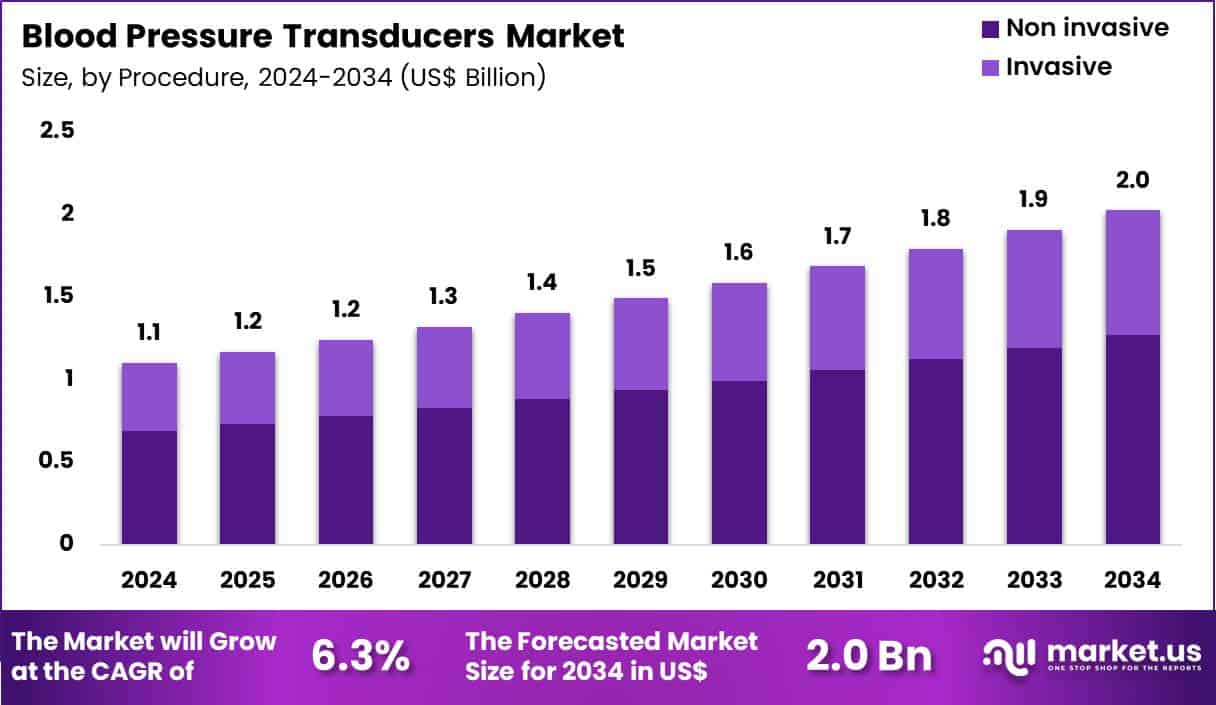
New York, NY – Oct 22, 2026 – Global Blood Pressure Transducers Market size is expected to be worth around US$ 2.0 Billion by 2034 from US$ 1.1 Billion in 2024, growing at a CAGR of 6.3% during the forecast period 2025 to 2034. In 2024, North America led the market, achieving over 39.9% share with a revenue of US$ 0.4 Billion.
Blood pressure transducers are medical devices used to measure and monitor blood pressure by converting pressure into electrical signals that can be displayed and analyzed by monitoring systems. These devices play an important role in hospitals, intensive care units (ICUs), operating rooms, emergency departments, and other clinical settings where accurate blood pressure measurement is essential.
Blood pressure transducers are broadly classified into invasive and non-invasive systems. Invasive blood pressure transducers are commonly used with arterial or venous catheters to provide continuous, real-time pressure measurements in critically ill patients and during complex surgical procedures. Non-invasive blood pressure monitoring systems typically use cuffs and electronic sensors to measure blood pressure without requiring catheter insertion.
The demand for blood pressure transducers is supported by the growing prevalence of cardiovascular diseases, the increasing number of surgical procedures, and the rising need for continuous patient monitoring. Technological advancements, including improved measurement accuracy, enhanced device compatibility, and integration with advanced patient monitoring systems, are also contributing to market development.
Manufacturers are increasingly focusing on product reliability, patient safety, and efficient clinical performance. As healthcare infrastructure expands and critical care services continue to advance, blood pressure transducers are expected to remain important components of modern medical monitoring equipment. These devices support timely clinical assessment and help healthcare professionals make informed decisions regarding patient management.
Key Takeaways
- In 2024, the market was valued at US$ 1.1 billion and is projected to reach US$ 2.0 billion by 2034, growing at a CAGR of 6.3%.
- By procedure, the market is segmented into non-invasive and invasive procedures, with the non-invasive segment dominating with a market share of 62.7%.
- By technology, the market is categorized into digital, aneroid, wearable, and other technologies, with the digital segment accounting for a significant share of 48.9%.
- By type, the market is divided into disposable and reusable products, with the disposable segment leading with the largest revenue share of 55.8%.
- By end user, the market is segmented into hospitals, ambulatory surgical centers, specialty clinics, and others, with hospitals holding the leading revenue share of 57.4%.
- Regionally, North America dominated the market, accounting for a share of 39.9%.
Key Market Segments
- Procedure Analysis: The non-invasive segment dominated the blood pressure transducers market, accounting for 62.7% share. Its growth is driven by widespread use in routine monitoring, hypertension screening, and post-operative care. Ease of use, patient comfort, and reduced complication risks further support adoption.
- Technology Analysis: The digital technology segment held a 48.9% market share, supported by clear displays, automated measurements, and efficient data recording. Integration with electronic health records and centralized monitoring systems enhances clinical workflows, reduces documentation efforts, and strengthens demand across hospitals and outpatient healthcare facilities.
- Type Analysis: The disposable segment accounted for 55.8% of the market, driven by increasing infection prevention requirements and reduced reprocessing needs. Single-use products support efficient patient turnover, simplify clinical workflows, and minimize cross-contamination risks, particularly in intensive care units, operating rooms, and emergency departments.
- End-User Analysis: The hospital segment dominated the blood pressure transducers market, capturing 57.4% share. High patient volumes, continuous monitoring requirements, and increasing surgical procedures support demand. Investments in advanced monitoring infrastructure, digital healthcare systems, and infection control further strengthen product adoption across hospital departments.
Regional Analysis
North America is Leading the Blood Pressure Transducers Market
North America accounted for 39.9% of the global blood pressure transducers market in 2024, supported by increasing demand for accurate hemodynamic monitoring, rising cardiovascular disease prevalence, and advanced healthcare infrastructure. Adoption is further strengthened by innovations in disposable transducers, improved sensor accuracy, and integration with electronic health records.
Increasing interventional cardiology procedures and investments in emergency care also contribute to regional market growth. Additionally, in 2024, the National Heart, Lung, and Blood Institute awarded Dynocardia a US$ 500,000 grant to advance continuous blood pressure monitoring technology.
Asia Pacific Expected to Record the Highest CAGR
Asia Pacific is projected to register the highest CAGR during the forecast period, driven by rising hypertension cases, expanding healthcare infrastructure, and growing investments in domestic medical device manufacturing.
China and India are strengthening local production capabilities, while Japan is advancing miniaturized and wearable monitoring technologies. Research collaborations and regulatory improvements are further supporting innovation. In 2024, India introduced a Rs. 500 crore medical device manufacturing scheme to support research, development, and domestic production capabilities.
Emerging Trends
- Growing preference for single-use transducers: Hospitals are increasingly focused on infection prevention and safe patient care. Single-use transducers can reduce the need for reprocessing between patients and support standardised clinical workflows. Their adoption is particularly relevant in intensive care units and operating rooms, where invasive pressure monitoring is required.
- Integration with advanced patient monitoring systems: Transducers are being used as part of connected bedside monitoring systems that display blood pressure waveforms and numerical readings. Compatibility with hospital monitors is important because clinicians need timely information to assess patients and make treatment decisions.
- Rising need for precise cardiovascular measurements: Cardiac catheterisation and other cardiovascular procedures require accurate pressure readings to assess heart and blood vessel function. The use of specialised pressure transducers in these procedures creates demand for devices that provide reliable measurements under clinical conditions.
- Greater focus on device safety and performance standards: Manufacturers are placing greater emphasis on measurement accuracy, electrical safety, compatibility and consistent product performance. The US Food and Drug Administration (FDA) recognises standards for invasive blood pressure monitoring equipment, supporting the need for compliant product design and testing.
- Development of compact and specialised pressure sensors: Medical device development is creating opportunities for smaller sensors designed for specific diagnostic and procedural needs. Catheter-tip pressure transducers, for example, are recognised as a distinct medical-device category by the FDA. Such specialised designs may support more targeted cardiovascular measurements.
Use Cases
- Intensive care unit (ICU) monitoring: Transducers are used to continuously measure arterial blood pressure in critically ill patients. They help clinical teams observe pressure changes and assess patient stability during severe illness, shock management and other situations requiring close monitoring.
- Operating rooms and anaesthesia: During major operations, invasive pressure monitoring may be used when close blood pressure control is required. Transducers provide continuous readings that help anaesthesia teams monitor changes during surgery and respond to significant variations.
- Cardiac catheterisation and heart procedures: Specialised transducers measure pressure inside the heart or blood vessels during selected diagnostic and treatment procedures. These measurements help clinicians assess cardiovascular function and support decisions during catheter-based investigations.
- Emergency and haemodynamic assessment: In emergency settings, invasive pressure monitoring may be used for selected patients with unstable circulation. Continuous readings help clinicians evaluate blood pressure changes while managing serious conditions and assessing responses to treatment.
- Medical research and device testing: Transducers are used in clinical research and medical-device evaluation to measure pressure changes under controlled conditions. Researchers can use these readings to study cardiovascular function, assess monitoring technologies and evaluate device performance.
Frequently Asked Questions About Blood Pressure Transducers
- What is a blood pressure transducer?
A blood pressure transducer is a medical device that converts blood pressure into an electrical signal. The signal is processed by a compatible monitoring system to display pressure readings and, in invasive systems, continuous pressure waveforms. - How does a blood pressure transducer work?
A transducer detects pressure changes through a sensing element and converts them into electrical signals. The connected monitor processes these signals and displays blood pressure values. Accurate readings depend on correct setup, calibration and compatible equipment. - Where are blood pressure transducers commonly used?
Blood pressure transducers are commonly used in intensive care units, operating rooms, cardiac catheterisation laboratories and selected emergency care settings. They support continuous pressure measurement when patients require close observation or procedures require direct cardiovascular pressure assessment. - What is the difference between invasive and non-invasive blood pressure monitoring?
Invasive monitoring measures pressure through a catheter placed inside a blood vessel and connected to a transducer. Non-invasive monitoring generally uses an external cuff. The appropriate method depends on patient condition and clinical requirements. - Why are disposable blood pressure transducers important?
Disposable transducers are designed for single-patient use and can reduce the need for device reprocessing between patients. Their use may support infection-control procedures, simplify preparation and improve workflow consistency, subject to manufacturer instructions and hospital protocols. - What challenges affect the blood pressure transducers market?
Key challenges include device costs, equipment compatibility, the need for reliable measurements, regulatory compliance and staff training. Hospitals must also consider product quality, maintenance requirements, supply availability and the total cost of ownership when selecting transducer systems. - What opportunities exist for blood pressure transducer manufacturers?
Manufacturers may benefit from developing reliable disposable products, improving compatibility with monitoring platforms and expanding distribution in underserved healthcare markets. Product innovation, regulatory compliance and partnerships with hospitals can support commercial growth, provided clinical performance and cost requirements are met.
Conclusion
The blood pressure transducers market is expected to experience steady growth, supported by increasing demand for accurate blood pressure monitoring, rising cardiovascular disease cases, and expanding critical care services. Technological advancements, digital monitoring systems, and the growing adoption of disposable products are further supporting market development.
North America currently holds a leading market position, while Asia-Pacific is expected to offer significant growth opportunities due to healthcare infrastructure expansion and medical device manufacturing investments. Manufacturers are focusing on product accuracy, patient safety, and system compatibility. Overall, continuous innovation and growing healthcare requirements are expected to strengthen market demand during the forecast period.
Discuss your needs with our analyst
Please share your requirements with more details so our analyst can check if they can solve your problem(s)



