
Overview
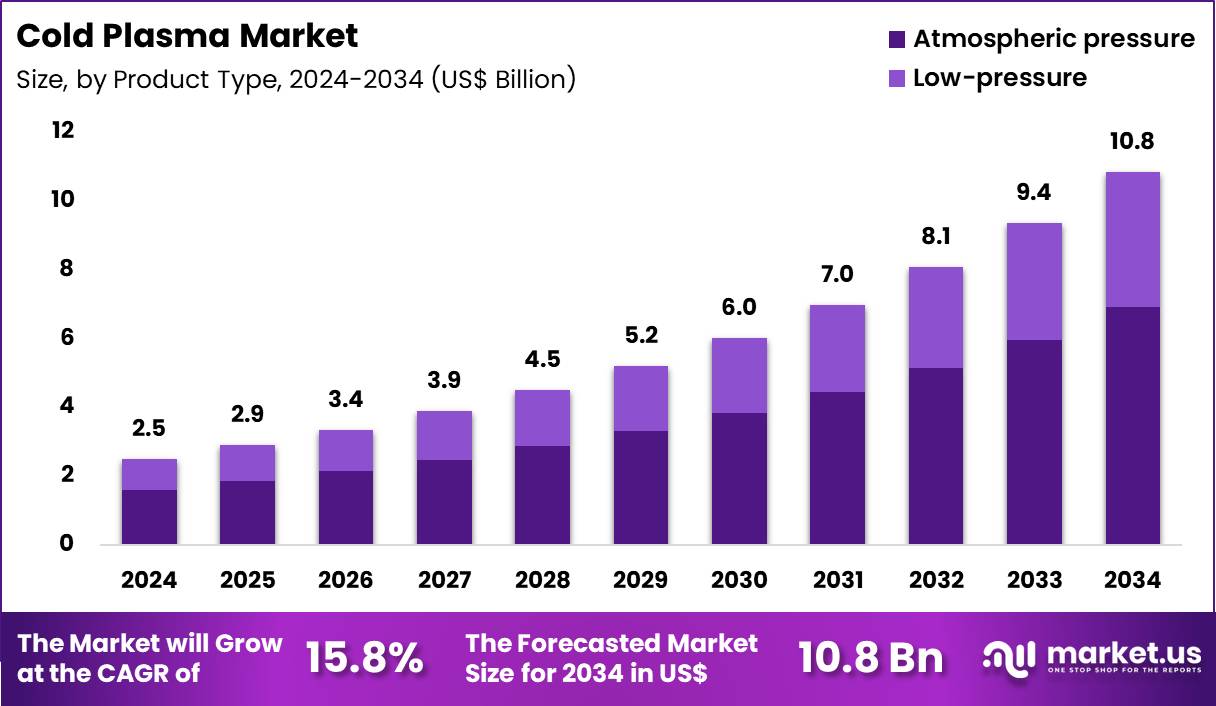
New York, NY – Oct 12, 2026 – The Global Cold Plasma Market size is expected to be worth around US$ 10.8 Billion by 2034 from US$ 2.5 Billion in 2024, growing at a CAGR of 15.8% during the forecast period 2025 to 2034. In 2024, North America led the market, achieving over 37.4% share with a revenue of US$ 0.9 Billion.
Cold plasma is an advanced technology that uses partially ionized gas at or near room temperature to modify, clean, disinfect, and treat surfaces without the need for high temperatures. Unlike conventional thermal plasma, cold plasma enables the treatment of heat-sensitive materials, making it suitable for a wide range of industrial and scientific applications.
The technology is gaining attention across several sectors, including healthcare, food processing, agriculture, electronics, textiles, packaging, and environmental management. In healthcare, cold plasma is being investigated for wound care, microbial inactivation, and medical instrument sterilization.
In the food industry, it offers potential applications in reducing microbial contamination on food surfaces and improving food safety. Agricultural applications include seed treatment, crop protection research, and potential improvements in germination.
Cold plasma technology is also being explored for surface activation, polymer treatment, precision cleaning, and the removal of selected contaminants. Its ability to operate with relatively low heat input may offer advantages in applications where conventional processing methods are unsuitable.
As research and commercial development continue, growing interest in non-thermal processing, sustainable manufacturing, and advanced disinfection solutions is creating opportunities for further innovation. However, performance, safety, regulatory requirements, and commercial feasibility vary by application and must be validated through appropriate testing.
Cold plasma is therefore emerging as a promising technology with the potential to support more efficient and specialized processes across multiple industries.
Key Takeaways
- In 2024, the cold plasma market generated revenue of US$ 2.5 billion and is projected to reach US$ 10.8 billion by 2034, growing at a CAGR of 15.8%.
- By product type, the market is segmented into atmospheric pressure and low-pressure cold plasma. Atmospheric pressure held the leading position in 2024, accounting for 63.7% of the market share.
- By technology, the market is categorized into direct treatment, remote treatment, and electrode contact. Direct treatment dominated the segment in 2024, capturing a significant market share of 46.9%.
- By application, the market is divided into wound healing, packaging decontamination, dentistry, cancer treatment, blood coagulation, and others. Wound healing emerged as the leading application, accounting for 41.8% of total market revenue.
- By end user, the market is segmented into the medical, textile, electrical and electronics industries, and others. The medical industry led the market in 2024, securing a revenue share of 54.6%.
- Regionally, North America dominated the cold plasma market in 2024, accounting for 37.4% of the global market share.
Key Market Segments
- Product Type Analysis: Atmospheric pressure plasma dominated the product type segment in 2024, accounting for 63.7% of the market share. Its lower infrastructure requirements, portability, operational flexibility, and suitability for clinical and industrial applications support adoption across diverse end-use environments.
- Technology Analysis: Direct treatment led the technology segment in 2024, capturing 46.9% of the market share. Its precise plasma delivery, localized surface interaction, operational simplicity, and suitability for wound care and industrial surface modification contribute to its widespread adoption.
- Application Analysis: Wound healing dominated the application segment in 2024, accounting for 41.8% of the market share. Growing chronic wound prevalence, antimicrobial capabilities, potential tissue regeneration benefits, and increasing demand for advanced wound care solutions support segment growth.
- End-User Analysis: The medical industry dominated the end-user segment in 2024, accounting for 54.6% of the market share. Rising demand for advanced wound care, infection control, medical device sterilization, and non-thermal treatment solutions continues to support adoption across healthcare facilities.
Regional Analysis
North America Leads the Cold Plasma Market
In 2024, North America accounted for 39.9% of the global cold plasma market, driven by increasing applications in wound healing, tissue treatment, and medical device sterilization. Growing demand for advanced wound care, infection control, and minimally invasive procedures supported regional adoption.
Innovations in portable plasma devices further expanded their use in dermatology, dentistry, and outpatient healthcare settings. In 2024, the FDA granted 510(k) clearance to the Canady Helios Cold Plasma Ablation System for soft tissue ablation, supporting technological advancement in the region.
Asia Pacific Expected to Record the Highest CAGR
Asia Pacific is projected to register the highest CAGR during the forecast period, supported by rising chronic wound cases, increasing healthcare investments, and expanding domestic medical device manufacturing. Growing diabetes prevalence is expected to increase demand for advanced wound management solutions.
Government initiatives to improve rural healthcare access and the development of affordable, portable plasma devices may further support adoption. Clinical research evaluating cold plasma applications in diabetic foot treatment and surgical sterilization is also expected to strengthen regional market opportunities.
Emerging Trends
- Growing investment in plasma-based wound care: Research is increasingly focused on using cold atmospheric plasma to reduce harmful microorganisms, manage biofilms, and support wound repair. Continued clinical evaluation is expected to influence the development of medical devices and specialised wound-care services.
- Development of atmospheric-pressure plasma systems: Manufacturers are developing systems that can operate without a vacuum chamber. These systems can support continuous production, localised treatment, and easier integration into industrial manufacturing lines, particularly for plastics, electronics, and medical devices.
- Increased interest in non-thermal food processing: Food manufacturers are exploring cold plasma as a low-temperature treatment to reduce microbial contamination while maintaining important food-quality characteristics. Research also covers packaging treatment, pesticide reduction, and the preservation of fresh produce.
- Expansion of plasma-activated water research: Plasma-treated water is being studied for seed germination, plant growth, and agricultural decontamination. This approach could provide new treatment options for crop production, although performance, operating costs, and field-scale results require further validation.
- Greater focus on process control and standardisation: Research is increasingly addressing plasma chemistry, treatment consistency, safety testing, and operating conditions. Better control of plasma-generated reactive species will be important for repeatable results, regulatory acceptance, and wider commercial use across different industries.
Use Cases
- Semiconductor and electronics manufacturing: Cold plasma is used to clean and prepare sensitive material surfaces, remove unwanted organic residues, and improve bonding between layers. These functions are valuable in semiconductor production, printed circuit boards, and electronic component manufacturing.
- Textile and garment processing: Textile producers can use cold plasma to change fabric surface properties, improve wettability, and support dyeing or coating performance. This may help reduce reliance on some conventional chemical treatments, depending on the material and production process.
- Polymer, plastic, and coating applications: Cold plasma can improve the surface properties of plastics before printing, painting, coating, or adhesive bonding. It is particularly useful for materials that are naturally difficult to bond, helping manufacturers improve surface compatibility without changing the entire material structure.
- Medical instrument and equipment decontamination: Cold plasma is being investigated for reducing microbial contamination on selected medical instruments and equipment. Its low-temperature operation is attractive for heat-sensitive materials, although suitability depends on the device, treatment method, and validated sterilisation requirements.
- Water and environmental treatment: Cold plasma is being explored for treating contaminated water and supporting the breakdown of selected pollutants. The reactive substances generated during treatment can help drive chemical reactions, but effectiveness depends on pollutant type, water composition, energy use, and system design.
Frequently Asked Questions About Cold Plasma
- How does cold plasma work?
Cold plasma is generated by applying electrical energy to a gas, producing reactive species that interact with targeted materials. Depending on the system, these interactions can alter surfaces, damage microorganisms, or initiate useful chemical reactions. - Is cold plasma safe for humans?
Cold plasma safety depends on the device, exposure conditions, treatment duration, and intended application. Medical use requires suitable safety evidence and clinical evaluation; findings from one system cannot automatically establish the safety of every plasma treatment. - What is the difference between cold plasma and thermal plasma?
Cold plasma operates under conditions where the gas remains relatively cool, making it suitable for some heat-sensitive materials. Thermal plasma operates at much higher gas temperatures and is generally used for different industrial processes, including high-temperature material treatment. - Can cold plasma kill bacteria and other microorganisms?
Yes, research shows that cold plasma can reduce bacteria, fungi, and other microorganisms under suitable conditions. Results vary with the organism, surface, exposure time, and equipment, so treatment effectiveness must be validated for each intended application. - Can cold plasma be used in medical treatments?
Cold atmospheric plasma is being studied for wound management, microbial control, and other biomedical applications. Some clinical findings are encouraging, but its suitability depends on the treatment indication, device, available evidence, and applicable medical regulations. - What factors are limiting cold plasma market growth?
Market expansion is constrained by equipment investment, process standardisation, application-specific validation, and uncertainty about long-term outcomes in some fields. Manufacturers must also demonstrate consistent performance and economic benefits before replacing established technologies with cold plasma systems. - What is the future outlook for the cold plasma market?
The outlook is promising across selected industrial and healthcare applications, supported by ongoing research and equipment development. However, adoption rates will depend on technical performance, regulatory requirements, manufacturing scale, and the ability to demonstrate clear economic advantages.
Conclusion
The cold plasma market is poised for significant growth, driven by increasing demand for non-thermal processing, advanced wound care, infection control, and sustainable manufacturing solutions. Valued at US$ 2.5 billion in 2024, the market is projected to reach US$ 10.8 billion by 2034, registering a CAGR of 15.8%. North America currently leads the market, while Asia Pacific is expected to experience the fastest growth.
Advancements in atmospheric pressure systems, plasma-based medical treatments, and industrial surface modification are expected to create new opportunities. However, regulatory compliance, standardisation, safety validation, and cost-effectiveness will remain critical to long-term market expansion.
Discuss your needs with our analyst
Please share your requirements with more details so our analyst can check if they can solve your problem(s)