
Overview
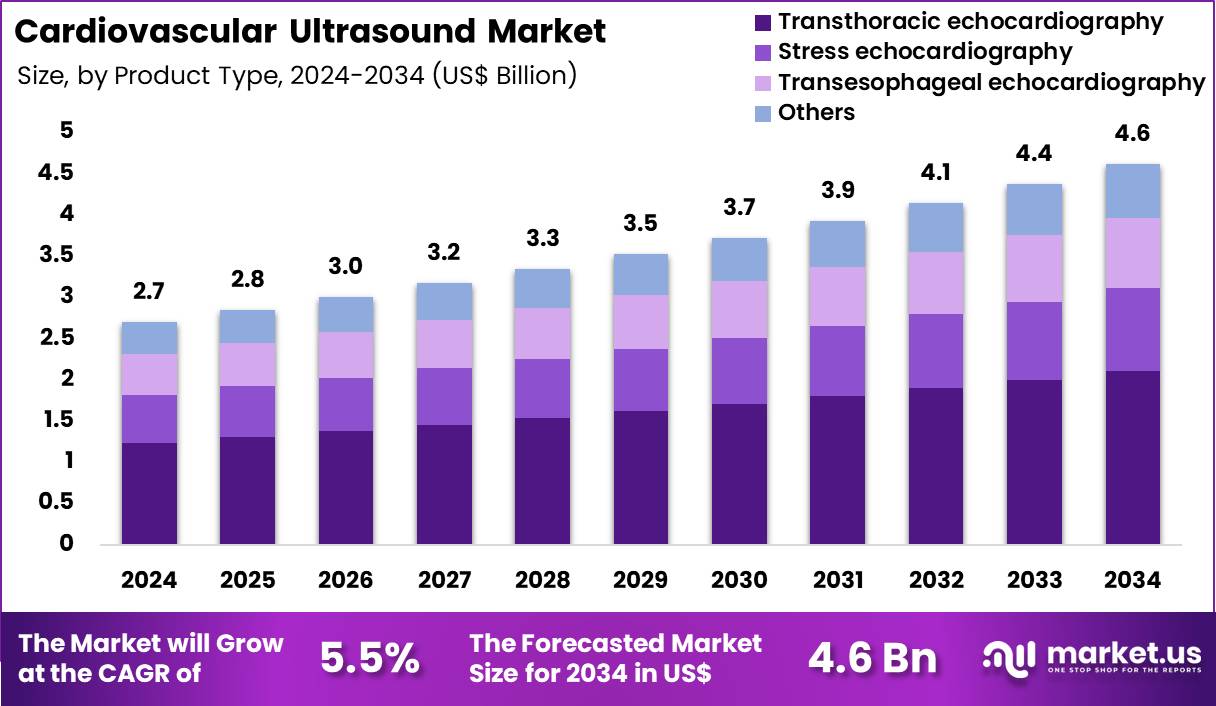
New York, NY – Oct 12, 2026 – The Global Cardiovascular Ultrasound Market size is expected to be worth around US$ 4.6 Billion by 2034 from US$ 2.7 Billion in 2024, growing at a CAGR of 5.5% during the forecast period 2025 to 2034. In 2024, North America led the market, achieving over 39.9% share with a revenue of US$ 1.1 Billion.
Cardiovascular ultrasound is a non-invasive medical imaging technique used to assess the structure and function of the heart and blood vessels. It uses high-frequency sound waves to produce real-time images, helping healthcare professionals identify and monitor various cardiovascular conditions. Common applications include echocardiography, vascular ultrasound, and Doppler imaging, which support the evaluation of blood flow, heart valve function, and cardiac performance.
The cardiovascular ultrasound market is being driven by the increasing prevalence of cardiovascular diseases, the growing geriatric population, and rising demand for early and accurate diagnosis. Technological advancements, including three-dimensional (3D) and four-dimensional (4D) imaging, portable ultrasound systems, and artificial intelligence (AI)-enabled diagnostic tools, are further improving imaging quality, clinical efficiency, and accessibility.
Hospitals, diagnostic imaging centers, specialty cardiac clinics, and ambulatory care facilities represent key end users of cardiovascular ultrasound equipment. The growing adoption of point-of-care ultrasound and portable devices is also expanding the use of these technologies across diverse healthcare settings.
North America holds a significant position in the market due to its advanced healthcare infrastructure and high adoption of medical imaging technologies. Meanwhile, Asia-Pacific is expected to offer substantial growth opportunities, supported by improving healthcare access, increasing medical investments, and rising awareness of cardiovascular health.
Overall, continuous innovation and the growing focus on preventive healthcare are expected to support the long-term development of the cardiovascular ultrasound market.
Key Takeaways
- In 2024, the cardiovascular ultrasound market generated revenue of US$ 7 billion and is projected to grow at a CAGR of 5.5%, reaching US$ 4.6 billion by 2034.
- By product type, the market is segmented into transthoracic echocardiography, stress echocardiography, transesophageal echocardiography, and others. Transthoracic echocardiography dominated the market in 2024, accounting for 45.8% of the market share.
- Based on technology, the market is categorized into 2D ultrasound, Doppler imaging, color flow imaging, and 3D/4D ultrasound. The 2D ultrasound segment held a significant market share of 48.9% in 2024.
- By display type, the market is divided into color display and monochrome display. The color display segment dominated the market, accounting for 62.4% of total revenue.
- Based on end users, the market is segmented into hospitals, ambulatory surgical centers, diagnostic centers, and others. Hospitals led the market in 2024, capturing a revenue share of 58.7%.
- Regionally, North America dominated the cardiovascular ultrasound market in 2024, accounting for 39.9% of the total market share.
Key Market Segments
- Product Type Analysis: Transthoracic echocardiography dominated the product type segment in 2024, accounting for 45.8% of the market share. Its non-invasive nature, diagnostic accuracy, affordability, and suitability for routine cardiac assessments support widespread adoption across hospitals, emergency departments, and outpatient healthcare facilities.
- Technology Analysis: 2D ultrasound held a leading position in the technology segment in 2024, accounting for 48.9% of the market share. Its affordability, reliable imaging capabilities, rapid image acquisition, and compatibility with Doppler technologies support widespread use in routine cardiovascular diagnosis and patient monitoring.
- Display Analysis: Color display dominated the display segment in 2024, accounting for 62.4% of the market share. Improved visualization of cardiac structures and blood flow, enhanced image clarity, and compatibility with advanced imaging technologies support its adoption across hospitals and diagnostic centers.
- End-User Analysis: Hospitals dominated the end-user segment in 2024, accounting for 58.7% of the market share. High patient volumes, advanced diagnostic infrastructure, availability of specialized cardiac professionals, and increasing demand for emergency cardiac assessments support widespread adoption of cardiovascular ultrasound systems in hospitals.
Regional Analysis
North America Cardiovascular Ultrasound Market
North America dominated the cardiovascular ultrasound market in 2024, accounting for 39.9% of the global market share. Regional growth is supported by the increasing adoption of non-invasive cardiac diagnostic technologies, including echocardiography, Doppler imaging, and 3D ultrasound systems.
The rising prevalence of cardiovascular diseases, an aging population, and growing demand for early diagnosis are further supporting market expansion. Technological advancements in strain imaging, contrast-enhanced ultrasound, and portable devices are improving diagnostic accuracy and accessibility. Established healthcare infrastructure, favorable reimbursement policies, and increasing integration of telemedicine into cardiac care are also strengthening regional demand.
Asia-Pacific Cardiovascular Ultrasound Market
Asia-Pacific is expected to register the highest CAGR during the forecast period, driven by healthcare infrastructure development, rising cardiovascular disease prevalence, and expanding access to diagnostic services.
Increasing investments in advanced imaging equipment and portable ultrasound systems are supporting adoption across hospitals and rural healthcare facilities. Government initiatives focused on early screening, technician training, and affordable healthcare are further contributing to market growth. Growing demand for cardiac diagnostics among diabetic and hypertensive populations is expected to create additional opportunities for manufacturers across the region.
Emerging Trends
- Artificial intelligence (AI) in cardiac imaging: AI-enabled ultrasound software is increasingly being developed to support image analysis, automatic measurements, and clinical workflows. These tools may reduce manual work and improve consistency, although their performance depends on clinical validation, image quality, and appropriate regulatory clearance. The FDA maintains a list of AI-enabled medical devices.
- Increasing adoption of portable ultrasound systems: Compact ultrasound equipment is making cardiac imaging more accessible in emergency departments, intensive care units, outpatient clinics, and other locations outside traditional imaging rooms. This supports faster bedside assessment and may improve access to cardiac evaluation in healthcare facilities with limited imaging infrastructure.
- Growth in three-dimensional cardiac imaging: Three-dimensional (3D) echocardiography is providing more detailed views of heart chambers, valves, and other structures. Its use in evaluating valve disorders and planning certain cardiac procedures is supporting demand for advanced ultrasound systems with improved image processing and measurement capabilities.
- Greater use of myocardial strain analysis: Strain imaging measures how heart muscle tissue changes shape during contraction and relaxation. It can help identify functional abnormalities that may not be obvious through conventional measurements alone. Clinical applications include evaluating cardiomyopathy, monitoring potential chemotherapy-related heart damage, and assessing selected valve disorders.
- Improved imaging through contrast-enhanced ultrasound: Contrast echocardiography uses specially designed contrast agents to improve the visibility of selected cardiac structures and blood flow. It can support assessment when standard images are unclear and assist in evaluating specific cardiac conditions. This creates opportunities for advanced imaging software, compatible equipment, and contrast-related clinical services.
Use Cases
- Diagnosis and monitoring of heart failure: diovascular ultrasound is used to assess the heart’s pumping ability, chamber size, and filling function. These measurements help healthcare professionals diagnose heart failure, evaluate disease severity, and monitor changes following treatment.
- Assessment of heart valve disorders: Ultrasound imaging helps identify narrowed, leaking, or improperly functioning heart valves. Doppler techniques measure the speed and direction of blood flow, supporting clinical decisions about further testing, treatment planning, and the need for valve-related procedures.
- Emergency and critical care assessment: Bedside cardiac ultrasound can provide rapid information about heart function and fluid status in patients who are seriously ill. It is particularly useful in emergency departments and intensive care units, where timely assessment can support urgent clinical decisions.
- Evaluation of congenital and fetal heart conditions: Fetal echocardiography is used to examine an unborn baby’s heart and identify certain structural abnormalities before birth. After birth, cardiovascular ultrasound can help assess congenital heart defects and support follow-up examinations to monitor heart structure and function.
- Guidance for cardiac procedures and treatment follow-up: Cardiovascular ultrasound supports the assessment of heart structures before and during selected interventions. Three-dimensional imaging can improve visualization of valve anatomy, while follow-up examinations help clinicians evaluate changes in heart function after treatment.
Frequently Asked Questions About Cardiovascular Ultrasound
- What are the main types of cardiovascular ultrasound?
The main types include transthoracic echocardiography, transesophageal echocardiography, stress echocardiography, Doppler imaging, and three-dimensional echocardiography. Each method provides different information about heart structure, blood flow, or performance under specific clinical conditions. - What diseases can cardiovascular ultrasound detect?
Cardiovascular ultrasound can help identify heart failure, cardiomyopathy, valve disorders, congenital heart defects, and abnormalities in heart chamber size or movement. The findings are interpreted alongside symptoms, medical history, and other diagnostic tests when required. - Is cardiovascular ultrasound a safe diagnostic method?
Cardiovascular ultrasound generally has a strong safety profile because it uses sound waves rather than ionizing radiation. Some examinations require additional preparation or involve a specialized probe or contrast agent, depending on the technique and the patient’s clinical needs. - How long does a cardiovascular ultrasound examination take?
A standard echocardiogram commonly takes less than one hour, although examination time varies by technique, patient condition, and image quality. More specialized procedures may require additional preparation, monitoring, or recovery time, as advised by the healthcare team. - What factors are driving cardiovascular ultrasound market growth?
Market growth is supported by the need for earlier heart disease diagnosis, wider use of advanced imaging, and demand for portable equipment. Greater clinical adoption of three-dimensional imaging and automated measurement tools may also support technology upgrades. - Which technologies are creating opportunities in this market?
Artificial intelligence, three-dimensional echocardiography, myocardial strain imaging, and contrast-enhanced ultrasound are creating opportunities for equipment manufacturers and software developers. These technologies support detailed cardiac assessment, improved measurement capabilities, and more efficient clinical workflows when appropriately validated. - Which end users contribute to cardiovascular ultrasound demand?
Hospitals, cardiac speciality centres, diagnostic imaging centres, and outpatient healthcare facilities are important end users. Emergency departments and intensive care units also use portable cardiac ultrasound to assess selected patients, supporting demand for equipment across different clinical settings. - How is artificial intelligence influencing market competition?
AI is creating opportunities for manufacturers to differentiate their systems through automated measurements, image analysis, and workflow support. Competitive success will depend on clinical performance, ease of use, regulatory compliance, compatibility with existing systems, and the value delivered to healthcare providers.
Conclusion
The cardiovascular ultrasound market is expected to witness steady growth, supported by the rising prevalence of cardiovascular diseases, an aging population, and increasing demand for early and accurate diagnosis. Technological advancements in artificial intelligence, 3D/4D imaging, portable ultrasound systems, and myocardial strain analysis are enhancing diagnostic capabilities and expanding clinical applications.
North America is expected to maintain a significant market position, while Asia-Pacific offers substantial growth opportunities due to improving healthcare infrastructure and rising medical investments. Furthermore, increasing adoption across hospitals, diagnostic centers, and point-of-care settings is expected to create new opportunities for manufacturers, supporting long-term market expansion and technological innovation.
Discuss your needs with our analyst
Please share your requirements with more details so our analyst can check if they can solve your problem(s)