


Overview
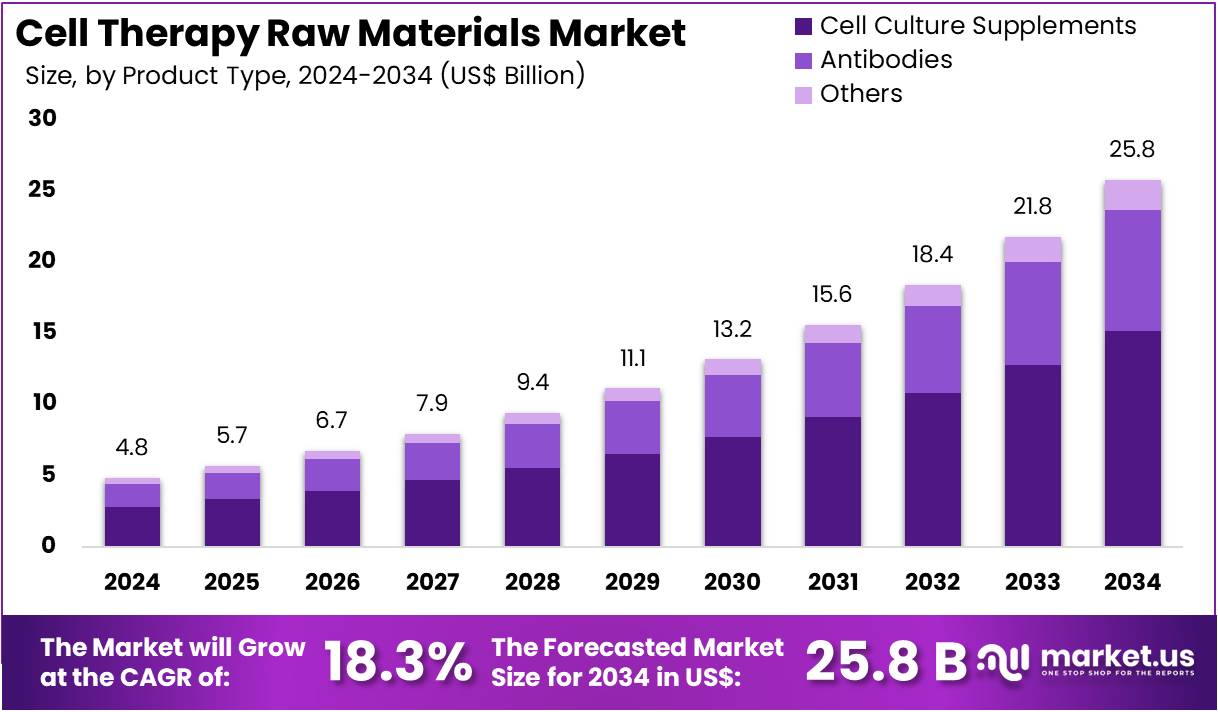
New York, NY – June 24, 2026 – The Cell Therapy Raw Materials Market Size is expected to be worth around US$ 25.8 Billion by 2034 from US$ 4.8 Billion in 2024, growing at a CAGR of 18.3% during the forecast period 2025 to 2034.
Cell therapy raw materials are essential components used in the development, manufacturing, and commercialization of advanced cell-based therapies. These materials include cell culture media, cytokines and growth factors, sera, reagents, buffers, enzymes, antibodies, and cryopreservation solutions that support cell isolation, expansion, differentiation, and storage processes.
The increasing adoption of cell therapies for the treatment of cancer, autoimmune disorders, genetic diseases, and regenerative medicine applications has significantly increased the demand for high-quality raw materials. Manufacturers are focusing on developing chemically defined, animal component-free, and GMP-compliant raw materials to ensure product consistency, safety, and regulatory compliance throughout the production process.
Advancements in cell therapy technologies, including CAR-T cell therapies, stem cell therapies, and gene-modified cellular treatments, are creating new opportunities for raw material suppliers. The industry is witnessing growing investments in research and development activities aimed at improving cell culture performance, scalability, and manufacturing efficiency.
As the global cell therapy industry continues to evolve, reliable and high-performance raw materials will remain critical for ensuring successful therapeutic outcomes, accelerating product development timelines, and supporting the commercialization of next-generation cellular therapies worldwide.
Key Takeaways
- The global cell therapy raw materials market was valued at US$ 4.8 billion in 2024 and is projected to reach US$ 25.8 billion by 2034, expanding at a CAGR of 18.3% during the forecast period.
- By product type, the market is categorized into cell culture supplements, antibodies, and others. Cell culture supplements emerged as the dominant segment, accounting for 58.7% of the total market share in 2023.
- Based on end user, the market is segmented into biopharmaceutical & pharmaceutical companies, CROs & CMOs, and others. Biopharmaceutical & pharmaceutical companies represented the largest segment, holding a 62.5% market share in 2023.
- North America maintained its leading position in the global market, capturing 46.3% of the overall market share in 2023.
Regional Analysis
North America accounted for the largest share of the cell therapy raw materials market, driven by the expanding cell and gene therapy development landscape and a growing number of regulatory approvals. The region benefits from a strong biotechnology ecosystem, advanced research infrastructure, and increasing clinical activities related to cell-based therapies.
Rising demand for essential raw materials, including cell culture media, reagents, growth factors, and cryopreservation products, is being supported by the growing number of therapy candidates progressing through clinical and commercial stages. In addition, the presence of leading life sciences companies and continuous investments in biopharmaceutical manufacturing have strengthened the region’s market position.
Asia Pacific is anticipated to register the fastest growth during the forecast period due to increasing investments in cell therapy research, expanding healthcare infrastructure, and supportive government initiatives. Countries such as China and Japan are witnessing significant growth in clinical trials and regenerative medicine programs, creating substantial demand for specialized raw materials used in cell therapy production.
Favorable regulatory developments and ongoing efforts to enhance biomanufacturing capabilities are further supporting market expansion. Moreover, the growing presence of global and regional biotechnology companies, coupled with increasing research collaborations and funding activities, is expected to accelerate the adoption of advanced cell therapies, thereby driving strong demand for cell therapy raw materials across the Asia Pacific region.
Emerging Trends in Cell Therapy Raw Materials
- 3D Culture Systems and Advanced Scaffolds: Cell culture is increasingly shifting from traditional 2D systems to advanced 3D platforms. Hydrogels and nanofibers enable realistic cell interactions, improving tissue mimicry, regenerative outcomes, and drug testing accuracy. These systems enhance structural support, promoting more physiologically relevant cell growth environments.
- Bio-Instructive Materials: Bio-instructive materials actively regulate cellular behavior rather than only providing support. They can influence immune cell activation, movement, and proliferation, improving therapeutic precision. This controlled guidance enhances treatment efficiency, reduces failure rates, and supports more effective outcomes in oncology and immune-related disorders.
- Nano-Coatings for Individual Cells: Nano-coatings provide ultra-thin protective layers around cells to enhance survival during delivery. These biocompatible coatings improve resistance to harsh biological environments and support targeted action in tissues such as tumors. They increase cell stability, prolong activity, and improve overall therapeutic efficiency in vivo.
- Smart Bioreactors and Automation: Smart bioreactors integrate sensors, robotics, and AI to monitor and control cell culture processes in real time. This reduces variability, minimizes human error, and ensures consistent raw material utilization. Automation enables scalable production, improved compliance, and efficient manufacturing of advanced cell therapies.
Use Cases of Cell Therapy Raw Materials
- Cancer Immunotherapy: Raw materials such as culture media, cytokines, and viral vectors are essential in engineering CAR-T and CAR-NK cells. These components support cell activation, expansion, and modification. Enhanced scaffolds and coatings further improve tumor targeting efficiency, strengthening immune response and therapeutic outcomes in cancer treatment.
- Stem Cell-Based Regenerative Therapies: Stem cell therapies rely on growth factors, scaffolds, and hydrogels to guide differentiation into specific tissues. These materials ensure proper cell adhesion and structural development. Optimized combinations improve tissue repair, accelerate healing, and reduce side effects, supporting effective regeneration of muscles, nerves, and bone.
- Personalized (Autologous) Cell Therapies: Autologous therapies require adaptable raw materials tailored to patient-specific cell quality. Stabilizers and customized media maintain viability during processing stages such as collection, modification, and infusion. These materials enhance survival, improve therapeutic consistency, and reduce variability-related risks, ensuring safer and more effective individualized treatments.
- Tissue Engineering: Tissue engineering uses nanofibers, hydrogels, and bio-inks to create structured 3D environments for cell growth. These materials support oxygen and nutrient diffusion while guiding tissue formation. They enable the development of functional structures like cartilage and skin, improving repair efficiency and long-term regenerative outcomes.
Frequently Asked Questions on Cell Therapy Raw Materials
- Why are raw materials important in cell therapy?
They are critical for ensuring cell viability, consistency, and safety throughout production processes. The growth and functional stability of therapeutic cells can be significantly influenced by the quality and reliability of these materials. - What are the main types of cell therapy raw materials?
Cell therapy raw materials include basal media, cytokines, growth factors, sera, cryopreservation agents, and buffers. These components collectively support cell culture, differentiation, preservation, and expansion in both autologous and allogeneic therapies. - What quality standards apply to these raw materials?
Raw materials for cell therapy must meet stringent quality standards, including Good Manufacturing Practice compliance, traceability, sterility, and reproducibility. Regulatory oversight ensures consistency and reduces risks of contamination or product variability. - What are the key challenges in this sector?
Key challenges in this segment include supply chain constraints, high production costs, regulatory complexities, and batch-to-batch variability. Limited availability of high-quality raw materials further impacts scalability and commercialization of advanced therapies. - How is the market expected to grow?
The market is experiencing strong growth due to advancements in cell-based research and supportive regulatory frameworks. Increasing investment from pharmaceutical companies and biotech firms continues to strengthen the global market expansion trajectory. - Who are the key end users?
Key end users of cell therapy raw materials include biopharmaceutical companies, research institutes, contract development and manufacturing organizations, and academic laboratories engaged in advanced therapy development and clinical-scale production processes. - Which regions dominate the market?
North America and Europe dominate the cell therapy raw materials market due to strong research infrastructure and funding. Asia-Pacific is emerging rapidly, supported by expanding biotech investments and increasing clinical trial activities. - What is the future outlook of the market?
Future growth of the cell therapy raw materials market is expected to be shaped by automation, standardized manufacturing platforms, and innovations in serum-free media. These developments are likely to enhance scalability and reduce production costs.
Conclusion
The cell therapy raw materials market is positioned for sustained expansion, supported by rising adoption of advanced cell-based therapies across oncology, regenerative medicine, and autoimmune disease treatment. The demand for high-quality, GMP-compliant, and chemically defined materials is increasing to ensure safety, consistency, and scalability in manufacturing processes.
Technological advancements, including 3D culture systems, bio-instructive materials, and automated bioreactors, are enhancing production efficiency and therapeutic effectiveness. Strong growth in clinical research activities and biopharmaceutical investments further strengthens market prospects. With North America leading and Asia Pacific emerging rapidly, the sector is expected to witness robust long-term growth globally.
Discuss your needs with our analyst
Please share your requirements with more details so our analyst can check if they can solve your problem(s)




