
Overview
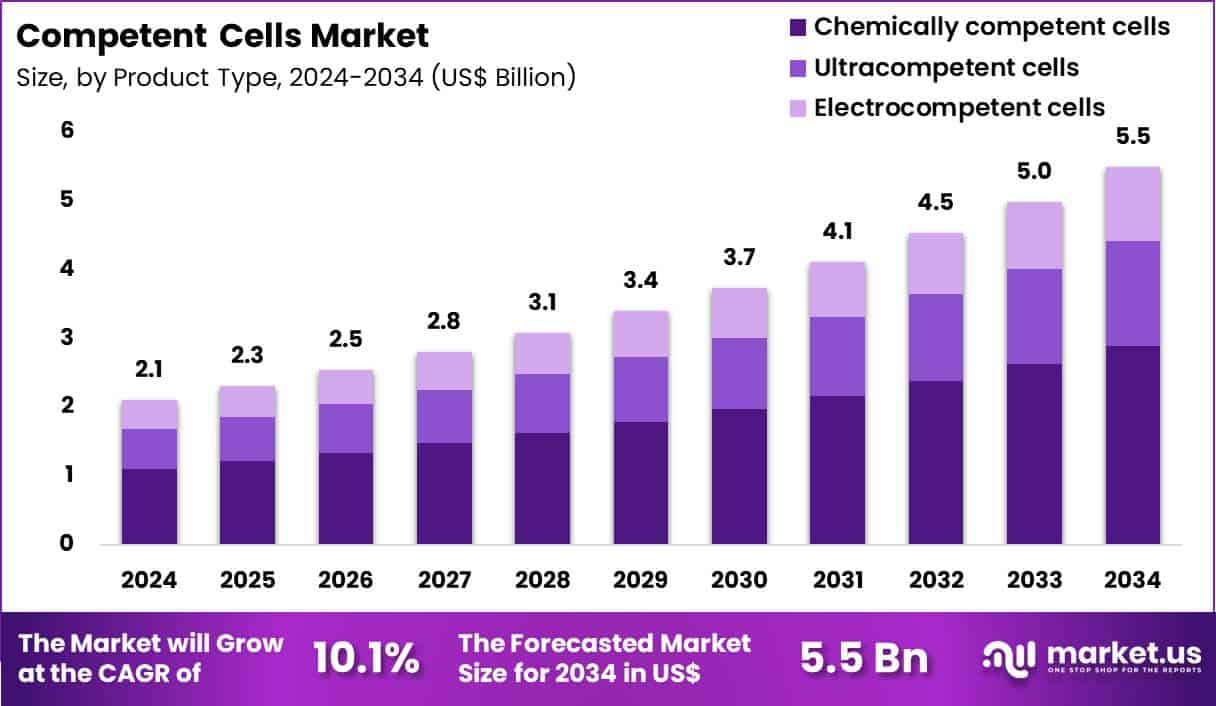
New York, NY – Oct 12, 2026 – The Global Competent Cells Market size is expected to be worth around US$ 5.5 Billion by 2034 from US$ 2.1 Billion in 2024, growing at a CAGR of 10.1% during the forecast period 2025 to 2034. In 2024, North America led the market, achieving over 38.8% share with a revenue of US$ 0.8 Billion.
Competent cells are specially prepared bacterial cells that can take up foreign DNA from their surroundings through a process known as transformation. They are widely used in molecular biology, genetic engineering, biotechnology, and pharmaceutical research. These cells play an important role in gene cloning, plasmid amplification, recombinant protein production, and the development of genetically modified organisms.
The competent cells market includes chemically competent and electrocompetent cells, which are selected based on experimental requirements, transformation efficiency, and application needs. Chemically competent cells are commonly used for routine cloning, while electrocompetent cells are preferred for applications requiring high transformation efficiency.
Market growth is supported by increasing investments in life sciences research, expanding genomics and proteomics studies, and rising demand for advanced molecular biology tools. The growth of biotechnology and pharmaceutical industries, along with the increasing adoption of synthetic biology and precision medicine research, is also contributing to market development.
Key end users include academic and research institutions, biotechnology companies, pharmaceutical manufacturers, and contract research organizations. Continuous improvements in cell performance, product consistency, and laboratory efficiency are expected to create further opportunities for market participants.
Key Takeaways
- In 2024, the competent cells market generated revenue of US$ 2.1 billion and is projected to reach US$ 5.5 billion by 2034, registering a CAGR of 10.1% during the forecast period.
- By product type, the market is segmented into chemically competent cells, ultracompetent cells, and electrocompetent cells. Chemically competent cells dominated the market in 2024, accounting for 52.6% of the total market share.
- Based on application, the market is categorized into cloning, mutagenesis, protein expression, and others. The cloning segment held a significant market share of 48.9% in 2024.
- By end user, the market is divided into pharmaceutical and biotechnology companies, academic and research institutes, and others. Pharmaceutical and biotechnology companies dominated the market in 2024, accounting for 56.2% of total revenue.
- Regionally, North America dominated the competent cells market in 2024, accounting for 38.3% of the global market share.
Key Market Segments
- Product Type Analysis: Chemically competent cells dominated the product type segment in 2024, accounting for 52.6% of the market share. Their ease of use, cost-effectiveness, reliable transformation efficiency, and compatibility with standard laboratory protocols support widespread adoption across academic institutions, pharmaceutical companies, and biotechnology research laboratories.
- Application Analysis: Cloning dominated the application segment in 2024, accounting for 48.9% of the market share. Increasing demand for recombinant DNA technologies, plasmid construction, genetic engineering, and drug discovery supports segment growth. Expanding genomics and synthetic biology research further strengthens the demand for competent cells.
- End-User Analysis: Pharmaceutical and biotechnology companies led the end-user segment in 2024, accounting for 56.2% of the market share. Rising research and development investments, expanding biologics pipelines, and growing demand for recombinant proteins, vaccines, and gene-based therapies continue to drive the adoption of competent cells.
Regional Analysis
North America Leads the Competent Cells Market
In 2024, North America dominated the competent cells market, accounting for 38.3% of the global market share. Regional growth is supported by strong biotechnology research, rising investments in genetic engineering, and increasing adoption of synthetic biology.
Pharmaceutical and biotechnology companies utilize competent cells for gene editing, plasmid cloning, recombinant protein production, and drug development. Funding for life sciences research and advancements in personalized medicine further strengthen regional demand. Improvements in cell stability, transformation efficiency, and automated laboratory workflows are also supporting market expansion.
Asia Pacific Expected to Register the Highest CAGR
The Asia Pacific competent cells market is expected to register the highest CAGR during the forecast period. Growth is driven by increasing government support for biotechnology research, expanding pharmaceutical manufacturing, and rising investments in genomics and agricultural biotechnology.
Growing demand for affordable therapeutics and biosimilars is encouraging competent cell adoption. Biotechnology startups and academic institutions are expanding molecular biology capabilities, while improvements in local production and laboratory infrastructure are expected to create additional growth opportunities across the region.
Emerging Trends
- Development of high-efficiency transformation methods: Researchers are improving the ability of competent cells to take up foreign DNA, particularly large DNA fragments and complex genetic constructs. Research on electrocompetent cells has demonstrated approaches that can improve transformation performance and simplify preparation.
- Improved stability of difficult DNA sequences: Some DNA sequences are unstable or harmful to bacterial cells when expressed during cloning. The U.S. FDA describes a technology that reduces unwanted gene expression in E. coli, helping researchers maintain difficult DNA sequences more reliably.
- Integration with automated laboratory systems: Automated liquid-handling equipment and high-throughput cloning workflows are helping laboratories process multiple DNA constructs in parallel. This creates opportunities for competent-cell products that deliver consistent results across standardized laboratory procedures.
- Wider use in synthetic biology and genetic engineering: Synthetic biology requires researchers to build, test, and modify genetic systems. Competent cells support the introduction and propagation of DNA constructs, making them useful tools for developing engineered microorganisms and testing biological designs.
- Expansion of transformation methods beyond common laboratory bacteria: Research is exploring DNA introduction methods for a wider range of bacterial species, including beneficial and industrially relevant microorganisms. This work may expand the use of specialized competent cells in microbial engineering, although transformation requirements vary by species.
Use Cases
- Gene cloning and plasmid amplification: Competent cells are used to introduce recombinant DNA into bacteria, where plasmids can be copied and recovered. This supports gene analysis, DNA preparation, and the development of molecular biology research tools.
- Recombinant protein research: Suitable bacterial cells can carry plasmids containing genes for specific proteins. These systems support protein production research, enzyme studies, and the development of biological materials for pharmaceutical and industrial applications.
- Mutation studies: Competent cells help researchers recover plasmids containing planned DNA changes. These materials can be analyzed to understand how genetic variations affect protein function, gene activity, and other biological processes.
- Synthetic biology development: Researchers use competent cells to introduce designed genetic constructs into suitable bacteria. This supports the testing of engineered biological systems and the development of new microbial functions for research and biotechnology applications.
- DNA library construction: Competent cells help researchers maintain collections of DNA fragments in bacterial hosts. These libraries support gene identification, genome mapping, sequence analysis, and studies of genetic variation across biological samples.
Frequently Asked Questions About Competent Cells
- What is transformation efficiency in competent cells?
Transformation efficiency measures how effectively competent cells take up introduced DNA and produce successfully transformed colonies. It is commonly expressed as colony-forming units per microgram of DNA and depends on cell quality, DNA characteristics, and experimental conditions. - How should competent cells be stored?
Competent cells are often supplied frozen and require storage at the manufacturer’s recommended temperature. Correct handling, temperature control, and minimizing unnecessary freeze–thaw cycles help preserve cell viability and transformation performance during laboratory use. - Which factors influence the selection of competent cells?
Selection depends on the bacterial strain, DNA size, transformation method, required efficiency, and intended application. Researchers should also consider product quality, storage requirements, protocol compatibility, and whether specialized strains are needed for difficult DNA constructs. - Which applications create demand for competent cells?
Major applications include plasmid amplification, gene cloning, mutation studies, DNA library construction, and synthetic biology. These activities require reliable DNA introduction into suitable bacterial hosts, supporting the use of competent cells in academic, industrial, and biotechnology laboratories. - What opportunities exist for competent-cell manufacturers?
Opportunities include developing improved transformation methods, specialized bacterial strains, products compatible with automated workflows, and solutions for unstable DNA constructs. These developments may help manufacturers address changing research requirements and improve the reliability of molecular biology experiments. - How does laboratory automation affect the competent cells market?
Laboratory automation enables researchers to handle multiple DNA constructs and samples using standardized workflows. This increases the importance of consistent product performance, compatibility with automated equipment, and dependable results across repeated transformation experiments. - Why is product quality important in the competent cells market?
Product quality affects DNA uptake, colony recovery, experimental consistency, and the reproducibility of research results. Reliable manufacturing, suitable storage conditions, clear technical specifications, and appropriate quality controls are important for laboratories selecting competent-cell products. - What is the future direction of the competent cells market?
Future development is likely to focus on higher transformation efficiency, improved handling of complex DNA, specialized bacterial hosts, and integration with automated research systems. Adoption will depend on demonstrated performance, laboratory requirements, product reliability, and research funding.
Conclusion
The competent cells market is expected to experience strong growth, supported by increasing investments in biotechnology, pharmaceutical research, genomics, and synthetic biology. Valued at US$ 2.1 billion in 2024, the market is projected to reach US$ 5.5 billion by 2034, registering a CAGR of 10.1%.
Chemically competent cells, cloning applications, and pharmaceutical and biotechnology companies remain key market contributors. North America currently leads the market, while Asia Pacific is expected to record the highest growth rate.
Advancements in transformation efficiency, laboratory automation, and specialized cell development are anticipated to create new opportunities for manufacturers and strengthen future market expansion.
Discuss your needs with our analyst
Please share your requirements with more details so our analyst can check if they can solve your problem(s)