


Overview
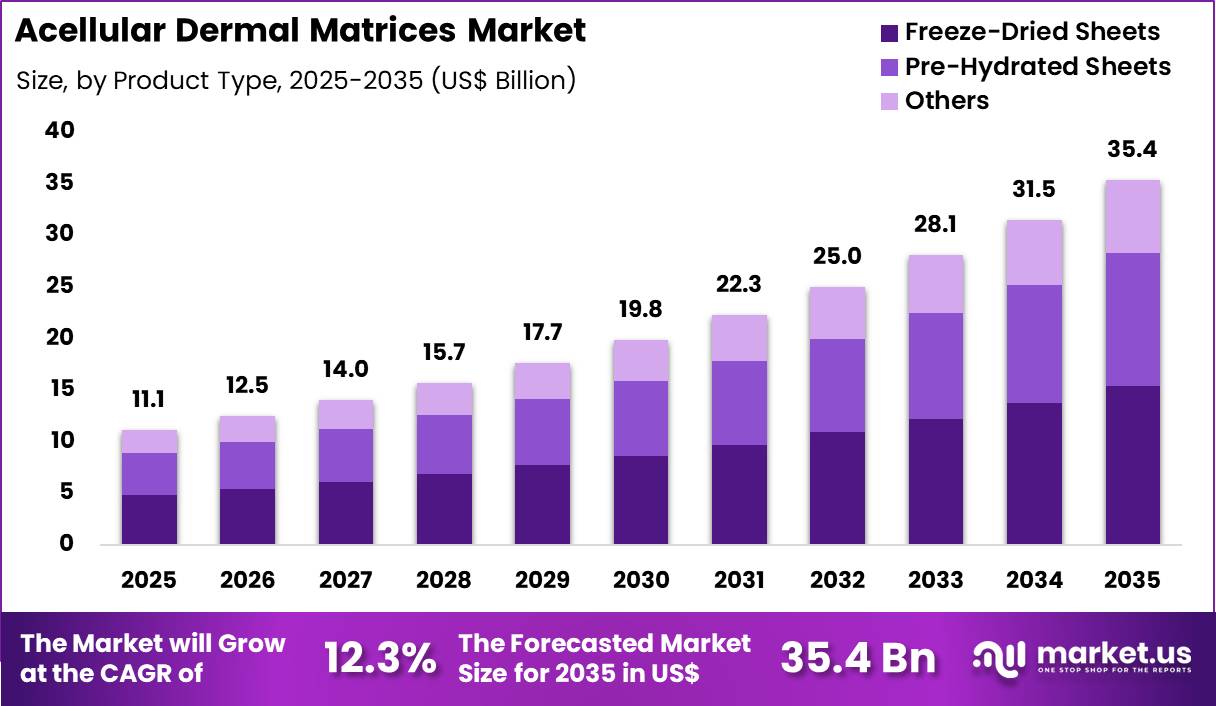
New York, NY – Nov 02, 2026 – The Global Acellular Dermal Matrices Market size is expected to be worth around US$ 35.4 billion by 2035 from US$ 11.1 billion in 2025, growing at a CAGR of 12.3% during the forecast period 2026-2035. In 2025, North America led the market, achieving over 43.1% share with a revenue of US$ 4.8 Billion.
Acellular Dermal Matrices (ADMs) are advanced biological scaffolds derived from human or animal dermal tissue, processed to remove cellular components while preserving the natural extracellular matrix (ECM). This framework primarily consists of collagen, elastin, and other structural proteins that support tissue integration and regeneration.
ADMs are increasingly used in various surgical specialties, including plastic and reconstructive surgery, breast reconstruction, wound management, burn treatment, and dental and periodontal procedures. Their unique structure provides a supportive environment for cellular infiltration, blood vessel formation (angiogenesis), and tissue remodeling.
One of the key advantages of Acellular Dermal Matrices is their ability to provide structural support while facilitating the body’s natural healing processes. Depending on the source, processing method, and intended application, ADMs may offer flexibility, strength, and biocompatibility, making them valuable tools in complex tissue repair and reconstruction.
With continued advancements in tissue processing and regenerative medicine, Acellular Dermal Matrices are playing an increasingly important role in modern surgical practice, offering healthcare professionals additional options for addressing challenging tissue defects and supporting improved reconstructive outcomes.
Key Takeaways
- In 2025, the Acellular Dermal Matrices market was valued at US$ 11.1 Billion, registering a CAGR of 12.3%, and is projected to reach US$ 35.4 Billion by 2035.
- By product type, the market is categorized into freeze-dried sheets, pre-hydrated sheets, and others. Among these, freeze-dried sheets dominated the market, accounting for a share of 43.6%.
- Based on source, the market is segmented into human, synthetic and biosynthetic, animal, and autologous. The human-derived segment held the largest market share of 47.9%.
- By application, the market is divided into chronic and acute wounds, breast reconstruction, and others. The chronic and acute wounds segment emerged as the leading application, capturing 41.7% of the total market revenue.
- Based on end-user, the market is classified into hospitals, Ambulatory Surgical Centers (ASCs), and others. The hospital segment dominated the market, accounting for a revenue share of 59.3%.
- Regionally, North America dominated the global Acellular Dermal Matrices market, securing the largest market share of 43.1%.
Key Market Segments
- Product Type Analysis: Freeze-dried sheets dominated the acellular dermal matrices market, accounting for 43.6% of the product type segment. Their extended shelf life, convenient storage, and reduced cold-chain requirements drive adoption. Easy rehydration, minimal wastage, and flexible surgical preparation further strengthen their preference among hospitals and healthcare professionals.
- Source Analysis: Human-derived matrices held the largest market share of 47.9%, driven by their excellent biocompatibility and natural integration with host tissues. Their ability to support vascularization and tissue regeneration makes them suitable for various reconstructive and wound care procedures. Established clinical experience and favorable outcomes further encourage adoption.
- Application Analysis: Chronic and acute wounds dominated the application segment, accounting for 41.7% of market revenue. Rising cases of diabetic ulcers, pressure injuries, traumatic wounds, and non-healing wounds are driving demand. Acellular dermal matrices support tissue regeneration and wound healing, making them valuable solutions for advanced wound management.
- End-User Analysis: Hospitals dominated the end-user segment, accounting for 59.3% of the market revenue. Their leadership is attributed to the high volume of reconstructive surgeries, complex wound treatments, and trauma cases. Advanced surgical infrastructure, specialized healthcare professionals, and centralized procurement practices further support the widespread adoption of acellular dermal matrices.
Regional Analysis
North America dominated the Acellular Dermal Matrices market, accounting for 43.1% of the market share in 2024. Regional growth is driven by increasing demand for breast reconstruction, hernia repair, and advanced wound management procedures.
Rising breast cancer cases, growing post-mastectomy reconstruction rates, and advanced healthcare infrastructure further support market expansion. The widespread adoption of biologic scaffolds among surgeons, along with increasing outpatient surgical procedures, strengthens regional demand.
Asia Pacific is expected to register the highest CAGR during the forecast period, supported by expanding healthcare infrastructure, rising awareness of reconstructive procedures, and increasing investments in oncology care. Countries such as India, South Korea, and Thailand are witnessing growing medical tourism and demand for advanced surgical treatments.
Additionally, rising disposable incomes, improved access to healthcare services, and increasing adoption of biologic grafts in trauma, burn treatment, and reconstructive surgeries are expected to accelerate regional market growth.
Emerging Trends
- Increasing Use in Breast Reconstruction Procedures: Acellular dermal matrices are gaining attention in implant-based breast reconstruction following mastectomy. Surgeons use these materials to provide additional tissue support, improve implant positioning and help create the breast shape. Growing adoption of prepectoral reconstruction techniques is also supporting product utilization.
- Development of Advanced Biological Materials: Manufacturers are focusing on improving tissue processing methods to retain important structural components such as collagen and elastin. Better decellularization and sterilization techniques are becoming important for improving product consistency, tissue integration and clinical performance.
- Expansion into Chronic Wound Management: The use of acellular dermal matrices is expanding beyond traditional reconstructive surgery into complex wound management. Healthcare professionals are exploring these materials for diabetic ulcers and other difficult-to-heal wounds because they provide a structural framework that supports tissue repair.
- Growing Interest in Animal-Derived Matrices: Human, porcine and bovine tissues are being used to develop acellular dermal matrix products. Different tissue sources and processing methods offer opportunities for product differentiation, encouraging manufacturers and researchers to evaluate their suitability for specific surgical applications.
- Greater Focus on Clinical Evidence and Product Safety: Healthcare providers are paying closer attention to complication rates, infection risks, product quality and long-term patient outcomes. This is increasing the importance of clinical studies, donor screening, tissue processing standards and appropriate patient selection.
Use Cases
- Breast Reconstruction: Acellular dermal matrices are used in breast reconstruction after mastectomy to support breast implants and tissue expanders. They help surgeons control implant positioning, provide additional soft-tissue coverage and support reconstruction, particularly in selected implant-based procedures.
- Hernia Repair and Abdominal Wall Reconstruction: ADMs are used in selected abdominal wall procedures to reinforce weakened or damaged soft tissue. Their collagen-based structure provides a biological scaffold that can integrate with surrounding tissue during the healing and remodeling process.
- Burn Treatment and Skin Reconstruction: ADMs can support the treatment of severe burns and extensive skin defects. They provide a dermal framework that helps prepare damaged areas for skin grafting and supports reconstruction when healthy donor skin is limited.
- Chronic Wound Treatment: Healthcare professionals use selected ADM products in managing difficult wounds, including diabetic foot ulcers. These materials provide a supportive framework for tissue repair and may help address defects where normal wound healing is delayed or impaired.
- Dental and Orthopedic Procedures: Acellular dermal matrices are used in selected dental and orthopedic procedures, including gingival recession treatment and tendon or ligament reconstruction. They provide soft-tissue support and a biological framework that can assist tissue repair and reconstruction.
Frequently Asked Questions About Acellular Dermal Matrices
- How do acellular dermal matrices work?
Acellular dermal matrices provide a structural framework for surrounding tissue. After implantation, the body’s cells can migrate into the material, while blood vessels develop within it, supporting tissue integration, healing and natural tissue remodeling. - What materials are used to manufacture acellular dermal matrices?
Acellular dermal matrices are commonly manufactured using human, porcine and bovine skin. Processing removes cellular components while preserving important extracellular matrix proteins, including collagen and elastin, which provide structural support. - What are the major benefits of acellular dermal matrices?
Acellular dermal matrices provide additional soft-tissue support and a framework for tissue integration. They can help surgeons reconstruct damaged areas, support implants and manage selected complex wounds, although clinical benefits vary by application and patient condition. - Are acellular dermal matrices associated with complications?
Yes. Possible complications include infection, fluid accumulation, delayed tissue integration, wound healing problems and graft failure. Risks depend on the product, surgical technique and patient characteristics, making careful clinical evaluation important before treatment. - What are the major factors driving the acellular dermal matrices market?
Increasing demand for reconstructive procedures, breast reconstruction after mastectomy, complex wound treatment and advanced surgical materials supports market demand. Expanding clinical applications and improvements in tissue processing also create opportunities for product adoption. - Which application represents an important market segment for acellular dermal matrices?
Breast reconstruction represents an important application segment because surgeons use these materials to support implants and tissue expanders after mastectomy. Other relevant applications include hernia repair, burn reconstruction, chronic wound treatment and dental procedures. - What is the future outlook for the acellular dermal matrices market?
The market outlook is supported by expanding reconstructive surgery applications, ongoing biomaterial development and increasing interest in advanced wound management. However, future adoption will depend on stronger clinical evidence, product safety, affordability and consistent treatment outcomes.
Conclusion
The Acellular Dermal Matrices market is expected to witness significant growth, driven by increasing demand for reconstructive surgeries, advanced wound care, and regenerative medicine applications. Rising adoption of freeze-dried sheets, strong demand for human-derived matrices, and expanding applications in chronic and acute wound treatment are supporting market development.
Hospitals remain the leading end-users due to their advanced surgical infrastructure and higher treatment volumes. North America currently dominates the market, while Asia Pacific offers promising growth opportunities through healthcare infrastructure development and increasing surgical procedures. Continued improvements in tissue processing, product safety, and clinical outcomes will further support long-term market expansion.
Discuss your needs with our analyst
Please share your requirements with more details so our analyst can check if they can solve your problem(s)



